
Briefing Room 04.04.2026
Simon Whistler • April 4, 2026
Members only
Note: this transcript was generated by AI and may contain errors or inconsistencies.
Welcome back to The Briefing Room, the weekly conflict rundown where we ask the age-old question what would we all be talking about if the Iran war wasn't happening?
This week we're going to visit the nation of India where after more than half a century of continuous conflict the ideological descendants of Chinese Chairman Mao Zedong have finally been vanquished.
From there we'll travel to Nepal to cover what's quickly becoming a political takedown for the ages and finally we'll turn to Haiti where the news, as usual, is oh so very bad.
India Declares Victory Over Maoist Insurgency After nearly 60 years of low-grade warfare the nation of India claims to have finally defeated one of its most persistent internal enemies.
Known as the Naxalite Maoist Insurgency India's communist rebels have worked fruitlessly to spark a peasant rebellion against New Delhi since 1967 in a war that has claimed tens of thousands of lives.
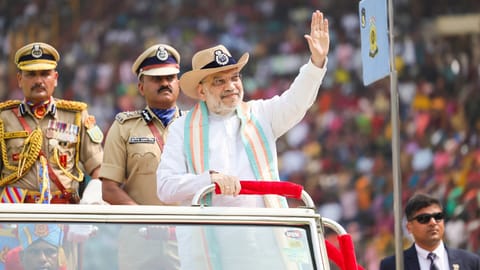
The Indian governors made it a priority to stamp the group out by a self-imposed deadline of March 31, 2026, and on that day Indian Home Minister Amit Shah declared victory.
Quote, I can say it openly that we have become Naxal free. There is no hesitation in saying this. But by Amit Shah's own admission, the story of the Naxal insurgency isn't quite finished yet and already Indian counterterrorism experts are warning that New Delhi might let off the pressure too soon.
India's Maoists have been in a state of retreat since the late 2000s, when the insurgency reached its peak under the People's Liberation Guerrilla Army. According to the South Asia Terrorism Portal, over 700 people died in the conflict each year between 2005 and 2008, with violence only accelerating further in 2009 and 2010.
But in 2009, the Indian government initiated Operation Green Hunt, a counterinsurgent offensive that forced the Maoists into a retreat.
Since then, the Maoists have never really been able to rally. They've carried out occasional or catastrophic terror attacks, but were forced to stop their open rebellion and go into hiding.
As conditions in their underdeveloped homeland started to improve and Indian forces got better at suppressing them and hunting them down, the Maoists struggled to attract new young recruits and watched as their leadership was hunted down, arrested, or killed.
New Delhi adjusted its counterterrorism strategy, offering amnesty, housing, and financial compensation for those who peacefully laid down their arms and vowing extermination for those who didn't. Between 2015 and 2025, more than 10,000 Maoist fighters surrendered to security forces.
By the mid-2000s, the remaining Maoists were on their last legs and India chose its moment to press the advantage.
In 2024, nearly 70 Maoists were killed in two high-profile battles with Indian troops, with no fatalities on the military side. In 2025, after an improvised explosive killed nine policemen, New Delhi initiated Operation Black Forest, a clearing operation that destroyed massive cash of weapons and dismantled some of the Maoists' core bases of operations.
A couple of weeks later, Indian forces killed Nambala Kashava Rao, better now. known as Gagana, the general secretary of the Maoist Communist Party of India, alongside dozens of his fighters.
According to the print, India went on to kill more than 20 other senior Maoist leaders after Gagana's death. Documented insurgent violence declined relative to the insurgency's peak by more than 80% according to the country's home ministry.
Deaths related to the conflict dropped even more precipitously, not counting the Maoists, with just over 100 deaths of civilians and security forces in 2025 compared to over 1,000 in 2010.
Through the 24th of March, India is on track to see those numbers fall even further, just five civilian deaths and one death among Indian security personnel compared to 52 Maoists killed.
In that same span of less than three months, more than 630 insurgents had surrendered to the Indian government, 2,300 more had surrendered in 2025 against 364 killed and roughly 1,000 arrested.
So when Hamit Shah came before the Indian parliament at the end of the month and declared New Delhi's ultimate victory over the Maoist movement, he certainly wasn't lying.
On the numbers, if all hold steady in the downward trend of insurgent attacks, any further attacks would be expected to claim only a handful of lives each year at the most.
Better yet, estimates on the remaining number of insurgents in hiding compared to the rates of arrest, surrender, and killing thus far in 2026 would suggest that the movement will be completely dismantled by the year's end.
Amit Shah and other Indian officials have laid out the finer points of their counterinsurgent strategy, emphasizing what Shah called a quote, all-agency approach, not just weapons.
Indian outlet NDTV explains that over the last 12 years, India has invested heavily in the development of impacted areas. Quote, 17,500 kilometers of roads have been built, 9,000 mobile towers installed, and 2,343 of them upgraded to 4G.
Banking penetration has also now deepened, with 6,025 new post officers providing banking services, 1,804 operational bank branches, 1,321 ATMs, and 75,000 banking correspondents brought into these regions.
Education and welfare infrastructure have expanded too, with 9,303 schools constructed and 258 tribal residential schools sanctioned, 179 already operational. End quote. India has also built new hospitals that have treated tens of thousands of rural patients and recruited tens of thousands more community health workers.
In essence, New Delhi has undercut the Maoists' entire appeal to their public base of support. The Maoists no longer represent the only way for indigenous communities to protect and defend their rights against a government that's no longer seen as infringing upon those rights.
Families are no longer kept in abject poverty, and they are no longer stuck in a place where neither they nor their children could ever conceive of a better future.
Among the older generations, where the Maoists have managed to sustain a degree of their prior support, there's a bit more skepticism around New Delhi and its ultimate intentions.
But for most ordinary people in this part of India, it's been made clear that joining the Maoists is a great great way to get killed, with no guarantee that the social change that the Maoists promise will come faster than the social change that New Delhi is already working on.
In one last bit of punctuation for New Delhi's victory statement, the nation announced one day before its self-imposed deadline that one of the last Maoist commanders, known by the Nom de Gour Shuresh, had surrendered after 36 years of continuous resistance.
Even now, there's still some risk that the remaining Maoist insurgents across India could spark another round of violence. There are still scattered cells across the country, and while it's easy enough to look at statistical trends and conclude that those holdouts will be wiped out soon, that's often not how counterinsurgencies actually play out.
The few Maoists who remain are likely to be among the most committed to the cause, and if they mirror the insurgent factions that have stuck to the cause after wider defeats in other places, from Al-Qaeda to the IRA, then these final Maoist loyalists will represent particularly radical strains of the movement.
The systemic issues that led to the Maoist insurgency are going away, but they're not gone. Abject poverty has decreased, but wealth inequality and unemployment are rising, and digital radicalization of new recruits is easier than ever.
Nonetheless, India has achieved an undeniable victory against the Maoist insurgency, and whatever hidden cells remain, they will be only a tiny fraction of the group's former strength.
When states fight against an insurgency, and when they fight against an ideology, total victory is more of an aspiration than a realistic outcome. But in practice, India has gotten as close to total victory over the Maoists as any global counterinsurgency could hope to achieve.
A Former Prime Minister Arrested For our next story, we turn our attention to Nepal, where on the 28th of March, former Prime Minister K.P.
Sharma Oli was arrested. Now, for that statement to make any sense, because after all, how often is a former Prime Minister arrested? We need a little context.
Given the insane year we've had, and it's only April, you would be forgiven for thinking that the crises in Iran and Venezuela are the only issues that the modern world has ever faced. But 2025 had its problems too, and some of those problems are still being dealt with.
The biggest global story of 2025 was the Gen Z protests that swept through much of the global south, somewhat like a tsunami, as years of frustration with government corruption and mismanaged economies erupted into violent displays of public anger.
The poster child of these protests was Nepal. Demonstrations began after the government ordered several social media apps, including Facebook, YouTube, WhatsApp, and Discord, to shut down for failing to register under new rules established by the Ministry of Communication and Information Technology.
For Nepal's Gen Z, this was a massive issue because these apps weren't just communication platforms.
They were an entire ecosystem that allowed them to stay connected with friends and family, attend online classes, and even earn money. So when the government came calling, they turned to the government. these very platforms and coordinated one of the most effective protest campaigns in recent history. It was so effective that K.P.
Shah Murali was forced to resign alongside his entire government. The youth, once again using discord, selected former Chief Justice Shashila Khaki as the caretaker prime minister and her government, and one main task, to prepare the country for elections, which were eventually held on the 5th of March.
The youth's preferred candidate was Belendra Shah, a rapper who had previously served as the mayor of Kathmandu, and who ultimately breezed his way through to the premiership.
However, the ouster of the previous regime wasn't the only outcome of these protests. According to multiple outlets, 76 people were killed in the 2025 protests, and more than 2,000 were injured. This is why the former prime minister and his home minister, Ramesh Lakhakh, were arrested.
Reuters reported that the police were investigating whether the two men had been negligent in failing to prevent the deaths that happened during the protests. Oli's party called the arrests an act of revenge, and has called for two-week-long protests.
The call was answered by Oli's supporters, who on the 28th of March took to the streets to protest the arrest.
An AFP photographer documented that the police had barricaded roads and used batons to drive back more than 100 of Oli's supporters near the court. While 100 protesters might not seem like a larger number, it demonstrates that even after losing most of his support, Oli still has a base within his own party.
That party holds 25 seats in the House of Representatives.
This means that it's too early to write the party's political obituary, and in fact, the party has faced worse times in Nepal's tumultuous political history, and still emerged intact.
This base of support is something Prime Minister Belendra Shah cannot ignore, as he attempts to implement his ambitious 100-point reform agenda meant to bring justice, prosperity, and transparency to Nepal. It's too early to tell whether Shah will be able to achieve everything in his reform agenda.
After all, he was only appointed Prime Minister on the 27th of March.
The biggest challenge he will face, as several former government officials told the Kathmandu Post, is the fact that Nepal's issues stem from deep-rooted structural issues, including limited resources, legal constraints, and, most notably, an entrenched bureaucracy that has often resisted or diluted reform attempts.
Krishna Gyalwali, one of the former officials, told the Post, quoting him here, "...earlier governments also issued sweeping directives from the top, but implementation faltered due to weak monitoring, a lack of ownership within the civil service, and poor coordination." End quote.
Gyalwali did note that Shah's government appeared more serious than past governments, and it had a clearer, more detailed plan. He also added that the Shah administration seems to have delved into the finer details, signalling a more hands-on approach.
Shah's government and its successes and failures will be closely watched by other countries, particularly those like Kenya, Morocco, and Indonesia, where Gen Z protesters did not manage to oust their governments.
If Shah is successful in Nepal, it will prove that a Gen Z figure, or at least one with the blessing of the youth, can lead effectively and deliver the on promises of reform this is important because gen z movements around the world have struggled with the transition from protest to governance analysts observed that youth-led movements often lack a clear
Roadmap for reform or governance and experts remain skeptical that post-election governments will avoid the same risks of poor political and economic management nepal has so far been the exception whether this remains the case a few years into sha's rule remains to be seen but the world will of course be watching and so of course will we violence in haiti
For our final story today we turn our attention to haiti where one of the country's most powerful gangs grand griff has been engaged in a violent confrontation with a local vigilante group according to cnn the attacks began with gang members burning homes and shooting civilians in the jean denis and pontson des neighborhoods survivors described fighting
Bodies strewn on the road the next morning remain liqueur director of the haiti observatory at the global initiative told the bbc the attack seemed to have been highly coordinated with roads reportedly blocked to prevent police from intervening and speaking of the police where were they why was it so easy for the gangs to prevent them from intervening well
Because although they have previously struggled to contain the gangs they do have the infrastructure equipment and manpower to stop one gang from fighting with a vigilante group according to the haitian national police they had tried their best to intervene having dispatched three armored vehicles but were slowed thanks to holes created by gang members by
The time they arrived the gang was fleeing the scene and multiple residences have been burned defensius plus a local rights group put out a statement saying that the lack of a security response and the abandonment of the area to armed groups demonstrate a complete abdication of responsibility by the authorities nor is the failure of the haitian police the
Only reason to be discouraged according to the bbc the attack was led by a commander known as ty kenkin a man who had first gained his reputation in haiti as a leading figure in a vigilante group founded to protect locals from gangs ty kenkin's decision to switch sides join grand grief and destroy entire neighborhoods isn't just a blow to whatever haitian
Morale may be left it's a sign of collapse in one of the few remaining structures that preserve haiti's social order vigilante groups known locally as bois calais have emerged across haiti in response to the state's persistent difficulties in containing gang expansion their continued existence in itself is a testament to the fact that the haitian state has
Been woefully ineffective in dealing with the gang threat but even when the bois calais don't eventually join the gangs outright they've developed a troubling tendency to go rogue according to insight crime the deficiencies of haiti's judicial and security systems provides an environment that is perfect for vigilante groups to expand into other illegal
Activities the situation mirrors mexico and colombia where vigilante movements eventually morphed into criminal organizations themselves the cour noted that t kenkin's role in the attack has raised critical concerns about what happens when vigilante brigades often viewed as essential partners for holding territory and supporting the police see their
Allegiances shift he said there's a risk of escalating violence in which civilians are increasingly trapped or even targeted directly but also a danger of further fragmentation where leaders like t kenkin move fluidly between roles as a vigilante a criminal or a police ally despite the scale of the violence this was not the only major story in haiti the
First foreign unit from a new gang suppression force backed by the united nations has now arrived in the country to help quell ongoing violence according to a statement issued on the 1st of april the un security council recently approved a plan to authorize a 5550 member force to replace a kenya-led mission that fell short of expectations the kenya-led
Mission was designed to receive voluntary contributions from other countries totaling 600 million u.s dollars annually but according to un records only 112 and a half million has been raised apart from chronic underfunding the mission was also significantly understaffed fewer than a thousand officers out of the planned 2500 were actually deployed of the 5601
People or more who were killed in haiti by the end of 2024 more than 4 000 of these deaths had occurred after the deployment of the kenya-led mission the new gang suppression force or gsf will have a strengthened mandate and will benefit from un-backed logistical support but it's not clear that the gsf will succeed where the kenyan-led mission failed first
While the gsf will be overseen by a standing group of partners that includes the us canada el salvador guatemala jamaica kenya and the bahamas it's not clear whether these countries themselves will be sending troops and if so how many chad benin and bangladesh are among the nations to have previously pledged troops according to reuters though none have so
Far been deployed second the gsf will rely at least partially on voluntary financial contributions and given that the previous mission barely managed to raise 20 of its budget there are reasons to be skeptical about whether this mission will fare any better and finally we have to ask what it will take to end haiti's gang crisis according to the un office on
Drugs and crime unadc the gangs exercise effective control over all access routes to port du prince including maritime approaches to the main ports internal road networks linking the capital to the north and south of the country and the principal land routes connecting port du prince to the border with dominican republic this territorial dominance enables
Gangs to regulate movement in and out of the capital with near impunity and to generate substantial revenue primarily through systematic extortion of commercial traffic including trucks buses and maritime shipments transiting these corridors and sea lanes this control creates a self-sustaining power structure revenue from extortion pays for weapons which
Maintain territorial dominance which ensures continued access to smuggling routes and checkpoints without breaking the cycle foreign troops will find themselves fighting an adversary that can outlast them financially and logistically previous international missions treated haiti's gang problem as primarily a security challenge requiring military force.
If this doesn't change, then Haiti is doomed to remain under the control of the gangs. And that would be a tragedy for the millions of Haitians who just want to go back to normal.
Unlock premium video briefings
Members get full access to premium reporting, in-depth briefings, and subscriber-only analysis.
Insiders Receive
- Full access to all premium articles and briefings
- Exclusive subscriber-only analysis and dispatches
- Support independent conflict journalism
From $5/month — cancel anytime