
Briefing Room 23.05.26: Protests Rock Bolivia, and More.
Thousands of protesters in Bolivia demand President Rodrigo Paz's resignation as the country faces economic hardship and political instability.
Fronts Staff • May 23, 2026
Members only
Note: this transcript was generated by AI and may contain errors or inconsistencies.
Welcome back to The Briefing Room, the weekly show that rounds up the key conflicts and geopolitical stories you likely missed while media attention was focused elsewhere. This week, there were rumblings in Bolivia as mass protests threatened to unseat the recently inaugurated president.
Meanwhile, far away in the Middle East, Pakistani deployment to Saudi Arabia raised questions about just how deep their new military alliance may go.
And in Europe, Ukraine has spied a once-in-a-generation chance to normalize relations with Hungary following the landslide election defeat of former Prime Minister Victor Orban. As always, thank you so much for subscribing. It's thanks to you that we're able to produce videos like this on the more obscure stories shaping our world.
And now let's hop over to Bolivia, where a series of protests may be about to set the new government teetering. So do you remember a time last year where almost every other story on war fronts was about a protest? The One Piece revolutions?
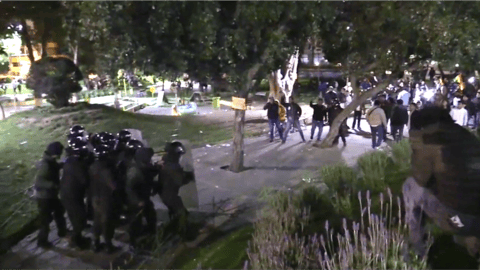
Well, it seems like Bolivia was feeling left out and has decided to stage its own protests. The demonstrations began in early May when thousands of miners, teachers, farmers, and rural workers took to the streets of La Paz, the political capital.
By May 14th, the protests escalated dramatically when miners began detonating dynamite in the city while other protesters attempted to breach the presidential palace.
And yes, you heard that right. The protesters were using dynamite. According to James Bosworth, author of the Latin America Risk Report Substack and one of the leading experts on the region, the use of dynamite is practically expected during Bolivian protests.
The explosions are meant to attract attention, not to hurt security forces or political rivals, and few people are ever injured, let alone killed, as the miners are really experienced at using explosives. This isn't to say that there haven't been any deaths at these protests, though.
According to The Guardian, four people have died so far, one during the clashes, and three others because roadblocks prevented them from getting adequate medical attention.
Additionally, dozens of people have been injured, thousands of vehicles have been abandoned on the highways, and business organizations are estimating that the protests are draining more than $50 million from the nation's economy every day.
These are the second round of major protests that President Rodrigo Paz has faced since coming into power in August 2025. His victory ushered in the country's first right-wing government after nearly two decades of left-wing rule by the movement for socialism, known as MAS.
The first round of protests erupted in December following a decision by Paz to remove fuel subsidies, causing the cost of diesel and gasoline to spike. According to DW, gas stations began selling adulterated fuel, which damaged vehicles.
Paz argued that this decision was necessary given the country's fiscal crisis, which The Guardian described as the worst in four decades.
In place of the subsidies, his government has instituted a modest increase to the minimum wage and the state pension.
Enrique Castillon, Bolivian, a lecturer in international development at UCL, wrote in The Conversation that these subsidies, which had been introduced in 1997, had become largely unsustainable. after bolivia's gas exports began declining in 2017 the decision to end the subsidies was welcomed by international investors and the imf who saw it as a necessary
Step in fixing the bolivian economy and according to bosworth they cheered when paz managed to survive the initial wave of protests however the bolivian people remained angry over the increased fuel prices and then the iran war happened prices spiked even further and the bolivian people got a lot more angry bolivia has responded in the usual way that most
Governments react when faced with such protests a heavy police presence reuters reported that more than 3 500 police officers were deployed to deal with the protests along with tear gas roadblocks and battens according to al jazeera the government has portrayed these protests as dangerous and undemocratic even though the government has attempted to address
The public's grievances paz is preparing a reform package with measures to boost domestic energy production and investment which should in the long term improve the economy enough that the bolivian people will no longer need the subsidies in the short term paz announced that he would reorganize his cabinet into an institution capable of listening to the
People he also announced an economic and social council that would give the protesters a say in the government's policies however there are those who fear that this might not be enough especially as the protesters have been calling for paz's resignation political scientist anna lucia velasco told france 24 and we'll quote her here once demands escalate to
The point of calling for a resignation there's no backing down it becomes more of a war of attrition end quote what makes paz's position even more precarious is the fact that the christian democratic party the vehicle he used to win the 2025 elections fractured within the legislature this means paz doesn't have much support among the political class his
Political weakness has become extremely visible recently as his allies only managed to win two out of nine governor positions up for grabs in elections held in march and april such a defeat coming mere months after his coalition had managed to unseat the long-running mass party indicated just how quickly the public had become disillusioned with him if
President paz does fall it wouldn't be the first time the nation has removed its president through popular revolt two presidents were ousted amid prolonged protests in 2003 and 2005. anna velasco told france 24 that even if paz doesn't fall his government's missteps and failures had created a golden opportunity for the opposition enter evo morales a
Politician who served as bolivia's 65th president from 2006 to 2019. since leaving office he's continued to be one of the nation's most influential leaders and is one of the main supporters of the protests describing them as a response to economic hardship and political persecution on monday the 18th of may his supporters clashed with police as they joined
Other protesters in demanding the president's resignation according to foreign policy these protests have reinvigorated calls for former president evo morales to return to office while this would be the best case scenario for the former president it is extremely unlikely to happen because of multiple factors First, Bolivia's constitutional court previously
Barred Morales from running in the 2025 elections, affirming a 2023 court order that a president cannot serve more than two terms.
Second, Morales is, to risk an understatement, extremely controversial.
During his presidency, he was accused of concentrating power in his hands, and his bid to be re-elected in 2019 was dogged by allegations of voter fraud. More pressingly, he is currently in hiding in the jungle region of Cochabamba to avoid trial on charges of sexually assaulting a teenage girl.
If Morales manages to overcome these issues, he will also have to deal with a very angry Uncle Sam.
Secretary of State Marco Rubio wrote on X, and we'll quote him here, Let there be no mistake. The United States stands squarely in support of Bolivia's legitimate constitutional government. We will not allow criminals and drug traffickers to overthrow democratically elected leaders in our hemisphere.
Now, this is the strongest endorsement that Paz has received to date. And it shows that, despite his domestic weakness, he still has friends in high places. With such support, it is likely that Paz will, once again, ride out the protests, as he did in December.
However, he will do so as a significantly weakened president, and it's only a matter of time before the next wave of protests begins. And next up, we have to turn to the border between Ukraine and Hungary, where, for once, tensions are drawing down instead of ratcheting up.
Weeks after new Hungarian Prime Minister Peter Magyar assumes the post, Kiev and Budapest are working toward a solution to a problem that has plagued the two nations' relationship for years.
The status of ethnic Hungarians in southwestern Ukraine. During the tenure of Magyar's predecessor, Viktor Orban, the Hungarian government frequently cited supposed repression of Ukraine's Hungarian minority, often to justify its own opposition to Ukraine within the European Union, the NATO alliance, and in direct bilateral relations.
Roughly 150,000 ethnic Hungarians live in Ukraine, mostly in the southwestern Zakharpatia Oblast, in a region historically referred to as Transcarpathia.
According to Orban and his government, Ukraine discriminated against these ethnic Hungarians by restricting their use of Hungarian language and infringing on their rights to education provided in Hungarian.
Since 2017, ethnic Hungarians have been subjected to a Ukrainian law that mandates the use of the Ukrainian language in at least 70% of a child's education after the fifth grade. That law has also drawn opposition from Russian, Romanian, and Bulgarian ethnic groups.
So severe were the tensions between Kiev and Budapest over the issue that in 2025, Ukraine announced it had uncovered a military intelligence network operating across Transcarpathia.
At that time, Ukrainian intelligence claimed that a Hungarian intelligence officer was coordinating an effort to collect sensitive military information, with both countries expelling each other's diplomats shortly afterward.
Ukraine has even alleged that at one point, prior to Russia's full-scale invasion in 2022, Hungary had considered moving its own troops into Ukraine to annex the Transcarpathia region. ukraine's hungarian population was also a factor in the blowout that defined the two nations relationship in the waning months of orban's rule after ukraine refused to fix a
Damaged pipeline that supplied russian oil to hungary and in exchange orban ramped up his opposition to eu aid for kiev's war effort today though the relationship between ukraine and hungary seems to be on the mend and if the two governments have their way the issue of ukraine's transcarpathian minority might finally be a settled issue hungary's new leader
Comes from the country's center right not only was he a defector from orban's fidesz party but he's embraced many hungarian populist causes in his own right including the need to protect and support hungarians abroad for that reason magyar and his government have demanded talks with ukraine to settle their status and improve their treatment under kiev as a
Prerequisite to the accession process that will eventually bring ukraine into the european union the key difference here is magyar's diplomatic approach inviting ukraine to work collaboratively to solve the issue instead of wielding it as a cudgel against kiev whenever it's convenient discussions between the two nations kicked off this wednesday with the
Foreign ministers of each country convening to discuss eu accession and hungarian minority rights hands in hands both nations have expressed their intent to hold the conversations as a trust-building exercise as much as an attempt to resolve the issue in the long term notably ukraine has invited representatives from his ministry of education and science as
Well as the transcarpathian hungarian college of higher education to be part of the meeting which euronews describes as a sign that ukraine may seek to amend its legislation in the near future ukraine's law as written risks running afoul of eu standards and the ukrainian parliament has already approved a suite of changes for a future replacement bill all the
Way back in 2023 when the new measure is passed as it seems likely to do it will protect the use of european union languages and the languages of national minorities not just in schools but in the media student organizations and political advertisements study of the ukrainian language will still be mandatory but classes will be able to be taught in eu
Languages even though these discussions and the anticipated legal changes that will follow are entirely cultural issues they are expected to have a significant stabilizing effect on the relationship between ukraine and hungary as such they're essentially intended to remove a long-standing flashpoint one that auburn used as pretext whenever it suited him and
One that a future hungarian leader could use in a similar fashion although auburn's pides party was delivered a catastrophic defeat in this year's elections and auburn is likely to be barred from seeking the premiership in the future the pides party still wields immense power in hungary and it's likely to be a real contender again in the future that of
Course opens the door for a successor to auburn's movement either continuing the policies that auburn implemented during his tenure or possibly adopting an even more extreme stance address the problems that ukraine's hungarian minority faces and magyar and his allies can ensure that the problem isn't a political weapon in the future while ukraine can
Eliminate the flimsy pretext that a future adversary in budapest could use to justify hostile or even military action nor is this the only step maya has taken to ensure that hungarian and ukrainian tensions hopefully become a thing of the past in statements alongside polish prime minister donald task on wednesday maya asserted hungary's new stance that
Ukraine does have the right to defend its territorial integrity and should be recognized as the victim of a russian invasion that of course is a substantial shift in hungary's position after years of support for moscow but the changes do not end there last week hungary summoned its russian ambassador to answer for a massive drone attack against the
Transcarpathia region where the hungarian minority found itself in russia's firing line in auburn's time such a move would have been unthinkable but under hungary's new leadership budapest's cozy relations with moscow appear to finally be a thing of the past so finally today we'll turn our attention toward the middle east and the iran war and we were doing
So well we went an entire week without discussing it once look on monday the 18th of may reuters reported that pakistan had deployed approximately 8 000 troops a squadron of fighter jets and an advanced air defense system to saudi arabia under a mutual defense pact signed between the two countries in september last year sources further told the outlet that
In early april islamabad had deployed a full squadron of around 16 aircraft mostly jf-17 fighter jets to riad as well as two squadrons of drones the deployment which was confirmed by three security officials and two government sources is the first major operational use of the agreement between the two nations when the defense pact was signed in september
2025 both countries committed to treating any act of aggression against one as an act against both yet as the iran war dragged on and saudi arabia absorbed iranian strikes on its energy infrastructure military bases and civilian sites several observers questioned whether pakistan would actually honor that commitment the news of the deployment will go a long
Way in quelling those doubts however it raises one important question given the pakistani jets and drones were deployed to saudi arabia by early april why wasn't pakistan more aggressive in its defense of its ally in our view there are three possible reasons first pakistan has a massive population of shia muslims who are very sympathetic to iran and when we
Say massive we mean it most estimates put pakistan's shia muslim population at anywhere from 15 to 20 percent of the country's 250 and 50 million people which means that on the low end that's 37 and a half million people and on the high end 50 million that is a lot of shias who could potentially get really pissed off with the central government and we've
Already seen what happens when iran supporters within pakistan rise up to support iran after the opening salvo of the war that took out iran's former supreme leader ayatollah ali khamenei and a host of other iranian leaders thousands took the streets of karachi in protests that left 22 people dead and scores of others injured several of the protesters
Attacked the perimeter of the u.s consulate before being dispersed by the authorities if pakistan had helped saudi arabia more aggressively then these protests would have been looked at like a picnic compared to the sectarian violence that might have erupted second there's the good old-fashioned geography pakistan shares a 900 kilometer border with iran and
That proximity meant that if pakistan got too involved in defending its ally tehran wouldn't have to go far to retaliate given that pakistan was already dealing with another conflict with afghanistan at around the same time it's likely that there was very little appetite in islamabad to fight wars on multiple fronts finally pakistan as one of the few
Countries with ties to both washington and tehran was working to position itself as a credible mediator helping the saudis strike back would have jeopardized those efforts saudi arabia by contrast faced no such constraints in late march riad carried out covert strikes against iran in retaliation for attacks on the kingdom according to reuters given the
Timing of these attacks and the fact that the earliest pakistani deployments were in early april it's possible that riad waited until it had assurances from islamabad that the deployment was going to happen before launching its retaliatory strikes having that assurance saudi arabia could afford to take a risk it might have otherwise avoided all of this
Raises an interesting question what would pakistan do if the ceasefire collapsed completely and we went back to seeing the kinds of kinetic strikes we saw at the start of the war if pakistan is unable to bring the warring parties back to the negotiating table it would face a major question to honor its new defensive alliance or not while azal bar being
Pushed into taking action against iran is not out of the question a more likely read is that pakistan will try to rely on deterrence though the generals will hope that having troops jets and air defense systems in saudi arabia will serve as a reminder to tehran of its capabilities and to perhaps think twice before striking the kingdom again and finally we
Have to discuss what this deployment means for the wider region when the pakistan saudi defense pact was first signed analysts immediately began speculating about whether this could be the foundation for something larger reports emerged in january this year suggesting that turkey was in advanced talks to join the agreement prompting discussion about the
Formation of an islamic nato a mutual defense block that would operate in much the same way as the original nato with an attack on one member being treated as an attack on all such a block must sound particularly appealing right now to the countries that have spent the early days of the war weathering barrages of iranian drones and ballistic missiles
Especially as american security guarantees are called into question after washington failed to retaliate against iran following recent attacks on the uae whether that will be enough to lead the formation of an islamic nato only time is going to tell for now we will continue to monitor the situation and observe how the pakistani deployment affects the wider
War thank you for watching
Unlock premium video briefings
Members get full access to premium reporting, in-depth briefings, and subscriber-only analysis.
Insiders Receive
- Full access to all premium articles and briefings
- Exclusive subscriber-only analysis and dispatches
- Support independent conflict journalism
From $5/month — cancel anytime