
WarFronts Weekly 12.9.2025.
Warfronts Weekly: December 9, 2025. Context and analysis on conflicts across the world. Two emails each week: Warfronts Weekly on Tuesdays, Friday Blitz on Fridays.
Evan Moloney • December 9, 2025
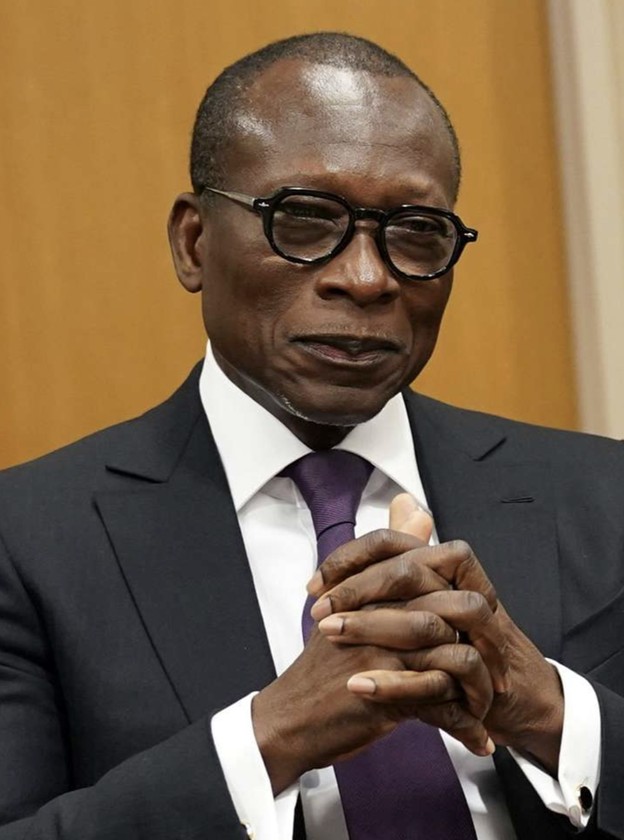
“ This treachery will not go unpunished. ”
-Patrice Talon, President of Benin.
Failed Coup in Benin Prompts Nigerian Intervention:
The small West African nation of Benin was rocked by violence on Sunday, as a group of junior officers attempted to stage a coup against the nation’s government and its president, Patrice Talon . Although the coup appeared rather poorly thought-out, and was quickly contained , it raised alarms across Africa as the latest in a recent series of attempts at regime change.
The coup broke out during the daytime hours on Sunday, when a group of soldiers loyal to Lieutenant Colonel Pascal Tigri stormed Benin’s state TV headquarters and, live on air, announced that they were assuming control of the country. A new military leadership committee, headed by Tigri, would remove President Talon, suspend all functions of the state, and dissolve the prior government.
Parallel to the television address, the coup plotters leveraged support from several military barracks in the nation’s seat of government, the city of Cotonou. There, Tigri’s allies took several hostages , including the Chief of the Army Staff and the Chief of the National Guard, and whisked them away into hiding.
By the evening, however, it was clear that the coup plotters had overestimated their ability to hold the nation. Loyalist units within the Benin Armed Forces responded rapidly , and the national leadership appeared to remain in control of the country’s military and civil institutions. By the day’s end, President Talon himself was on state TV to tell his people that order had been restored: “ I would like to assure you that the situation is completely under control and therefore invite you to calmly go about your activities starting this very evening ”.
But Talon’s survival wasn’t just thanks to his own armed forces. Instead, the coup attempt prompted rapid intervention on multiple fronts . Nigerian President Bola Tinubu dispatched combat aircraft , including Chinese JF-17 fighters and Brazilian A-29 Super Tucanos, to carry out a series of airstrikes targeting the fleeing coup plotters. West Africa’s dominant regional bloc, ECOWAS , deployed troops from Nigeria, Ghana, the Ivory Coast, and Sierra Leone, and quickly took control of important installations .
As of now, Lt. Col. Tigri and other high-level coup plotters are nowhere to be found , and they’re believed to have several hostages still in their custody. The Chief of Army Staff and Chief of National Guard have been released, and publicly available flight-tracking data indicates that Nigerian aircraft are continuing to hunt down coup plotters , including ones that may have fled into neighboring Togo . Fourteen people have been arrested, as of Monday night.
The coup plotters stated real grievances against Benin’s government, not least their frustration with the deteriorating security situation in the country’s north. There, Benin has become a staging ground for transnational insurgent groups, particularly the al-Qaeda affiliate JNIM , which uses Benin’s territory to sustain its operations in Niger and Burkina Faso.
For now, however, it appears that Benin is stable —a welcome surprise, in a continent that’s dealt with several recent military takeovers. Within the last several months, the militaries of Madagascar and Guinea-Bissau have each seized control of their respective nations, while the Sahel states of Burkina Faso, Mali, and Niger are led by military juntas that have presided over a fast-growing regional security crisis .
Image Credit: “Patrice Talon at USAID HQ (4) (Cropped)” by USAID is licensed under PDM 1.0 Universal.
This Week on WarFronts:

For years, and especially in 2025, our WarFronts team has been sounding the alarm on the need to combat existential military threats facing Europe . Over the weekend, we published this episode on the sheer urgency with which Europe has got to get its shit together, before its compounding military and industrial challenges become too much to bear.
What we didn’t know at that time, however, was just how world-changing the United States’ new National Security Strategy would be. Published just days ago, the new NSS calls explicitly for the United States to abandon the post-Cold War order in Europe , realign itself to focus on the Western Hemisphere, and shift the burden for NATO collective defense onto Europe and Canada. For more information on the NSS, check out this article by War on the Rocks .
Pressure on Syrian Kurds Increasing Rapidly:
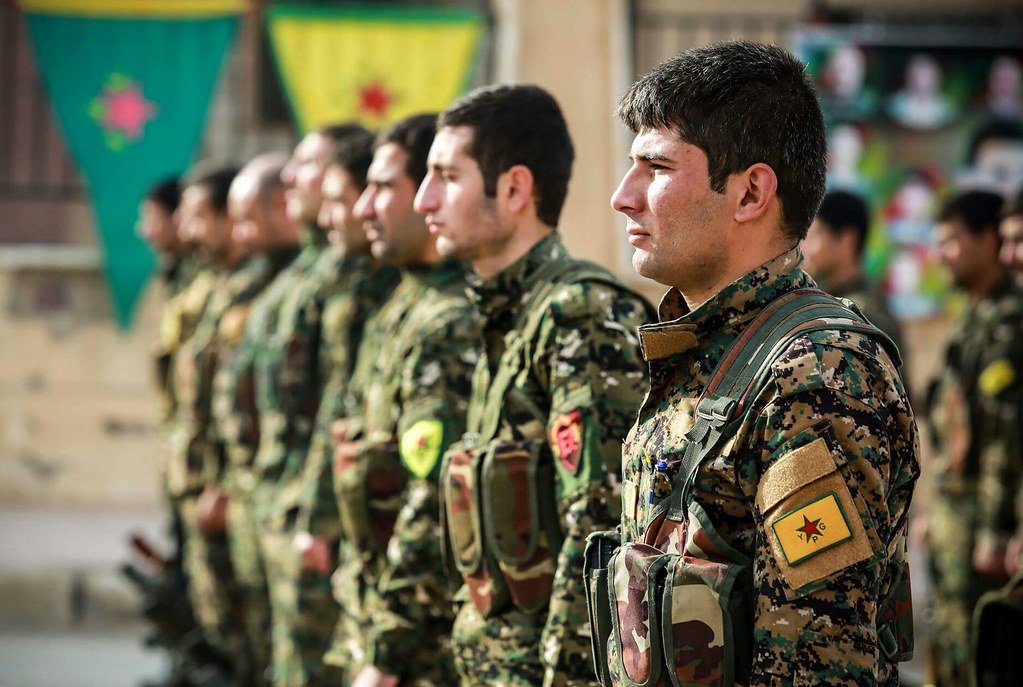
Yesterday marked the one-year anniversary of the fall of Syria’s Assad dynasty, amidst a lightning assault by rebel group Hay’at Tahrir al-Sham and its allies. But as some Syrians celebrated the progress that Syria’s made since then, others—particularly the Kurdish-led Rojava administration in Syria’s northeast—are preparing for a return to conflict .
Over the last several days, Syria and the transitional government’s primary international backer, Turkey , have been issuing warnings to Rojava’s autonomous government that it’s time to integrate with Damascus , once and for all. That effort began in earnest over the weekend, when Turkish Foreign Minister Hakan Fidan publicly demanded that Rojava’s paramilitaries, and especially the Kurdish-led Syrian Democratic Forces (SDF), must disarm by the end of this year or face military action .
Reintegration of the Rojava region has been an outstanding issue in Syria since the fall of Assad, and despite occasional flickers of hope that progress could come soon, the problem has been largely intractable. The SDF have been unwilling to integrate to the Syrian military unless it can remain a regionally distinct bloc, despite the signing of a recent deal. Meanwhile, the conduct of the Syrian transitional government and their forces in other parts of the country have led Kurdish leaders to fear that their people would be targeted after striking a deal.
Damascus, meanwhile, has been insistent that a re-incorporated Rojava is essential to the nation’s future . Turkey has been especially interested in eliminating autonomous Kurdish centers of power , and can take greater latitude in Syria as it works toward a disarmament deal with its own Kurdish insurgent paramilitaries. Rojava also controls lucrative oil fields and rich agricultural lands, both of which would be economically impactful for Syria’s government.
Now, it appears that both Syria and Turkey intend to increase the pressure on the SDF and the Rojava government. On Sunday, Turkish Army convoys reportedly entered Syria from three directions at once, with early indications that they will converge upon the embattled city of Manbij. The Syrian Army has been reinforcing positions in Dier-ez-Zor , potentially enabling a two-front offensive if both nations were to take military action.
Syria’s Kurdish leaders have expressed their frustrations with the government in Damascus, and its refusal to move “ beyond the mindset of factions and limited ideological loyalties ” in order to build a more cohesive state vision. Their protestations, however, may not matter much, as Turkey has gained the clear favor of the United States in an abandonment of the US’ Kurdish former allies.
When Turkey last took direct action against the Kurdish population in Syria, in 2019, the resulting offensive led to the deaths of hundreds, as Turkey carved out a large buffer zone on Syrian territory. Today, SDF leaders insist that the Turkish deployments do not constitute a serious threat to Rojava— but it’s unclear that Rojava could truly protect itself , against a Turkish military that’s been gaining in power ever since.
Image Credit: “Kurdish YPG Fighters” by Kurdishstruggle is licensed under CC BY 2.0 .
What We're Reading:
Mali’s military dictatorship is going through an exceptionally difficult time right now, as JNIM insurgents keep up the pressure on Bamako despite the presence of Russian paramilitaries.
In this recent Foreign Policy takedown of the Malian junta, experts Alex Laskaris and Oliver Walther explain the many failings that have led Mali to its current predicament, not as a mere echo of colonial exploitation, but as a result of real, avoidable catastrophe that Mali’s government has brought upon itself.
Around the World:
Thailand and Cambodia are trading fire once again , after Thailand launched a series of airstrikes in response to what it claimed was a buildup of Cambodian heavy weapons near a sensitive border zone. Thailand states that it evaluated Cambodian forces could use Soviet-era and Chinese-made rocket launchers to attack multiple sensitive targets, and attempted to lock onto those coordinates. Thailand has indicated that it does not intend to engage in de-escalation until its military objectives have been fulfilled.
The border between Pakistan and Afghanistan also went hot again, when, late on Friday night, the two nations exchanged heavy fire leading to the deaths of at least five people. The true death toll appears to be considerably higher. According to Pakistani state sources, the clashes started due to Afghan “ unprovoked firing ” across the border zone, while Afghanistan accused Pakistan of initiating the exchange.
A horrific attack on a kindergarten and hospital in South Kordofan State left over one hundred people, including at least sixty-three children, dead on December 4. The attack was perpetrated by the Rapid Support Forces (RSF), who used drones and artillery fire to strike the kindergarten first, and then follow wounded children and caretakers with sustained fire as they fled to a nearby hospital.
Also in Sudan, the RSF claimed that it captured the strategic Heglig oil field in South Kordofan Province. Not only is Heglig a critical source of revenue for the Sudanese military regime, but it hosts a refinery that processes a very high portion of South Sudan’s oil—and thus, provides a similarly high proportion of South Sudan’s state revenues.
Ukrainian forces have withdrawn from several key villages near the embattled city of Pokrovsk in order to avoid encirclement, as the nation’s defense in this area of the Donbas continues to deteriorate. While troops reportedly sustained losses during the withdrawal, the choice will likely enhance Ukraine’s ability to sustain its fight elsewhere, as the nation makes increasingly difficult decisions to avoid unnecessary losses among its troops.
An unusual confrontation between the Congolese military and a generally pro-government militia, known as the Wazalendo, ended with over thirty people dead in a bomb blast and twenty others wounded. The confrontation erupted as Congolese soldiers were ordered not to move through a certain area by the Wazalendo, leading to heated arguments prior to the unexplained explosion.
China engaged in intense air drills from its Liaoning aircraft carrier on Monday, in waters near Japan’s Okinawa island chain. The carrier hosted around 100 takeoffs and landings during the course of the exercises, amidst reports that Chinese fighter jets locked onto Japanese jets, and China massed over a hundred naval vessels near contested waters, during the same stretch. The exercises and other escalations come at a moment of heightened tension, after Japan’s new Prime Minister stated Tokyo’s willingness to defend Taiwan.
After several weeks of reduced militant activity, the JNIM insurgency in Mali attacked and burned a convoy of dozens of fuel tankers over the weekend, corresponding to the end of a truce that JNIM had established with Bamako. In a social media video, a JNIM fighter claimed that Russia’s Africa Corps had unsuccessfully tried to protect the convoy.
Suspected Pakistani Taliban militants killed six Pakistani soldiers at a checkpoint in the country’s northwest, in an ambush attack that’s likely to further raise tensions between Pakistan and Afghanistan. The Pakistani Taliban is likely to use the ongoing violence in the border zone to grant themselves greater operational latitude in their own attacks.
An explosion outside a police station in Mexico’s Michoacan State left five people dead and twelve injured, in the latest security incident in a state beset by overlapping cartel and organized criminal insurgencies. The explosion comes amidst efforts by Mexico’s Sheinbaum government to surge troops into the zone and quell the ongoing violence.
Qatari officials are sounding the alarm on the evolving truce governing the Gaza Strip, emphasizing that progression to the next stage of the ceasefire is far from a done deal. According to Qatar’s Prime Minister, negotiations have reached a “ critical moment ”, but “ cannot be completed until there is a full withdrawal of the Israeli forces […] which is not the case today. ” Days ago, a Hamas leader claimed that the group is ready to discuss “ freezing or storing ” its arsenal of weapons ahead of a second-phase peace deal.
Ugandan opposition candidate Bobi Wine was beaten by the nation’s security forces this weekend, according to Wine’s posts on social media. According to the candidate, Ugandan police and military personnel hit Wine in the face with a cane and hospitalized several of his aides and supporters, while they made their way to a campaign location in the northern city of Gulu.
Law enforcement in Tanzania patrolled largely vacant streets today, as anticipated Independence Day protests failed to materialize in the wake of the nation’s fatal series of recent crackdowns. Watch for a potential escalation after dark, if the thousands of people who had planned to protest decide to take to the streets under more favorable conditions.
The European Union is considering steps to strengthen Lebanon’s Internal Security Forces, as the Lebanese Army prepares for chaos in its deteriorating efforts to disarm the Hezbollah organization. The EU will carry out missions in early 2026 to evaluate its options in the country, making overtures that Lebanon may have little choice but to accept. Last week, Israeli and Lebanese civilian representatives held direct talks for the first time in decades, as a deadline approaches for Hezbollah to fully disarm.
German parliamentarians approved a highly controversial military service law , aimed at boosting recruitment numbers for the national military and prepare Germany for a potential future war with Russia. The law creates a two-track recruitment plan, with a high-paying voluntary service option, and the option to trigger need-based conscription if voluntary recruitment numbers fall short of their target. The law intends to build a German military of up to 260,000 active soldiers; it currently stands at 183,000.