
How Illicit Finance Fuels All Sides of the Sudan War.
The Sudanese Civil War is fueled by a constant flow of foreign capital into the conflict zone, with both the Sudanese Armed Forces and the Rapid Support Forces relying on external funding to sustain the fight.
Evan Moloney • February 16, 2026
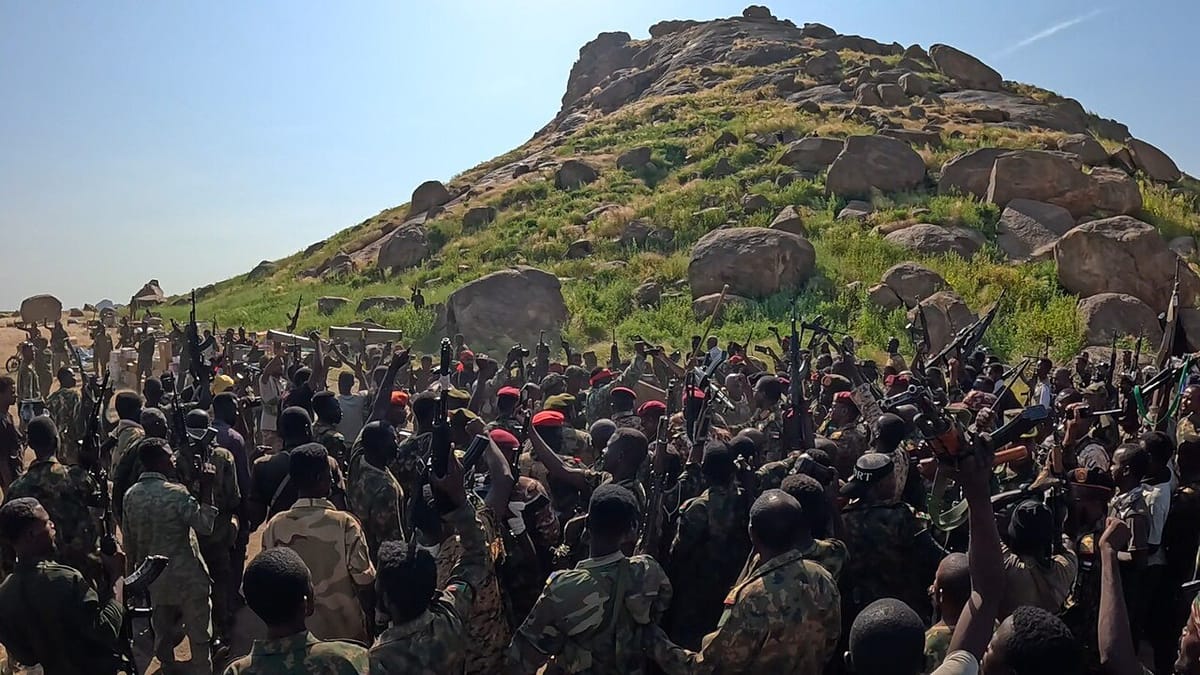
Up next
Moscow is Struggling to Drum Up Interest in its Africa Summit. Here's What that Means
Casus Belli · September 8, 2026 · 14 min read
Niger's Rebellion Shows the Sahel Crisis is Growing Out of Control
Saturday's failed coup in Niamey was staged by soldiers from Niger's jihadist-plagued frontlines — and only Russia's Africa Corps saved the junta that sent them there.
Paweł Wójcik · September 3, 2026 · 10 min read
Sudan’s Paramilitaries are the Best-Funded Insurgents on Earth. They’re also Losing the War.
Sudan’s Rapid Support Forces are arguably the most well-funded and armed insurgency in decades. With billions of dollars in funding and near-daily weapon deliveries from the UAE, winning the civil war should in theory have been easy. But the opposite is true. The RSF is losing.
Thomas van Linge · August 31, 2026 · 11 min read
The Sudanese Civil War is nothing less than an ongoing global atrocity, universally recognized among experts and conflict observers as one of the worst conflicts in modern history. Over twelve million people have been internally or externally displaced, and more than double their number have spent at least part of the conflict’s duration at risk of famine. Reasonably reliable death toll estimates, with a degree of external verification, have crested over 150,000, while more pessimistic assessments suggest that similar numbers of people could have been killed or taken captive, just during the siege and genocidal massacres in the city of El-Fasher.
Yet despite the horror and devastation of the Sudanese Civil War, the conflict continues—powered not just by soldiers and weaponry, but by a constant flow of foreign capital into the conflict zone. Both the Sudanese Armed Forces (SAF) and the Rapid Support Forces (RSF) are the beneficiaries of vast financial networks: some of them illicit, some semi-licit, and others, operating in areas that global institutions currently struggle or fail to regulate.
These networks allow both the SAF and the RSF to sustain their military operations, often with the silent complicity of world governments that have outright condemned the actions of either or both groups. Without these financial flows, much of the war’s destruction would likely not have been possible—tying both networks, and their international beneficiaries, to the deaths of what may be hundreds of thousands of Sudanese civilians.
The Problem.
Illicit flows of finances, goods, and resources have always played a role in global conflicts, but the problem has worsened exponentially in the digital age. Armed with 21st-century transfer and conversion methods, shielded with modern encryption and other tools to help avoid accountability, nations and non-state actors have found it easier to move, access, and divert secret cash flows than ever. Those hidden networks pose a fundamental challenge for outside authorities, whether national or international, who might otherwise seek to track and disrupt the flow of funds that sustain modern conflicts. The old investigator’s adage, “follow the money”, is more difficult to put into practice today than it’s ever been.
This problem perseveres far outside the confines of the Sudanese Civil War. Similar networks power conflicts from the Congo to Myanmar, from Middle Eastern crises to Latin American criminal insurgencies, and they infuse non-state insurgencies, organized syndicates, terror networks, and other asymmetric actors with all the funds they need, to sustain operations. But in Sudan, the problem is particularly severe. Leaders on both sides have personally enriched themselves, to extraordinary degrees, through their participation in the conflict.
The leader of the RSF, a man known as Hemedti, was already worth an estimated $7 billion before the start of the conflict, and has managed to keep himself and his fighting force engaged in global financial networks despite what should amount to crushing international sanctions. Sudan’s ruling military regime have deftly engaged in their own sanctions-skirting efforts, and are believed to be profiting massively, both by skimming off the top of a churning war economy, and by using the war to direct the flow of other capital directly into regime leaders’ personal coffers.
In both cases, the sustaining impact of these financial networks cannot be overstated. The Sudanese regime has lost nearly all of its traditional sources of revenue, including over a fifty-percent reduction in revenues from oil exports and a vast reduction in its gold exports, while the value of the Sudanese pound has cratered.
The Flow.
The illicit, semi-licit, and hidden financial networks at play in Sudan require a nuanced, expansive definition of “capital”. These networks are not merely sustained by wire transfers; in fact, their greatest strength, and the source of their staying power, is their remarkable ability to rapidly convert and re-convert capital into many different forms before it reaches its eventual destination.
Within these networks, sums of money are regularly transferred in all directions. Digitally stored, traceable money may become physical cash, which may become cash of different currencies, before converting to free-flowing cryptocurrency, and then to fixed stablecoins like Tether. Cash may be converted into raw goods, like gold, oil, or critical minerals; it may be converted into weaponry, war supplies, or even humanitarian goods, before being converted back into cash or digitally stored capital through downstream legal, or illegal, purchases.
Capital is converted into the physical networks that facilitate arms smuggling, human trafficking, and the narcotics trade, with the networks themselves holding value, in forms that are practically unrecognizable as a mechanism to store cash. It’s transferred through both official networks, and untracked local markets in far-flung locations where international monitoring authorities cannot reach.
These endless tools of capital conversion grant illicit financial networks all their greatest advantages. While individual conversions within the network, like cryptocurrency transfers or weapons purchases, may be traceable, the larger flow of funds is too complex, and too unaccountable, to ever be fully mapped.
Money constantly re-enters the licit global financial system before exiting again, often bearing telltale signs that it’s tied to some unknown illicit network, but that money’s origins are often hard to trace, and it can be easily scrubbed and re-converted to new, untraced forms, once it moves outside those networks again.
This process is highly complex, difficult to achieve, and requires constant work and expenditure on the part of illicit or semi-licit brokers. Actors looking to exploit this system must be able to cultivate networks of trustworthy partners, often at the local level, and sometimes all around the world, to manage the transfer of money in and out of its various forms.
But the payoff is obvious: A near-complete lack of accountability, and access to entirely untraceable methods of capital conversion and transfer, using methods that global authorities have neither the reach nor the resources to monitor. Those methods are at their most potent, in global combat zones where monitoring becomes impossible, and where armed factions have their own complex incentives to secretly facilitate financial flows that reach far beyond their own interests—but that can fuel war effort as capital interacts with conflict.
The Tools.
The civil war in Sudan is a prime opportunity to understand the specifics of these networks, starting with the range of tools at the SAF’s, and the RSF’s disposal. Each of these tools can be leveraged to serve many interests at once; often, they’ll be used to bolster the RSF’s or the SAF’s war machine, but capital flows through the conflict zone for many reasons.
Sometimes, that has little or nothing to do with the SAF or RSF, except that armed factions stand to benefit by skimming off transactions that take place under their watch. While the SAF and the RSF are each primarily concerned with their civil war, both of these fighting forces leverage their position in combat zones, to provide tools and services that other illicit brokers couldn’t match.
Often, capital flows through the Sudanese Civil War in the form of pure gold, mined in both SAF-controlled and, now primarily, RSF-controlled areas. The majority of that gold is illegally trafficked through smuggling networks that work with either side. By the admission of the SAF government’s own Finance Minister in early 2026, seventy tons of gold were produced in Sudan in 2025, but just twenty tons were exported through official channels.
Broadly, smuggled Sudanese gold enters a known global network, in which it is processed in the United Arab Emirates, repackaged as Emirati gold, and transferred to other developed nations, predominantly Switzerland. We outlined this network on WarFronts, here, in 2024. Frequently, gold flowing out from Sudan will be intermingled with gold trafficked from other African conflict zones, especially as wartime Sudan has become an increasingly useful transit point for larger gold-smuggling networks.
Similarly, Sudan offers physical, convertible assets for export in the form of oil, agricultural yields, and livestock, as well as smaller quantities of various critical minerals. Each of those resources can be used in various ways: to store Sudanese or external capital in physical forms with known value, to exchange for capital that can fuel either side of Sudan’s war machine, or to allow the transfer of foreign capital into Sudan, through purchase and sale of physical goods. In each case, because such high quantities of these goods are smuggled illegally, they are disengaged from any mechanisms of external oversight.
Then, there are the mess of shell corporations, outside brokers, and other tools that make digital transfers and conversions of currency harder to trace. In the RSF’s case, the paramilitary relies heavily on the United Arab Emirates, where RSF senior leaders headquarter their known financial offices, and maintain broad networks of shell companies under the Emirates’ universally recognized legitimacy.
As early as 2024, the United Nations had identified at least fifty companies directly tied to RSF leader Hemedti and his family, strictly to facilitate the transfer of gold to the UAE and then to international markets. The overall array of companies that the RSF relies on is far larger, and is constantly evolving, using legitimate partners in the Emirates and elsewhere to create new financial pathways faster than they can be identified, tracked, sanctioned, and dismantled by outside actors.
These companies allow the RSF to continue to pay its forces, fund propaganda and foreign lobbying campaigns, and leverage international mercenaries and munitions. While international governments have attempted to keep up through sanctions, they are constantly working to catch up; see the United Kingdom’s latest sanctions in early February, identifying new high-level financiers and facilitators that have used legitimate non-Western banking systems as a tool in their larger networks. While sanctions will disrupt newly discovered networks, they do not disrupt the process that will allow those networks to be replaced.
Nor is the RSF the only Sudanese faction to leverage these sorts of networks. While the RSF’s capital flows rely largely on the United Arab Emirates, the SAF’s rely on Egypt, Saudi Arabia, and, to a lesser extent, other partners across the Middle East and beyond. SAF leaders are known to have cultivated complex financial networks tying them to both Iran, and its associated proxy actors abroad, while using other networks to smuggle resources, acquire embargoed weaponry, and otherwise fuel the Sudanese war machine.
Because the SAF is an internationally recognized global government, its semi-licit and illicit networks are shrouded in another layer of complexity: the SAF’s ability to leverage, and misuse, its place in the global banking system, the global arms market, humanitarian aid supply networks, and more.
These connections allow the SAF to take capital, stored in illicit forms, and introduce it to legally recognized global networks more easily than the RSF can, while still leveraging all the illicit capital-conversion tools that would keep this money’s origin point untraceable.
On both sides, foreign backers use a range of methods to transfer capital into the conflict zone. The Chinese-made drones and howitzers that supply the RSF, or the Turkish drones and Serbian rifles that supply the SAF, are weapons, but they are also capital in themselves, pre-converted and sent to a conflict zone where they can either be used, or re-converted into other forms.
Finally, there are the dedicated currency conversion tools, both digital and physical, that the RSF and SAF each use to sustain their operations. Both are known to leverage cryptocurrency to move money unpredictably, in sums that can be mixed together, separated back out, and repeatedly converted into various tethered and untethered forms. While that process does not make cryptocurrency untraceable, it makes the investigative process far more complex and time-intensive.
Just as important are hawala networks on the ground: informal, largely trust-based money transferring systems that run through dealers transferring cash without documentation. These networks have proved critical in helping civilians to access cash and humanitarian aid, but they are equally useful as tools of money-laundering, illicit finance, and cash conversion into new, explicitly un-traced forms.
The Larger Problem.
Taken together, these illicit networks allow both Sudan’s SAF and the RSF to sustain combat operations at scale. These same networks pull in knowingly, or unknowingly complicit partners from all across the globe. In many cases, those partners use financial conversion networks to inject capital into the conflict zone. In others, they interact with Sudanese war money in its washed, post-laundering forms, or while it is temporarily cloaked by either legitimate financial systems, or fully untraceable smuggling or hawala networks.
In both cases, the outcome is the same. Despite international prohibitions, global sanctions, and condemnations of the war in Sudan, governments, private industry, and the world financial system all end up interacting with the conflict anyhow. Often, those interactions are unintentional, and many will never be accurately identified as transactions connected to the Sudanese conflict.
Yet this understanding of the situation—nuanced as it may be—still fails to capture the true breadth of the problem. The SAF and RSF each gain substantially from the use of illicit finance networks, and each can thank those networks for the scale of their current military efforts. They are each beneficiaries of these networks, they each work to cultivate and perpetuate them, and they each will continue to rely on those networks until, and after, the eventual end of this conflict.
The networks, however, are not designed for either the SAF’s benefit, or the RSF’s. The global flow of illicit finance goes well beyond either faction, and does not exist primarily to serve participants in armed conflicts, whether in Sudan or anywhere else.
Broadly, illicit finance is a simple by-product of licit finance, but the highly complex, transnational illicit finance networks that exist today, ultimately serve a massive pool of liquid capital that its owners deliberately distance from the influence of their own, and other global governments.
The illicit networks that run through Sudan and other conflict zones are part of the same global system that creates demand for tax havens, legitimate shell corporations, and other generally accepted tools to keep a person, organization, or nation’s capital away from external threats: taxation, economic instability, political or law enforcement risk, and more. At its most basic level, capital is stored in transnational smuggling networks or laundered through hawala exchanges for the same reason that it might be stored in a Cayman bank account, or used to acquire valuable property abroad.
Illicit networks, however, are inherently harder to trace, and easier to manipulate through extralegal means. Moreover, they provide a broader and more reliable set of tools for particularly well-organized actors to build their own self-contained laundering and conversion mechanisms.
These advantages make illicit networks vastly preferable to licit ones, for a range of actors: criminal syndicates, terror groups, insurgencies, legitimate businesses engaged in fraudulent or other illegal activities, and more. The capital that each of those groups inject into illicit networks, however, pales in comparison to the money provided through another phenomenon: Capital flight.
Unlike the other forces that would cause money to enter illicit systems, capital flight is generally a society-wide behavior, in which financial assets are moved out of a given country at large scale, and hidden or preserved elsewhere. Sometimes, capital flight is a short-term response to an urgent problem: financial breakdown, political instability, or the outbreak of conflict. In these instances, national elites tend to ensure that their money goes elsewhere, held in forms that will preserve its value while a domestic situation returns to normal.
In some cases, however, capital flight is an ongoing process, especially among national elites whose power is tied to unpredictable authoritarian regimes. Take a nation like China, or Russia, where each nation’s wealthiest people are believed to hold incredible amounts of money deliberately outside the reach of the state.
In these places, oligarchs, generationally wealthy families, and other elites are subject to unpredictable purges and internal upheaval. Threats to their wealth often come without warning, and without external indicators of trouble that would cause broader capital flight across society.
Faced by such instability, under the rule of a regime that conveys consistent benefits and advantages to wealthy elites unless their fortunes suddenly change, pre-emptive capital flight is a natural next step. Funds held outside a given regime are seizure-proof, purge-proof, exile-proof, and can reliably be accessed by a person’s surviving descendants, should that person not survive their own fall from grace.
For these elements of global society, illicit networks are even more tempting than they otherwise might be. A Russian oligarch, for example, can store wealth outside of Russia, without having to rely on institutions that answer to the sanctions-happy global West. Money disappears without a trace, in illicit networks, far easier than it disappears in even the most privacy-minded formal institutions. It is more easily convertible, making it more easily recoverable without having to re-engage with licit financial systems.
The broader implication, however, is that global illicit finance networks serve this highly liquid, highly sensitive global slush fund, handling transfers and providing ways to control immense sums of money that must be kept separate from the world of legitimate finance. Conflicts like the Sudanese Civil War don’t just operate within these networks, tangential to the far larger sums set aside for long-term capital flight. Instead, conflicts are a primary facilitator of this shadow financial system. They open access to entire categories of capital conversion that are otherwise difficult to leverage, and they provide avenues for temporary investment that are unlike any other on Earth. Money hidden through capital flight will eventually be secured by its owners, but first, it must be converted and re-converted until it is both untraceable, and unrecognizable. For that, there is no better tool than war.
In Sudan, the SAF and the RSF each stand to gain, by working as active participants in this complex system. They are guardians of foreign capital placed temporarily under their care, and they are stewards of the far larger system in which that capital flows. As the price of doing business, a fair share of that capital will be transferred to them directly, fueling the war machine on both sides, and accelerating the human devastation on the periphery.
For the financial actors who rely on this vast illicit system, the eventual victor in Sudan is largely irrelevant. From their perspective, the war itself is the asset that truly matters, as a tool to unlock the many tools of illicit finance that can only be leveraged during an active conflict. When the Sudan war ends, another will take its place—but transitioning to new wars, and new networks, costs time and money. It is far more efficient to ensure that the Sudanese Civil War, or another war like it, will continue, for as long as it helps illicit capital to flow.
References
- 1thesentry.org/reports/sudans-anti-corruption-whitewash
- 2atlanticcouncil.org/blogs/new-atlanticist/the-sudan-crisis-has-become-a-magnet-for-foreign-malign-influence…
- 3sudanwarmonitor.com/p/western-blacklists-over-war-crimes
- 4globalinitiative.net/analysis/illicit-networks-commoditized-violence-state-collapse-sudan-conflict
- 5sudantransparency.org/wp-content/uploads/2024/08/IFF122023.pdf
- 6btl-research.com/p/sudan-a-breeding-ground-for-global?utm_source=publication-search
- 7aljazeera.com/news/2025/11/20/sudan-has-vast-oil-gold-and-agricultural-resources-who-controls-them
- 8newlinesinstitute.org/global-security-mil-priorities/the-case-for-u-s-involvement-in-the-sudanese-civil-war
- 9issafrica.org/iss-today/sudan-s-civil-war-reignites-the-illicit-car-trade-into-chad
- 10hrw.org/news/2024/09/09/sudan-abusive-warring-parties-acquire-new-weapons
- 11theafricareport.com/356320/sudan-weapons-from-china-russia-serbia-turkiye-uae-and-yemen-fuelling-the-war-am…
- 12chathamhouse.org/2025/03/gold-and-war-sudan/conclusion-and-policy-implications
- 13brookings.edu/articles/chinas-achilles-heel-capital-flight
- 14weforum.org/stories/2025/02/why-capital-flows-have-the-potential-to-change-the-economic-status-quo
- 15globalinitiative.net/analysis/gangsters-at-war-russias-use-of-organized-crime-as-an-instrument-of-statecraft
- 16atlanticcouncil.org/in-depth-research-reports/report/defending-the-united-states-against-russian-dark-money
- 17openknowledge.worldbank.org/entities/publication/778999c2-4beb-5b77-ab1a-ebac520ceea8
- 18cepa.org/comprehensive-reports/addicted-to-war-undermining-russias-economy
Written by
Evan Moloney is Head Writer at WarFronts and HomeFronts, and contributes analysis regularly to Fronts. Evan leads ongoing coverage of global conflicts and other rapidly evolving stories. Evan also authors the twice-weekly email newsletter WarFronts Weekly
Related articles
Moscow is Struggling to Drum Up Interest in its Africa Summit. Here's What that Means
Casus Belli · September 8, 2026 · 14 min read
Niger's Rebellion Shows the Sahel Crisis is Growing Out of Control
Saturday's failed coup in Niamey was staged by soldiers from Niger's jihadist-plagued frontlines — and only Russia's Africa Corps saved the junta that sent them there.
Paweł Wójcik · September 3, 2026 · 10 min read
Sudan’s Paramilitaries are the Best-Funded Insurgents on Earth. They’re also Losing the War.
Sudan’s Rapid Support Forces are arguably the most well-funded and armed insurgency in decades. With billions of dollars in funding and near-daily weapon deliveries from the UAE, winning the civil war should in theory have been easy. But the opposite is true. The RSF is losing.
Thomas van Linge · August 31, 2026 · 11 min read
Continue in
Become a Member
Members get full access to premium reporting, in-depth briefings, and subscriber-only analysis.
Insiders Receive
- Full access to all premium articles and briefings
- Exclusive subscriber-only analysis and dispatches
- Support independent conflict journalism
Signed in or already a member, but still locked? Fix an access problem
From $5/month — cancel anytime