
Africa Refuses to Allow More Nations.
From Somaliland to Ambazonia, secessionist movements keep failing for the same reason: the African Union treats colonial-era borders as untouchable, fearing one new state would invite dozens more.
Simon Whistler • June 23, 2026
Members only
Note: this transcript was generated by AI and may contain errors or inconsistencies.
Across the African continent, war is a constant fact of life. Individual nations may be quite stable at any given time, they might be entirely safe, but across the region, other nations are practically guaranteed to be in conflict with each other or with themselves.
At the time that this episode was written, a brutal civil war was raging across Sudan and the African Horn, and South Sudan were on the brink of restarting two of the deadliest conflicts of the 21st century.
The entire Sahel, a fair portion of Nigeria and Somalia, and the northern reaches of Mozambique were each overrun with Jihadist insurgencies.
A proxy war over precious resources was taking place in the eastern Congo, several nations were reaming in the aftermath of recent attempted or successful military coups, and others were fresh off some of the bloodiest anti-dissident crackdowns of the 2020s.
Now as ever, Africa is a continent with stunning human potential, but across so many parts of Africa, it's a place where the worst impulses of humanity are on full and constant display.
It's easy to look at a place like Africa and see every modern-day conflict as an echo of history. The continent is torn apart by borders that Africa's population didn't get to choose, and it's ruled by leaders who Africa's population often didn't get the chance to elect.
In so many African nations, there are entire populations, millions upon millions of people who reject the very idea that the post-colonial order could ever serve them.
Modern Africa is the living legacy of incredible, constant exploitation. And how could a modern Africa built on the remnants of that very system ever be asked to succeed? Break the borders, rethink the balance or the array of nations, build governments that work for their people, and maybe things could be better.
But there's a rule that governs Africa today, not imposed by the outside, but chosen by leaders all across the continent. No new nations, even when a new nation might seem like an obvious solution. Ever since the nations of Africa gained their post-colonial independence, that rule has been enforced through blood and steel.
So it's time that we understand why. As you possess, so you may possess. This was originally a legal principle from the days of the Romans.
Those were the words that settled what might have been the most important debate in modern African history. Laid out by the Organization of African Unity, the immediate predecessor of today's African Union, as you possess, so you may possess, was a foundational principle that laid out Africa's approach to its modern borders. The rule was simple.
Whatever colonial boundaries Africa had chosen to rely on when new nations claimed their sovereign territory, those were the borders that African nations would abide by in the future. Whatever territory African nations possessed, at the time the principle was adopted, that territory would be theirs moving forward.
At the time, it seemed like a decent enough option.
Even as new nations were still finding their feet, it was obvious that Africa's dozens upon dozens of leaders would have trouble keeping the peace. So that simple rule aimed to get rid of two potential sparks for future conflict, before conflicts could ever erupt. Under that core principle, African nations couldn't have border disputes.
After all, whatever territory they possessed when Africa decolonized was the territory they'd all agreed to live with, historical claims be damned. And also, thanks to that principle, African leaders had an easy solution to fall back on when constituent groups in their own countries made inevitable claims of succession.
It wasn't even up to individual African leaders, after all.
The entire continent had agreed new nations were out of the question. In theory, that meant that Africa could get ahead of a second wave of independence movements, and it could avoid proxy wars funded by rival nations because all nations would understand their commitment to respecting the continental status quo.
Of course, we could look back on that foundational principle today and broadly agree that it didn't exactly work as expected.
African nations have found plenty of reasons to go to war, other than territorial disputes alone, and sovereignty movements, internal rebellions, and insurgent groups have found a way to thrive anyhow. But the prohibition on new nations has withstood the test of time, and it's just as much a driver of African politics today as it's ever been.
Of course, there's a really simple, effective case for Africa to take the opposite approach.
And thus, the current post-colonial status quo has caused an immense amount of bloodshed across the continent. Some of the continent's nations are exceptionally diverse and have been in a mere constant state of warfare against warring ethnic groups or regional factions since their independence. Take the Democratic Republic of the Congo as one example.
Some of the continent's deadliest conflicts have been fought over questions of sovereignty, and some sovereign movements have preserved for decades without success. The nation of Angola has the Cabinda Movement, Nigeria has the Biafra Movement, Mali has the Azawad, Cameroon, the Ambazonia, Senegal, the Casamance, and the list truly does go on.
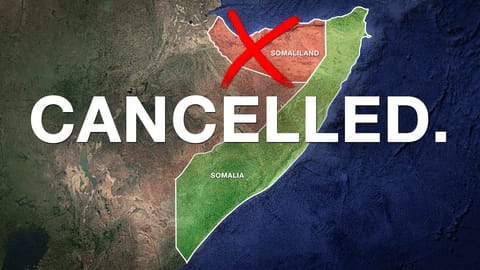
In Somalia, the autonomous breakaway state of Somaliland has been largely democratic, relatively stable contrast to Somalia for decades, and has never had its independence claim recognized by any member of the African Union.
There have, of course, been two cases where new African nations did gain their independence through a continentally brokered process, Eritrea, which gained independence in 1993, and South Sudan in 2011. But those cases share several elements in common that the vast majority of other cases don't.
First and foremost, South Sudan and Eritrea are each ethnically diverse, their nations made up of many clans and tribes instead of just one.
That's in contrast to a place like Somaliland, ruled mostly by a single powerful tribe, meaning that if African nations were to recognize Somaliland's sovereignty, they'd be setting a precedent that individual, land-holding, autonomous tribes can make their own sovereignty bids in the future.
As for why that's a problem, there are hundreds of those across Africa, most of which aren't making any serious attempts to establish sovereignty right now, but very well could if Somaliland had already succeeded.
Beyond their ethnic or tribal makeup, Eritrea and South Sudan were each lands where conflicts had raged for far longer. and burned far hotter than across many of these other areas where resistance groups are active regime repression had largely failed to keep the movement in check there was no real regime loyalist population in those areas and sudan's and
Ethiopia's respective claims that they could handle the separatist issue internally were no longer credible both independence movements drew broad international support and both of them participated in complex peace and sovereignty processes which most of these other groups hadn't even been able to achieve there's also a third exception to consider the land
Of western sahara but that's a bit of a special case as it's been held as a moroccan colony for the last several decades as of now the situation appears to have been resolved in morocco's favor and probably permanently we published a recent episode on the topic if you'd like to learn more about that so by the logic of the modern day african union there is a
Clear well-developed case to resist sovereign movements except in a narrowly defined set of exceptional cases there's also a security calculus here essentially the decision to choose stability over sovereignty across africa as well as across the rest of the world there's a general understanding that revolutions tend to involve a good deal of violence and
That assumption has been borne out in africa many times in the long intractable civil wars that sovereignty disputes tend to create these sovereignty movements are broadly violent rewarding those movements would be rewarding violence and if violence is rewarded that creates greater incentives for violence in the future not to mention the introduction of more
Nations and more distinct sets of national interest across africa is a dangerous proposition africa's 54 sovereign states have a hard enough time not going to war with each other already and every new state that's added to the equation is another vector for future conflicts to arise the alternative protecting africa's current status quo and its current
International borders may not be perfect but it's controlled chaos instead of complete chaos it's the devil african knows and in the minds of african leaders that seems to be good enough the really big question of course is whether that trade-off is worth it and whether africa can justify prioritizing stability over sovereignty especially when africa seems
As outwardly unstable as it does remember the current state of affairs in africa is one where there's always a major war going on somewhere the place where countless insurgent groups are active at any given time internal repression is a fact of life in many nations and governments are always liable to be overthrown proponents of africa's approach would argue
That as bad as all of this might be the alternative is still worse and that if africa made the switch today then it would spend decades wishing that it could go back and undo that decision once it was made but the alternative argument is damning that in the name of stability that doesn't actually exist african leaders have chosen to deny the right to
Self-determination for many millions of people and before we get into discussing why that obvious counter-argument doesn't seem to carry the weight that it should we've got to take a moment to talk about something near and dear to our hearts here at warfronts and that is of course our premium subscription service fronts.co over at fronts our team goes even
Deeper into the global conflicts of geopolitics the hidden influences that shape our world front subscribers get exclusive access to two premium episodes every single week plus our entire catalog of written articles featuring award-winning journalists and experts from across the globe the subscription costs just five dollars a month or fifty dollars a year
And it helps us preserve our independence and expand our free offerings on youtube while you're checking out fronts be sure to sign up for our twice weekly email newsletter warfronts weekly totally for free to get regular updates on all the evolving stories that we are watching check out fronts.co sign up to warfronts weekly again for free a big thanks to
Those who already subscribed and now back to africa all right so we got the general lay of the lands on the way that sovereignty disputes tend to be handled in modern africa but with such a compelling argument against the status quo that millions of people are suffering in war zones across the continent to preserve stability that doesn't actually exist we've
Got to ask just why that counter argument doesn't seem to stick after all that's hardly a new observation and generations of african opposition leaders foreign policy experts rights advocates and other knowledgeable voices have spent entire careers trying to make a change but that hasn't happened and if anything africa's commitment to the status quo has only
Gotten stronger with time for our viewers in western nations it may seem a bit strange that the international community particularly the u.s and europe having put their collective foot down and pressured african nations to at least recognize a sovereignty claim like somaliland's where a generally peaceful breakaway state could become a real stabilizing force
In an otherwise volatile region but generally the modern international community tends to defer to the judgment of the african union especially after the end of the cold war that's largely a reflection of the world's post-colonial legacy in africa european and other foreign capitals got the chance to do as they pleased with africa the results were outright
Horrific and now with the benefit of hindsight the rest of the world has agreed that african problems are best addressed with african solutions the international community still meddles in africa of course it does it still exploits natural resources and fuels or attempts to end conflicts even as it provides comprehensive humanitarian support but really overt
Acts of control in which the outside world would essentially hand down orders to african governments are mostly a thing of the past especially when it comes to the principles that african leaders believe are vital in doing the best they can for the continent the african union's resistance to new nations is one of these core principles and even when world
Leaders would like to see africa handle the situation differently they've constantly held themselves back from trying to dominate decision making on internal african matters then we've got to go back to the concerns about generalization that depending on who africa chooses to allow to claim sovereignty or how those movements go about claiming sovereignty,
Africa can create a precedent that other groups will immediately seize upon.
That's a genuine risk to the continent in a number of different ways. It's not easy to build new nations. It's certainly not cheap.
And many of the regions across Africa that want to become independent are impoverished, desperate, or barely self-sufficient. Often, that's by design. If you're the leader of a nation that deals with a separatist threat, then it is easier to control and defeat those separatists when they are kept generationally poor and disenfranchised.
But the result of that past repression and deprivation is that these areas, in the modern day, are hardly ready to be a country. They're propped up through systems of economic redistribution, humanitarian aid, and more.
But by introducing new borders, unpredictable new leaders, and other variables that put even more strain on the system, those regions might be worse off once they've gained independence.
And as much as that might be a problem for one distinct region or another, it's a much bigger problem if a cascade of new nations all shocks the system at once. Worse yet, there are no new guarantees that once new countries gain independence, they'd stay peaceful.
Modern Africa already has a major corruption problem, a major dictatorship problem, a major repression problem.
And if we want to be really cynical about the whole thing, new nations are just a chance for another regional elite to set up the same systems of self-enrichment.
Set the precedent that new nations are being welcomed, and there will be no limit to the number of elite groups trying to set up their own little kingdoms on a continent where, like it or not, exploitation and corruption are allowed. The same goes for international conflicts.
If many of Africa's current sovereignty movements were to gain stated, then they'd immediately find themselves at war with their prior ruling governments or against their other nearby neighbors, or perhaps even against elements of their own population who'd seek sovereignty for themselves in response.
There's real value to the African Union drawing a hard line that sovereignty claims can't be recognized if they're just going to lead to new conflicts. With that, there are the consequences that come with getting rid of one of the few principles Africa's managed to stick to.
That same guideline that we mentioned before, as you possess, so you may possess. That principle has the side effect of preventing independence movements from picking up real momentum. But it was ultimately about preserving post-colonial borders, and more importantly, getting rid of the pretext of land disputes as a cause of future conflict.
If that principle is abandoned either intentionally or unintentionally, then there's no end to the number of conflicts that could spring up between more established African governments.
Even now, as we put this episode together, Ethiopia is insisting that it should gain access to the sea, a claim that other African nations would struggle to oppose so easily if they could no longer rest on the idea that Africa's post-colonial borders must be respected.
And then there's the simple fact that these independence movements often have... have either a violent past or a bitterly extreme or supremacist guiding ideology, or are currently engaged in conflicts that have grown exceptionally dark.
The idea of recognizing a sovereignty claim may sound nice when it's discussed and debated by spectators across other continents, but actually handing out endorsements for sovereignty claims inherently rewards and legitimizes whatever group has been trying to make that claim.
Take the prevalence of jihadist extremism and terrorist-style resistance as an example.
How do you draw a distinction and support sovereignty claims from groups that have avoided Salafi jihadist ideology while finding enough of a pretext to deny the sovereignty claims of groups that have hit all the same pre-independence benchmarks that do espouse jihadist ideology?
How do you hand out recognition of new nations but deny the recognition of, say, an Islamic state-style caliphate that mirrors the Syria and Iraq of 2015 when that caliphate has conquered the land, gained the local support, and made all the same claims that successful sovereign movements did?
Sure, you could deny them sovereignty based on their extremist, intrinsically violent belief system, but then African nations can make bad-faith claims of extremism or intrinsically violent qualities to prevent any of their rivals from gaining sovereignty.
And how do you deal with the absolute mess of African resistance movements that have been co-opted by jihadist rhetoric and terror tactics over time?
Some of those groups do have a historical sovereignty claim that would need to be recognized as such if other claims across the continent were also being recognized. But their communities now support exceptionally extreme ideological positions.
Even worse, many of those communities have radicalized because decades of non-recognition and repressive violence have pushed them toward more extreme options.
We also have to acknowledge the two test cases that Africa does have at its disposal, neither of which have turned out very well.
Eritrea is one of the most repressive countries on Earth, routinely compared to North Korea or Turkmenistan in its restriction of various freedoms, and it played a major role in Ethiopia's Tigray War, which was probably the deadliest war of the 21st century.
Hell, if the headlines at the time we wrote this episode are any indication, then Eritrea might be at war in Ethiopia again by the time the episode is released.
South Sudan is arguably even worse. It's turned into the world's poorest country, with 80% of its population living in extreme poverty, and it's incredibly corrupt, consistently ranking as the most corrupt place on the planet.
It too owes the site of a major 21st century war just a couple of sure years after it gained independence, and again, current tensions suggest that South Sudan could be back at war by the time you see this.
The African Union tried to establish a high threshold for legitimacy to ensure that only the countries that were truly ready to be sovereign nations would get the chance to do so.
That process has now gone zero for two, and it's easy to see why African nations would see arguments for a greater emphasis on sovereignty claims as an attempt to let them go. lower a threshold that already wasn't high enough.
Africa would like a world in which there are fewer wars, less corruption, and less poverty, but in the two modern instances in which Africa has allowed for the creation of a new sovereign nation, war, corruption, and poverty followed close behind.
Hanging above all of those arguments, however, is one central problem, and one that advocates of African sovereignty movements are all right to point out.
Maybe all of those anti-sovereignty arguments are legitimate in an academic sense, but the people preaching for faithful adherence to the African status quo are also the people who stand to benefit most by keeping it in place.
For leaders who are already in power across Africa, the blanket prohibition on new nations is tremendously helpful to justify cracking down on dissidents, enable violent opposition and reprisals toward armed autonomous groups, and get other African leaders to look the other way.
There are some African leaders that don't have to deal with separatist or anti-regime sentiment. But enough of the more powerful leaders share that problem in common that they're able to guide and manipulate African policy away from anything that would cut into their interests.
Some African leaders are especially good at playing their game both across the continent and internationally.
Paul Kagame of Rwanda, Yoweri Museveni of Uganda, and until recently, Abiy Ahmed of Ethiopia. Others are a bit more hand-fisted, but the tactics work well enough anyway.
Regardless of any of the arguments in favor, Africa's prohibition on sovereignty movements prevents political opposition, activists, and ordinary people from standing up to power, especially when that power is corrupt, coercive, and willing to use violence while fudging the details in order to legitimize their own acts of repression.
If African leaders can find any trace of a desire for independence among, say, minority ethnic groups that they already dislike, or they can manufacture the perception that a desire for independence might exist, then they've got all the justification they need to repress those internal rivals in the name of African unity.
However, Africa's push for internal stability doesn't just allow for violence in that case, it justifies violence on the premise that a bit of violent repression today will prevent an even more violent revolution from happening tomorrow.
It's no mistake that some of the African leaders who fight hardest against recognition of sovereignty claims are the same ones that took power through military force, used underhanded tactics to secure an illegitimate mandate, or have enjoyed their positions of power for multiple decades straight.
If you'll allow our warfare I'd seem to be a little bit reductive here, so that we can get a broader point across, those are the bad guys, and when the bad guys really like the status quo, that is usually a sign that the status quo might, you know, also be bad.
Take all these competing arguments together and one thing is clear, Africa has found its way to a real impasse.
Try to rewrite the continent's post-colonial borders, even with- best intentions and africa will introduce a wide range of new geopolitical risks with immense potential to cause harm africa would be attempting to use a tool of sovereignty recognition to solve a problem when in both the prior cases that africa has tried to use that tool the process has gone
Unbelievably poorly but the alternative is complacency a permanent acceptance of the way that africa currently does things when the systems that govern africa today have been thoroughly exploited by a corrupt and violent cabal of illegitimate and unelected leaders there's no risk-free option you're damned if you do you're damned if you don't to be clear
We're not going to try and present some resolution to the problem in today's episode quite frankly it's question that has stumped lots of really smart people for many years and we would be out of our minds to claim that we found some magical solution that escaped everybody else although we're pretty sure there'll be people in the comments who think they've
Got the answer also just as a general rule this guy with this accent writing prescriptions to fix africa doesn't tend to look very good but we can recognize just as all of those very smart people have recognized that at the very least africa's post-colonial order needs a rethink as you possess so you may possess that's a principle that used to work at least
On some level in a very different time as africa dealt with a very different set of problems but the african problems of the immediate post-independence years are not the african problems of today and today's african problems require today's african solutions not yesterday's the really discouraging thing about all of this is that a truly transformative
Change can't happen quickly the old guard of african dictators the musibanes and the buyers and the obiangs are clearly on their way out but they've passed the torch to the shishikades the saluhusans or at times their own direct descendants younger men indoctrinated to the older generation's way of doing things the young leaders who've come along and
Promised real change abhi ahmed of ethiopia ibrahim terraro of pakina faso and others have now proved to be just as repressive just as hungry for power and just as vulnerable to internal and transnational threats as any of their peers and when the people do attempt to take charge they're either shot dead in the streets like in tanzania or they survive long
Enough to see their movement co-opted and exploited by the powerful like in madagascar there are exceptions of course but too many of africa's national governments and too many of its international institutions exist to preserve the flow of wealth and power toward a select few whether or not the continental status quo should change it cannot change until
That broader situation evolves and that will take decades luckily there is one silver lining in all of this but if african governments are going to need all that time to evolve then the people of the continent have time to find a better and more comprehensive solution pushing for change in their home nations may be very difficult and very dangerous but
Reaching out to each other across the entire continent has never been easier.
Whether in Africa, Asia, Europe, or anywhere else, the world has already started to witness a new round of revolutions and uprisings led by young, savvy activists and reformers who genuinely believe that a better future is possible.
The choice between sovereignty and stability is a bitterly hard choice to make, but if there's a third way forward, then we've got to trust that the continent's ordinary people can find it.
Unlock premium video briefings
Members get full access to premium reporting, in-depth briefings, and subscriber-only analysis.
Insiders Receive
- Full access to all premium articles and briefings
- Exclusive subscriber-only analysis and dispatches
- Support independent conflict journalism
From $5/month — cancel anytime