
Algeria and Mali's Russia-Backed Rapprochement. And More.
Simon Whistler • August 1, 2026
Members only
Note: this transcript was generated by AI and may contain errors or inconsistencies.
Welcome to The Briefing Room, the weekly show where we step back from the cacophony of news blasting out of the Middle East to briefly take stock of what else is happening in the world. I'm Simon, and this week we'll be only covering two stories instead of three as one of our regular writers is off enjoying the summer. Or something like that.
Lucky bastards. But the two stories we do have are so under the radar as to be positively subterranean. Firstly, there's the growing rapprochement between former enemies, Mali and Algeria, a rapprochement that could reshape North Africa.
Then we're building to South America, where Colombia's incoming tough on-crime president has already faced his first legislative setback, one that may spell doom for his Bukali-inspired anti-gang agenda. As always, thank you for subscribing.
It's your membership that allows us to make videos like The Briefing Room, as well as fund our videos covering unsexy topics over on the main channel.
And with that out of the way, let's zero in on today's first story, shall we? Algeria. We chose to cover the North American nation of Algeria today, not because of anything happening within its own borders, but because of its relationship with its southern neighbor, Mali.
Algeria has long been one of Mali's most influential neighbors, primarily because of the presence of a large Touareg minority in both nations, and Algiers has used this influence to place itself as the default negotiator through multiple Touareg uprisings in Mali.
These rebellions mainly happened because of a feeling within Mali's Touareg community that the government has abandoned them, and the northern part of the country more broadly, in favor of developing the nation's south. The most recent Touareg uprising happened in 2012, with the Touaregs hoping to secede and form their own nation known as Azawad.
The conflict ended in 2015 with the signing of the Algiers Accord, a peace deal negotiated by Algeria, which, among other things, aimed to give greater political authority to the northern regions of Mali, without allowing total secession, and to boost the economy to address the decades of marginalization.
While not a victory for either side, the Accords were widely seen as compromises that both sides could live with. For Bamako, the Accords ended a war that was bleeding the country of manpower and treasure, while making it deeply unpopular to a significant section of the population.
For the Touaregs, the Accords promised more political power and economic development than they had seen in generations. And for Algeria, the deal cemented its place as a regional diplomatic powerhouse.
But given that we're talking about this deal on The Briefing Room, and not our other weekly show, The World's Great Peace Deals, you can probably guess that the Accords did not last very long.
Mali went through two coups between 2020 and 2021, which brought General Asima Goite to power.
Apart from doing the normal things that we've come to expect from a West African dictator, kicking out the French, inviting in the Russians, and being woefully incapable of fighting the various insurgent groups in the country, Goite went a step further and pulled Mali out of the Algiers Accord.
Bamako claimed that it was pulling out because the Touaregs were not complying with the terms of the deal and were not acting in good faith.
It also accused the to Algeria of interfering in Mali's internal affairs by hosting rebellious Taureg groups and acting with perceived hostility toward Mali's sovereignty. Regardless of the reason, the outcome was the same. With Bamako's exit, the Taureg rebels once again took up arms against the government and restarted their insurgency.
This decision marked the beginning of an acrimonious relationship between Algiers and Bamako, a relationship that got even more contentious in April 2025 after Algeria shot down a Malian drone that had been flying near the border town of Tinsawa-Tan.
The Alliance of Sahel States, or AES, an organization made up of Niger, Mali, and Burkina Faso, three Sahelian countries that recently caught the coup bug and Moscow fever, decried this as an act of aggression that, quote, "...prevented the neutralization of a terrorist group that was planning terrorist acts against the AES." Ambassadors were recalled,
Embassies and airspaces were closed, and the relationship hit rock bottom.
Most observers believed it would stay that way for a really long time.
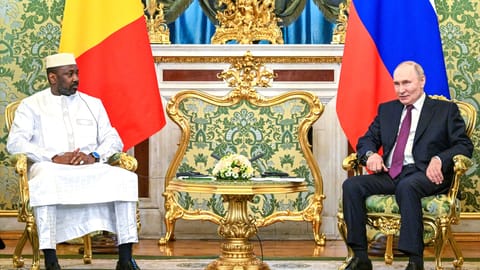
That was until a few weeks ago, when, without much prior warning, the relationship between the two nations began to thaw, with both countries reinstating their ambassadors and reopening their airspace to one another. And that raises an interesting question. Why did the relationship improve so suddenly?
And the answer, as shocking as it might sound, is Russia, an important ally for both nations. French outlet Le Monde reported that Russia was pushing for a rapprochement as early as June 2025, when Goethe made a rare international trip to Moscow.
These early attempts at diplomacy did not have much success, because a few months later, at a UN meeting, Mali's Prime Minister, General Abdoulaye Maigar, accused Algiers of, quoting him here, "...offering lodging and cover to terrorists." End quote.
Despite this, Russia kept pushing behind the scenes, and was only able to make a breakthrough after receiving help from the most unwelcome of sources, Jama'at-Nusrat al-Islam wal-Muslunim, or JANIM, an Al-Qaeda-linked group active throughout the Sahel, and the Azawad Liberation Front, or FLA, an ethno-nationalist Tareg separatist group.
Then, on the 25th of April this year, the two groups launched a coordinated wave of attacks across multiple positions held by the Malian government and their Russian allies. The attacks were so devastating that the Russian forces pulled out of multiple locations, abandoning their Malian counterparts.
It recently emerged that Algeria had used its close ties with the Tareg groups to help facilitate the Russians' withdrawal. For the Kremlin, that intervention was a godsend, because it stopped what was already an embarrassing military defeat from becoming a wholesale slaughter of Russian troops.
The intervention also convinced Moscow that a political solution would be a better way to resolve the issue with the Tareg community, with Russia's foreign minister, Sergei Lavrov, making that point on the 8th of July during a meeting with his Sahelian counterparts in Niamh.
Such a political solution will, once again, need Algeria to mediate, and Algiers would love nothing more. Beyond restoring ties with Mali and the rest of the Sahelian states, finding a political fix to the Tareg community.
The Taureg crisis is squarely in Algeria's interest since it keeps its own Taureg community from radicalizing and joining the push for the creation of an independent Taureg state.
For Mali, a political solution would mean they can focus their attention on Jenem and the other jihadist groups that are wrecking havoc across the country. The question is whether the FLA would accept such a deal.
From their point of view, they have seen how quickly a deal can be terminated by a future government, and given Mali's history of coups, we can safely assume there's some group of officers somewhere in the country dreaming of their own rise to the top.
In fact, in August 2025, the junta arrested several high-ranking officers over an attempted coup plot. Surprise! With that in mind, the FLA would probably be very hesitant to sign a new peace deal, lose the battlefield gains they've made with Jenem, only to have Bamako tear up the deal the moment a new government finds it convenient.
Still, the Tauregs might decide that a deal, one with the backing of Algiers and Moscow, might be in their best interest long term, especially with their recent losses in Anephas, and the Russians sending a new shipment of weapons to help Bamako fight back. So, for now, all we can do is wait and see what direction the FLA chooses to take.
And for our final story today, we're turning our attention to the Latin American nation of Colombia, which recently elected Abelardo de la Esprea, the hard-right figure who goes by the nickname El Tigre, following the four-year rule of leftist Gustavo Petro.
And while El Tigre is his preferred nickname, most people have baptized him Colombia's Naive Bukele. That's because of how similar their approach to the drug and gang crises are. And also because de la Esprea just really looks like Bukele, even down to the hairstyle.
De la Esprea will be inaugurated on the 7th of August at the Arena Auditorium of the Santiago de Cali University, or USC, the first time in Colombia's history that the transfer of presidential power is held inside an enclosed venue.
The inauguration is happening at the university because of an ongoing feud between de la Esprea and Petro, with the latter refusing to acknowledge the former's electoral victory. Petro's claims, without evidence, that de la Esprea's election was marred by fraud and that Ivan Cepeda, his handpicked candidate, is the nation's rival president.
In response, de la Esprea suspended the political handover meetings, accusing Petro of trying to stage a coup in order to stay in power and calling him a tyrant. So a pretty typical day in South America.
The feud between Petro and de la Esprea won't affect the handover of power because Colombia's constitution was written specifically to avoid such issues, but it will affect how effectively the new president can implement his buckelimaxing agenda.
And we are already seeing that play out in Colombia's parliament. On the 20th of July, Colombia's newly elected Congress took office, and one of their first tasks was to select the president of the Senate, a powerful position whose holder directs Senate sessions and acts as the primary public face of the legislature.
There were two main candidates for the position.
Alfredo de Luque of the Layu Party, who was supported by the incoming government, and Honoria Enriquez of the Centro Democrático Party, who was supported by the opposition.
Two days before the vote, Rodrigo Lara, the incoming interior minister, had told Spanish language outlet El Tiempo that he viewed de Luque's election as a foregone conclusion because it was a reciprocal gesture that Congress owed de la Resprea since he won without the support of the parties, and this made Congress livid because they understood it as a demand
From the president to fall in line and serve as nothing more than a rubber stamp to his agenda.
It made Congress so livid that Honoria Enriquez won the Senate presidency by 56 votes over de Luque's 45.
What was surprising about this defeat is that eight parties had publicly pledged a combined 55 votes for de Luque, meaning 10 votes flipped during the actual voting. The House, on the other hand, went the other way, with Nicolas Barguio, a conservative who had the support of the incoming president, winning with 180 votes.
Enriquez's victory was widely seen, including by James Bosworth, one of the leading Latin American analysts, as a victory for legislative independence and a reminder to the senators that they were elected to represent the people's interests, not the president's.
However, there are questions about whether that legislative independence will last because it is built on a shaky alliance. As we mentioned before, Enriquez is a member of the Democratic Center Party.
What we didn't mention is that this is a party that was established by Alvaro Uribe, a right-wing, tough-on-crime figure who was the president of Colombia from 2002 to 2010.
Uribe and Petro have a contentious relationship, and even that feels like we're underselling it. They are on opposite sides of the political spectrum, and Uribe once called Petro a moral hip man because of his former ties with the guerrilla group M19. Uribe, for his part, is suspected of having ties to far-right power militaries.
Despite that, Ivan Cepeda, widely seen as an extension of Petro in the Senate, openly showed his ballot, proving that he was voting for Enriquez. Petro and his historic pact party apparently despise the incoming president so much that they are willing to ally with their historic ideological rivals to hand the new president his first legislative defeat.
If these two parties can continue to work together, then they can really frustrate the incoming presidents.
That's because Dela Resprea doesn't have a serious base in the Senate. Iran is a member of the National Salvation Movement, which only has four members in the Senate and one member in the National Assembly. The rest of his support is borrowed.
And we've already seen that when push comes to shove, that borrowed support can melt away faster than ice in a European heat wave. The incoming president has signaled that if he can't secure the support of Congress to pass his agenda, then he will rule by decree as much as possible.
On the campaign trail, he said that his administration would arrive with a package of more than 400 decrees prepared to immediately implement much of its program.
Nearly 100 of those would be issued within the first few days. after his inauguration with the goal of generating as much momentum as possible for the president's agenda.
And while the president is convinced that he can achieve most of his goals by decree, with his lawyer pointing to Article 189, Paragraph 11 of the Colombian Constitution as justification, constitutional experts are not convinced.
They have previously warned that the Colombian Constitution limits what the president can do by decree, and that if he tried to usurp the role of Congress, his actions could be challenged in the constitutional court.
For someone who has modeled himself so heavily on Bicali, this has to be quite a bit of bill to swallow. Bicali achieved much of his success by ignoring pesky things like the courts, the Constitution, and human rights. But he also did it by winning overwhelming electoral majorities, allowing him to turn the National Assembly into a rubber stamp body.
Teller Aspera doesn't have the political capital to do that, something that his opponents, including Petro, will take full advantage of in the coming weeks and months to try and paint him as an ineffective leader.
How the incoming president navigates this challenge will be the defining feature of his presidency, and it will determine whether he can even implement his anti-gang policies in the first place. Thank you for watching.
Unlock premium video briefings
Members get full access to premium reporting, in-depth briefings, and subscriber-only analysis.
Insiders Receive
- Full access to all premium articles and briefings
- Exclusive subscriber-only analysis and dispatches
- Support independent conflict journalism
From $5/month — cancel anytime