
America’s Isolationist Shift is Bigger Than We Realized.
Russia's job market is shifting due to the war in Ukraine, with being a general in the army becoming a highly sought-after position.
Simon Whistler • October 28, 2025
Members only
Note: this transcript was generated by AI and may contain errors or inconsistencies.
Ever since the conclusion of the Cold War, the United States has been the world's dominant power. America's economic strength, America's military might, America's diplomatic clout, and America's cultural impact is second to none, combining to provide Washington unparalleled leverage in global affairs.
Of course, America's position is no more stable than any superpower through history.
Today, China is preparing to challenge America's dominance and may already qualify as a rival superpower in itself. Post-Soviet Russia hasn't yet lost its ambition. The powerful nations of Europe are starting to wake up from a complacent slumber.
India and Brazil are quite clearly on the rise, and they're all headed into a century of intense geopolitical competition. Out of all the ways that the United States could have handled that moment, well, suffice it to say that retreat wasn't the option the world expected.
Under an administration that's made no bones of its preference for a distinctly America-first brand of quasi-isolationism, the US has stunned the world with its newfound willingness to upset the global order.
America has added layers of challenge to its relationships with long-time allies and softened its stance on what used to be its most authoritarian adversaries. But according to the stream of high-level leaks coming from inside the Pentagon, the United States' pivot away from the rest of the world might be a much bigger deal than the world had realized.
Every four years, the US Secretary of Defense, or if it suits your tastes, Secretary of War, oversees the creation of America's national defense strategy.
The document is intended to issue all-encompassing strategic guidance to the United States military and its defense industrial complex dictating strategy, procurement, and other aspects of a grand guiding defense vision.
The document is always at least somewhat political, and it's based on a precursor document that comes out of the White House, the national security strategy, which is drafted in turn by the staff of America's current president.
Naturally, that means that the product of the national defense strategy can't help but account for the goals and worldview of whichever political administration happens to be leading the country.
But in most cases, when the national defense strategy dictates changes in America's defense outlook, those changes are more of a series of tweaks than a truly comprehensive overhaul of America's approach to geopolitics.
But judging by the leaks coming out of the Pentagon, as it works to finalize the national defense strategy that will come out in the next few weeks or months, this administration's national defense strategy is going to make a far larger impact.
According to a range of anonymous Pentagon sources speaking to US outlets like Politico and the Military Times, the upcoming national defense strategy is going to call for a complete overhaul of the way that America looks at both its own military and its place in the world.
In essence, the document will lay out the case for America to deprioritize the great power conflicts that it's emphasized for so long, countering the nation with which it has nuclear parity, Russia and the nation that it considers to be a rising rival, China.
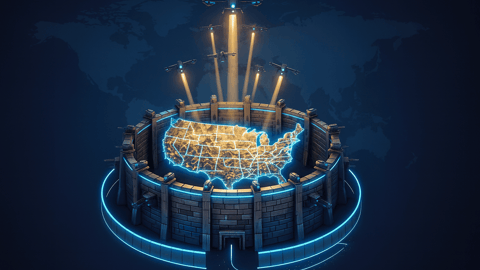
Instead, the document will redirect America's focus and pro. prioritized defense of the American homeland, including the island state of Hawaii, the northerly state of Alaska, and the contiguous 48 states that make up the U.S. mainland.
And while the U.S. will still keep an international focus, that focus is expected to shift away from Europe, away from Asia, and away from Africa toward Latin America and the other nations that make up the bulk of the Western Hemisphere.
At the heart of the rationale behind the change is the current U.S. administration's outlook on the threats facing the United States, and specifically, the way that it measures and evaluates relative threats to America and its citizens.
Under Donald Trump, both on the campaign trail and now in the White House, foreign intervention has become a far less appealing prospect for today's Republican Party, at least compared to the party's orientation at the height of the Bush years after 9-11.
Instead of advocating for global operations to either protect international democracy or ensure the safety of American interests by taking action abroad, Trump's version of Republican ideology calls for the United States to drastically reduce its on-the-ground involvement in foreign conflicts.
Rather than a way to proactively assert America's will, those foreign operations unnecessarily place America's troops in harm's way, with little to no benefit for ordinary people. Instead, the threats to American interests and sovereignty that are really worth addressing are ones that hit closer to home.
As Trump summed them up in an executive order issued on the first day of his term, America's priorities should be to, quote, seal the borders and maintain the sovereignty, territorial integrity, and security of the United States by repelling forms of invasion, including unlawful mass migration, narcotics trafficking, human smuggling and trafficking, and
Other criminal activities.
Further afield, adversaries can be deterred from opposing the U.S. through economic incentives and disincentives, while neutral parties or parties that are prone to becoming adversaries in the future, can instead be tempted with lucrative and mutually enriching investment deals.
For Trump and his political coalition, the calculation is as much a political one as a geostrategic one. Trump's political movement has thrived on its ability to find, and then emphasize, the right-leaning populist stance on just about every issue.
They spotlight the problems that feel more salient to the average voter, even if well-informed policymakers would judge other issues to actually be more pressing.
When it comes time to choose solutions to those problems, Trump and his allies typically choose to answer with policies that feel bold, unconventional, and focused on improving the lot of the people who support the political movement. In that sense, a shift of focus toward the Western Hemisphere makes good, clear sense.
After all, American voters rarely hear about the ins and outs of NATO's strategy against Russia, or about the day-to-day churning of the geopolitical dance of the United States and China, unless they seek that information out for themselves.
Instead, it's the changes across America due to a rolling drug crisis, wave after wave of migration, violence on the streets, and extortion and trafficking behind closed doors that dominate American political discourse.
America's new national defense strategy might pivot the United States away from China and Russia, but it pivots the Pentagon and the US military toward those issues.
So to address the issues most keenly felt across the American homeland, the focus shifts to the nations on America's doorstep. Latin America, Canada, and all the other places that lie west of the Atlantic and east of the Pacific.
Now, the rationale that would drive an American strategic shift toward Latin America might be easy enough to puzzle out, but that doesn't mean that it's immune from drawing counter-arguments from across the political spectrum.
Remember, although this strategic shift is consistent with the idea of pulling America's attention toward the issues that impact its own people, those issues aren't necessarily the relevant geo-strategic problems that you'd want the nation's military and defense apparatus to be focused on.
And perhaps the most pressing issue to raise around this strategic realignment is also the most obvious one. America was focused on the strategic threats posed by Russia, and especially China, for a reason.
The plan is expected to draw the frustration and even the outright opposition of China's hawks within Trump's own party, as well as on the Democrat side of American politics.
For decades, and more today than ever before, the strategic need to counter a rising China in the Indo-Pacific has been a guiding North Star for a substantial number of American foreign policy leaders.
And while, again, it's not unusual for a new political administration to use the national defense strategy to call for adjustments in America's strategic thinking, a shift on this scale is no small issue.
The convictions of America's China hawks are not arbitrary, and they aren't simply political convenience. Instead, they reflect a deeply held belief across much of American politics that China intends to engage the United States in a new great power struggle that America will lose if it's not careful.
But those war hawks, a national defense strategy that calls for them to pivot away from China, would essentially call for them to ignore something that they consider to be an existential threat.
Perhaps to alleviate those concerns, Pentagon officials have been careful to stress that the plan doesn't call on America to dismiss China outright.
Instead, it'll frame China as a key priority, just one that's subordinated to questions like border security, anti-trafficking operations, and other action that would bring a direct, tangible effect in addressing the issues that Trump's administration wants to focus on.
Military actions in the Western Hemisphere will focus closely on deterring and countering Chinese actions in Latin America, according to some sources, and providing deterrence that actually make change closer to home.
The idea that China could one day attack American cities is just as much a problem today as it was yesterday. And making sure that China can't threaten America directly is still very important.
It's just that if China is threatening, say, Taiwan or Vietnam or the Philippines in... instead of the United States, then Washington should, under Trump's logic, think very carefully about whether threats to those nations are good cause to expend American lives or American wealth.
For that reason, it may be easier to understand America's upcoming strategic shift as a turn toward the defense of the American homeland. Under that logic, America's homeland doesn't get meaningfully more or less safe if a couple of nations halfway around the world have a war that never spills over to U.S. soil.
Instead, homeland security is literally what it sounds like.
Secure the homeland and America's military and its defense industrial complex will have done their job. But it's here that we find another area of likely criticism, or perhaps a line of argument, that we can split into two parts.
The legitimacy of the idea of homeland defense and the question of whether affairs halfway around the world have a tangible impact on America's security.
Now, to address the first issue, critics of the plan aren't likely to argue that America simply shouldn't protect its homeland. Even at a time of incredible political division, the phrase America shouldn't get attacked still tends to poll pretty well with American audiences.
Instead, it's a question of resources and whether it's a good idea to devote the tremendous resources of the U.S. military and its defense industry toward the Western Hemisphere at all.
America, in its own corner of the world, enjoys a situation similar to what a polar bear might experience in the high Arctic, where it faces no natural predators on or near its own habitat.
It would be an understatement to say that no nation in the Americas could pose a meaningful military challenge to the United States, when in fact all of the other nations of the Americas combined couldn't pose a meaningful military challenge, even if they operated at perfect efficiency.
Devote the American military to locking down the Western Hemisphere, and it's a bit like hiring the peak Russian Wagner group to deal with a mouse infestation.
It's not that Wagner wouldn't get the job done, it's that their presence would be extreme overkill, where a pest control guy could probably take care of the issue.
Of course, there's another side to that same coin, where Trump and his allies would argue that if the military would be such complete overkill, then by using it to lock down the Americas, they should be able to eliminate every single one of the threats that they're meant to address.
Just take the example playing out before our eyes, with US warships deployed to the waters around Venezuela, obliterating any small boat that's even suspected of carrying narcotics.
Deal with the Americas that way, and no drug smuggler should ever be able to make it to the US border, no undocumented migrant should ever be able to find their way through, trafficking and cartel operations shouldn't be able to hide from US military intelligence, and they shouldn't be able to stand up to the troops that form the tip of the spear in American
Combat operations.
Moreover, they should be able to address a threat that American political discourse may not agree on, but that Trump's administration and political movement regard as an acute and immediate threat. The millions of migrants already on you.
U.S. soil, who some fear could pose a coordinated, armed internal security threat. While the idea is highly controversial in the United States, and is regarded among most of the American left as a conspiracy theory, it's been an undeniably salient theory on the right.
Depending on the particular frame you might encounter, the theory endorses the existence of Chinese paramilitary sleeper agents, Iran-backed proxy militias, Islamic State cells, or a number of other perceived threats on U.S. soil.
Speaking of threats on U.S. soil, some political commentators have even suggested that Trump's military intends to retool itself to deploy more efficiently and in larger numbers to American cities and states that are seen as being adversarial to America's federal government.
That interpretation would seem to reflect Trump and his defense and or war secretary's remarks at a meeting of America's military leaders advocating the use of American cities as quote training grounds for U.S. troops.
Moving outside American politics, a U.S. military shift toward the Western Hemisphere would quickly turn into a bone of contention across that part of the world.
Some international leaders may welcome greater involvement from Washington, especially under Trump. Javier Millet of Argentina, for example, or Nayib Bukele from El Salvador. Others could be expected to push back.
Mark Carney of Canada, coming off that whole saga where Trump was advocating the annexation of Canada. Or Gustavo Petro of Colombia, whose disdain for the Trump administration has been no secret.
That, of course, is to say nothing of nations like Venezuela and Cuba, currently or historically regarded by the U.S. as adversaries, or nations like Mexico under Claudia Scheinbaum or Brazil under Lula da Silva, that would likely seek to balance their close trade and diplomatic relations with America against their own geopolitical ambitions.
Nor does the modern U.S. have a spotless history or anything close to it when its military has been deployed across Latin America. In the early 20th century, America presided over the so-called Banana Wars across Central America and the Caribbean during the Cold War.
The nation sponsored repressive autocrats and carried out invasions of places like Granada and Panama.
And on the grand geostrategic stage, an American pivot toward the Western Hemisphere would bring major implications. The United States would likely exert far greater control over globally relevant points like the Panama Canal, the increasingly navigable Arctic, and the trade routes that brush up against the Americas.
At the same time, repositioned U.S. assets have to be repositioned from somewhere and could be drawn from any of the strategically significant zones where America still stations tens of thousands of its troops.
That would include troops watching over the critical Red Sea, the oil-rich Persian Gulf, and a number of ongoing security operations in the Middle East. Troops stationed on or near American allies in the Indo-Pacific, or troops charged with keeping watch over European members of the NATO alliance.
Downsize or conclude those deployments, and even if Washington is unconcerned by or unafraid of the potential upheaval that could occur in the security vacuum it would leave behind, American assets may be put at risk in the long term.
But, at its core, America… has rumored national defense strategy represents a change in the united states's priorities and thus a rethink of the areas where washington wants to work proactively versus the areas where it's willing to be reactive no nation not even a military as formidable as the united states can be working to assert its will everywhere at
Once and where national security is concerned the u.s has worked for decades to focus its attention towards threats far afield disrupting or destroying them long before they could place the american homeland at risk the u.s has engaged in long wars in the middle east to ensure that terrorist organizations cannot gather their strength to attack the american
Homeland the u.s has focused its attention on russia and china to keep each of them contained and prevent them from ever rising to the level where they could rival the u.s as a true peer or even as a stronger superpower meanwhile the situation closer to home has been neglected and that's the problem that the united states now seems intent on solving that
Change will come with benefits and it will come with costs but now it's on the administration in washington to prove that the upside of their strategic shifts can outweigh the potential costs to america's position on the global stage thank you for watching
Unlock premium video briefings
Members get full access to premium reporting, in-depth briefings, and subscriber-only analysis.
Insiders Receive
- Full access to all premium articles and briefings
- Exclusive subscriber-only analysis and dispatches
- Support independent conflict journalism
From $5/month — cancel anytime