
Are Manned Warships Already Obsolete?
Are Manned Warships Already Obsolete? — a Fronts video briefing on Strategy & Defense.
Simon Whistler • December 9, 2025
Members only
Note: this transcript was generated by AI and may contain errors or inconsistencies.
Across the world of Western defense analysis, there's a fringe, but increasingly popular idea in circulation about the world's navies. The idea, put simply, is that the idea of a navy that relies on manned warships is about to become obsolete. Or even worse, that it already is obsolete.
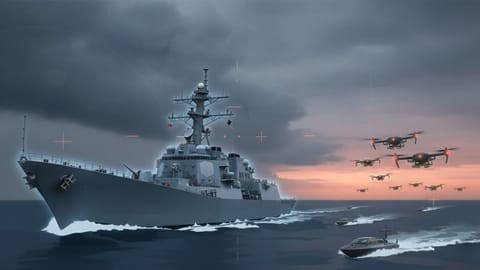
On the 21st century battlefield, where drone swarms, hypersonic cruise missiles, directed energy weapons, and ship-killing warheads are all either on the horizon or already deployed into combat, sophisticated warships are not an asset. They're a liability, or at least, that's how the thinking goes.
So, are global combat vessels, at risk of becoming obsolete, have the world's navies, the pride and joy of their respective nations, already turned into a liability?
And are the small subset of onlookers sounding the alarm today, simply overreacting? Or will they be remembered as modern-day military Cassandras, trying to warn the world about a coming storm and being ignored until it's far too late?
VALUE PROPOSITION Depending on who you're listening to, the argument against manned naval vessels in the 21st century might lean on a variety of different arguments.
But in the vast majority of arguments that are worth listening to, the foundational concern about manned naval warfare is consistent. Manned warships, regardless of anything else, are valuable. They represent the equivalent of tens or hundreds of millions, or even billions of dollars each.
Manned by dozens, hundreds, or even thousands of living, breathing sailors, and loaded with some of the most expensive and sophisticated weaponry that their own and nations can afford.
And if that incredibly valuable investment can be taken out of commission, or worse, turned into an involuntary submarine, then all of that value is lost, never to be recouped. Of course, that's no more or less true today than it was in decades gone by.
A sunk battleship during World War I also represented a massive loss of aggregated wealth and human life, and so did a sunk aircraft carrier during World War II. Believe it or not, there has actually never been an avian history that enjoyed losing ships.
But in the modern day, the risk-to-reward ratio of putting all of that value into one floating vessel has started to shift, and these days, it's shifting fairly dramatically.
Problem number one, there are more ways to sink a warship today than there have ever been. We mentioned a couple of those methods a moment ago.
Massive aircraft carrier-killing missiles that are capable, at least in theory, of sinking ships that are supposed to be unsinkable, and maneuverable hypersonic cruise missiles that can find their way through a ship's anti-air defenses before striking their target.
There's also the problem of aerial drone swarms, which are now sometimes capable of attacking in coordination with overwhelming numbers, so many that it's impossible to shoot them all down. Even worse, there are sea drones now, prowling toward their targets in the dead of night before opening the throttle and skimming through to impact.
Hit the waterline, rip massive holes in the sides of ships, and as Russia found out the hard way in its war with Ukraine, they send those ships straight to the bottom of the sea.
Problem number two, and even more important, is that destroying an enemy vessel is cheaper than ever. Going back to our World War I example, It used to be that if you wanted a single battleship, you'd need to send a battleship of your own to sink it. You might destroy all of that aggregate value built up in an enemy vessel, or you might lose yours.
Fast forward a bit over a century, and Russia just witnessed the sinking of what used to be its flagship vessel, the Moskva, a ship so valuable that replacing it would cost around $750 million, according to Forbes Ukraine.
To sink it, Ukraine used two Neptune cruise missiles, each estimated to cost a mere $1.5 million, with crowdfunders able to pay for the construction of one of its iconic Seababy drones at a cost of only about $221,000, whereas its Magura V-5 cost between $250,000 and $300,000.
In exchange, a pair of Ukrainian attacks in 2024 managed to sink the missile Corvette Ivanovitz and the patrol ship Sergei Kotov, each of which cost about $65 million to build in exchange for a small handful of Maguras each.
In essence, unmanned missiles and drones used properly in the modern day can sink even major combat vessels at practically negligible cost, without ever putting a single person at risk on their own side.
Autoneeda's sinking manned warships diminish the warfighting capacity of the nations that sailed them, but it allows an adversary to impose massive financial and human losses while absorbing hardly any losses themselves.
We've also got to pay a bit of attention to problem number three, which is that in most places on Earth, it is more costly to lose a warship today than it's ever been.
All across the globe, the vast majority of nations with the wealth to maintain a powerful naval fleet have developed an allergy to the idea of battlefield losses, whether in the US, Europe, China, or elsewhere.
It's even true for Russia, where the Kremlin has devoted an incredible effort toward making sure that middle class and wealthy Russians don't have to feel the costs of its war in Ukraine. It's not just that people across the globe don't want to see their sons and daughters die in war.
In most places, there's not even the expectation that younger generations face a risk of dying in war. At the same time, many of those advanced nations have watched as their shipbuilding capacity dwindles to practically nothing, meaning that whatever ships are destroyed aren't likely to be replaced.
For a bit of perspective, China, South Korea, and Japan combine to make up nearly 95% of all global shipbuilding capacity.
So, just as we can observe that ships are easier and cheaper to sink, we can observe that it's more important to avoid losing those vessels and avoid killing the personnel on board than it's been at any other point in modern history.
Arguments for Obsolescence The costs and benefits trade-off that we've just described is an observation that we'd describe as being generally agreeable to modern experts. There will always be exceptions here and there, but broadly speaking, the fundamental set of observations we've just made really aren't all that controversial.
The controversy pops up as soon as we start to consider what to do about that problem, and it is... here that we find our small but growing list of naval doomsayers insisting that the worst is ahead for modern naval fleets take for example an article by james wirz chairman of the department of national security affairs at america's naval postgraduate school
Written for the u.s naval institute in september of 2025 for the core arguments of the piece we can just check out the title get the people off the boat unmanned is the essence of autonomy in the article wirz argues for a complete rethink of the united states's naval force composition taking manned operators out of warships wherever possible and placing
Unmanned vessels at the core of the united states's future naval fleet instead of treating them as an auxiliary means to support manned vessels wirz calls for the navy to focus on designing as many truly autonomous vessels as possible meaning vessels with no crew quarters no onboard life support systems and thus no capacity to even optionally carry a crew
Complement not only that but the piece advocates a complete rethink of naval vessel lifespans measuring the lives of these vessels not in decades but in years or maybe even months the idea here would be to keep up with the fast-paced nature of modern warfare those arguments are particularly salient coming from this specific author a well-placed guiding voice
In u.s naval theory not just some hobbyist looking in from the outside or take the analysis offered by dr brent eastwood an emerging threats expert who tackled the issue for the national security journal also in 2025 eastwood emphasizes the major threat of aerial kamikaze drones pelting surface vessels relentlessly even as undersea kamikaze submarines risk
Blowing apart the hulls of those same warships the answer according to eastwood is a so-called ghost fleet a force design that simply assumes that humans will not be a part of the equation eastwood notes openly that this quote second revolution in military affairs end quote leaves him uneasy about the risks of leaving humans out of warfare but he describes
The change as being inevitable despite what he and other quote traditionalists might have to say about it a review of his arguments by the veterans newsletter constant contact summed it up even better quoting manned surface ships with sailors will soon be a thing of the past the shift to unmanned sea craft is assured leaving surface vessels as antiques
Military expert chris osborne threw his own support behind that evaluation via the outlet warrior maven where he serves as managing editor in 2023 in that analysis osborne emphasized that large manned surface warships face a massive and unprecedented risk on the high seas and while they weren't fully obsolete at the time the article was written it was
Already transparently obvious where things were headed in that analysis osborne emphasized the threats of chinese russian north korean and iranian anti-ship missiles and argued for the adoption of a fleet structure that would use motherships to launch large numbers of aerial surface and undersea drones from standoff range before allowing those drones to move
Into a combat zone and do the actual fighting outside of the united states australian analyst john and do the actual fighting outside of the united states of the united states of the united states of the united states of the united states of the united states of the united states of the united states of the united states of the united states of the united
States of the united states of the united states of the united states of the united states of the united states of the united states of the united states of the united states of the united states of the united states of the united states of the united states of the united states of the united states of the united states of the united states of the united
States of the united states of the united states of the united states of the united states of the united states of the united states of the united states of the united states of the united states of the united states of the united states of the united states of the united states of the united states of the united states of the united states of the united
States of the united states of the united states of the united states of the united states of the united states of the united states of the united states of the united states of the united Thank you.
Quiggin took an even harsher tone toward modern navies in 2024, offering the outlet Crooked Timber an article entitled, quote, "'Navies are obsolete, but no one will admit it.'" By Quiggin's evaluation, anti-ship missiles and drones had already pushed modern navies to a point of obsolescence, as shown not just by the war in Ukraine, but by the Red Sea
Attacks perpetuated by Yemen's Houthi rebels, who proved impossible for the UK and US navies to stop completely.
As Quiggin points out, surface warships are at the mercy of satellite-based intelligence, as well as reconnaissance conducted by high-flying aircraft.
They're a relatively small, self-contained fighting unit, and will often be overwhelmed by the land-based capabilities of adversaries if they have to come close to shore, even if those land-based capabilities only consist of drones and missiles. And coming close to shore doesn't mean you've got to see the shoreline, either.
Quiggin points out Chinese anti-ship missiles can hit targets at a range of over 1,000 kilometers.
Similarly, Canadian naval expert Jeff Gilmore wrote an article just weeks after Quiggin's herald, in quote, the demise of the Canadian surface fleet.
As Gilmore noted, Canada, and other middle powers like it, can no longer afford to maintain complex, technologically sophisticated, expensive manned surface fleets, and can no longer justify the possession of surface fleets given the threat of impending or current obsolescence.
To paraphrase Gilmore's argument, given the impact that a nation like Ukraine can have by using drones and missiles against a disproportionately powerful naval adversary, it would be foolish to do anything else.
And the analyses just keep piling on from there. Defense expert and retired Army Major General John Ferrari argued in 2025 that the U.S. Navy, quote, must pivot away from large, costly platforms and embrace mass production and customizability, and abandon the 355-ship target that the U.S. has been chasing for decades.
Instead, the U.S. should, quote, plan for tens of thousands of mostly smaller and relatively autonomous vessels, many of which will be tailored, specialized platforms for specific mission sets.
Ferrari called for manned naval aviation to be cancelled entirely for the upcoming 6th-generation F-A-X-X fighter project to be thrown out, and for a, quote, 180-degree pivot into this new style of warfighting.
Critics of new, expensive submarines bound for Australia condemn the designs as, quote, billion-dollar coffins, simply waiting to be detected by cheap sensors, sunk by cheap drones, and condemned to spend an eternity on the ocean floor. Although they argue their case differently, each of these expert analyses zeroes in on the same set of new realities.
Man vessels are too expensive to justify using or building, they're too easy to detect and destroy, and if modern navies don't completely retool their approach, like yesterday, they're going to be destroyed. Arguments against.
Okay, now, look, across all our work at war fronts, political fronts, and elsewhere, we've got to admit that at this point, we are no strangers to Nostradamus. style predictions of inevitable doom.
While sometimes those arguments are completely baseless, they do tend to overstate their own case, and we would be remiss not to bring up the wide range of counter-arguments against the idea of imminent naval obsolescence.
Perhaps the most obvious place to start, however, isn't to present a formal argument from any particular nation or military leader, but instead to see what the world's military decision-makers are doing as they try to respond to the warfighting advancements of the modern world.
If we were to take, let's say, defense spending dollars and treat them as if they were votes in favor or in opposition of the idea that manned warships are important, then the consensus is overwhelming.
Nations all across the globe, including the world's most important military powers, are all continuing to sign contracts, lay down steel, and commission new warships that are expected to sail for decades to come. Now, we should admit that this is an imperfect metric.
Defense spending decisions are often highly political, just as much about boosting the domestic economy or cultivating ties with a foreign partner as they are about building and maintaining a modern military.
Not only that, but the forward-thinking people trying to argue that modern warships are obsolete could credibly accuse the people in charge of modern military procurement to be compromised in their judgment.
After all, those people work in key roles within sprawling military bureaucracies, where institutional resistance to change is practically just a guarantee.
They are steeped in military doctrine that they were taught years or even decades ago, insisting on making their decisions as if they still had to fight a cold war, or at least that's the argument that you could make as an outside reformer pushing for a sedentary, stagnant military to wake up to the new threats that it's facing.
But even still, there's good reason to believe that those military decisions to maintain investment in large fleets of manned surface warships have a good deal of careful calculation behind them.
After all, it's a conclusion shared, for example, by both Washington and Beijing, both the fighting nations of Europe and the nation of Russia, despite their shared incentives to try and get an edge over each other, and thus to move away from manned warships first if they truly believed that warships were obsolete.
Rogue nations, with a history of adaptive, unconventional warfighting, like Iran with its drones and proxy networks, or North Korea with its cyber operators as an asymmetric strategy, are commissioning entirely new classes and types of manned warships.
Even a nation like Ukraine, a nation that has hardly any combat fleet to speak of, and that has used its revolutionary sea drones to sink Russian warships at incredible cost, is still looking to pick up new manned warships when the war against Russia concludes.
Ukraine already has a contract with Turkey to procure three brand new corvettes, the first of which has done its sea trials and is waiting in a Turkish port until Ukraine can take custody of it without fearing that Russia will immediately try and sink it.
That's not to say that those nations aren't also focused on unmanned systems warfare, including as it relates to their navies.
Ukraine, as mentioned, is in possession of the most formidable and sophisticated C-drone fleet in the world, and its allies in NATO and elsewhere would be fools not to take a post-war Ukraine and make it into a military industrial drone powerhouse, including on the water.
The United States is investing in new shipyards and initiatives to build unmanned surface and underwater vessels in large numbers, including the Port Alpha concept by Saronic, the Manta and Orca lines of underwater drones, and much, much more.
China is known to be pursuing all sorts of naval drone motherships, submarine drones, and even drones that can go from operating underwater to flying through the air at a moment's notice.
These nations, and others like them, haven't simply decided that naval drones aren't important, or that the advances in areas that would counter manned warships should be overlooked.
Instead, they disagree with the very premise of the question, that having a navy built with manned warships versus a navy made up of uncrewed systems is an either-or proposition.
Their argument is that you can do both, and that in doing both, you can achieve a level of operational symbiosis that goes far beyond what either group of systems could achieve on their own.
Individual analyses each have their own interpretation to offer.
While writing for the RAND Corporation, researcher and formal naval ship captain Dr. Bradley Martin argued that, quote, surface ships are not the best capability everywhere, but they remain, for the most part, highly useful and effective platforms across a spectrum of missions and conflict scenarios.
Martin argues for a diverse naval force structure in future decades, but instead of abandoning manned warships, he argues for far greater investment in self-defense capabilities for individual vessels, quoting again, for example, a ship might not be able to serve as an area air defense platform, but it should have the ability to provide point defense to
Protect itself, end quote.
Writing for the Washington Post, retired Admiral and former NATO Supreme Allied Commander, James Stavridis, argued that surface warships are far from obsolete, even if it's important to pair them with different sorts of unmanned vessels to better adjust to the risks and pitfalls of modern naval warfare.
Stavridis also points out the value of manned warships, not necessarily as a tool to be used in combat, but as a tool to shape perceptions, and argues that it's very different as a nation on the receiving end to see a potentially hostile larger power dispatch a massive frigate or even a carrier strike group off your coast instead of sending a couple of drone
Boats.
Writing for Breaking Defense in 2025, naval expert Dr. Stephen Wills outright rebuts the article that we cited earlier by retired Army General John Ferrari and instead argues that it would be outright unrealistic to make an all-or-nothing push toward autonomous naval warfare.
Willis points out that the lessons from Ukraine don't really scale to a global navy like the United States, where the expectation is that American warships will often operate on different continents or far into the open ocean.
Instead, they point to a clear but relatively contained need to improve naval fighting capabilities in waters relatively close to shore, where land-based drones pose a threat, but that they don't carry over to conflicts that have to account for the vastness of global ocean.
Quoting Wills here, these realities are why the Navy has focused on the concept of manned and unmanned teaming, rather than the wholesale replacement of manned systems.
Quoting again, all or nothing force structure changes are often ill-informed and fail in global combat.
And writing for maritime executive, naval research laboratory professor, Shelley Gallop, argues for a shift not away from manned vessels entirely, but toward the adoption of larger numbers of smaller-sized, lightly manned warships that can maximize firepower and minimize risk of loss while still looping in human operators.
We should circle back to some of the analyses that we cited arguing for the obsolescence of manned naval fleets, because while those analyses do argue that it is essential to get crewed warships as far away from modern combat as possible, they don't all argue for cutting human sailors out entirely.
That analysis, by James Wirtz for example, argues in favor of using manned ships very selectively, and only in the most important naval operations, where losses are more justifiable, and their unique capabilities can make the difference between victory and defeat, while unmanned warships are trusted to deal with less pressing concerns.
Chris Osborne argues for shifting the role of manned warships to essentially serve as drone motherships, launching unmanned systems from standoff range and keeping their crews safe, but using that human capability to coordinate operations from afar.
Look at the broad array of counter-arguments against the idea that manned warships are obsolete, and the logic is compelling.
Manned warships do offer a range of capabilities that unmanned systems don't, and simply switching over to AI-driven unmanned models at a time when both ship design concepts and onboard technology are still in their infancy would mean committing completely to an unproven style of warfighting.
The flexibility of a combined manned and unmanned fleet provides clear advantages over a complete commitment in either direction, and there is a place for even the largest manned vessels as long as they're outside the reach of adversary weapons.
Perhaps most important, those counter-arguments force analysts to ask a key question about the way that naval warfare is changing, even though everyone on all sides can recognize that a change is taking place.
To borrow a phrase we've used before, global navies have to figure out whether this revolution in naval warfare represents a battleship problem or a missile problem.
A battleship problem would be the sort of lesson that global navies learned during World War II when the arrival of the aircraft carrier simply nullified the battleship's value as a weapon and compromised it so completely that navies were best off just abandoning the idea while they still could.
The missile problem, by contrast, would be a problem in which two sets of capabilities are having a sort of technological duel, similar to the way that missile technology and missile defense technology have dueled back and forth across modern history.
Someone, somewhere, develops a new kind of missile technology that can get through missile defense systems, and for a while, missiles are the better technology. But then missile defense systems improve and missiles are no longer as effective as they used to be. until missiles advance again, and so on and so forth.
If modern navies are truly facing a battleship problem, and the idea of manned warships overall is now a relic of a bygone era, then yes, the right move would be to change the way that navies are structured, thus changing the way that naval wars are fought.
But if this is a missile defense problem, if it's possible to retool the way that manned navies operate, pair them with new technology, improve the defense capabilities of manned assets, and still enjoy the benefits of having them as part of the fleet, then it would be foolish for manned warships to be abandoned completely.
Of course, those scattered tomb sets, there still are there, and we've got to admit, it is entirely possible that they could turn out to be right.
Perhaps all this talk of retaining manned warships, rethinking their role, and pairing them with newer technologies will one day be remembered as a failure to adapt, a decision no more intelligent than the choice to charge cavalry into a hail of machine gunfire.
But right now, the preponderance of evidence around 2020's naval warfare suggests that it's not yet time to abandon the manned warship completely. Should they remain the linchpin of global navies? No, probably not.
But they still have a role to play, and nations who abandon them too soon may one day regret it. Thank you for watching.
Unlock premium video briefings
Members get full access to premium reporting, in-depth briefings, and subscriber-only analysis.
Insiders Receive
- Full access to all premium articles and briefings
- Exclusive subscriber-only analysis and dispatches
- Support independent conflict journalism
From $5/month — cancel anytime