
Bomb Attacks Target Macron in Syria. And More.
Simon Whistler • July 20, 2026
Members only
Note: this transcript was generated by AI and may contain errors or inconsistencies.
Welcome back to The Briefing Room, the weekly show that aims to remind front subscribers that there are even more awful things going on in the world than they realized. I'm Simon, and this week the major awful thing we're focusing on is whether Yemen might be about to spiral back into civil war.
Beyond that, we're also drilling down on the influence of outside actors on the wars gripping Eastern Congo, specifically that of the United Arab Emirates.
But first, we'll be traveling to Syria, where President Macron's recent state, as it was interrupted by twin bomb attacks that appeared to be targeting his delegation.
As ever, thank you for subscribing, as thanks to you guys that were able to produce videos like this covering important yet overlooked stories, as well as look at less popular conflicts on the main channel. And with that, let's get straight into our headline story this week, Macron in Syria.
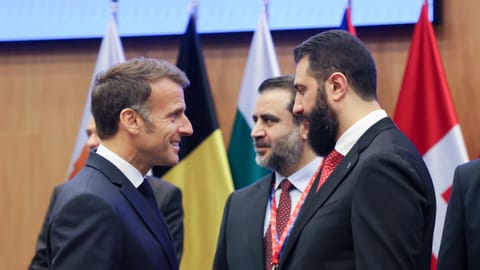
For our first story, we turn our attention to the Middle Eastern nation of Syria, which recently hosted French President Emmanuel Macron for a landmark two-day state visit before the NATO summit in Ankara. Macron, accompanied by a French business delegation, became the first Western leader to visit Syria since the end of the Civil War.
He landed in Damascus on Monday, left on Tuesday, and in that short window, still managed to dodge a bomb that appears to have been aimed squarely at him.
The visit itself had been a long time coming, given that Macron was the first Western head of state to host the new Syrian leader, Ahmed al-Sharah, after the latter's forces gave former Syrian dictator Bashar al-Assad a one-way ticket to Moscow.
Macron billed the talks as a chance for France to show unity with the Syrian people, telling the press, and we'll quote him here, "...I have come to express France's commitment to the Syrian people, for a sovereign Syria united in its diversity and at peace with its neighbors." End quote.
And that's an important message, because since al-Sharah came to power in December 2024, he has struggled to contain the sectarian violence in the country.
That isn't to say that Syria is as dangerous today as it was during the height of the Civil War. By December 2025, after a year in office, Shara had managed to reduce the overall violence in the country by 44%, according to data from the conflict monitoring group Akhlet.
But while that is a remarkable achievement given Syria's fragmented political landscape and the turbulent regional environments, there were still significant flare-ups of violence between forces aligned with Syria's new army and armed groups linked to minority communities and former supporters of the Assad regime.
This violence resulted in the mass killings of members of the Druze and Dallahuite communities. Reuters reported that more than 1,500 Alawites were killed, while the Syrian Observatory of Human Rights estimated that 300 Druze had been killed.
For his part, al-Sharah promised to protect the minority communities and even launched investigations to find those responsible for the killings.
But, I mean, my dude, look at your own troops. But according to most observers, those investigators have little chance of bringing actual justice to the victims. Which is one of the reasons why Macron's trip was so important.
If there's one thing al-Sharah wants above all else, it's international acceptance. And if Macron can apply enough pressure for al-Sharah to hold the responsible parties accountable, then this trip will be a major success. As important as the humanitarian aspects of this trip was, it wasn't the main reason why Macron was in Damascus.
He and al-Sharah announced that they had agreed to reappoint ambassadors after more than a decade. Well... marking a major restoration in diplomatic ties after France symbolically reopened its embassy in Syria in 2025.
Also on the diplomatic front, Macron stressed to al-Sharah that he shouldn't send troops into Lebanon, which the latter agreed to, regardless of any requests or pressure.
Macron's insistence that Syria shouldn't involve itself in Lebanon's affairs came just after American President Donald Trump floated the idea of using Syrian forces to combat Hezbollah, an Iranian-backed terror group in Lebanon.
Which means that on this key issue, Macron and Trump, two world leaders whose relationship has been described as tumultuous, are on different sides. And for now at least, Macron appears to be winning.
Aside from diplomacy, the two leaders also discussed business, signing a raft of deals meant to transform Syria into a regional hub for trade, investment, and logistics. French shipping giant CMA-CGM signed a partnership with Damascus to handle air freight at Damascus international airport, building on an earlier contract to run two dry ports in the country.
There was also an agreement to return $58.29 million that France had confiscated from the late Refaat al-Assad, Bashar al-Assad's uncle.
For both Macron and al-Sharah, this was an empathic meeting on all fronts. For Macron, who is in his final few months in office, as he can't run free election in 2027, this is the kind of high-profile engagement that he believes will cement his international legacy.
He secured major business deals for French companies in a region of the world that's growing, and is expected to contribute significantly to the global economy in the next few years.
He re-established diplomatic relations with a nation whose president is being courted by everyone from Trump to Putin, beat Trump in a game of Middle Eastern geopolitical chess, and did all of this while presenting himself as one of the few global leaders who care about the minority communities in Syria.
For al-Sharah, it's further proof of how much he has managed to reinvent himself from being the leader of a rebel group with ties to al-Qaeda to a widely respected and sought-after international leader.
A transformation that was further cemented by his presence in Ankara, on the sidelines of a NATO summit, where President Trump said he would remove Syria from the list of state sponsors of terror, a designation which brings with it a wide range of sanctions.
However, note that we said the meeting was not perfect, but near perfect. And for that qualifier, you can thank the bombing that we alluded to at the start of this chapter. Days before Macron landed in Damascus, an explosion tore through a cafe in the city, killing at least 10 people and injuring 20 others.
While no group claimed responsibility for the attack, Millard Fardal, Al Jazeera's Syria correspondent, noted that the Syrian government had been working to uncover sleeper cells operating in the country, aiming to destabilize the new government. One bombing would be horrific enough, but this is the Middle East, and bombs here are a dime a dozen.
During Macron's visit, two more bombs would go off, one near the Ministry of Tourism and the other near the Four Seasons Hotel, where Macron had left just minutes prior.
One person was killed, 31 were injured in these attacks. While this is a major embarrassment for Al-Shara's government, they are immensely lucky that no one in the French delegation got hurt or killed, or they would be looking at a major diplomatic incidents.
But this raises a major problem. question is al-shara's syria safe while damascus would point to the fact that they managed to reduce overall violence by 44 in their first full year in office and they seem on track to do just as well this year minority communities would disagree early this month two people were killed and dozens of others injured following
Clashes between the jews and government forces in sueda province the fact that sectarian violence is still ongoing in damascus has proven incapable of providing justice to the victims of the past attacks proves that despite all the attempts at rebranding his image al-shara still has a long way to go if he wants to truly transform syria and hopefully he does
It because the syrian people deserve a chance at peace and prosperity after the nightmare of the last decade is yemen headed back to another war another day another middle eastern country on the brink and this time we're traveling to yemen there the iran baghutti rebel organization and the internationally recognized yemeni military are on a knife's edge
After what seems to be the largest direct confrontation between the two dueling governments in years far from an isolated incident the houthis seem to have iran's support to begin a new cycle of confrontation at the same time that the wider middle east is on the path back to full-scale war for the past several months conventional geopolitical wisdom has held
That the houthi rebels were not eager for a fight either with the government that controls yemen's other half or with anybody else throughout several months of war between iran and a u.s israeli coalition the houthis sat mostly on the sidelines issuing the occasional threat launching a couple of projectiles but otherwise leaving their patron to fend for
Itself that's despite the fact that if the houthis were willing to absorb a bit of pain the war could have been the perfect opportunity for the group to assert control over the bab al-mendeb strait closing the southern end of the red sea using the same tactics iran employed to close the strait of hormuz the reason why that didn't happen was thought to be a
Combination of the houthis diminished weapon stockpiles and the massive internal problems from an ongoing humanitarian crisis to supply shortages to a simmering public discontent with houthi rule but the situation has started to change over the last month when the houthis began to issue new and unexpected calls for military mobilization during a span of
Several weeks they've opened numerous recruiting centers and spun up a propaganda campaign especially across the northern part of the country the houthis message was simple the iran linked axis of resistance was bound for war the houthi government was ordering a society-wide general mobilization and their newly recruited newly trained fighters would be sent
Into battle against the americans the israelis the saudis or any force that supported those states or drew on their aid to survive but although that internal propaganda campaign has slowly been coming to life it's actually not the inciting incident here yemen's internal power dynamics are a rather complex thing to understand because although yemen does
Divide into two main factions the houthis and the internationally recognized government that doesn't tell anywhere near the full story instead layered within those larger factions are a much wider array of clan and tribal sub-factions some that align with the houthis and some that don't recently in an affair that can't really be disconnected from the
National divide but should still be regarded as a separate issue houthi-aligned government-aligned tribes have been going at it in the governor or province of al-jawaf they haven't engaged in an armed confrontation or at least they hadn't until the last few days but those rival tribes have been mobilizing and stockpiling weapons for a while now as for how
The tension started it's a long story basically a houthi connected arms dealer was kidnapped and held hostage for nearly 50 days because of a property dispute he was released and then called for tribal retaliation and when a prominent anti-houthi sheikh got involved the houthis detained him tribal militias have been gathering in advance of a fight they've
Been creating roadblocks and checkpoints and the houthis have responded in kind houthis however claimed that saudi arabia is behind the whole thing and that's been the basis for their overtures to the yemeni public calling for mass mobilization in a vacuum the whole thing with the arms dealer didn't necessarily have to matter outside the communities that
Were directly impacted but now the houthis have seized on the issue and made it much larger than it otherwise would have been the internationally recognized government clearly understand what's happening here and it's been issuing its own demands for military readiness in advance of a major confrontation yemeni forces have established a joint operational
Command center and shifted troops toward the anticipated front lines last friday the 3rd of july the houthis claimed but saudi war planes have tried to stop an iranian aircraft from landing at the airport in the houthi control capital city of sanar spiking tensions even further finally on the 5th of july all hell broke loose not in al-juaf but in the
Southern governors of hodeida there it's not entirely clear what happened other than the basic reality that there was a large military confrontation and lots of people died according to the yemeni government 15 government soldiers were killed along with over 50 houthis but even though the houthis hadn't commented on those fighters as of the time of writing
They're highly likely to dispute the numbers if they take any position at all as of now houthi bag state militia has only acknowledged two deaths on the houthi side all the while the military build-up in al-jaaf government continues and it seems likely that a much larger confrontation will happen there instead of in hodeida the larger geopolitical context
Here is impossible to ignore as at the time of writing the united states and iran are back to open hostilities and this time the u.s doesn't seem interested in drawing down tensions but ratcheting them upward at a time when u.s and israeli unity has been fractured and iran is in control of the strait of hormuz the houthis seem to be ready to join the fight
Or at least join a fight in support of iran's larger regional aims if iran goes hot then expect yemen to go hot too even if we don't quite know how intense this emerging yemeni conflict will ultimately be emirati influence growing in the congo in the democratic republic of the congo dictator felix shishikady doesn't have many friends but the few friends that
He does have really on he can count on the support of the united states a country that assigned mineral extraction deals dressed up as a peace accord between the drc and rwanda despite the fact that on the ground fighting still rages between the drc and its allied militias and a rebel group m23 that counts on rwanda's direct support via financing and troop
Deployments shishikadia's friends in paris and brussels were old colonial ties have long since given way to economic and security engagement and he's gotten consistent diplomatic partners in south africa angola and elsewhere but according to a recent report by yale ford of the africa file at the critical threats project and a recent fronts.co podcast guest
By the way felix shishikady has made another new friend the uae now look it's 2026 and you div viewer care enough about geopolitics to be watching a premium subscriber episode on niche and overlooked conflict news so we trust that you don't need us to explain that when the emirates shows up in a war zone across the middle east and africa it's usually bad
News the emirates are made a habit of supporting proxy allies in highly destabilizing ways whether it's the southern transitional council that briefly took over eastern yemen late last year the libyan disputed government under warlord khalifa haftar or the capital g genocidal rapid support forces of sudan in a world where iran gets all the credit for
Maintaining an axis of resistance the emirates deserves a pretty substantial not of its own for building what we'd charitably describe as an access of unnecessary now though biemurits appear to have chosen the congo as their next collaborative project under the auspices of the very same peace deal that america's been touting for months as we mentioned that
Peace deal is more akin to a resource extraction arrangement with both the congolese and rwandan governments set to reap the rewards even as they continue to battle for dominance over the same critical resource deposits that the deal is supposed to cover like most of these deals coming out of washington extraction is facilitated mostly through private
Companies and not just from the united states instead the congo has signed numerous mining deals with the emirates over the last year including a deal that granted the emirates majority control over the world's third largest tin mine and another deal that will see the congo ship 50 000 tons of copper to the emirates and saudi arabia as critical threats
Describes the emirates have secured industrial mining rights built up logistical corridors purchased major assets that once held by the swiss locked down the rights to the congo's gold exports and more of course the emirates will also want to protect their investments and to that end they've been funneling weapons and supplies to the congo in a smaller but
Equally impactful version of their support for sudan's rsf that includes quote several batches of armored personnel carriers for use against m-23 rebels and quoting again tens of thousands of small arms the congoleese military and its militia partners shisha kady's brother has traveled to the emirates to discuss even more substantial military assistance and
Quoting again the drc announced in april 2026 that the uae committed to help fund training for paramilitary force of more than 20 000 that will purportedly protect mines in the southern drc end quote even notorious ex-blackwater leader eric prince has been working on the congo issue on the emirates's behalf including in a bid that would have seen salvadoran
Mercenaries deployed to protect jishikadi and his allies as critical threats points out it's not quite so simple as to say that the emirates are just backing the drc against rwanda and that's the end of it the emirates rely on rwanda for a separate stream of gold exports including those from both legitimate mines and illegitimate artisanal mines that have
Their gold laundered through a rwandan emirati pipeline rwanda also exports the key mineral colt out to the emirates after it's harvested from m23 controlled territory in june 2026 the two countries held joint committee meetings as if their relationship was just business as usual with little to no acknowledgement of the emirates as work in support of
Shishikadi but the principle that allows abu dhabi and kigali to keep up appearances while actually fighting on opposite sides of a brutal resource war is the same principle that's allowed the united states to claim that this whole thing is governed by a peace deal there is the situation in the congo as it's defined by document and reality and then there is
The situation in the congo as it's defined by optics both kigali and kinshasa want to hold as high a share as possible of the eastern congo's most lucrative resource deposits both of them are willing to fight and sacrifice their own fighting sons in order to make that happen but neither of them feels particularly inclined to make a stink about it when
Instead they can both profit from a much larger international network anchored by the us and facilitated by the emirates this is how the world has sleepwalked its way to the bizarre reality that this is the modern congo where the u.s can levy sanctions against rwanda claim that there's no problem to sanction and even enjoy lucrative three-way deals with
Rwanda and the emirates all at the same time even as the congo and felix shishikady directly benefit from us and emirati support quite frankly the whole thing is unbelievably cynical and even more corrupt but then again we're talking about a resource war in the congo so i mean what else is new thank you for watching
Unlock premium video briefings
Members get full access to premium reporting, in-depth briefings, and subscriber-only analysis.
Insiders Receive
- Full access to all premium articles and briefings
- Exclusive subscriber-only analysis and dispatches
- Support independent conflict journalism
From $5/month — cancel anytime