
Briefing Room 02.05.26: Water Wars are Starting to Spread. And More.
Deadly clashes over wells in Chad, strained by a million Sudanese refugees, preview a global surge in water conflicts. Plus: Cambodia revives conscription and Colombia's rebels escalate.
Simon Whistler • May 2, 2026
Members only
Note: this transcript was generated by AI and may contain errors or inconsistencies.
Welcome to The Briefing Room, the weekly show that acts as your routine reminder that wars and conflicts happen in places other than the Middle East. Sometimes. This week, we're traveling to three different continents, including South America, where a recent terrorist attack put the spotlight on the growing power of Colombia's rebels.
We'll also be checking in on Asia, where Cambodia has reintroduced conscription in an attempt to level the playing field after its short 2025 war with Thailand. But first, we're in Africa, where fighting along the Chadian border may herald a new kind of fast-approaching conflict, water wars. As always, thank you so much for subscribing.
It's thanks to you guys that were able to produce this show, these articles, hell, even this entire website. And with that moment of sincerity out of the way, let's get straight into today's stories, starting with what may be the most worrying of all, the slow but steady spread of water wars.
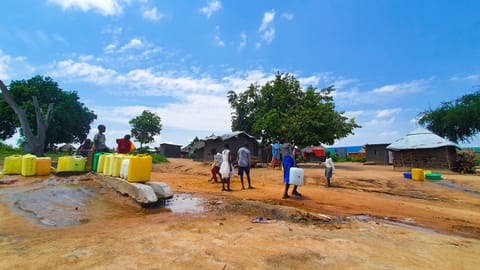
For our first story, we turn our attention to the Central African nation of Chad, where on the 27th of April, the Associated Press reported that at least 42 people have been killed and 10 wounded, not because of war or any major conflict, but because of water.
So, I'll say it again, 42 people were killed fighting over water, the stuff that, for most of us, comes out of the tab. Although, as you're about to see, it's obviously a little bit more complicated than that.
According to the BBC, the fighting initially saw two families argue over a water well before escalating into a cycle of reprisal attacks between rival ethnic groups.
It spread over a wide area, with villagers burned down and people fleeing their homes. The situation became so chaotic that according to Limane Mahatma, Chad's deputy prime minister, who led a government delegation to the area, the military was forced to intervene to bring the situation under control. Now, ethnic violence is neither new nor unique in Chad.
In fact, shortly after the country gained independence from France in 1960, it devolved into a civil war that saw a great deal of fighting along ethnic lines. To this day, the nation is still dealing with insurgencies. What makes this incident stand out is the timing and the fact that they were fighting over water.
Let's start with the water aspect. People fighting and dying over water is becoming something of a regular occurrence in Chad. In November last year, at least 26 people were injured when a dispute over a well turned violent in Gos Koro, a rural community north of Mao in western Chad.
Less than two weeks before that, another fight over a well in a neighboring province left about 30 people dead. Earlier that month, fighting between farming and herding communities in Babalao killed four people and displaced several others.
Around the same time, a separate clash in Nagora in southern Chad left 33 people dead after competing claims to an old well escalated into violence.
For instance, in the space of a few weeks, underscores just how volatile the situation in Chad was even before the violence on the 27th. And many of them can be traced back to the same source, the utter meltdown happening across Chad's eastern border. This is where the timing aspect comes.
You see, Chad shares a 1,400-kilometer-long border with Sudan, and since April 2023, nearly a million Sudanese refugees have crossed into Chad. So why do we highlight that particular month?
Well, because that's when Sudan collapsed into one of the worst civil wars this century, as the Sudanese armed forces and the paramilitary rapid support forces battled for supremacy.
To put those figures into perspective, refugee aid organization HIAS noted that in just over two years, more Sudanese refugees have fled to Chad than in the previous two decades of Sudanese displacement combined. And they keep coming. According to the World Food Programme, 15,000 more refugees crossed the border in January of this year alone.
Chad was already one of the poorest countries before Sudan blew up. In 2024, the government declared a food emergency for the third year in a row.
Now that nation is trying to absorb over a million additional people into a country where basic services can be almost non-existent, and that has caused a lot of friction between the Chadian people and the refugees.
The International Crisis Group wrote in November 2024 that some Chadians were accusing refugees of driving up prices and monopolizing essentials, particularly firewoods and, well, you guessed it, water. The fact that indigenous Chadian people were complaining about the cost of water going up is important because it shows these events are directly connected.
And people are noticing and beginning to criticize the government for it.
Senator Albert Bahimi-Badake has accused Chad's leaders of ignoring repeated warnings, arguing the government sees nothing and says nothing, showing blindness in the face of people suffering. And given how water violence appears to be growing, it's hard to argue with that assessment.
With refugees still pouring in from Sudan and humanitarian funding drying up, the conditions for further clashes are already in place.
Yet the key thing about this story is that this kind of violence isn't just limited to Chad. Speaking at the 2025 AidX Nairobi summit, Maria Pinzon, a water expert working for the Red Cross, said there had been 347 water conflicts globally in 2023, with 56 occurring in sub-Saharan Africa alone, up from 44 the previous year.
She warns that if nothing changes, we could be looking at over 1,000 water-related conflicts per year across Africa by 2050.
We are already seeing an increase. According to a 2025 report by the Pacific Institute, water-related conflicts are rising in sub-Saharan Africa, with 76 recorded in 2024, up from 56 in 2023. Analysts warn that climate change is accelerating the problem.
Experts project that Africa's arid and semi-arid regions could expand by 5 to 8 percent by 2100, which means water is going to become an ever more important resource. Nor is it just Africa. In Asia, Kyrgyzstan and Tajikistan recently fought a short conflict over access to water in the Fagana Valley.
When India and Pakistan clashed in 2025, India retaliated by suspending the Indus Waters Treaty.
These are just a small number of examples, but they point to a growing problem. will, you if governments don't act now then the violence that we are witnessing in chad will look like a preview of what's coming across the world and as water scarcity increases in arid regions so may the intensity of these clashes grow into something much bloodier now for our
Next story we turn our attention to the southeast asian nation of cambodia where according to the associated press the cabinet approved a law requiring cambodian men aged 18 to 25 to serve in the military for two years a government spokesperson said that the new draft law will replace an existing law from 2006 which had 30 as the age limit this was never
Actually implemented and it no longer addresses the current and future needs of the cambodian military saying vanley a researcher focusing on asia pacific geopolitics told cambodian outlet cambo ja news that the move reflected the practical needs of the military which was reliant on veterans who had fought in other conflicts that in his view were getting too
Old to serve quoting him here i believe the government realized that waiting any longer would leave the army empty and they couldn't find enough volunteers to fill the gaps now even those of you who are fans of the obscure topics we like to cover here on the briefing room you might be wondering if cambodian conscription isn't just a little bit recherche the
Equivalent of starting a conversation about football with an acquaintance and then feeling your heart sink as they start going into statistics about the average number of corners awarded last year in the bundesliga but what makes this story slightly more interesting than that at least we hope is the royal elephant in the room the backdrop to these latest
Moves is cambodia's ongoing border tensions with thailand in 2025 what had been a long-running low-level territorial dispute between cambodia and thailand erupted into the worst bloodshed in nearly two decades the conflict rooted in historical disputes over colonial era borders resulted in the death of more than a hundred people and reportedly displaced more
Than half a million a ceasefire was brokered in late july but it collapsed within months even after a more formal peace agreement in october eventually a second ceasefire was signed in december and at the time of recording it is still in place even though the border dispute itself remains unresolved while the fighting didn't manage to resolve the
Decades-long conflict it did highlight the massive gulf between the thai and cambodian militaries a gulf so vast you could establish your own petro state in it according to cnn thailand's armed forces made up of more than 360 000 active duty personnel are roughly three times the size of cambodia's thailand's military was ranked 14th out of 27 in the region
In the 2024 laoi institute assessment of military capabilities cambodia was 23rd the international institute for strategic studies or iiss described thailand's air force as one of the best equipped and trained in southeast asia meanwhile the cambodian air force can politely be described as small and lightly equipped you get the picture comparing the two is a
Little like comparing a doberman to a dasun part of their gap simply reflects the size difference between the two countries thailand has four times cambodia's population and a gdp more than 10 times larger, but a significant part of it also reflects decades of preferential access to American military support.
Thailand is a major non-NATO ally of the U.S. and co-hosts the annual Cobra Gold military exercise, which began in 1982 and has since become the longest-running international military exercise in the world.
Apart from Cobra Gold, Thai and American forces conduct more than 60 exercises together annually. That kind of sustained, long-term partnership builds institutional knowledge, expertise, and grants access to weapon systems that take generations to develop. For its part, Cambodia has a defense relationship with China.
Beijing has developed a naval presence at Cambodia's Rhine Naval Base on the Gulf of Thailand, a facility that international analysts say would be capable of hosting Chinese aircraft carriers. Cambodia and China also completed what was described as their largest ever Golden Dragon joint military exercise in May last year.
Now, obviously, a military partnership with China isn't anything to be sniffed at.
Yet it doesn't seem to have translated into any long-term gains in equipment or funding for Cambodia. It's against this backdrop that Phnom Penh decided to introduce conscription.
While a spokesperson for the Cambodian Ministry of Defense insisted that the conscription was not a response to war or any border issue, it's impossible not to see this as Phnom Penh trying to close the massive gap between the Thai and Cambodian militaries as quickly as possible.
Whether conscription can actually achieve that is a different question entirely. Building a modern military capable of matching a well-funded regional power takes far longer than the two years most conscripts will serve for and requires a lot more than just forcing people into service.
It requires buy-in from citizens, some of whom are already pushing back on the idea of conscription.
There is a fear that mandatory service will put people out of work at a time when more than half of Cambodian adults are already in debt. 26-year-old Kuan Trevon told local outlet The Khmer Times, quoting him here, wealthy families may not have a problem, but poor ones like mine with debts at the bank will suffer.
I'm the only son and breadwinner who will provide daily necessities. There's also a fear, as researcher Seng Van Lee noted, that the children of wealthy Cambodians will be able to escape conscription.
The government has pushed back on this, with a spokesperson insisting that this was not about sending only the children of the poor to serve, that the law would apply equally to everyone. But history has shown us that this is unlikely to be the case, as Black Sabbath sang all the way back in 1970. Politicians hide themselves away.
They only started the war. Why should they go out to fight? They leave that role to the poor.
For now, Cambodia seems intent on pursuing conscription, despite the public pushback and the questions about its effectiveness. Whether it will make Cambodia any safer is a question that only time, and possibly another conflict with Thailand, will answer.
And for our final story today, we turn our attention to Colombia, where on Saturday, the 26th of April, a bomb went off in a bus traveling along the Pan American Highway in the southwestern part of the country.
According to General Hugo Lopez, chief of the Colombian military forces, the bomb exploded after assailants stopped traffic by blocking the road with a bus and another vehicle, indicating that it was a well-planned attack. At the time of recording, the official death toll stands at 21, with more than 50 people injured.
Octavio Guzman, the governor of Carco Department, where the attacks took place, described the bombing as the area's, quote, most brutal and ruthless attack against the civilian population in decades.
In terms of civilian deaths, it's likely Colombia's deadliest terrorist incident since the Revolutionary Armed Forces of Colombia, better known by the Spanish acronym of FARC, bombed a social club in Bogota in 2003, killing 36.
The government blamed the attack on Ivan Jacobi Drobo Arredondo, alias Marlon, who is believed to be a member of the EMC, a cocaine-smuggling guerrilla faction that briefly entered peace talks with the government. The EMC is not a conventional criminal cartel.
It was formed by former FARC commanders, who refused to lay out arms when the rest of the organization signed the historic 2016 Havana Peace Accord, which brought an end to over five decades of guerrilla warfare.
Pedro Sanchez, the nation's defense minister, described Marlon as demented and a terrorist, promising that the government would do everything in its power to prevent it from happening again. The government has offered a $1.4 million bounty, the highest amounts in the country's history, for information leading to Marlon's arrest.
While this attack was the most public and commanded the most attention from the press, it wasn't the only attack that happened in Colombia over the weekend. General Lopez told the press that from the 24th to the 26th of April, there had been 26 terrorist attacks in Karka and Val de Karka departments.
Some of the other attacks included drone strikes targeting civilians, a targeted strike against a police station using explosives and rifles, and an attack against a military battalion in Palmyra, where the insurgents used gas cylinders rigged with explosives to cause massive damage.
Local outlets reported that the same group of insurgents had also attempted to attack the Santana radar station, which controls air traffic in southwest Colombia. According to Joseph Fraquez, the fact that these attacks were concentrated in Karka and Val de Karka departments underscores their strategic importance.
Southern Val is a strategic corridor due to its connection with Karka-growing areas in Karka and routes for drug trafficking.
As the various armed groups in the region fragment, control over such corridors becomes extremely important because it is the difference between success and failure. And for gangs like these, failure either means death or the destruction of the gang.
Now, even a single one of these attacks would be devastating and considered a massive security failure in most countries, but in Colombia, it's an indication of just how much the country's security situation has deteriorated in recent years.
Since January 2025, there have been dozens of attacks, including the kidnapping of indigenous senators, Ida Quilque, and her two bodyguards in February by the EMC. Nor is the EMC the only armed group driving the violence.
The National Liberation Army, or ELN, seized territory near the Venezuelan border in 2025, while the Gulf Clan, the country's largest drug trafficking organization, has continued to expand its reach across multiple departments.
Together, these groups, plus myriad other minor activity inverbots.com, if they apply them. and offshoots of the bigger gangs have triggered a multi-front security crisis the government has attempted to fight back against the insurgents including launching airstrikes in november last year that according to a government spokesperson killed 19 fighters however
As this weekend clearly demonstrated that hasn't been enough to stop the attacks the violence this weekend is in many ways the culmination of the failure of president petro's signature total peace initiative launched when he took office in 2022 the policy sought to bring all of colombia's major armed groups to the negotiating table in the hopes of ending the
Decades of civil war that have racked the nation early games including a bilateral ceasefire with the eln have since unraveled and the government and armed groups have been unable to reach a settlement to put it plainly rather than use the ceasefires to negotiate the armed groups used them to seize more territory and recruit more members without fear of
Reprisal a senior military official told the international crisis group that the ceasefires had caused a quote complete loss of momentum end quote from january to march 2023. since then the situation only seems to have gotten worse now all this is happening just five weeks before colombians go to the polls on the 31st of may to choose a successor to
President gustavo petro who is constitutionally barred from seeking a second term in office with the elections in mind president petro has suggested that the most recent attacks as well as the broader pattern of violence the country has been dealing with could be an attempt by the gangs to influence the outcome quoting there the attackers want the far right
Fascism to govern colombia because they know they can conduct their cocaine and illicit gold businesses with them even cepeda a presidential candidate from petro's left-wing historic pact party has made similar allegations writing on x that it's deeply concerning that most of the attacks were concentrated in the southern part of the country where historic
Pact is popular the right-wing candidates have themselves seized on the attacks with paloma valencia a center-right senator and protege of former president alvaro uribe accusing the government of allowing violence to grow valencia has urged voters to reject total peace and abelardo de la espriela another popular right-wing candidate pulling at 21 and a half
Percent has promoted a platform focused on radical order which includes cancelling all negotiations with armed groups and launching a full military offensive this will likely resonate more with the colombian people than what evan cepeda is offering which according to adam isaacson of the washington office on latin america is more peace talks and no coherent
Military strategy now we can't guarantee that the radical order approach or any other militarized approach will bring peace to colombia when el salvador's president launched his own version of radical order it dramatically reduced the crime rate transforming el salvador into one of the safest countries in latin america but when ecuador's president daniel
Naboa tried a comparable strategy it provided only an initial respite before homicides went roaring back up again while the first year of ecuador's internal armed conflict 2024 saw homicides drop 14 from 2023 the following year 2025 saw them hit an all-time high of 50.9 per hundred thousand for comparison the u.s murder rate in 2025 is projected to be around
Per 100,000.
In Brazil, it's 19.2. Whichever way you cut it, Ecuador under Noboa has become an extremely murderous place.
Now, we're not saying that Colombia will end up like either El Salvador or Ecuador should they try a more militaristic approach. We simply can't predict the future. It's old crystal ball still not working.
What we are saying is that whatever government comes next owes it to the Colombian people to try something different, or else the armed groups will continue to feel confident enough to carry out attacks with impunity.
Unlock premium video briefings
Members get full access to premium reporting, in-depth briefings, and subscriber-only analysis.
Insiders Receive
- Full access to all premium articles and briefings
- Exclusive subscriber-only analysis and dispatches
- Support independent conflict journalism
From $5/month — cancel anytime