
Briefing Room 06.06.26: Hezbollah's Drones are Bleeding the IDF. And More.
Hezbollah's use of drones has become a major concern for the IDF, with the terror group launching successful strikes against Israeli air defense infrastructure
Simon Whistler • June 8, 2026
Members only
Note: this transcript was generated by AI and may contain errors or inconsistencies.
Welcome back to the briefing room the weekly reminder for all you front subscribers the plenty of the world's forgotten corners continue to be as oh so depressingly violent as the places that you see in the news i'm simon and this week we're bucking the trend by starting with a better known conflict the on again off again fighting between israel and
Hezbollah but rather than looking at the war in general we're going to zero in on one aspect the way hezbollah is using drones to score unexpected hits against the idf after that we're heading halfway across the world to venezuela where a recent border skirmish with guiana has raised dark memories of former autocrat nicholas maduro's threats to annex an
Orange province and finally we'll be checking in on south africa where a wave of anti-immigrant protests recently turned deadly as always thank you so much for subscribing it's your subscriptions that allow us to produce videos like this one covering the lesser-known stories as well as the more niche topics that we could do over on the main channel and now
Let's head over to let me on to see how the drone revolution is impacting the middle east's another major conflict for our first story we turn our attention to the middle east to discuss something that regular viewers of our content will be intimately familiar with by now and that is of course drones on the 4th of june hezbollah's media office published what
Appeared to be an ai generated video titled dome of the birds showing its drones which have been transformed to look like the common swift successfully attacking israeli air defense infrastructure while videos like these are extremely common during wartime mostly as a form of propaganda what made this one stand out is the fact that in a way it's true over
The past few weeks hezbollah has had several successful drone strikes against israel both within israel and in lebanon in early may hezbollah published footage showing an fpv drone approaching an iron dome battery as several soldiers stood nearby seemingly unaware of the incoming threats the drone successfully hit the battery in another incident a drone
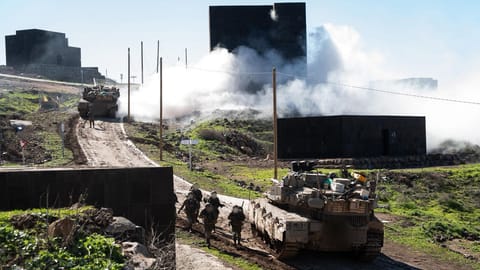
Struck a vehicle in a convoy being used by an idf commander as he toured southern lebanon days later a hezbollah drone struck an israeli tank these are just three of the multiple drone attacks the group has launched during its current war with israel the wall street journal reported that drones are now the leading cause of battlefield deaths for the idf
Killing seven of the eleven israeli soldiers killed since the ceasefire between israel and lebanon went into effect the drones have sown fear among israeli ground troops in lebanon and have challenged the long-held assumption that israel would always enjoy unchallenged air superiority over lebanese skies more importantly they have exposed a flaw in israel's
Strategy jerusalem's thinking was that by seizing territory in southern lebanon to build a buffer zone residents of northern israel would be safe from hezbollah's attacks hezbollah's prolific use of drones means that even with a buffer zone in place the group could still strike as long as its drones have sufficient range now given how effective the drones
Have been and how much carnage they are sowing within israel's troops you would be forgiven for thinking that this is the first time hezbollah has used them however hezbollah has been using drones since at least 2023 what makes the recent wave different is three things.
First, according to the Amit Terrorism and Intelligence Research Institute, Hezbollah has accumulated a large stock of FPV drones, many of which were smuggled across the Lebanese border. By some estimates, by June 2025, Hezbollah had about 5,000 drones capable of carrying 7 kilograms of explosives.
Given that the group operates workshops in southern Lebanon and the Bakar Valley to assemble drones, that number had undoubtedly increased before the war with Iran began in late February. Second, some of Hezbollah's drones are now equipped with thermal sensors, enabling them to fly at night and detect heat signatures from IDF members.
Cameron Chell, CEO of drone company Dragonfly, described the use of thermal sensors as a game-changer in an interview with Fox News, and it's not difficult to see why.
One of the IDF's main tactics in Lebanon is conducting nighttime operations, relying on the cover of darkness to move with relatively little resistance.
If Hezbollah makes these thermal sensor drones more widely available to its members, Israel may be forced to significantly change its strategy, abandoning a tool that has been crucial in its fight against the group. While those two are major changes, the single most important one has been the group's adoption of fiber-optic drones.
This is an adaptation that first showed up on the drone-saturated battlefields of Ukraine, and these FPV drones are controlled by fiber-optic cables, which make them immune to electronic jamming. An Israeli security officer told the Wall Street Journal that nearly 80% of Hezbollah's drones today are fiber-optic, making them a major issue for Jerusalem.
Drone experts are warning that the situation is likely going to get worse for Israel as Hezbollah drone pilots get more experience.
Samuel Bendet, an advisor with the Russia Studies Program at CNA, a Washington-based think tank, told the Wall Street Journal, and we'll quote him here, with each flight, each mission, Hezbollah pilots gain experience, whether the mission is successful or not. That's how it works in Ukraine. End quote.
Now the big question is, how will Israel respond?
The fact that Israel was caught by surprise with Fox News describing the situation as utter chaos is shocking, because military officers had been warning that Hezbollah would likely use fiber-optic drones to avoid electronic jamming as far back as 2024, and despite those warnings, the military's top bras appeared to do little to prepare for the threat.
And even when drone attacks became more commonplace by April, the military had yet to adopt countermeasures that have become standard practice in the Ukraine war, such as hanging protective nets over stationary soldiers and equipment.
What makes this particularly fascinating, though, isn't the impact it's having on the IDF, but what it bodes for other conflicts that may be fought in the near future. Thanks to the white-hot pace of technological advancement in Ukraine, the military capabilities of drones are now growing faster and faster, even as costs drop lower and lower.
And smaller states and insurgent groups across the world are paying attention, adopting tactics that were pioneered by Kiev or Moscow to give them an advantage over an otherwise superior opponent.
Hezbollah are riding the crest of that wave, but so are cartels, rebel groups, space that the first again was rare, but the first again is a hard-ranked Г-2-7-7-7-8-27-9-8-7-9-9-7-9-8-8-8-8-8-9-8-9-9-8-8-9-8-9-6-8-9-8-9-8-9-8-9-8-9-8-9-9-9-8-8-14.
The first again is, when you try to get an Thank you. and even private military contractors as seen by the deployment of one-way attack drones against gang strongholds in haiti what's happening in lebanon should therefore be a warning to the west if it doesn't want to be left behind it needs to invest in anti-drone technology now while it is not under attack
Because when a war comes it will be too late to understand the next story we've got to wind back the clock by a couple of years to the days when nicolas maduro still ruled venezuela with an iron fist it was in 2024 in what we now recognize as the waning days of maduro's tenure that the venezuelan national assembly passed a law establishing a new venezuelan
State unfortunately for maduro that state was not part of venezuela's internationally recognized territory instead it was the region of esiquibo a thickly forested sparsely occupied land that makes up about two-thirds of the territory of neighboring guiana at the time maduro's motivations were well understood yes venezuela had a long-standing territorial
Claim on esiquibo but the more important part of the story was that esiquibo is home to immense natural resources including a massive oil deposit that's turned guiana into the world's fastest growing economy maduro's government responded by turning up the pressure including with a referendum held in 2023 and eventually caracas worked its way up to
Threatening a full-scale invasion of course that invasion never materialized and today maduro is in u.s custody awaiting trial venezuela is now under the command of dulcie rodriguez a one-time maduro deputy who has proven herself to be very willing to run a sort of shadow american administration but this week close observers of latin american news were given
A reminder that even though venezuela is a very different place today than it was just a couple of years ago venezuela's lingering claim to esiquibo is far from a settled issue that reminder came in the form of a skirmish on the border between venezuela and guiana when a patrol vessel on the cuyune river the waterway that defines parts of the border divide
Came under attack by armed men located on the venezuelan shore the circumstances of the gunfight remain murky but according to the guiana defense force its soldiers were fired on and one of them was wounded according to local sources several other soldiers were lightly injured although none were killed venezuela forcefully denied guiana's version of events
Accusing the nation of fabricating a false narrative though it failed to offer a concrete alternative explanation now along most of the world's borders are light skirmish with only a single serious injury might make the news but it's unlikely to carry any larger geopolitical ramifications in esiquibo however the situation is oh so very different and this
Incident provides the clearest proof yet that a maduro era policy toward esiquibo is continuing in force the guiana venezuela border is porous at best and there's a fair bit of criminal activity that happens there including narcotics and resource smuggling but at the same time venezuelan state forces are believed to be highly active in the same region region
Taking advantage of the shadowy border zone to move at will and occasionally provoke armed confrontations with their next-door neighbors a couple of years ago eight guianese soldiers who were wounded in a similar ambush and within recent months another confrontation between guianese troops and armed venezuelans was resolved without violence depending on the
Regional security analyst who's weighing in those venezuelans might be members of organized criminal groups or part of the country's intelligence services or soldiers out of uniform and given the way that the venezuelan intelligence state its military and its organized criminal enterprises all tend to intermingle it's entirely possible that all three of
These claims are true at once the broader point is that venezuelan armed action along the border is hardly new and when confrontations like these take place they are hardly a coincidence of course there's no way to have a conversation about what the venezuelan state is doing recently without also factoring in the role of the u.s for its part the u.s is more
Focused on venezuelan internal security purges of the regime and efforts to open the venezuelan oil market to u.s and international companies and it's entirely fair to assume that the u.s wouldn't want caracas causing trouble by picking fights over the guianese border at an inopportune time esikibo however seems to be one of the priorities from the old
Maduro regime that's stuck around and become a priority for the government that's come after venezuela's acting leader delci rodriguez makes a point of wearing a pin on her lapel that shows esikibo to be a part of venezuela and even after maduro's ouster venezuela's international legal proceedings against guiana remain active in early may venezuelan and
Guianese negotiators met at the international court of justice in the hague where guiana continues to try and defend an 1899 border decision that delivered control of esikibo venezuela continued to argue in support of a later agreement that according to caracas means that esikibo isn't a settled issue and reiterated its claim that a colonial era decision
Made by empires that have long since withered away has no right to dictate latin american affairs today as for why caracas would continue to push for esikibo the answers are threefold for one thing dulcie rodriguez and are in a circular trying to walk a very fine line right now appeasing venezuelan hardliners and nationalists as much as possible while
Demonstrating to washington that they remain fully committed to doing what america wants after all none of them want to get maduroed in the dead of night and there's a very real chance that any one of them could be so by continuing to prosecute the esikibo issue caracas is able to pursue a potential victory that venezuelan hardliners still feel strongly
About buying themselves time and political goodwill so that the current leadership can maintain its place in power then of course was the economic and exploitative argument secure control over esikibo and venezuela would gain access to immense natural resources which could then be harvested and sold off to start a windfall than the venezuelan economy in the
More optimistic version of the story those new economic assets are put toward a rehabilitation of the venezuelan state for the collective benefit of the country and its people in the more cynical read one of the most corrupt governments in the world world would get the opportunity to siphon off incredible wealth from oil drilling, mineral harvesting, timber
Trading, and much more.
Finally, there's the possibility that the United States could be interested in Ezequibo as well.
Washington's conduct, both during and after Maduro's ouster, has made it abundantly clear that American leaders are interested in Venezuelan resources, especially oil. When Venezuela delivers those resources, its leadership is rewarded and the country is given a way to reintegrate with the rest of the world.
So, what better gift to deliver to the United States than Ezequibo itself?
And as regional analyst James Bosworth noted after the recent ICJ meeting, Trump's own willingness to capture Maduro, reopen the question of the Falkland Islands, destabilize Cuba, and otherwise change the order of things in Latin America, may lead Rodriguez enter in a circle to believe that territorial changes in the region are finally back on the table.
Over the past century, there have been hardly any major wars or conquests across Latin America, but right now, Venezuela's military and its hardliners have something they'd like to conquer, carry out that operation just right, and there may be a way to defuse any frustration from the hemisphere's dominant superpower by offering a share of Ezequibo's
Resources on a silver platter.
And for our final story today, we turn our attention to Africa, to a country that is rarely, if ever mentioned in the France universe, South Africa, a country that has been in the news recently for all of the wrong reasons.
On 17 April, a 43-year-old Cameroonian shopkeeper who has lived in South Africa for close to 20 years was attacked during protests targeting foreign-owned shops in Durban, the nation's third largest city. He closed his shop, locked the doors, and turned off the lights, but a group of about 10 young men broke in and attacked him.
He told the press, quoting him here, "...they whipped me and my three colleagues, who are not South Africans, with golf sticks and heavy whips and sprayed pepper spray on us." They also used stun guns.
We ran outside the shop. They followed us outside and whipped us. No one came to assist us." End quote.
Although the shop owner is a legal resident in South Africa, he has not lodged a case with the police, as he doesn't trust the country's criminal justice system. And this attack was not a one-off.
Starting in April, a grassroots movement called March & March, which advocates for more stringent immigration controls into the country, began organizing protests against undocumented migrants all over the country.
A lot of these protests turned violent. Some were even fatal. In late May, in the coastal town of Bossel Bay in the Western Cape, about 55 shacks in an informal settlement were set on fire, some while people were still inside.
When the dust had settled, the Mozambican government claimed that five of its citizens had been killed. This isn't the first time that South Africa has dealt with a wave of xenophobic violence. In 2008, 62 people were killed, 1,700 injured, and more than 100,000 displaced after riots that started in Johannesburg spread throughout the country.
Violence also flared up in 2015, forcing then-president Jacob Zuma to deploy the army before eventually traveling to Mozambique to personally apologize.
And again in 2019 it led to a nigerian boycott of an economic summit in cape town given this grim track record we have to ask the obvious question why does this keep happening and the short answer is that south africa's in serious trouble the nation's unemployment rate currently sits at over 32 with youth unemployment closer to 61 south africa also has the
Highest rate of income inequality in the world a fact that has persisted since the end of apartheid south africa is also one of the most crime-ridden nations in the world with a crime index of 74.7 points out of 100 in 2025. for comparison kenya has a crime index of 56 out of 100 in the same period while the czech republic stood at 26.5 and while the murder
Rate recently dropped to 36.6 per 100 000 that is still significantly higher than the rate in countries like colombia where armed groups are actively engaged in conflict with the state while successive governments have promised to address these issues nothing has fundamentally changed in the country for south africans looking for people to blame immigrants
Often from mozambique or nigeria have become a convenient scapegoat they have been blamed for everything from overtaxing the country's welfare system to driving down wages by accepting lower pay than native-born south africans and even for the high crime rate however the data both from the police and from government agencies like the south african social
Security agency do not support this in fact according to the social security agency in 2024 less than 0.5 percent of child support grant recipients were immigrants although the data doesn't support it the narrative has still taken hold a 2025 survey from the human sciences research council hsrc found that south africans were more hostile towards immigrants
Than at any other point since the survey began in 2003 the rise in anti-immigrant sentiment has been highest among poor and working-class adults this is particularly concerning because south africa will be heading to the polls in november to elect local government leaders in a bid to either maintain or gain power political aspirants may play into the
Xenophobia creating a cycle that will undoubtedly lead to more violence in the months and years to come especially because the issues facing the country aren't the kind that any government can solve in a short time for now praetoria has tried to handle the fallout as best it can in an open letter president cyril ramaphosa said that the recent wave of
Violence was not a reflection of the people or the government adding that there was no place for xenophobia ethnic mobilization or violence in the country when speaking to parliament he added that the government would crack down on illegal migration and would strengthen border security despite these statements the damage has already been done though nigeria
Summoned the acting south african high commissioner for a formal dressing down ghana lodged a complaint with the african union and a host of countries issued travel advisories against south africa with some seeking to repatriate their citizens it's too early to say whether these attacks will have any lasting impact on the number of people willing to move to
South africa praetoria has long been an attractive destination for african immigrants because of how much stronger south africa's economy is compared to its neighbors if that continues to be true then people will continue to move to south africa despite the risk which means that if the grievances that led to this violence are not addressed in a meaningful
Way not through statements in parliament and open letters but rather meaningful policy reform then it's a question of when not if the next wave of violence happens thank you for watching
Unlock premium video briefings
Members get full access to premium reporting, in-depth briefings, and subscriber-only analysis.
Insiders Receive
- Full access to all premium articles and briefings
- Exclusive subscriber-only analysis and dispatches
- Support independent conflict journalism
From $5/month — cancel anytime