
Briefing Room 07.17.2026: JNIM Battles Islamic State, Thai Insurgency Picks Up Strength, Sheikh Hasina Contemplates Return Home.
Simon Whistler • July 18, 2026
Members only
Note: this transcript was generated by AI and may contain errors or inconsistencies.
Welcome back to the briefing room the weekly show that asks the enduring question what else has been keeping our writers awake at night this week we're gonna take a trip to mali where the al-qaeda linked insurgency janim has dealt with a prominent ex-commander who defected to the islamic state from there we're turning to thailand where a simmering insurgency
Is showing signs that it's about to heat back up and finally we're headed across to south asia to bangladesh where former dictator sheikh assina has made the one decision that almost no former autocrat ever makes as always we're able to bring you this show thanks to the generous support of our premium subscribers that's you by the way so thanks for helping
Us do what we do for our lead story we turn our attention to mali a frequent destination on fronts in the past few weeks to check in on one of the most brutal jihadist groups in the sahel jama'at nusrat al-islam wa muslimin or janim fortunately because god damn regular viewers of the briefing room will remember that back in february we reported on a major
Defection from janim to the islamic state sahel province or issp by sadhu samahuna samahuna is a senior commander who was responsible for janim's activities in burkina faso's est region but sado wasn't just a run-of-the-mill commander he was as close to royalty as possible within janim because he was the younger brother of abu hanifa janim's emir for niger
Speaking exclusively to the front team hasret kargin an african studies researcher at intelligence firm mental world said that sadhu not only brought crucial battlefield intelligence to the islamic state but also revealed secret agreements that janim had made with several regional countries including mauritania sadhu accused janim of not actually fighting in
The name of religion which in the world of jihadists is one of the most serious accusations you could make because it could destroy an entire group's credibility more important according to kargin is the fact that sadhu had amassed a force of 200 fighters along the niger benin border to launch an attack on janim all of this forced janim to act and on the
13th of july they launched an attack that ended in sardu's death while not much is known about the attack itself from the number of forces that janim deployed to the exact location where it took place the group did release a video showing their fighters dragging what appeared to be sardu's corpse across the ground and this feels like something that we have
To say a lot more often nowadays please don't go looking for that video it's extremely gruesome and it just reveals the lengths that the jihadists are willing to go to in order to achieve their objectives one thing we do know according to kargin is that the fighters that killed sadhu appeared to have spent a month alongside him before killing him and
Returning to janim if this is true it would suggest that janim managed to plant fighters in sardu's camp most likely under the pretext that they were defectors who agreed with him before activating them when it became clear that sadhu was becoming too big of a threat which raises a question about how many more double agents janim has managed to plant within
The ranks of the issp and whether it's planning on activating them at any point soon however according to another sahel focus terrorism tracker who spoke exclusively to our team malio janim doesn't look like it's getting ready for a big fight in a statement shared after sadhu's death janim claims that they never sought war with the issp that in fact it was
Always the latter group that had always initiated skirmishes while janim only took the initiative when they felt they had no other option like when they got intelligence that sadhu was amassing his 200-man force to attack them janim further claims that while it would be easier to focus its attention on eliminating issp they had instead chosen to spend their
Time planning complex assaults on bamako and attacking several military camps simultaneously in mali basically they didn't really care what the issp got up to as long as the issp left janim alone now this might have been convincing if we didn't have battlefield reports proving that issp was eating janim's lunch malio told our team that over the past year the
War between the two jihadist groups was headed in a decidedly pro issp direction janim had lost hundreds of fighters in the sabah region of burkina faso and in northeast mali the issp on the other hand had gone from strength to strength advancing along a key route in burkina faso and attacking janim in the town of jika and they aren't the only ones giving
Janim a hard time on the 4th of july janim and the azawad liberation front or fla an ethno-nationalist harag militia group that had been allied with janim for months now launched a coordinated attack on anafis a town in northern mali on the road linking kadal to gao this wasn't the first time that the two groups had launched coordinated attacks on positions
Held by the government and their russian allies however unlike in the first attack launched in april bamako and the russian africa corps stood their ground and fought back they managed to get reinforcements to anefis and ultimately broke through the siege lines henny nasebea an analyst at the conflict monitoring group aklet described the battle for anafis as
A test of whether the janim fla alliance could reverse one of the government's most significant military gains since late 2023 they failed that test and it cost them heavily in men and equipment that kind of loss will force janim to regroup before it can attempt anything on that scale again although we have to insist that the group is far from finished sahel
Tracker brand phillip reported the janim ambushed a large malian army convoy near neono in the segu region yesterday killing three soldiers capturing a fourth and seizing a significant haul of weapons and ammunition which will go a long way in replenishing their stocks whatever janim does next one thing is clear they get to do it without having to constantly
Look over their shoulder for an attack from sardu the fact that the threat is gone may end up being one of the most important victories for the group this year next up let's turn our attention to thailand not to cover the tensions with cambodia over the border dispute that's still bubbling away beneath the surface but to cover an insurgency that has been
Quietly ravaging the southern edge of the country for years now in the month since thailand's february general elections the situation has started to devolve quickly march was particularly difficult for thailand as militants set off a wave vas attacks against cctv infrastructure buried ieds under roads and picked off security personnel and local officials in
A string of targeted killings in may gunmen opened fire on a police station killing an officer days later four attackers disguised in women's clothing ambushed a police sergeant and his family outside a school in yarang district killing his wife a school teacher and in june there were three separate attacks that disrupted a major highway killed a village
Defense volunteer and injured a family of four now sadly none of this is new thailand's deep south the region that encompasses the provinces patani yala naratiwat and parts of songkhla was once part of the malay sultanate of patani a historically independent kingdom that later fell under thailand's control this control was cemented by the 1909 anglo-siamese
Treaty which left the sultanate under bangkok while transferring some territory to the brits periodic resistance and armed separatism came afterward becoming particularly intense in the 1960s and 70s before declining sharply during the 80s and 90s the resistance found support in the region because malay muslims who make up the local majority have long felt
Like outsiders in their own homeland the education system prioritizes the thai language over the local patani malay language and the public sector has historically employed very few muslims compared to their buddhist counterparts bangkok has also been extremely repressive in responding to social unrest often through mass arrests and extrajudicial killings
The modern insurgency began in january 2004 when militants raided an army camp to steal weapons which triggered a crackdown by the thai army in october that year thousands of malay muslims gathered outside a police station to protest what they believed to be the wrongful detention of six people the military opened fire killing seven more than 1300 people
Were arrested at the scene strip searched and many of them tortured others were transported to a military camp more than five hours away they were packed so tightly together that 78 people died of suffocation this incident radicalized a generation of young malay muslims and it is still invoked by insurgents today as a rallying cry against bangkok in the
Years since the insurgency reignited the barisian revolucionationale or brn has emerged as the leading separatist group its goal is to cede from thailand and form an independent state of patani at the moment that goal seems to be far from reach as bangkok has managed to maintain a strong grip on the region still that doesn't mean the situation is completely
Under control since 2004 more than 6 000 people have been killed a number that looks set to grow given the incidents we mentioned at the start of this chapter and the conflict seems to be taking on a new dimension according to narisha ismail an analyst at the international center for political violence and terrorism research the war has gone online while the
Official social media accounts of the brn have focused on distributing news releases and formal statements the kind of dry stuff that doesn't really grab attention the accounts of their sympathizers and rank and file members have been a lot more proactive ismail reported that these accounts have been sharing content around violent incidents to foster a
Culture of fear showcase the strength of the organization and maintain the group's momentum in its fight against the government.
In March, users affiliated with the BRN shared footage of the CCCV arson attacks that were mentioned earlier. These users also amplify the political demands of the insurgents, including graffiti pushing for Patani independence to continue legitimizing the insurgents' goals.
But perhaps the most insidious role these accounts are playing is to continue to weaponize past tragedies, such as the Takhbi massacre, to generate support. Now, it's really difficult to know how effective any of this actually is.
There's no reliable way to trace a specific Facebook post to a specific result, and the BRN has no incentive to publish any real numbers that would give us more insight into this operation.
Instead, we're left with one crucial piece of evidence, the fact that these accounts keep posting. Sympathizer networks that run these kinds of operations for years, evading platform takedowns and monitoring by the Thai state, tend to drop the effort once it stops paying off.
So the fact that it's still going strong indicates that at the very least it's doing one thing well, keeping fighters and sympathizers engaged in a war that hasn't produced a clear win on the ground in years.
What it hasn't done is move Bangkok. Throughout multiple governments, Thailand has continued to insist that any resolution to this conflict needs to align with the Thai constitution which says that Thailand is one indivisible kingdom.
Basically, no matter how loudly the insurgents demand an independent state or what platform they use, Thailand won't accept it.
This has created an uncomfortable situation, because while the political wing of the BRN has agreed to pursue solutions within the framework of the Thai constitution, its military wing has not given up on a fully independent Pitani. Which means that peace will continue to be elusive.
And that's a shame, because as long as the violence continues, the civilians of southern Thailand will continue to suffer.
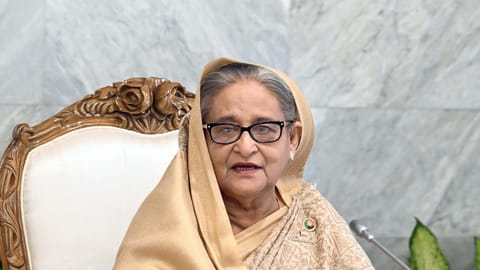
At the moment of her downfall in 2024, Sheik Asinawazed, the now former dictator of Bangladesh, was perhaps the world's most prominent casualty of a global Gen Z protest movement.
After a 15 year long premiership that saw Asina leverage forced disappearances, extrajudicial killings, electoral manipulation, and media crackdowns to stay in power while enriching herself and are in a circle through a wide range of corrupt acts, Asina's ouster was the fall of a giant in South Asia.
She had led the country's then dominant political party, the Awami League, for over 40 years straight.
And it took well over 1,000 protesters dead, more than 20,000 injured, and an entire nation paralyzed to finally push her out. But Sheik Asina didn't leave Bangladesh in a body bag like, say, Muammar Gaddafi or Benito Mussolini.
Instead, like Syrian ex-dictator Bashar al-Assad or Liberian ex-warlord Charles Taylor, she was able to flee into exile, in her case taking refuge in India.
There, Asina has spent nearly two years watching her successors in an interim government and then their successors, chosen in a national election, dismantle her regime and political legacy. Her use of hidden detention centers has long been uncovered.
She's been investigated for myriad corrupt dealings. in her time as leader and she's been tried in absentia for crimes against humanity convicted and sentenced to death nonetheless it's become clear that asina is safe as long as she stays put india has repeatedly refused requests to extradite her and she has very deep ties across the administration in new
Delhi where prime minister narendra modi and his allies have no interest in selling her out but the fact that asina is so safe in india and the grim reality of what's waiting for her if she were to return to her home nation has made the last week of news from the asina camp all the more surprising speaking to reuters in a nearly hour-long interview late last
Week has seen revealed that sheena and a circle are planning to return to bangladesh as soon as this december once they arrive according to asina herself they don't plan to fight or to try and take back power but to surrender nor does the scene seem to misunderstand the stakes quoting her directly they may arrest me on my return they may even kill me still i
Have to go if death comes i wanted to come on my own soil where my parents are buried and where their blood was shed end quote now we probably don't have to explain why that decision is so unusual that a long-time autocrat who ruled her nation with an iron fist was deposed but escaped with her life and achieved relative safety would voluntarily return home
To face accountability for her actions with very few exceptions across modern history that just doesn't happen so that begs the question what exactly is shaker seen as play here what is she trying to accomplish with a return to her country and has she worked out some mind-bending political calculus or maybe does she simply have a death wish in part has seen
As calculus seems to be informed by a desire to support her party faithful in bangladesh where the awami league has been banned since shortly after her departure ex-members of her administration have been subject to investigations and tribunals while their crimes against the bangladeshi people have been laid bare whenever evidence of those crimes can be
Found but the country's political transition has been difficult the interim government drew constant criticism on a variety of issues and while the awami league is banned it still draws the support of many millions across bangladesh having been the dominant political force since the nation's founding until it was formally prohibited from operating in may of
Last year in some post-dictatorship transitions across modern history a national population might be almost unanimously willing to turn the page on the old regime but that's just not the case in bangladesh has seen always overthrown in a popular revolution but what's needed now is a national reconciliation by traveling back to bangladesh has seen her
Probably doesn't expect that she could avoid jail time completely but she has been provided with clear signals from bangladesh's current government that if she were to return her death sentence might be subject to a rethink if given the opportunity to try a senior in person the government is likely to do so and while there's still ample rage in bangladesh
Toward a scene and a legacy it's not clear that there's enough support to justify the execution of an elderly woman who did oversee the rapid growth and advancement of her country quoting the country's minister for foreign affairs if a scene were to return Now, quote, she will have to go to jail and further proceedings will follow as per the provisions of
The law.
In returning, Hasina may believe that she can work her way down to imprisonment under house arrest or even a decision to abandon her prosecution in the name of peaceful reunification.
Or, seeing that her personal journey through politics is finished but that the Awami League could still survive and thrive again, Hasina may want to stand trial as a way to absorb the blame for the political party's legacy.
In exchange, she may be able to secure and end the ban against the Awami League itself or pave the way for a cleaner transition to a successor movement.
Nonetheless, it's worth actually taking the idea of a death wish seriously, at least in a manner of speaking. By the time she returns to Bangladesh on the timeline that she's laid out, Hasina will be 79 years old.
She's dealt with documented past health concerns and was nearly killed in a 2004 assassination attempt that left her with permanent vision and hearing problems.
While there's been no public disclosure of a new diagnosis, she's at an age where degenerative illnesses are hardly a surprise, be it cancer, early signs of dementia, or anything else.
She's also a devout Bengali Muslim, raised in a tradition that places a strong emphasis on returning to one's ancestral homeland, if at all possible, before the time of one's death. Her father, Sheikh Mujibur Rahman, who was the founding president of the country, killed in a coup in 1975 alongside Sheikh Hasina's mother and much of her family.
They were all laid to rest on their home nation's soil. And it's not particularly difficult to imagine that Hasina would want to be interred beside them.
That's especially complicated in Bengali Islamic tradition, where the end-of-life process is typically handled quickly as dictated by the faith itself, and where a complex repatriation process after Hasina's passing, due to the tensions between India and Bangladesh around her life and legacy, might make it impossible for her body to be transferred in time.
It's a highly unusual set of circumstances. And while we certainly don't mean to make this into too much of a tender moment for Sheikh Hasina, we do expect that this process will be worth watching.
A long-time autocrat, with a very complex political legacy, nearing the end of her own life, has chosen to return home and end her story with a measure of accountability.
Thank you for watching.
Unlock premium video briefings
Members get full access to premium reporting, in-depth briefings, and subscriber-only analysis.
Insiders Receive
- Full access to all premium articles and briefings
- Exclusive subscriber-only analysis and dispatches
- Support independent conflict journalism
From $5/month — cancel anytime