
Briefing Room 11.22.2025
Briefing Room 11.22.2025 — a Fronts video briefing on Strategy & Defense.
Simon Whistler • November 22, 2025
Members only
Note: this transcript was generated by AI and may contain errors or inconsistencies.
Welcome back to The Briefing Room, the weekly show made for the people who prefer the behind the scenes to the actual movie, because we all know that's the best part.
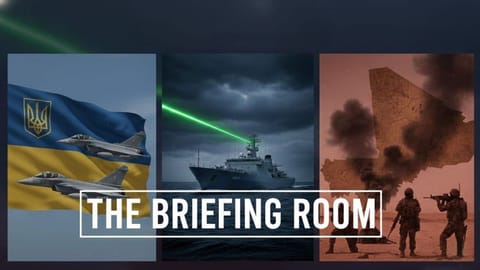
This week we're diving into the geopolitical weeds to give you an update on the crisis in Mali and tell you about the James Bond-esque story playing out in British waters where a Russian spy ship is being tracked by jets and a Navy frigate.
But before we get into that, we'll turn this episode's focus towards Ukraine, where Kyiv's vision for its future air force has raised more questions than answers.
And as always, thank you so much for being a subscriber here on Fronts.co. Your subscription makes it possible for us to not only cover these kinds of stories, but also the important stories that don't necessarily please the YouTube algorithmic gods. And with that said, Ukraine.
Ukraine's Future Air Force Controversy All told, it's been a bit of a rough week for Ukraine between the country's major corruption scandal, its flagging defense in Pokrovsk, and a new US-backed peace deal that would offer Russia a staggering series of concessions in exchange for hardly anything that could benefit Ukraine.
But even still, Kyiv did generate at least one set of positive headlines when it signed on the dotted line to purchase up to 100 copies of France's vaunted multirole fighter, the Rafale. The deal would see Ukraine pick up the F-4 variant of the fighter, the most sophisticated version currently available.
A delta-winged, high-powered, supercruise-capable jet, the Rafale is a true multirole fighter, combining advanced radar, optoelectronics, and electronic warfare systems with the ability to carry a wide range of munitions, up to 9,500 kilograms in total, on 14 hardpoints.
The aircraft operates at an impressive range, it's highly technologically sophisticated, and it is a clear step above anything else in Ukraine's current arsenal, or for that matter, anything in Russia's, unless its claims about the Su-57 are to be believed.
For France, the landmark deal represents the largest single export order for the Rafale ever placed, with Egypt, India, Qatar, the Emirates, Indonesia, and other customers already waiting for their copies.
The deal wasn't without controversy, however, as it came just a few weeks after Ukraine announced a similar arrangement with another European provider. Less than a month ago, Ukraine and Sweden agreed on a framework for Ukraine to purchase as many as 150 copies of the Saab Gripen, specifically its advanced E variant.
Like the Rafale F-4, the Gripen E is equipped with all manner of advanced combat avionics, and while it comes with fewer hardpoints, a shorter range, and a lowered payload capacity, it's built to operate off rugged airstrips or even roads, optimized for anti-tank operations that were envisioned specifically with a Russian invasion in mind.
Ukraine's decision to agree to both deals at once raises a number of questions about what exactly Ukraine is hoping to achieve. For one thing, it's not yet clear how Ukraine intends to finance either purchase, let alone both, with the sticker price for a cumulative 250 highly advanced combat jets expected to be in the multiple tens of billions.
According to France, the Rafale deal will be financed via frozen Russian assets and other European Union programs, but the specifics on that plan are not clear at a time when France's financial trouble is especially acute.
Not only that, but flying both models at once would lead to substantial logistical headaches for Ukraine. Already, the nation has struggled mightily to find and train enough pilots and maintenance crews to fly its American-made F-16s to the point that pilot shortages have meaningfully compromised Ukraine's ability to fight this war.
Now, Ukraine will need to find a way to fill a far greater number of vacancies, build supply chains, and an overall sustainment infrastructure, and find a way to integrate these new aircraft into an increasingly complicated air force.
Doing that with just one new combat jet was hard enough, but doing it with two is going to be immensely difficult. Nor are these aircraft expected to make an immediate difference on the front lines. Sweden has already indicated that it will take around three years for the first Gripen E aircraft to arrive in Ukraine, let alone the full fleet.
France does not expect to fill its entire export deal with Ukraine until 2035 at the earliest. Both nations are obligated to fill other large export orders with international customers, as well as setting aside production capacity to beef up their own air forces.
While both France and Sweden are working to expand their capacity and add new production lines, those expansions are only expected to shave a couple of years off the overall timeline to procure their respective aircrafts.
Unlike other export customers, Ukraine cannot wait for its deliveries, with Russia still barreling down upon its eastern flank. But no nation wants to hear that its very expensive order of combat jets is going to be delayed. The decision to procure the Rafale, in particular, may alleviate some of Ukraine's headaches in the short term.
France has indicated that a small batch of Rafales could be available soon, perhaps enough to add a squadron or two of capability to Ukraine's air force while the war against Russia is still underway, but even that comes with complications, as Ukraine hasn't yet signed the purchase deal for the Rafale, and has instead committed only to signing a letter of
Intent.
In the event that Ukraine does manage to secure a peace deal with Russia at some point, and that the stipulations of that peace deal don't bar Ukraine from accepting advanced military hardware, the eventual addition of up to 250 Grippens and Rafales would grant Ukraine a new level of reassurance around its own security.
That sort of air power in its arsenal would bring Ukraine far closer to parity with Russia in the skies, which would be a very meaningful deterrent, considering that Ukraine has already denied Russia control of its airspace for the duration of this conflict.
If Ukraine is going to accept these jets eventually, though, it'll have to be under the auspices of a different peace deal than the one that Russia is proposing. That deal would bar Kiev from possessing entire categories of advanced military hardware, and ban the possession of long-range munitions that would grant deep-strike capability into Russia.
Russian spy ship in UK waters As I speak, a Russian spy ship, the Yantar, is on the edge of UK waters, north of Scotland, having Why are you coping with the case of the United States in China?
Thank you. entered the UK's wider waters over the last few weeks. This is a vessel for gathering intelligence and mapping our undersea cables. This is the second time this year that this ship, the Yantar, has deployed to UK waters.
So a message to Russia and Putin is this. We see you. We know what you're doing.
And if the Yantar travels south this week, we are ready. These were the words of British Defense Secretary John Healy, who, during a Wednesday press conference, announced that a Russian spy ship was in UK waters. Yes, you heard that right.
A Russian spy ship has been in the UK's territorial waters for weeks now. And according to the British Defense Secretary, this is the second incursion this year. So since the world has decided to take a turn into James Bond territory, we have to ask, what is the Yantar?
What has it been doing in British waters? And finally, how will the UK respond? Let's start with our first question.
What is the Yantar? In the eyes of the Kremlin, it is a simple research vessel that carries out basic studies on oceanic ecosystems. I'll stop.
I'll stop. But that's what they say it does. It's roughly 108 meters long.
It can reach top speeds of 15 knots or 28 kph, which is pretty standard for a ship of this size. And according to Russia, it's an ordinary ship. Nothing more to see here.
Please move along, comrade. But since we don't really trust the Russians to tell the truth in such matters, let's hear what other people have to say about it.
According to the Council on Geostrategy, a London-based think tank, the Yantar is a mothership to two submarines that can reportedly reach depths of 6,100 meters, almost twice as deep as the wreck of the Titanic.
It was constructed and operated by the Maine Directorate of Deep Sea Research, a secretive branch of Russia's armed forces that reports directly to the Ministry of Defense.
Data from the ship tracking website MarineTraffic indicates that it hasn't broadcast its location since the 2nd of November and was last seen tracked in the Baltic Sea north of the Latvian coast. So you can understand why Westminster was just a little bit concerned when it turned up in British waters.
And that leads us to our next question. What's it been doing? Well, the British government believes that it's been mapping the UK's critical undersea infrastructure for a possible future strike.
That infrastructure includes the roughly 60 cables that connect Britain to the outside world, carrying an estimated 99% of the nation's data traffic. Retired Royal Navy Commander Tom Sharp told the BBC that these cables transfer, and we'll quote him here, up to $7 trillion worth of financial transactions every day between us and America alone.
And it's not just cables.
There are also gas pipelines that transport vital energy stores from Norway and other countries to British shores. And this infrastructure is extremely delicate.
Britain's National Security Strategy Committee warned in a September report that attacks on undersea cables could cause catastrophic disruption to the financial and communication systems that the country relies on.
Dr. Siddharth Kaushal, an expert in maritime technology, warned that the pipelines are even We'll be more vulnerable, telling Sky News, and we'll quote him here, I think in some ways the pipeline network is far more fragile because we are more reliant on a handful of critical pipelines.
So if Russia chose to attack this infrastructure, the UK would be, and we'll use a very technical term here, absolutely f***ed up. But would Russia actually attack these cables?
Well, according to Moscow, they would never even think of doing that. In the wake of the Defense Secretary's accusation, the Russian embassy put out a statement saying in part, the endless accusations and suspicions of the British leadership cause only a smile.
Our country's actions do not affect the interests of the United Kingdom and are not aimed at undermining its security.
We are not interested in British underwater communications. However, we only need to look at Russia's past actions to know that they would be totally okay attacking the UK's cables should the opportunity present itself. Since September, Russian drones have made incursions into NATO airspace, forcing member nations to scramble and shoot them down.
US investigators recently uncovered evidence that Russia was at least partially responsible for a hack targeting the federal court filing system.
And perhaps most pertinent, a Russian oil tanker dragged its anchor along the ocean floor in Finland's waters, severing the Estlink-2, a high-voltage undersea power cable that connects Estonia to Finland, allowing electricity to flow between the Baltic states and the Nordic grid.
This is all part of Russia's hybrid warfare strategy that relies on sabotage, disruption, and plausible deniability to weaken Western nations without crossing the threshold into open conflict.
And that brings us to our final question, how will the UK respond? Well, according to the September report that we mentioned earlier, London has been far too timid in defending its undersea assets. The report argues for more muscular deterrence measures, with punitive consequences for malicious damage.
And so far, the UK has shown some teeth. London has deployed the HMS Somerset, a frigate with anti-submarine capabilities, and RAF Poseidon P-8 planes to track it. In response, the Yantar directed lasers at the British pilots, which Healy called deeply dangerous.
And he wasn't exaggerating. According to May K. Beeler, chief transportation correspondent for Queen City News, shining lasers on planes can cause temporary blindness, and in some cases, even permanent eye damage.
Lasers can also cause veiling glare, which essentially makes it impossible for pilots to see instruments or the outside. This was the first time that the Yantar had taken such aggressive action against British aircraft, and Healy made clear that the government took it extremely seriously and had military options ready.
We don't believe Britain will need to use those options.
Despite all the posturing, Russia is in no position to fight NATO. Moscow is bogged down in Ukraine, hemorrhaging men and equipment in a grinding war of attrition. A direct confrontation with NATO would be suicide, and Putin knows it.
But that doesn't mean the UK, and to a wider degree, the entire Western world, can afford to be complacent. The incident The incident should serve as a wake-up call that vital infrastructure is, for all intents and purposes, virtually undefended.
In the wake of the S-Link 2 attack, British Admiral Keith Blount, NATO's Deputy Supreme Allied Commander Europe, told CBS, and we'll quote him here, we're not going to be pushed around or interfered with.
We're not going to be subject to illegal behaviors that either threaten the rule of law, or worse, threaten the safety and security of our people.
NATO needs to live up to this, because if they don't, Russia will keep testing boundaries until something far more catastrophic than a severed cable forces the West to finally draw a line that it should have drawn years ago.
Mali's Siege Continues And for our final story today, we turn our attention to Mali, where ever since September, fighters from the al-Qaeda-affiliated jihadist group Jama'at-Nusrat al-Islam wa al-Muslimim, or Janim, have effectively placed the capital city, Bamako, under siege.
According to Al Jazeera, Janim fighters have cut off major highways and are ambushing fuel trucks coming from Senegal and the Ivory Coast, which cover more than 95% of Mali's fuel. The impact was immediate. Satellite images show lines of vehicles queuing for fuel at petrol stations.
A worker at a private petrol station told Xinhua News, China's official state news agency, and we'll quote them here, the station has been out of fuel for three days. We're just trying to keep order, but it's hard to watch people wait helplessly.
Schools and businesses have been forced to close, commercial and humanitarian flights have been grounded, and the residents go without power for hours.
The situation is so dire that a former Malian minister currently living in exile told The Guardian, and we'll quote him here, I don't want to sound too dramatic, but the country is collapsing before our eyes.
Now, if Warfronts, our YouTube channel, is a part of your media diet, and odds are that it is because you're here, well, you're probably already familiar with all of this because we covered it on the main channel a couple of weeks ago.
In those two weeks, though, several key things have changed that are making it more and more likely that the nation will fall to the jihadists.
First, the release of three hostages from the United Arab Emirates. Now, in most cases, the release of hostages, while something to celebrate, don't get us wrong, isn't enough to fundamentally change the tide of a battle. It's more a symbolic victory and relief for the families involved.
That is, unless the hostage is a member of the House of Maktoum, the ruling royal family of the Emirate of Dubai, and one of the six ruling families of the United Arab Emirates. On the 26th of September, Janim kidnapped Sheikh Jama bin Maktoum al-Maktoum, a retired Emirati general involved in the gold trade and two of his business partners.
According to Wasim Nassar, a journalist at France 24, who has been monitoring jihadi groups for more than a decade, terrorist groups usually demand between $6 and $10 million to release hostages.
Janim had actually asked for a lower amount recently, demanding $5 million for the release of Tuit. hostages but the presence of the former general allowed them to significantly increase their figures so how much we talking here well according to two sources that spoke to the independent middle east outlet our monitor one a person close to the negotiations
And the second an individual within mali security forces jim first received about seven hundred thousand dollars for proof of life and then 50 million dollars in cash and 20 million dollars in ammunition for the release of the hostages now even allowing for exaggeration in the game of narrative telephone that is reporting these are still astronomical figures
And represent one of the highest ransoms ever paid for context the u.s government is offering a reward of 50 million dollars for information leading to the arrest of venezuelan president nicolas maduro that's a sitting president and one of the richest nations in the world 50 million dollars will go a long way in mali where according to the institute for
Security studies or iss more than 3.4 million people about 14 percent of the population live on less than two dollars and 15 cents per day according to jessica davis the president of insight threat intelligence a firm that provides analysis on international security janim will use this money to pay for fighters food and sustenance and to improve their grip
On the areas under their control this money will also help to accelerate their operational reach and sophistication by allowing them to purchase and use improvised explosive devices and drones to conduct assaults which means that the siege of bamako is about to get significantly worse beyond the siege this kidnapping is significant as he represents a
Fundamental change in janim's strategy previously the group had targeted western citizens out of an assumption that their governments would pay anything to get them back an assumption that was proven right in 2020 when they received 40 million dollars for the release of one french and two italian hostages now the group seems to be targeting citizens of
Countries that in its view support the malian government it's a pressure tactic that combined with the fuel blockade could see bamako starved for fuel with no friends to come to its aid when the traps run dry the second major event that happened is the revelation by human rights watch that the malian military and allied militias killed at least 31 civilians
In two attacks in the central region of segu where the jihadi group is strongest in our video on the main channel we warned that the malian army already unpopular because of seizing power thrice in the past 10 years and expanding crackdowns against the political opposition media and protesters risked alienating the malian public by leaning into the violent
Tactics that they'd learn from the wagner group it's quite obvious that no one in the malian government watches war fronts because if they had they would know that you don't make an enemy out of your people when there's a bloodthirsty al-qaeda link jihadi group baying for your blood and to their credit the malian people have been extremely patient with the
Government despite all these crises they understand what at stake, as Ulf Leysing, the Bumarco-based head of the Sahel program at the Conrad Adenauer Foundation, told The Guardian, So far, nobody is demonstrating against the government, because I think they know if they brought down this government, then the next one would be an Islamist one, so it can also
Kind of strengthen the regime's resolve a bit.
Whether that strengthened resolve will be enough for Bumarco to hold out against the jihadists, only time will tell. However, one thing is clear.
If Mali falls to Janim, it won't be just one country falling to the Al-Qaeda affiliate. It will be the entire Sahel region. As the former Malian minister told The Guardian, I would not be shocked if another overthrow happens.
Mali will go first, and then you have the same domino effect that we've seen between 2020 and 2023, with all of these countries falling one after the other. And that cannot be allowed to happen. Thank you for watching.
Unlock premium video briefings
Members get full access to premium reporting, in-depth briefings, and subscriber-only analysis.
Insiders Receive
- Full access to all premium articles and briefings
- Exclusive subscriber-only analysis and dispatches
- Support independent conflict journalism
From $5/month — cancel anytime