
Briefing Room 14.02.26
A GRU deputy chief shot 12 kilometres from the Kremlin is the latest in a string of attacks exposing how freely Ukrainian operatives move inside Russia — and how badly its security services are failing.
Simon Whistler • February 14, 2026
Members only
Note: this transcript was generated by AI and may contain errors or inconsistencies.
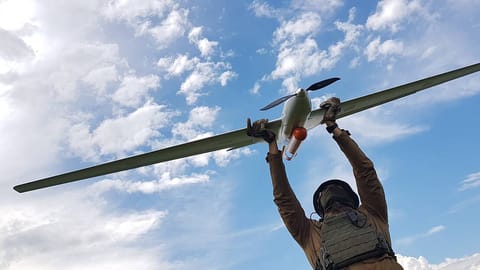
Welcome to this week's edition of The Briefing Room, the exclusive Frontstar Co. show that delves into the stories everyone else is ignoring. I'm Simon, and this week we're staying laser-focused on Eastern Europe, where Ukraine has recently announced its intention to start exporting its cutting-edge FPV drones.
Venice has skipped north to Estonia, where a long-awaited intelligence report has revealed some fascinating things about Moscow's future plans.
First up, though, we're checking on one of the most dangerous jobs in the world, being a general in Russia's army, as a new campaign to kill the Kremlin's officers seemingly gets underway. Once again, thank you, specifically you, for subscribing. That's not true.
Thank you, dear audience. Thank you, subscribers. Appreciate you.
You guys absolutely allow us to produce this more niche content, as well as supporting the main show over on YouTube. And now, let's delve the f**k into our first story. Heaven's feeling spicy today.
That's how we roll in our house, baby. For our main story this week, we turn our attention to Russia to talk about the job markets. Not the entire job market, which is facing an acute labor shortage, but one job in particular.
Now, before the invasion of Ukraine, this job was absolutely coveted given the presumably high salary and access it afforded. After the war began, however, it went from coveted to something most people would actively try and avoid. The job?
Being a general in Russia's army. Other than frontline soldiers, few positions have fared as badly since the start of the war. At least 13 generals have been killed in Ukraine alone, and several others have been targeted within Russia.
Again, multiple, high-ranking, Russian military officials have been targeted and killed within Russia's own territory. The most recent target? Lieutenant General Vladimir Alekseyev, deputy head of the GRU, Russia's military intelligence agency.
British outlet The Independent reported that on Friday, the 6th of February, Alekseyev was shot several times by an unidentified person in a residential building of northwest Moscow. He was rushed to hospital, where, according to Russian media reports, he underwent surgery and has since regained consciousness.
According to Shashank Joshi, defense editor at The Economist, Alekseyev was the top intelligence officer for Russia's invasion of Ukraine and oversaw planning for the long-range strike campaign that later unfolded, which might explain why he was targeted.
He had previously been the target of American sanctions for his role in meddling in the 2016 elections, and British sanctions for his role that he played in the assassination of Sergei Skripal, a former Russian intelligence officer who became a double agent for the UK. Certainly a very diverse portfolio.
Moscow immediately blamed Ukraine, with Russian foreign minister Sergei Lavrov, describing the attempted assassination attempt as an act of terrorism and meant to derail the peace negotiations.
Ukraine, on the other hand, denied any involvement in the shooting, with foreign minister Andriy Sibir, telling Reuters that Alekseyev was probably a victim of Russian infighting. Moscow also launched a manhunt for the suspect.
F and they've so far arrested three individuals first lubomir korba a ukrainian-born russian citizen who is believed to be the shooter he allegedly fled to the uae before being extradited back to russia russia claims that he was recruited by ukrainian intelligence in 2025 underwent training in kiev and was paid monthly in cryptocurrency the other two
Individuals of victor and pavel vasin a father and son who are believed to have aided korba investigators also identified a fourth co-conspirator zineda serebritskaya who they believe fled to ukraine after the shooting by itself the attempted assassination is an interesting but unremarkable story after all this is a war and such attacks are to be expected
What makes it really interesting is what it and all the attacks inside russia say about moscow's security apparatus joshy argues that even if the assassination failed it exposes the incompetence of the fsb russia's security service which seems unable to prevent ukraine's daring raids and cover operations deep inside russia when we say deep we mean it that's
Why i emphasized the word the way i did the attack happens just 12 kilometers from the kremlin the fsb jesus that's a special level of incompetence the fsb is russia's principal security agency has been failing spectacularly at its core mission of keeping the country safe between drone strikes on airfields hundreds of kilometers inside russian territory and
Car bombings in residential neighborhoods of moscow ukrainian intelligence has demonstrated an ability to operate with relative impunity in what should be one of the most heavily surveilled countries in the world this has to sting for a country that prides itself on its counterintelligence capabilities but it's not just the fsb that's failed the gru which is
Tasked with military intelligence hasn't fared much better in protecting its own the repeated assassinations suggest that it has failed to cultivate the networks needed to detect ukrainian operatives before they strike whether these embarrassments will lead to any meaningful change is hard to say history though suggests not putin has shown a remarkable
Tolerance for intelligence failures from the botched predictions before the 2022 invasion to the fsb's inability to prevent the crocus city hall terrorist attack in 2024. according to former cia officer sean wiswester putin cannot afford to hold his intelligence services accountable because they are not merely instruments of the state but pillars of his
Personal power in wiswester's view the most likely outcome isn't reform rather the russian services are likely to try and pin any blame on each other while these are embarrassments for russia they represent a significant opportunity for the west the chaos created could provide cover for western intelligence agencies to expand their own networks and collect
Even more intelligence as russian security services scramble to plug leaks and hunt for ukrainian operatives they have fewer resources to devote to counterintelligence operations against nato agencies western agencies could also exploit the chaos to ramp up the recruitment of russians who are disillusioned with the war and specifically target personnel cross
Rushes intelligence services, many of whom will have lost friends and colleagues in the fighting.
Finally, we have to examine whether the latest assassination attempt will have any impact on the ongoing negotiations. In our view, it doesn't seem likely. Moscow has already blamed Ukraine for trying to derail negotiations, but that's mostly posturing.
Both sides understand that this is the cost of war. Ukraine sees these generals as legitimate military targets responsible for ordering strikes on civilian infrastructure. Russia, meanwhile, continues to launch missiles and drones at Ukrainian cities, even while sitting at the negotiating table.
This isn't going to change anytime soon. So until the war comes to an end, the hunting will continue, and being a Russian general will continue to be one of the most dangerous jobs in the world.
Sticking with Eastern Europe, it's time to move on to our next story, the big news that Ukraine has made the long-awaited decision to open its defense industry to foreign markets.
To understand just why that decision is so important, we need only to look as far as Ukraine's front lines, where the nation's war effort has been fueled by vast contributions from over 1,000 arms manufacturing companies nationwide. Ukraine's defense industry is a far cry from, say, America's Lockheed Martin or China's Norinco Group.
Instead, it is positively overrun with startups, garage companies, and independent privately owned ventures working in a constant iterative process.
On Ukraine's front lines, technology evolves with stunning speed, and Ukraine's defense producers have proven themselves to be unlike any other defense industrial complex on the globe.
They're incredibly adaptable, they're able to use real-time battlefield data at scale to inform their decisions, and they're prioritizing specific types of equipment like drones, sensors, and other affordable but high-tech hardware that have proved immensely important on the model battlefield.
Right now, the efforts and the resources of those companies are directed almost fully toward Ukraine's own defense.
Individual experts might travel the globe, sharing observations and advocating change in the Western defense industry, but Ukraine has insisted that whatever those producers can make, Kyiv should funnel toward the battlefield.
That hasn't stopped Ukrainian and international defense experts from recognizing the broad of truth, that in the crucible of this war with Russia, Ukraine has developed a hell of an arms industry, churning out lots of equipment that Western and other nations would really like to buy whenever they can.
In fact, there's a strong argument that Ukraine could credibly stand alongside Turkey and South Korea, the world's two fastest-growing arms producers, by a wide margin, except for the fact that Ukraine's defense industry is locked into an ongoing conflict.
Or at least it was locked into a conflict, until this week when Ukrainian President Vladimir Zelenskyy announced that Ukraine's domestically produced weapons are finally heading to the export market. According to Ukrainian officials, the decision is largely a pragmatic one.
At this point, Ukraine's defense industry is producing hardware faster than Kyiv could buy it. while constantly expanding its capacity to churn out more and more kit.
The defense industry has some incredible momentum right now, and as long as orders and funds keep rolling in, that momentum will continue. But Kiev is facing a growing cash crunch, and now the time is right to alleviate some of its defense burden by allowing other nations to pour their wealth into Ukraine's defense industry.
Of course, those other nations wouldn't simply be giving donations, they'd be buying equipment of their own, but because Ukraine can't keep up with equipment production anyway, it's a perfect time to allow some of Ukraine's newest hardware to flow across its borders.
The change comes at a critical time for the nations of Europe, as they raise defense spending toward a 5% threshold of their GDP in the next several years and work to rebuild their stocks of warfighting equipment.
Some of Europe's most important gaps in the current militaries of European nations are centered on high-tech emerging weapons systems like drones, or that is to say, exactly the sort of hardware that Ukraine is best at building.
Over the last year, Ukraine has started to collaborate with European defense companies by providing their designs for outside companies to build, most prominently in a joint drone production initiative in the UK.
But now, Ukrainian manufacturers will be able to either build their hardware in Ukraine before exporting it elsewhere, or even better, bring their personnel and designs to other European countries in order to set up shop. According to Zelensky, the Ukraine is already working to do that.
In 2026, the nation is expected to open up 10 export centers for Ukrainian weapon systems located all around Europe.
Aerial combat drones are expected to be a key priority, as well as electronic warfare systems and Ukraine's highly innovative sea drones. One of those export centers is expected to begin production this very month in Germany, although the precise company involved in that effort has not been identified.
The rest will be split among the Baltics and the nations of Northern Europe.
According to estimates by the Kyiv School of Economics Institute, the financial benefits for Ukraine could be massive. Its defense sector was already estimated to be worth US$15 billion in 2025, but it's believed to have up to US$35 billion worth of unused, existing production capacity simply because Ukraine couldn't fund all that production by itself.
According to the institution's numbers, Ukraine could build production capacity worth US$50 billion each year as soon as 2028, if Europe places orders as expected.
The boom also offers one other tangential benefit for Ukraine, the ability to offshore its weapons production, even amidst an ongoing full-scale war.
While recent Russian attacks against Ukraine have prioritized civil energy infrastructure, Ukraine's defense industry is a juicy target for Russia too, and as companies and production lines grow larger, Ukraine's most important defense industrial targets become harder to hide.
But if those facilities are on NATO territory, then even while the war continues, Ukraine can rest assured that those assets will not be targeted, at least using conventional means.
While sabotage, cyberattacks, and other hybrid methods will still be in Russia's arsenal, the most important part of Ukraine's defense industrial complex can otherwise be kept safe for the rest of the war. So too will it remain safe on NATO territory. even in a post-war world where Ukraine cannot join the alliance outright.
And finally, we turn to the nation of Estonia, where if Tallinn's intelligence service is to be believed, then the entire Western world might have gained a reprieve from the specter of future Russian aggression.
NATO nations have made no secret of their fears around Moscow's ultimate intentions, with intelligence services from across the alliance in general agreement, that at some point, and possibly as early as 2027, Russia was going to try and challenge NATO with a direct act of military aggression.
But in a report this week by Estonia's foreign intelligence service, the country's spies claim that Russia is now not expected to attack any NATO member state within the next two years. After a jarring, chaotic, and very messy start to Europe's push toward rearmament, the continent can take a sigh of relief.
According to Estonia, that rearmament push worked. Estonia's findings were released in the nation's annual intelligence assessment, a document that's eagerly anticipated by defense officials and analysts across the Western world.
Partly to cope with Estonia's very small size, the nation's intelligence services are regarded as among the best in the world, and because of Estonia's obvious proximity to Russia, its intelligence efforts are firmly focused on the threat from Moscow.
According to the report, Russia's recent defense decisions, its recent moves to reorganize its military, and some recent changes to its military-industrial complex all suggest that Russia is no longer prioritizing a probing attack against the NATO alliance.
Options like a limited takeover of NATO territory, an armed and obvious violation of NATO airspace, or an attack on particularly vulnerable nations like Estonia now appear to be contrary to the sorts of actions that Russia seems to be preparing for. Quoting the report, Russia has no intention of militarily attacking Estonia or any other NATO state in 2026.
We are likely to reach a similar assessment next year because Tallinn and Europe have taken steps to compel the Kremlin to calculate very carefully what, if anything, it can risk attempting. The implications of that finding are absolutely game-changing for NATO, and they imply that NATO has been successful on multiple fronts simultaneously.
For one thing, despite NATO's relatively sluggish efforts to revamp its military and especially its defense industrial production, its improvements do seem to have made Moscow think twice about what Europe could be capable of.
For another, this change in Moscow's calculus would seem to suggest that Europe's efforts to improve its infrastructure, its rapid response times, its forward deployment, and other key features of its armed deterrent have sufficiently dampened the Kremlin's ambitions.
Finally, the change also implies Moscow's shifting perceptions of NATO's willingness to fight, which could be the most important development of all.
While NATO has very pointedly refused to take dramatic action against recent Russia and shows a force whenever dramatic action can be avoided, the alliance has treated recent Russian provocations very seriously, and Estonia's observations would suggest that NATO's seriousness was enough to change Moscow's thinking.
That's not to say that Russia has simply abandoned the idea that it would be a military power in the future. In fact, Estonia's rapport found precisely the opposite. But now, instead of planning to provoke the NATO alliance, Russia is shifting into a posture of coordinated, long-term deterrence against Europe.
That is to say, in the span of a couple of years at most, Russia has gone from wanting to take action against Europe to wanting to make sure that Europe doesn't attack Russia.
As such, Russia is working hard to grab its military-industrial complex to spy sanctions, focusing on high-volume, low-tech munitions that Russia can produce quickly, to cope with NATO's clear advantage in high-tech defense. The report provided specific numbers in a few key areas.
In 2025, Russia allegedly produced 3.4 million artillery shells, 2.3 million mortar rounds, half a million rockets, and 800,000 pieces of ammunition for tanks and infantry fighting vehicles.
In total, Russia purportedly spent the equivalent of 12.6 billion US dollars on the effort, with that figure being so low in comparison to NATO spending because Russia has focused its efforts on building affordable, low-tech hardware.
As NATO has understood for some time, Russia favors sheer quantity over quality, hoping that it can lure adversaries into grinding attritional battles where Russia is at its best.
Estonia's report also points out improvements across the Russian military, many of which mirror improvements observed on Ukraine's frontlines.
Russia has purportedly integrated unmanned drone warfare principles and hardware across all branches of its military, suggesting that in future wars, the presence of high-saturation Russian drones should be a core expectation for NATO forces.
In particular, Estonia pointed out the Russian navy's new fleets of sea drones optimized for a mix of intelligence, precision strike, and indirect strike operations in future conflicts.
As with Russia's artillery and other ammunition production, the report points out that production in these areas exceeds current expenditures in Ukraine, meaning that Russia is actively stockpiling munitions and drones for future conflicts, even as it wages war on its flank.
Geopolitically, the report indicates that despite U.S. President Donald Trump's apparent fondness for Moscow, Russia still considers the U.S. to be its primary global adversary, even if the U.S. is manipulated more easily today than it generally tends to be.
In all, the report does encourage European leaders to breathe a sigh of relief, but that relief should be sharply tempered by the larger reality at play.
Russia isn't planning for any immediate provocation, at least according to this assessment, but it is planning for years and probably decades of stockpiling and deterrence in order to keep Europe at bay.
Of course, whether Europe needs to be kept at bay is another question entirely, and it seems like a fairly notable flaw in Russia's strategic calculus to believe that Europe, in its current form, would have any interest or ability to attack Russia outright.
Even still, the best way to deter an adversary that's stockpiling weapons is to stockpile weapons, and it appears that Europe will be in that position for a very long time.
Quoting the reports forward by Estonian intelligence director Kaupo Rossin, Russia remains a dangerous country despite its incompetence and vigilance is necessary to prevent the expansion. vision. So, that was a good sign of M-Roy, it's a counter-class system.
Unless it was a good sign of M-Roy, it is a good sign of the shield, but it's not to have a good sign of M-Roy.
But, in the way, an L-Roy will not be at the same time to take the shield. Thank you for its skill set, and this is not to say a good sign of the Mandel M-Roy. Deutsch and the priest explained to be the same source of the mention.
You of the Russian world.
Unlock premium video briefings
Members get full access to premium reporting, in-depth briefings, and subscriber-only analysis.
Insiders Receive
- Full access to all premium articles and briefings
- Exclusive subscriber-only analysis and dispatches
- Support independent conflict journalism
From $5/month — cancel anytime