
Briefing Room 3.14.26: Chinese Missiles Appear in Serbia; Destabilization in the Sahel; Moldova Turns Up the Pressure.
China delivers advanced supersonic missiles to Serbia, JNIM expands across the Sahel into Benin while Russia's Africa Corps falters, and Moldova seizes on Russian distraction to push for Transnistrian reintegration.
Simon Whistler • March 15, 2026
Members only
Note: this transcript was generated by AI and may contain errors or inconsistencies.
Welcome back to the Briefing Room Front Stalko's weekly respite from the ongoing war in Iran as we turn our attention to simmering crises and geopolitical intrigue across, you know, the rest of the world.
Today, we are going to be discussing the arrival of new Chinese weapons in a rather notorious European arsenal, widening destabilization by several insurgent actors in Africa's Sahel region, and the plight of a longtime Russian ally in the Moldovan separatist region of Transnistria. Across our discussion, we can promise three things for you.
Consistent bad news for Moscow, consistent surprises by national and local governments rising on the international stage, and just eight remaining utterances of the word Iran, three of which will get out of the way right now. Iran, Iran, Iran!
As always, thank you so much for your support and your interest in the important geopolitical developments happening outside the global headlines.
Let's jump into it. Chinese missiles appear in Serbia. China and the nations of Europe are not direct military competitors, or at the least, not right now.
But when Chinese ballistic missiles suddenly show up in the arsenal of a rogue European military, it's understandable that European defense leaders might be a little bit uneasy about that.
And that's precisely what happened several days ago, when the nations of Serbia revealed that it had come into possession of a Chinese weapon without compare in any arsenal across the European nations of NATO.
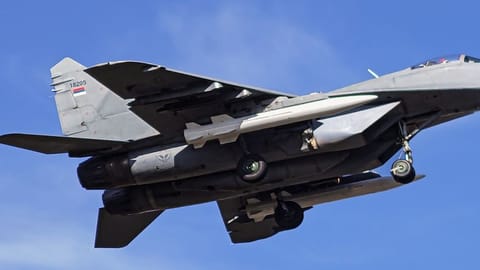
The weapon's known as the CM-400, and on the 9th of March, a pair of CM-400 missiles showed up in a photograph hanging off the underwing pylons of a Serbian MiG-29.
Now look, Serbia has been signaling to the rest of the world for a little while that some sort of major weapon reveal was coming.
As the war zone explained, the head of the Serbian military had recently alluded to air-launched missile capabilities that didn't match anything in the known Serbian arsenal and that would exceed the range of existing Serbian hardware.
The nation's president, Alexander Vucic, piled on, quoting him, people couldn't dream about everything we have, everything we are acquiring.
They couldn't dream. Sounds vaguely Trumpian, doesn't it? Of course, that's not exactly true.
The CM-400 is hardly a wonder weapon by modern standards, but it is a highly significant addition to the Serbian arsenal nonetheless. It packs a hell of a bunch. It can be fitted out with a high-explosive warhead or a larger armor-piercing warhead, with the latter weighing in at 200 kilograms or 440 pounds.
Its range is a bit more relevant, officially reported at 250 kilometers, but rumored to travel as far as 400. It can be configured as an anti-radiation missile, but is generally discussed in context of anti-ship capabilities, even being referred to, at times, as a carrier-killer missile.
It's a standoff weapon meant to guide itself autonomously to its target once it's fired, and it's capable of fulfilling that mission in all weather conditions.
But the missile's most notable for its speed, coming in somewhere around 4.5-5 times the speed of sound. It's not a true hypersonic weapon, it's not known to be able to alter its trajectory mid-course like a hypersonic cruise missile would, and it's not known for sure that the missile even travels fast enough to qualify, but...
But as exhausted defense experts have worked to remind the world for many years now, the hypersonic distinction is often just a buzzword.
The much more important question is capability. And at least on paper, the CM-400 is a highly capable weapon. More importantly, it's a weapon with no real equivalent across the European militaries of NATO.
The storm shadow by Britain and France is stealthier and more precise, but also about seven or eight times slower. The Taurus KEP D350, made by Germany and Sweden, boasts a longer range and a bigger warhead, but still doesn't push past the sound barrier.
Other weapons in NATO arsenals are plagued by similar issues, and none of them can combine air-launched capability with speed, range, and firepower in the way that China's can.
Worse still, for European leaders, this was not a system that was supposed to show up on the continent any time soon. The missile has purportedly been in active service since the early 2010s. And to this point, China has only ever shared it with Pakistan, one of Beijing's most trusted international partners.
Pakistan claims to have used the weapon successfully in strikes against India in 2025, although those claims haven't yet been externally verified or supported with indisputable evidence from either Pakistan or China.
So, for the missiles to have been surreptitiously shipped off to Serbia, that violates a range of expectations around both the missiles themselves and the ways that China intends to use them.
Now, even though Serbia has a rather antagonistic track record when it comes to modern European relations, understatements of the month we know, we should be clear-eyed about the risks that this does and doesn't pose.
It's not technically impossible that in some near-future catastrophe, those missiles could be turned against Europe, but that is hardly a likely outcome. For Serbia to pick a fight with Europe under any circumstances, well, that would be a bad idea.
At worst, in a hypothetical conflict between Serbia and one of its neighbors, the missiles could conceivably be used as a deterrent against European intervention, but even that could fairly be regarded as an empty threat.
The more compelling question is this, why did China choose this moment not only to provide these weapons to Serbia, but to sign off on Serbia's decision to reveal their existence? The obvious answer, of course, would be to dig at Europe and the United States.
Here's China making high-tech arms sales in Europe, a place where Washington has had a near monopoly on arms sales for a very long time.
China's providing advanced weapons to a nation that often acts at cross-purposes with the rest of Europe, increasing the threat level that Serbia presents and tacitly endorsing Serbia's approach to the Balkans, where these and other Serbian weapons are most likely to be used. But the real audience might not be Europe, but Russia.
Moscow has been Serbia's primary arms guarantor since Moscow was the capital of the Soviet Union, and even the aircraft that Serbia used to carry its Chinese missiles was the Soviet-era MiG-29.
But right now, the rest of the world is watching as Russia fails to support one long-time partner after another. Armenia, Syria, Venezuela, and now Iran. In Europe, the only nation closer to Russia today than Serbia is Belarus, itself little more than a Russian vassal state.
When Russia attempts to project some degree of power and influence into Europe, especially after its full-scale invasion of Ukraine, that power usually goes furthest when it's directed through Belgrade. So for China and Serbia to reveal such a significant weapons exchange now may make European nations nervous. But for Russia, it adds insult to injury.
Russia has failed to support Iran in the ways that much of the world might have expected, and as a result, it's losing the faith of its remaining allies faster than ever.
Now here's China grinning wide and striking deals with one of Russia's most important geo-strategic partners and presenting itself as the non-Western security guarantor a nation would really want if they had any intention of standing up to NATO.
Destabilization in the Sahel Next up, let's turn our attention to the African Sahel, where the Al-Qaeda-linked insurgent terror group Janim appears to be expanding its reach and adding new nations to its target list.
At the peak of the regional dry season, Janim seems to be moving too quickly for local governments to keep up, outpacing even Russia's Africa Corps and clearing the way for other insurgent groups to claim victories of their own.
Headed into the month of March, Janim had been concentrating a fairly large share of its forces in northern Burkina Faso, particularly in and around the town of Titao. A strategically located settlement, Titao has been plagued by insurgent attacks for years, intensifying across February with a pair of mass casualty attacks by Janim.
In the more recent attack, carried out on the same day that the U.S. and Israel launched their offensive against Iran, Janim claimed to have killed 30 Burkina Faso soldiers, delivering the latest in a long line of setbacks for Ogadogu.
Now, though, Janim's attention appears to have shifted all the way across Burkina Faso and past its southeastern border and away from the other two military-led nations where Janim tends to focus its offensive, Mali and Niger.
Instead, Janim has been probing into northern Benin, where the group had established a foothold and carried out two large attacks against the nation's military last year.
Since that time, Janim had mostly ignored Benin, but that changed last week, where the group attacked a secluded military outpost and overran the site. At least 15 soldiers were killed, trying to defend their position. Before long, Janim demonstrated that the attack was far from an isolated incident, with an attack on a larger military camp on 7 March.
While Janim was pushed back from the area, it managed to capture large stockpiles of weapons and ammunition before retreating, and Beninese soldiers reportedly suffered heavy losses. The nation's military continued to engage Janim across the following few days, killing 17 of the group's fighters in a counterattack.
For Janim, the decision to push into Benin seems to have been partially motivated by pure opportunism.
Benin is dealing with significant internal challenges right now, coming up on a contentious presidential election and reeling in the aftermath of a coup plot that nearly succeeded. last December. Partially, though, Janim appeared to be responding to a challenge from insurgent rivals.
A few weeks ago, a former Janim commander had defected to the Islamic State and then accused Janim of forming ceasefire agreements with Benin and the Ivory Coast, ceasefires of course being a real jihadist faux pas.
So not only is Benin a particularly convenient target for Janim right now, but the organization's got a point to prove about its willingness to demonstrate its wrath against any government in the region.
That's a high priority for Janim right now, as the rise of other more extreme groups in the region, especially the Islamic State, means that Janim is at a risk of losing its reputation as the most dangerous, effective insurgent actor across the Sahel.
Meanwhile in Mali, Janim has forced the nation's military government to rethink its security partnership with foreign governments.
This week, Mali was delivered yet another reminder that the Russian Africa Corps, the successor to the mercenary Wagner Group, are not nearly as effective as Russian rhetoric had hyped them up to be. In Mali's Sego province, Janim killed at least six Africa Corps soldiers, with videos showing the mutilation and execution of Caucasian men at the site.
Those acts of mutilation are partly a spectacle, but they're also meant to deliver a very specific message.
Russians, and their Malian counterparts, are known for exceptional brutality against civilians in rural areas, and displays of pre-execution violence against Africa Corps soldiers as a form of public retribution. The killings come, as Mali's faith in the Africa Corps seems to be slipping, and for good reason.
The recent article in the Africa Report explains that Russia troops are participating far less frequently in frontline skirmishers than they used to, as they've become far less flexible and effective than their Wagner Group predecessors.
Many of the most talented or experienced mercenaries who aided Mali back in the Wagner days are long gone, and the troops who remain are sharply constrained by the Kremlin.
In an indicator of just how bad the problem has gotten, Reuters reported last week that the United States is on the verge of sealing a new intelligence-sharing deal with Mali, allowing American drones and aircraft to operate over the country's airspace.
That deal has slowly been coming together over the last few months, but the fact that Mali is considering that prospect at all is a testament to the ways that Russia disappointed a regime that swore off Western support just a couple of years ago.
As Dunyam continues to destabilize the region, other insurgent groups are taking full advantage. In the nation of Niger, where the Islamic State, Sahel Province, led a brazen assault on the country's largest airport back in January, Islamic State fighters have now launched another major attack against an airbase.
While the attack was purportedly pushed back, the idea that the Islamic State could attack a major airbase at all and have a chance at success this soon after the embarrassment of the January attack in Niamh is a clear indictment of the state of Niger's defenses.
In Mali, however, it was the country's Touareg rebels that drew the interest of war watchers across the globe when, on the 11th of March, Touareg fighters launched one of their most sophisticated attacks ever. On that day, they sent a swarm of roughly 25 kamikaze drones to attack an airport where Mali forces their heroes have been worshipped.
I don't know. and their Russian advisors were known to operate.
Not only is that the largest known drone swarmed by an insurgent group in the history of Sahel warfare, but it was most likely an act of proxy warfare after Toreg fighters have received direct training in drone swarm tactics from Ukraine.
Moldova Turns Up For Pressure And for our final story this week, we turn our attention to Eastern Europe, specifically to the nation of Moldova and its Russian-supported breakaway state of Transnistria, where for the past few months, one of the most interesting geopolitical developments has been happening with most people, none the wiser.
According to Balkan Insights, the balance of power in Transnistria is changing fast, with Moldova getting stronger while the breakaway region is getting weaker because Russia is too distracted to adequately support it.
For the better part of four years, Russia has been consumed by its war in Ukraine, a war that has stretched Moscow's military, economic, and diplomatic resources to their limits. The estimated 1,500 Russian troops stationed in Transnistria since 1992 have been effectively cut off since Ukraine closed the border in February 2022.
This has severely restricted Russia's ability to reinforce or resupply a garrison that once served as a key lever of influence over Moldova.
With the outbreak of war in Iran, Moscow has chosen to double down on attacking Ukraine, with limited attention given to Iran, calculating that Washington will be too distracted with what's going on in the Middle East to give Ukraine the diplomatic or military support it needs.
The result is that Transnistria, already an afterthought given all the logistical hurdles, has slipped even further down the Kremlin's list of priorities. And Chisinau has seized on this opportunity like a dog with a bone.
The most immediate issue for Transnistria is its energy supply. For more than three decades, the breakaway region relied on free Russian gas supplied by Gazprom, a lifeline that propped up an otherwise uncompetitive industrial base and filled the coffers of the separatist authorities.
The economic impact has been severe, with reports indicating that Tiraspol's economy contracted by 18% in 2025, with a 30% collapse in industrial production and almost 15% inflation.
Per capita GDP in the breakaway region now stands at about $4,800 compared to about $8,400 in the rest of Moldova, which is a significant difference, especially for a region that built its identity on the promise of Russian protection and prosperity. And the crisis is about to get worse.
According to a statement issued by the Transnistrian government, the war in Iran has disrupted supply chains meaning the government wouldn't be able to meet the region's energy demands.
Additionally, Balkan Insights reported that Russia was having trouble paying for gas supplied to Transnistria by a Hungarian company via intermediaries in Dubai. This has forced Transnistria to change the fuel powering the Kurgan thermoelectric power plant that supplies electricity to the whole region from gas to coal, which is a lot less efficient.
As a result, heat and hot water are only being delivered to household users and not industrial users.
This crisis comes at the worst possible time for Transnistria. In late February, Moldova's president, Maa Sandi, signed a decree that stripped Moldovan citizenship from nine members of the separatist administration. Stanislav Sekriari, an advisor to the president, put out a statement saying that those who were targeted were working for Russia.
Apart from revoking citizenship, Chisinau has been pushing bills through parliament that would make integration faster. One of these bills would see businesses based in Transnistria pay taxes under the same rules that apply across the rest of Moldova.
Revenues collected from the region would be channeled into a dedicated development fund indebted to support Transnistria's gradual economic integration.
Additionally, according to the Romanian daily Adoverall, Moldova has been working with the US and the EU on a broader reintegration plan in a process that officials described as sensitive and requiring full discretion. Taken together, all of this paints a picture of a nation that has had enough of its breakaway region and is ready to bring it to heel.
Whether this strategy will actually work, that's another matter entirely.
There are several significant obstacles that do need to be overcome before integration can successfully happen.
The most important is economics, because according to the Speaker of Moldova's parliament, Igor Grossu, reintegration could cost anywhere from $430 to $540 million a year, which would mainly cover gas supplies, pensions, medical insurance, and education financing.
That is an astronomical sum, especially when you consider that Moldova's entire state budget for 2026 is roughly $5.4 billion.
In other words, absorbing Transnistria would add about 10% to government spending overnight. Second, according to the Center for Strategic and International Studies, CSIS, although 90% of Transnistria's residents hold Moldovan citizenship, the region's predominantly Russian-speaking population has been conditioned for decades to view Moldova as foreign.
There's also the fact that many of these residents hold dual citizenship, with some estimates suggesting that around 50% have Russian citizenship.
And speaking of Russia, while the Kremlin's focus is currently elsewhere, the roughly 1,500 Russian troops stationed in the region are a physical reminder that Russia has not abandoned its claim. We also need to talk about the Transnistrian elite.
The region's economy is dominated by the Sheriff Corporation, a conglomerate that, according to one report, controls about 60% to 70% of Transnistria's economic activity, from retail to fuel, telecoms, and the media.
Sheriff's owners have benefited enormously from Transnistria's grey zone status, and they have little incentive to welcome Moldovan anti-corruption reforms or EU regulatory standards. Despite all of these headwinds, there is significant momentum toward reintegration for the first time in three decades.
A recent poll found that approximately 45% of Transnistrians support reintegration with Moldova, and indicated that economic realities were pushing Transnistrians towards reunification with Moldova.
Now it's up to Moldova to prove that it can close the deal. The windows open. But windows close, Russia will not stay distracted forever, and Transnistrian elites will not sit idly by while their power erodes.
Unlock premium video briefings
Members get full access to premium reporting, in-depth briefings, and subscriber-only analysis.
Insiders Receive
- Full access to all premium articles and briefings
- Exclusive subscriber-only analysis and dispatches
- Support independent conflict journalism
From $5/month — cancel anytime