
Briefing Room 14.11.25: Kenya's Growing Threat of Intercommunal Violence
Briefing Room 14.11.25: Kenya's Growing Threat of Intercommunal Violence — a Fronts video briefing on Africa.
Simon Whistler • November 14, 2025
Members only
Note: this transcript was generated by AI and may contain errors or inconsistencies.
Welcome back to The Briefing Room, the weekly show that gazes upon a world of media filled with stories about gerrymandering, the US shutdown ending, and AI stock sell-offs, and whispers to itself, Oh, you sweet summer child.
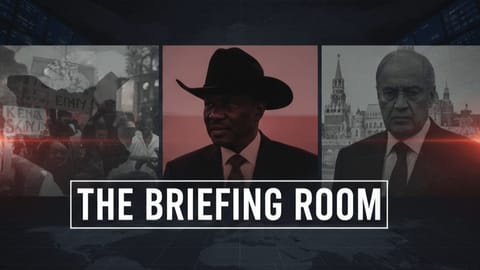
I'm Simon Whistler, and this week we're once again diving into stories away from the regular headlines to focus instead on stuff like the latest purges in an increasingly unstable South Sudan, or these swirling rumors that Russia's Minister of Foreign Affairs, Sergei Lavrov, may have fallen out of favor with Vladimir Putin.
But before we get into that, we're turning this episode's focus towards Kenya, where a recent report has suggested that tribal divisions are on the rise, divisions that could yet lead to a repeat of 2007's widespread post-election violence.
As always, thank you so much for being a subscriber. Without your contributions, we'd be unable to cover these sorts of under-the-radar stories. And with that said, let's zoom in on Kenya and the worrying possibility of increased tribal violence.
Is Kenya on the Brink of an Ethnically Charged Conflict? For our first story, we turn our attention to the East African nation of Kenya, where the specter of ethnically charged violence is, once again, raising its ugly head.
In late 2007, after a hotly contested election between incumbent president, Mwak Baki, and opposition leader, Rehla Odinga, Kenya descended into chaos.
Hundreds were killed, hundreds of thousands were displaced, and the country seemed to be on the brink of all-out civil war. The fact that it didn't get to that point is a testament to how quickly the international community mobilized, brought the two principles together, and ironed out a power-sharing agreement.
Despite this apparent victory of diplomacy over violence, the UN warned that Kenya was still susceptible to violence in future elections, unless institutions were strengthened and the perpetrators brought to justice.
And this almost happened. A BBC investigation revealed that communities in the Rift Valley, one of the region's hardest hit by the conflict, were purchasing sophisticated weapons, including the AK-47S and G3 rifles, in the lead-up to the 2013 elections. While these elections were extremely tense, the nation didn't devolve into bloodletting for two reasons.
One, the images from the 2007-2008 post-election violence were still fresh in people's minds, and no one wanted a repeat of what happened. And two, the government had invested extensively in trying to address the root cause of the conflict.
This had involved establishing the National Cohesion and Integration Commission, or NCIC, tasked with promoting national unity and eliminating ethnic discrimination, implementing a new constitution meant to ensure that all communities felt included in the government, and conducting extensive education campaigns on the risks of tribalism.
The success of these programs became most apparent during the 2024 Gen Z protests, when the youth declared that they were tribeless, leaderless, and fearless.
It was something that even President Ruto, otherwise no fan of the protesters, celebrated saying, in a speech and we'll quote him here i am very proud of our young people they have stepped forward tribalist and peacefully to engage in the affairs of their country this isn't to say that tribalism has been completely eliminated far from it in fact rather the
Youth were signaling their desire to move beyond the ethnic divisions that had defined kenyan politics for decades however according to odepodev data analytics and research firm and tribalist youth a community-based organization the dream of a tribalist kenya appears to be evaporating the study which analyzed over six million posts on x between the first of
January 2024 and the 31st of october 2025 found that kenya's online spaces had become more tribal than a year before the researchers saw a significant spike in the number of negative ethnic posts going from 39 in 2024 to 49 in 2025 while neutral posts fell from 44 to 37 during that same period narratives of regional unity tribal loyalty and historical
Grievances have crabbed back into the national conversation what was most alarming according to colin zamolu a journalist at the kenyan outlet the daily nation is the fact that the narratives are spreading fast and are no longer confined to political rallies or speeches they are amplified by influencers ordinary kenyan internet users and through coordinated
Disinformation campaigns designed to inflame divisions and there is fear that with the 2027 elections on the horizon this increase in ethnically charged content could lead to the same or even greater levels of violence than experienced in 2007. in an interview with the daily nation patricia and dango head of research at odepodev put it this way as we move
Close to 2027 and bearing in mind what happened in 2007 and 2008 what we are creating is animosity of tribes the possibility of violence becomes high end quote what makes the situation even more precarious is that the world has fundamentally changed since 2007 back then the international community moved quickly to intervene un secretary general kofi anan
Arrived in kenya the united states and european union applied pressure and within weeks there was a mediation process underway the speed of that response helped prevent kenya from tipping into full-blown civil war but look what's happening now in places like sudan and tanzania where despite evidence of mass killings and in the case of al-fasha bloodstains
And mass graves that are visible from space the international community's response has largely been relegated to vague statements of concern that well somebody should really do something about this for kenya the message is clear if the country descends into violence in 2027 you cannot count on the swift international response that helped stabilize things two
Decades earlier now we have to be clear the violence is not inevitable and that despite the increased ethnic tensions kenya could very well have a peaceful election in 2027 as the researchers noted in their report many and he'll you online users are not taking the bait and are pushing back against attempts to balkanize the country.
However, we also have to be honest about the risks.
The tribalism that youth rejected in 2024 is being deliberately resurrected by political actors who see ethnic mobilization as their path to power. If they are successful, then the progress that the country has made since 2007 could be completely erased. That's why the alarm bells need to start ringing now, not in 2027, when it might already be too late.
Salvaqir Takes Control For a man who's supposedly on death's door, South Sudanese leader Salvaqir never seems to tire of finding new and inventive ways to shake up his government.
This Thursday, South Sudan's Stetson-hat-obsessed president showed his own vice president, Benjamin Balmel, the door in a move that calls into question everything that the international community thought it knew about South Sudan's future.
Now, Benjamin Balmel was no ordinary vice president in the way that onlookers from, say, the United States would understand the post.
For one thing, Balmel was one of five people to hold the post of vice president simultaneously, along with a handful of trusted members of Salvaqir's inner circle and his mortal enemy, the currently suspended opposition leader, Reik Machar, who's undergoing trial on charges of murder, treason, and crimes against humanity.
But the fact that Benjamin Balmel was one of five in his post doesn't mean that he was irrelevant. In fact, he's very much the opposite.
Up until this week, he was widely understood to be Salvaqir's chosen successor, and based on a number of reports about Qir's poor and deteriorating health, it seemed as if Balmel might have assumed the presidency sooner rather than later. But today, Benjamin Balmel is out on his ass, and nobody in South Sudan, aside from Salvaqir himself, seems to know why.
He was not only stripped of his post as vice president, but his position as the deputy leader of Qir's political party, the Sudan People's Liberation Movement, and in the nation's military, where he previously held the rank of general, he's now a private.
With him went several other figures from across South Sudan's government, including his party's now former secretary-general, and the now former governor of the National Bank.
According to some sources, Balmel has now been placed under house arrest, although you'd never know it from his social media posts, where he expressed his quote, deepest gratitude to Salvaqir for quote, the honor of serving our nation. Balmel's wife, currently serving as the nation's council general, appears to have kept her post as of now.
For global analysts, the most important question now is a simple one. What brought Benjamin Balmel out of favor with the nation's president?
Whatever it was, it probably wasn't the problems with Balmel that the world already knows about, although he was recently accused of presiding over companies that received nearly two billion US dollars for construction that was never accomplished, and he's also been dealing with international sanctions since 2017 as a result of his prior corrupt conduct
Elsewhere.
Put simply, crazy, crazy, crazy. Corruption didn't stop Bolmel from being made Keir's successor, and it's probably not the thing that ultimately changed Keir's mind about his future.
More likely, the answer lies in the ever-paranoid Salva Keir's concerns about a potential military coup, concerns that saw new life breathed into them over the last couple of weeks after Bolmel reportedly made unilateral changes to Salva Keir's security detail.
According to South Sudanese sources speaking to journalists across the Arab world, the decision reportedly spooked Keir after he hadn't been consulted and learned that he'd be surrounded by lots of new faces of questionable loyalty at the behest of a man who was already marked as his likely legitimate successor.
The other figures removed in the most recent purge were known allies of Bolmel, suggesting that their ouster may not have simply been a matter of convenience, but an attempt by Keir to expunge what might have been a shadowy government-in-waiting poised to take advantage once Bolmel chose to move.
After his ouster, Bolmel's home was reportedly raided, although any information that may have been found on his devices or in his residence has not yet been announced to the world.
Of course, with Bolmel gone, there's a rather important vacancy in the city of Juba, not just to replace the man as vice president, but to be tapped as Salva Keir's new personal successor.
Say what you will about Keir, but the man does know how to hold on to power, and he understands that by designating a preferred successor, he can make it harder for other powerful people to usurp him, while also shining a spotlight on the person who's poised best to make a play for power.
According to the early reports coming out of South Sudan, the most prominent name in circulation is General Paul Molong Awan, otherwise known in South Sudan as King Paul, and formerly both the chief of staff of the Sudan People's Liberation Army and the governor of the state of northern Bar-el Castle.
Molong has lived in exile in Kenya since 2017, reportedly with at least some of his over 100 wives, and back in 2018, he formally announced the creation of a new rebel group to depose Keir. He's also a known war criminal who led units that carried out large-scale ethnic cleansing of South Sudan's newer people in 2013.
But more than anything else, Paul Molong is a kingmaker, widely recognized as the man who got Salva Keir himself elevated to power.
The relationship between Keir and Molong appears to have softened in recent years, and while Molong is far from beloved by the Ugandan military leaders who've long propped up Keir's administration, he's a person with an enduring power base in Juba.
He's also got the respect, or at least the fear, of a large portion of South Sudan's political establishment, whereas those same establishment figures were quite pleased to see Bolmel gone. If King Paul returns to South Sudan in the coming months, then it may be a sign of his rapid return to Keir's good graces.
Regardless, with Benjamin Bolmel now gone, there's a position that needs to be filled. The dives are out again in Juba, to try and figure out the hard way who Salva Keir's net successor is going to be. Is this the end for Sergei Lavrov?
And for our final story today, we turn our attention to Russia, where there's growing evidence of a rift between two of the country's most powerful men, President Vladimir Putin and Sergei Lavrov, the nation's Minister of Foreign Affairs.
Rumors of a falling out between the two men began swirling on the 5th of November, after Lavrov missed an emergency meeting of the Russian Security Council, held to discuss the possibility of resuming nuclear tests in response to activity by the United States.
According to Andrei Kolonikov, the long-serving and well-connected Kremlin correspondent for the Russian outlet Kommissant, the absence was, and we'll quote him here, by prior agreements, which isn't saying very much, is it?
Adding to the intrigue, Lavrov was inexplicably left off Russia's delegation in the forthcoming G20 summit in South Africa, with a more junior official appointed in his place.
In the absence of evidence, speculation was rife, because, as Pyotr Tsar, Russian affairs reporter for the Guardian wrote, few things invite Kremlin watching, like the unexplained absence of a senior official. The conclusion that most Russian observers reached was that Lavrov had fallen out with Putin and was on his way out.
So, is this true? Is this the end for a man who Sky News once dubbed the Jedi Master of the Dark Arts of Diplomacy? And if it is, does it mark a turning point in Russia's foreign policy?
Now, you're probably thinking to yourself, Simon, do we really need a full briefing room segment on one minister? Ministers get replaced all the time, and nothing really changes. In most cases, you'd probably be right, and that's because there are few ministers anywhere in the world like Sergei Lavrov.
Roland Oliphant, the Telegraph's chief foreign policy analyst, described him like this, "...eloquent, charming when he needs to be, and a master of the darker side of that Soviet heritage, the bullying, trolling, and transparent lying and intimidation." End quote.
Lavrov has been at the helm of Russia's foreign ministry since 2004, only four years after Putin first became Russian president, and has been the voice of Russia on the world stage.
Domestically, he's one of the most trusted officials by the Russian public, with 21% of Russians in recent opinion polls saying they trusted him, only Putin had a higher score at 47%.
So, you can understand why there's a lot of interest in whether the two men have fallen out. And that brings us to our first question, is it true? And the honest answer is, we don't know.
Geopolitical analysis is inherently a speculative exercise, and that goes doubly so when you're trying to read Russian tea leaves. According to the Kremlin, none of this is true, there's nothing to see here, and in fact, the relationship between the two men is so good that they're probably married.
Were gay marriage not an imperialist plot to undermine traditional Russian families?
I went to a Russian accent again. Quoting Dmitry Paskov, Putin's spokesperson, Sergei Viktorovich continues to work, and he is actively at work.
When there are relevant public events, you will see the minister. end quote so since there isn't any way for us to verify whether a falling out did happen short of either a developing mind-reading powers or b the kremlin announcing lavrov's firing on retirement by falling out of a window let's ask another question why did the rumors begin in the first place
As we mentioned at the start the rumors began after lavrov missed a key security council meeting but that's only a half of the answer the other half according to the moscow times lies in the cancelled budapest meeting between trump and putin the meeting was reportedly cancelled after a tense call between lavrov and u.s secretary of state marco rubio at the
End of that call rubio concluded that russia was not going to give any ground when it came to putin's key demands on ending the war in ukraine a former high-ranking kremlin official told the guardian that lavrov had mishandled the conversation and had quoting them here made a diplomatic mess of it according to the source lavrov had pressed an uncompromising
Set of demands to appear patriotic in the eyes of the kremlin which proved to be counterproductive the source further added that putin had previously shown irritation with lavrov's increasingly confrontational tone and his diminishing ability to project diplomatic finesse with all this evidence it's apparent that at the bare minimum putin was disappointed in
How lavrov handled the conversation whether it results in lavrov's ouster is another matter entirely and that brings us to our final question would lavrov's ouster signal a turning point in russia's foreign policy and the short answer is it depends on who putin appoints as lavrov's successor and the long answer is no as the kremlin official pointed out to
The guardian putin had been disappointed in lavrov's increasingly confrontational tone however in oliphant's view it is that confrontational posture that has allowed lavrov to survive in putin's russia where the president has concentrated real foreign policy decision making in the kremlin and relied more and more on soldiers and spies not diplomats to
Implement his vision any successor to lavrov would need to balance being diplomatically savvy enough to handle high-level negotiations in a way that keeps putin happy and politically connected enough to survive in putin's inner circle some believe that dmitry peskov lavrov fits the bill however for all the talks of a successor there is the very real
Possibility that lavrov stays in his post on tuesday the 11th of november lavrov made his first public appearance in two weeks in an interview where he accused britain and the baltic states of attempting to provoke war between russia and nato he also insisted that russia was ready to resume preparations for a meeting between trump and putin and we'll quote
Him here if and when the american side renews their proposal whether lavrov survives or not one thing is clear in putin's russia even the most powerful officials serve at the pleasure of one man alone what happens after putin leaves office is another matter entirely thank you for watching Thank you.
Unlock premium video briefings
Members get full access to premium reporting, in-depth briefings, and subscriber-only analysis.
Insiders Receive
- Full access to all premium articles and briefings
- Exclusive subscriber-only analysis and dispatches
- Support independent conflict journalism
From $5/month — cancel anytime