
Briefing Room 17.01.26
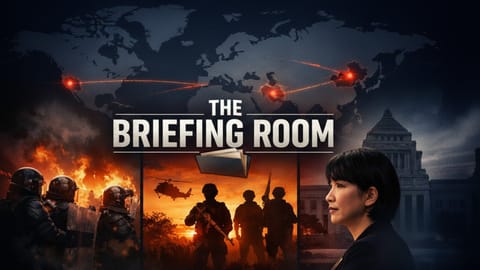
Briefing Room 17.01.26 — a Fronts video briefing on Strategy & Defense.
Simon Whistler • January 17, 2026
Members only
Note: this transcript was generated by AI and may contain errors or inconsistencies.
Welcome back to The Briefing Room, the weekly show for people who see the headlines on their news app, look at what's trending on social media, and wonder, yeah, I mean, sure, what are the real stories? This week, we've got a trio of under-the-radar items that everyone should be talking about.
First, we'll be checking in on Iran not to cover the mass protests, but to zero in on a claim that Kurdish forces crossed into the Islamic Republic from Iraq, seizing an IRGC headquarters.
Then it's a hop and a skip and a jump over to the Sahel nation of Burkina Faso, where the latest in a long line of alleged coup attempts against the military ruler may turn out to have been closer to success than anybody realized. And finally, we're weighing up news of Japan's proposed snap election and what it might mean for regional security.
As always, thank you so much for subscribing, appreciate you.
Look, by becoming a member, you not only support videos like this one, but you also allow us to broaden our reach on the main channel, covering topics that are just a bit less sexy or interesting to the mainstream media. And with that out of the way, let's check in on the other news coming out of Iran.
So for our first story, we turn our attention to Iran, where for the past few weeks the protests have been competing with the capture of Maduro for the title of Most Intense News Story of the Year.
And for most ridiculous, I saw a picture of Donald Trump getting a re-gifted Nobel Prize this morning, which was something. However, while the world was focused on those two stories, something else was happening in Iran that deserves just as much attention. According to Reuters, armed Kurdish groups had tried to cross into Iran from Iraq.
Three sources, including a senior Iranian official, told the outlet that Turkish intelligence had warned Iran's Revolutionary Guards of the Kurdish fighters crossing the border, with the Iranian official confirming that IRGC had engaged the fighters. The fact that the Kurds would try to cross the border into Iran during a time of crisis is not surprising.
After all, they have been fighting the Iranian government for years at this point, and the major Kurdish parties that exist within the Islamic Republic have thrown their weight behind the protests.
Neither is it surprising that Turkey shared the intelligence with Iran, as the former also has its own years-long conflict with the Kurds. What is surprising is the level of success that Kurdish militias claim to have had, how muted the response by the Iranian regime has been, and just how vulnerable Tehran looks in the wake of everything that has happened.
As things stand, the Middle East might just be flipped on its head, and we're still in January.
Let's start with the success. According to a statement by the National Army of Kurdistan, the military wing of the Kurdistan Freedom Party, their fighters had captured and destroyed an IRGC headquarters in Kermanshar, a city in the country's northwest.
Although Kermanshar is located about 496 kilometers away from Tehran and doesn't have the same security architecture as the capital, the fact that a Kurdish militia was able to penetrate Iranian territory, engage IRGC forces, and capture a military headquarters is remarkable.
These groups typically- operate as hit-and-run forces, launching quick raids from Iraqi Kurdistan before retreating across the border. So even temporarily seizing an IRGC facility represents a significant operational achievement for them. However, we need to be cautious here, because apart from the National Army Statement, we don't have much else to go on.
There's been no independent verification for international observers, journalists or even from Iranian state media, and given the internet blackout imposed by Tehran, it will probably take a while before this can be verified, which might explain why there has been such a muted response from Tehran in the wake of this attack.
According to Seth Franz-Munner, fellow at the Foundation for the Defense of Democracies, Iranian officials haven't singled out the Kurdish opposition groups in their statements on the protests.
We do have to point out that Iranian Foreign Minister Abbas Agarchi has accused terrorist entities and separatist groups of infiltrating protests and serving the interests of Israel and America.
However, that still falls short of specifically calling out the Kurdish militias and acknowledging the attacks. There are several possible reasons why Tehran is choosing silence. First, acknowledging a successful Kurdish military operation would legitimize these groups as a credible threat and potentially inspire further action.
By refusing to confirm or deny the Kerman Shah incident, Tehran avoids giving the Kurdish militias the publicity and the validation they seek. Any official acknowledgement risks inspiring other groups to do the same, knowing that it will provoke a response from Tehran.
Second, publicly admitting that Iran had to rely on Turkish intelligence to detect Kurdish fighters crossing its own border would expose serious weaknesses in the country's security apparatus.
Externally, that isn't a particularly grave risk, as Iranian intelligence isn't held to the same lofty standards as MI6, the CIA, or Mossad. However, internally, where the intelligence agencies have a reputation of near-omniscience, it would be devastating. Third, and perhaps most important, Tehran simply has bigger fish to fry at the moment.
The fact that the protests spread to every corner of the country brought out hundreds of thousands of people and were sustained despite some of the most repressive tactics we've seen in recent history… well, that indicates that the Iranian people are pretty angry. And that anger isn't going to go away any time soon.
Because even if the government manages to quash the protests, the underlying economic issues that took people to the streets in the first place still exist, and the Iranian government doesn't seem to have a viable plan to tackle them.
As history has shown us time and time again, military strength can only go so far when the people lose faith in the government's ability to manage the economy. And then there's the ever-looming spectre of a strike from Washington that could topple the entire regime.
On Thursday, Iran's envoy to Pakistan, Reza Amiri Markadam, revealed that President Trump had informed Tehran that he wouldn't strike the country and had urged the Iranian government to exercise restraint.
After that report, Iran re-opened its airspace to commercial flights, indicating that he had that, at least in the short term, Tehran believed it was safe from an American strike. However, there is a real possibility that this is a move meant to lull the Iranian government into a false sense of security.
As Patrick Wintour, a diplomatic editor for The Guardian, noted in a recent piece, this wouldn't be the first time that Trump pulls off such a fate.
Before America struck Iranian nuclear facilities in the summer of 2025, Trump had suggested that his officials were fully engaged in negotiations with their Iranian counterparts over Tehran's nuclear program, when in reality was to say that the administration wasn't planning a jolly picnic.
Senator Lindsey Graham, a key Trump ally, has lent credence to the idea that this could be a fate. He criticized the report, suggesting that America wouldn't strike Iran, writing on X, and we'll quote him here, "...nothing could be further from the truth.
Quite the opposite. Stay tuned." So given all of these headwinds, Kurdish border incursions, serious as they might be, pale in comparison to the existential threats facing the regime right now. They are just another crack in the wall that is very much poised to collapse.
Next up, we travel to the nation of Burkina Faso, where the leader of the nation's military regime, Captain Ibrahim Traore, was very nearly overthrown in a coup attempt. Or at least, that's the official story in a developing saga that mirrors other dubious but politically advantageous claims of coup attempts against Traore in the past.
The first signs of trouble in Burkina Faso came on the night of December 3rd into December 4th, when hundreds of Birkinabe civilians took to the streets in the capital city of Ogedogu and the city of Bobo de Alasu.
The civilian crowds had come out in support of Traore, for the most part, and they'd been driven out onto the streets by an alert sent to their mobile devices by government forces, warning them of an attempt to, quote, "...destabilize Burkina Faso's institutions." At the time, the bulk of the information available to those civilian demonstrators had come
From an exiled activist named Ibrahim Maiga, who lives in the United States but reportedly shares close ties with the Traore regime.
According to Maiga, the threat to Burkina Faso was coming from the nation's former transitional president, Paul-Henri Sandago de Miba, a long-standing villain in Traore's Burkina Faso, and the very man who Traore himself had overthrown in September of 2022 in order to take power for himself.
Working from Togo, de Miba has purportedly planned and was about to launch a coup attempt that would target members of the current regime and bring de Miba back to power.
At first, the allegations were treated with some skepticism by Burkina Faso opposition leaders, foreign analysts, and ordinary citizens that aren't particularly enthusiastic about Traore's leadership.
After all, it's not particularly uncommon for Traore or his allies to allege that he's been targeted in a coup attempt, with military officers usually held responsible, and nearby nations like Togo or Côte d'Ivoire accused of funding or orchestrating the attempts. What comes next is fairly consistent.
Traore alleges a coup plot, spins up some public outrage, and uses the situation as a pretext to launch internal military purges, target civilian dissidents, or otherwise expand his regime's political power. And to be clear, we here on The Briefing Room, we're not going to claim conclusively that this situation was any different.
It would not be particularly surprising if that were exactly what's happened.
There are, however, some extenuating circumstances that suggest that there may have been a bit more weight to this allegation than some of the others that Traore's allies have levied in the past.
For one thing, the Birkinabe government didn't provide any further information on the issue for several days, only acknowledging the incident at all on the 6th of January.
On that day, Okotogo confirmed via state TV that there had been a plot to kill Traore and his high-ranking allies, and that it had been masterminded by Damiba, the leader of the last military hunter.
Instead of Togo, the coup plot was allegedly fermented from the Ivory Coast, with the support of the Ivorian government.
A recent report by Le Monde validated concerns that there may have been ample anti-Traore sentiment within the Birkinabe military to justify something like this after Traore's imprisonment and torture of military officers has become more and more commonplace.
According to the report, Burkina Faso's military officers have grown more disillusioned with their leader as a result of the government's failure to contain or dismantle the terror group Chinim, which has waged a highly effective combination of insurgent and economic warfare against Ogudogu across 2025.
And while details are easy enough to manufacture, the details provided by Burkina Faso's security minister in the wake of the alleged coup went beyond what his ministry would typically offer in a situation like this.
According to him, the coup plotters had intended to kill Traore in a shooting at close range, or failing that by placing explosives at his residence before expanding the scope of the killings to include numerous military and civilian leaders.
After that, the coup plotters would launch an operation to take over or destroy the base from which the military coordinates its drone flights, which would, in turn, prompt a military incursion into Burkina Faso by the soldiers of another nation.
According to the Defense Ministry, the plot involved numerous soldiers and civilians, with the soldiers recruiting others to form operational cells and the civilians charged with mobilizing supporters in the streets to show their support for the takeover.
That final detail, paired with a rather overlooked note from reports at the time that a portion of the civilians demonstrating on January 3rd did not appear to support Traore, suggests that there may have been a real reason to get civilian Traore supporters out into the streets post-haste.
Either way, it's become clear that the Traore regime is intent on turning this coup attempt into a national issue and taking the time to deliberately convince Berkanabe civilians that it was legitimate.
Since the 6th of January, state TV has featured nightly video confessions by alleged coup plotters, a tool of persuasion that the regime typically hasn't relied on.
Burkina Faso's political opposition have derided the confessions as being scripted and lightly manufactured, and while global news outlets have been unable to contact the accused or their utzers themselves left behind, they can never understand each other of their gentlemen. representatives, the televised confessions clearly mark a shift toward a more
Confrontational approach by the Traore regime.
Even still, it's more difficult to determine whether the change is motivated by political factors or may reflect a fear within Traore's government that its prior messaging was insufficient to dissuade what may have been a genuine coup attempt.
Ironically, the events of the last two weeks are also a reminder of the dangers that a foreign leader can encounter if they become known as the Boy Who Cried Coup.
You allege often enough that there are nefarious plots against you, and by the time an actual nefarious plot against you spins into motion, the world might not believe those claims until the plot has already succeeded. Finally, we turn to the nation of Japan, where Prime Minister Sane Takaichi is making a very bold gamble just a few months into her tenure.
This week, Takaichi informed members of a Liberal Democratic Party, as well as its coalition partner, the Japan Innovation Party, that she intends to imminently dissolve Japan's lower legislative house and call a snap election.
While Japan wasn't due for an election until over two and a half years from now, Takaichi apparently plans to dissolve the chamber almost as soon as it convenes for its upcoming legislative session on the 23rd of January. Once that's done, Takaichi has indicated that she may hold elections as early as February the 8th.
As with other countries ruled by parliamentary government, Takaichi's decision to call a snap election would represent an attempt to shore up the power of her ruling party.
The Liberal Democratic Party, or LDP, is a minority-governing party and relies on its coalition ally to control a razor-thin majority in the lower chamber, where a majority of Japan's political decision-making power is concentrated.
According to the LDP's Secretary General, Takaichi's objective is to, quote, at the very least, secure a majority in the chamber outright.
Now, Takaichi's snap elections weren't only a surprise because they constitute political upheaval in a country where ruling parties pride themselves on careful, methodical government stewardship most of the time.
They're also a surprise because they're a tactic that the LDP tried in 2024 under the leadership of Shigeru Ishiba, with disastrous consequences that ultimately led to his resignation. Even worse, the LDP was punished in the upper house just last year when voters eliminated the LDP's majority in that chamber.
At the time, voters seemed to be focused on a long string of scandals that had hit the LDP and its politicians, as well as its lethargic governance and its apparent inability to engage in proper reform. Takaichi, however, seems to believe that this time is different, and she may ultimately be proven correct.
Unlike her predecessor and unlike most LDP leaders in recent memory, Takaichi has proven to be quite popular across Japan, with approvals cresting as high as 70% during her tenure and sitting above 60% at the time of writing.
While those numbers aren't quite the approvals that LDP leaders have drawn at the height of their historic popularity, they're numbers that the LDP hasn't sustained since Shinzo Abe.
Takaichi has impressed the Japanese public during her short- tenure, both personally as a motorcycle-riding heavy metal drumming firebrand with a seemingly limitless capacity to resist exhaustion, and as national leader.
A longtime voice among Japan's war hawks, Takaichi has advocated a shift toward militarization, a change of Japan's constitution to allow greater strength on defense, and a larger role for Japan as a guarantor of regional security.
Takaichi has even gone toe-to-toe with China, refusing to back down after Beijing expressed outrage at a claim that Japan would defend Taiwan militarily from a Chinese invasion.
Takaichi's approach to domestic issues has also proved quite popular, from a focus on cost-of-living issues to the promise of new policies to foster indigenous economic growth without relying on immigration. While a day for Japan's snap elections has not yet been announced, Takaichi appears to want to call that election as quickly as possible.
That's not only because of her current popularity and the obvious advantages that would come with leaving as little time as possible for things to go sideways, but also because of the difficult political timing that she faces. Takaichi's appeal, and the argument to grant her a greater mandate to govern, is basically built on credit.
Takaichi would like to be doing more, and she's got lots of ideas about how to do more, but she can't actually do very much if she's governing from such a vulnerable position.
Takaichi is focused on her desire for Japanese citizens to, quote, feel the effects of her governance, and argues that if she's granted greater latitude, then people will feel greater effects sooner than they otherwise would.
But Japan's annual budget for the fiscal year is due in April, and the more time that an LDP majority has at its disposal to build and pass that budget, the better.
Even as Takaichi makes overtures to Japanese voters that focus mainly on domestic policy, it's impossible to overlook the security and foreign policy implications of an LDP majority, potentially even a big one.
Takaichi has pledged to change the nation's constitution to allow a grand expansion and overhaul of its military, and has hinted at the possibility of pursuing nuclear weapons.
To achieve either of those goals, Takaichi would need a two-thirds majority in both of Japan's legislative houses, plus a majority vote in a national referendum, and a sign-off from the Japanese emperor, although that last step is mostly formality.
Since Japan ratified and implemented its constitution all the way back in 1947, it has never been amended, and in her current position, at the head of a minority government, Takaichi is likely to have a very hard time overcoming that historical barrier.
If, however, she can expand her party's power in the next couple of months, then she'll be able to work from a significantly stronger position, and if she can deliver a clear legislative victory this early into her tenure, then her position at the head of the LDP will probably be secure for years.
With job security and legislative security comes time, and in a global environment like this one, it's entirely possible that Takaichi could realize her geopolitical ambitions if she's got enough time to work. Thank you for watching.
Unlock premium video briefings
Members get full access to premium reporting, in-depth briefings, and subscriber-only analysis.
Insiders Receive
- Full access to all premium articles and briefings
- Exclusive subscriber-only analysis and dispatches
- Support independent conflict journalism
From $5/month — cancel anytime