
Briefing Room 20.06.26: What is Israel Up to in Somaliland? And More.
Reports of Israeli overtures to Hargeisa — recognition talks, a possible base near Berbera, even Gazan resettlement — point to a widening contest for the Red Sea's southern shore.
Simon Whistler • June 22, 2026
Members only
Note: this transcript was generated by AI and may contain errors or inconsistencies.
Welcome back to The Briefing Room, the weekly show that goes beyond the headlines to dig up all the obscure stories that really matter. I'm Simon, and this week, while all eyes were on the peace deal between America and Iran, another less noticed story was bubbling up that also involved Israel.
In this case, it was the growing Israeli presence in the unrecognized breakaway state of Somaliland and the lingering questions it raised.
Aside from that, there was also the major jihadist attack on the airport in Niger's capital, as well as a series of abductions carried out across Africa that all seemed to link back to South Sudan. As always, thank you so much for subscribing.
Your membership doesn't just help pay for exclusive content like this, it also allows us to cover smaller and less popular stories over on the main channels.
Stories like Sudan or Maama that much of the world just loves to ignore. And with that, let's get right into the mystery of what Israel's doing in Somaliland.
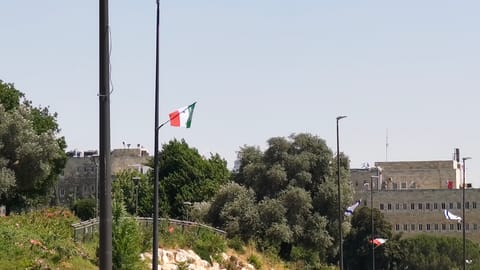
Israel Denies Presence in Somaliland For our first story, we travel to the Somali separatist region of Somaliland, where several months after Israel became the first nation to formally recognize Somaliland's independence, the territory has opened up an embassy in Jerusalem.
In a historic meeting with Israeli Prime Minister Benjamin Netanyahu, Somali President Abdul Durrman Abdullahi oversaw the opening of the mission in West Jerusalem instead of Tel Aviv, where most foreign embassies in Israel choose to set up shop.
But while news coverage in Jerusalem and Hageser is focused on the deepening relationship between the two governments, the rest of the Middle East is focused on the practical implications, specifically the risk that Israel may create a military base on Somaliland's territory.
Those were concerns that Somaliland's Defense Minister Mohamed Yusuf Ali had to address directly this week.
As part of Somaliland's trip to Israel, Yusuf Ali was asked about reports from the Somali Guardian, a pro-Mogadishu outlet. According to the Somali Guardian, Israel had recently opened an intelligence base on Somaliland soil and was in talks to open a military base there too. According to Yusuf Ali, those allegations are baseless.
There is no Israeli base in Somaliland currently and no plan to build one. Yusuf Ali did note, however, that Israel is providing training services for Somaliland's military and its police. Israeli Defense Minister Israel Katz added that the two governments are working together to fight terrorist groups in the region.
And in a later interview, Somaliland's leader refused to rule out the idea that an Israeli base could be allowed in the future. But despite both governments' denial of an Israeli true presence, regional governments and global analysts broadly agree that this is where the relationship is headed.
It's hardly a surprise, after all, that Israel would seek to establish bases on the Somaliland coastline, where several converging Israeli interests come together at once.
Somaliland sits on the Gulf of Aden, near the Bab al-Mandeb Strait that leads into the Red Sea. That waterway is critical to global trade routes and especially to Israel, a country that relies on the Red Sea for a high share of its imports.
On the other side of the Gulf of Aden is the nation of Yemen and specifically the Iran-backed Houthi rebel organization in control of the Yemeni capital and much of the territory closest to the Red Sea.
Establish a base in Somaliland and Israel would significantly enhance its capability to monitor the houthis protect trade in the red sea and if necessary engage in military action against the houthis directly there's also another dimension of proxy conflict to consider as israel has gotten closer with somaliland its rival turkey has gotten closer with the
Somali government in mogadishu right now turkey is believed to position somewhere between 800 and 2 000 troops on somali soil along with f-16 fighter jets and armed strike and reconnaissance drones as israel steps up its international competition with turkey somalia is a critical space for their rivalry to play out related to the israel turkey proxy conflict
An israeli troop deployment in somaliland would complicate a much larger regional power struggle as israel along with ethiopia the uae morocco and other countries wrestles back and forth with a rival coalition including turkey saudi arabia pakistan qatar egypt and others for ethiopia an israeli troop presence would likely be seen as a positive israel's
Relationship with egypt a long-time ethiopian rival is degrading fast for the emirates meanwhile an israeli base could be very useful as the nation looks to re-consolidate the supply and weapons shipment routes it's used to sustain sudan's rebel rapid support forces for egypt and for nearby eritrea an israeli troop presence may constitute a serious threat in
Saudi arabia an israeli base in somaliland would probably raise fears of a functional encirclement of saudi territory nonetheless a base in somaliland would be quite exposed from an israeli perspective surrounded by ethiopia to the west somalia to the east and south and houthi controlled yemen to the north israel remains the only nation to recognize
Somaliland at least for now and jerusalem is well aware of ongoing somali efforts to destabilize and challenge the separatist region not least through its recent recognition of a new federal north eastern state that encroaches directly on somaliland's territory but as much as an israeli base in somaliland or even an intelligence outpost would constitute a
Meaningful change in the regional security dynamic it would also serve as a public reflection of something that's been true for the last several years israel's close ally in the persian gulf the united arab emirates has spent those recent years building an extensive network of military and intelligence outposts essentially building a ring of control that
Stretches from the indian ocean to the somali and yemeni coasts those outposts are technically emirati but in truth they represent a joint effort between abu dhabi and jerusalem the outposts host israeli radar systems signals intelligence systems and at times israeli troops and intelligence officers the data collected from these outposts travels into a
Jointly managed intelligence sharing platform between the two countries referred to as crystal ball which israel and the emirates used to track the houthis monitor regional shipping and most likely gather intelligence on other regional rivals israel has coordinated closely with the emirates since the early days of the network's construction and those
Outposts have now been integrated into the larger missile defense apparatus that both nations rely on that regional network took a substantial hit in early 2026 at around the same time as israel recognized somalian and the Emirates began to make several notable power plays, including a brief separatist takeover of non-Houthi-controlled Yemen.
At that time, Somalia revoked agreements with the Emirates that allowed Abu Dhabi to use bases in both Somaliland and the autonomous Pundland region. Publicly, Abu Dhabi withdrew from those bases, although in reality, the Emirati military still operates out of both regions.
But if Israel can establish its own base in Somaliland, its unique relationship with the separatist region will provide a critical backstop for itself and the Emirates, introducing new resiliency to a surveillance network that will be very important in the decades to come.
And for our next story, we'll turn our attention to the world's youngest nation, South Sudan, where a recent wave of abductions has instilled fear in the country's dissident community, particularly those living abroad.
On Tuesday 9th June, a Sorbet al-Gaddafi deit, a South Sudanese whistleblower with Kenyan citizenship, was abducted in Nairobi at gunpoint before being driven more than 900 kilometers to the Narapal border crossing.
He was then handed over to South Sudanese security personnel and transported to Juba, where he is being held at a military complex. Before his abduction, al-Gaddafi had claimed that his life was in danger because of his conversations with the press and police about high-level corruption in South Sudan.
He claimed that money was being siphoned out of the country through a company called CapitalPay, a digital payment platform which operates several lucrative government contracts.
The company has come under scrutiny from the UN and non-governmental watchdog groups over its alleged links to South Sudan's political elite, including the daughter of President Salva Keir. On the same day that al-Gaddafi was abducted in Kenya, another South Sudanese dissident was being unwillingly transported back to his home country from Egypt.
Kennedy Nehmeyer, a journalist who had worked for several South Sudanese outlets, had been detained by Egyptian authorities in late April while renewing his residency permit and remained in custody until he was deported back to Juba.
Nehmeyer had reportedly been afraid for his life after Juba accused him of being connected to the National Salvation Front, one of the many militant groups fighting the South Sudanese government. These two incidents are the latest in a campaign carried out by the South Sudanese security services to intimidate dissidents abroad.
Since 2016, at least a dozen people have been abducted and brought back to South Sudan, some of whom, including a human rights lawyer and a member of the opposition, were executed upon their return.
This latest wave of abductions is happening at a particularly sensitive time for South Sudan, as the nation grapples with one of the worst political and security crises in its short history. In March 2025, President Salva Keir placed first Vice President Rik Machar under house arrest after fighting broke out in the strategically important town of Nasir.
By September, the government had opened a treason trial against Machar, accusing him of murder, treason, and crimes against humanity.
Machar's party, the Sudan People's Liberation Movement in opposition, responded with an offensive across Zhongli state, capturing towns and threatening to march toward the capital. of juba the national salvation front the same group that maya is accused of having ties to formed a military alliance with them shortly afterwards with the two groups conducting
Multiple joint attacks against government positions the security situation has since deteriorated so much that according to the un security council it is now worse than at any other point since a 2018 peace deal was signed to end the civil war against this backdrop it is easy to see why the south sudanese government would go to great lengths to forcefully
Repatriate individuals it considers enemies of the state the government's fighting for its survival and any accusations of corruption especially to the degree that al qaddafi was alleging would destroy its last remaining shreds of credibility and there wasn't a lot of that to begin with it would also bolster the claims of the opposition that the government
Is incapable of ruling and is instead a captured entity that does nothing but funnel resources and money to kia's faction at the risk of being whisked off to south sudan by hard guns let me just go on record here and say that this is a pretty fair read of the government in juba that it's basically become a way for the ruling elite to get ever richer while
The rest of the nation lives in grinding poverty in 2023 juba spent more on medical care for salvakir alone than it did on the entire rest of south sudan's population apart from trying to silence claims of corruption these abductions were meant to send a clear message to the nation's opposition no one is safe from juba's reach no matter how far they might be
What makes this message particularly potent is the fact that regional governments especially kenya have been extremely willing to work with south sudan to repatriate dissidents since 2016 nairobi has assisted juba in capturing multiple dissidents including james gatet duck the former spokesperson for riek machar gatet claimed that kenyan government forces
Seized him from his nairobi home in november 2016 and forced him onto a plane to juba where he was accused of treason and sentenced to death before being freed as part of the 2018 peace deal he also claimed that a high-ranking police officer told him there was a deal between the kenyan and south sudanese presidents that allowed for his capture while it would
Be extremely difficult to confirm whether such a deal actually exists for reasons that are beyond obvious it might explain why kenya went from being a country renowned for welcoming dissidents and keeping them safe to one where they constantly have to look over their shoulders in fear in 2024 alone kenyan authorities oversaw the rendition of ugandan
Opposition leader kisa besigye the forced return of four turkish refugees the deportation of 36 ugandan opposition supporters and the abduction of a rwandan human rights defender the fates of many of these individuals including those abducted this july are still unknown however given how repressive local governments can be we can hazard a guess that they're
Not being held at the ritz carlton or some similarly expensive establishment and whether they are ever seen again that's a matter of luck more than anything else now all of this taken together paints a concerning picture for east african In a region of the world where elections, when they do happen, are constantly marred by violence and claims of fraud, a
Robust opposition was often seen as the last hope for democracy.
With governments hunting the opposition at home and to cross borders, that hope's fading fast. And with it, East Africa's commitment to democracy.
Niger's airport is attacked again For our final story, we turn our attention to the Sahelian nation of Niger, where a jihadist group has once again attacked an airport in the nation's capital of Niamh. On Thursday, the 18th of June, at about 6 a.m. local time, residents reported hearing gunshots at Diori-Hamani International Airport.
One resident told the AFP that the gunshots lasted for hours.
The attackers reportedly arrived at a security checkpoint near the airport by taxi, where they faced fierce resistance from security forces. As the fighting spread, gunmen scattered into a route to Changa, a neighborhood next to the airport where residents reportedly used crude weapons to hunt them down.
Once the dust had settled, Niamh announced that 11 soldiers, two civilians, and 22 attackers have been killed, while 20 suspects have been arrested.
The group that claimed credit for the attack is Jamaat Masrat al-Islam wa Musanim, also known, fortunately, as Janim, an al-Qaeda-affiliated jihadist group that gained international notoriety this April after launching a coordinated wave of attacks across six cities in Mali.
Janim described the attacks as a suicide mission targeting the military base next to the airport. This was the airport's second brush with jihadists this year.
In January, militants from the Islamic State Sahel Province targeted the airport using heavy weaponry and drones, damaging planes, setting an ammunition cache on fire, and wounding four Nigerian soldiers.
Despite the disparity in the death toll, Henni Unsa Ibia, a researcher at the conflict monitoring group Ackled told the New York Times that Thursday's attack appeared to be a much smaller one in scale compared to January's, and that it had failed given how quickly government forces were able to repel the attackers.
While the scale of the attack might have been smaller, the fact that the same airport was attacked twice, mere months apart, raises several difficult questions.
The first of which is why, in both cases, the government was unable to intercept any intelligence that could have prevented these attacks in the first place. That's a damning indictment of Niger's junta and their Russian allies. Despite coming to power in a 2023 coup promising that they would end the jihadist threat, they are still struggling to contain it.
We also have to ask why the same airport keeps getting attacked, and whether it will be attacked again in the future. The most obvious explanation is that the militants were targeting the military base located in the same complex as the airport. Air Base 101 is where most of Niger's drones and military aircraft are stationed.
It is also home to Russian forces and the newly established counterterrorism units of the Alliance of Sahelian States, or AES. The AES is made up of three countries, Mali, Niger, and Burkina Faso, all of which have had coups recently and are dealing with multiple jihadist groups.
By attacking the base, the militants are proclaiming that they aren't afraid of the junta or their allies.
The second reason is a lot more frightening. FIGHT If either group manages to successfully attack the airport, and that's uranium. About 1,000 metric tons of yellowcake uranium has been sitting at Airbase 101, caught in a legal dispute between the French mining company Arano and Niger's government, which seized it back in November.
Niger would very much like to sell this uranium to Russia. In fact, a Russian vessel waited off the port of Lahme for weeks before leaving empty.
However, Naime has so far been unable to, for a multitude of reasons, including the closed border with Benin and the fact that the alternative route through Burkina Faso passes through territory controlled by jihadists.
So the yellowcake has stayed at Airbase 101. Now on its own, yellowcake uranium is nowhere near weapons-grade because it contains only 0.7% of U-235, the isotope of uranium capable of sustaining a nuclear chain reaction. Weapons-grade uranium is highly enriched and has about 90% U-235.
Still, this isn't the kind of material that should be left out in the open in a place that has been attacked by terrorists twice.
A jihadist group that got its hands on even a fraction of the yellowcake uranium could have a lot of leverage, not in the sense of constructing a bomb or anything, but in the sense of being able to sell it and use that money to finance even more terror activities.
In 2025, for example, Janim received a $50 million ransom after capturing an Emirati sheik, and since then their capabilities have increased exponentially.
Given how valuable uranium is, it would likely fetch an even higher price, meaning the group would have even more money to spend on recruiting, training, and arming their fighters, which would in turn make them an even greater threat than they are now.
And finally, we have to discuss the possibility that this attack was motivated less by the financial incentives of capturing uranium or the symbolism of attacking the military base, but rather just by plain old rivalry.
Janim and ISSP have been locked in a long-running feud, with the two groups attacking each other repeatedly in a bid to establish dominance over a section of Niger that borders Nigeria to the east and Benin to the south.
Control over this area would give either group a lot more flexibility when it comes to moving around and selecting targets. By attacking the Niamh airport so soon after ISSP's attack, and with a lot more casualties, Janim could be sending a not-so-subtle message to its rivals that it's a more potent force.
If this is the reason, or if ISSP perceives it as the reason, then we can expect a lot more attacks as both groups attempt to establish their dominance.
And it won't just be limited to these two groups. Other jihadist groups will take advantage of the confusion to launch their own attacks. And for a region that is already dealing with a severe humanitarian crisis, this could be catastrophic.
Unlock premium video briefings
Members get full access to premium reporting, in-depth briefings, and subscriber-only analysis.
Insiders Receive
- Full access to all premium articles and briefings
- Exclusive subscriber-only analysis and dispatches
- Support independent conflict journalism
From $5/month — cancel anytime