
Briefing Room 24.01.26
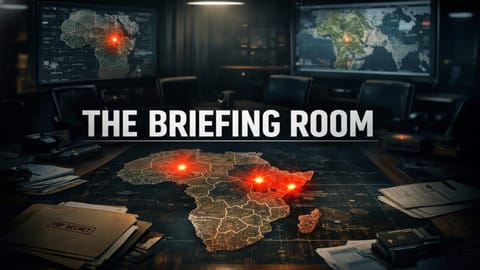
Briefing Room 24.01.26 — a Fronts video briefing on Strategy & Defense.
Simon Whistler • January 24, 2026
Members only
Note: this transcript was generated by AI and may contain errors or inconsistencies.
Welcome back to The Briefing Room, the weekly show that takes a break from all the madness in the headlines to tell you about all the madness happening, well, everywhere else.
This week, while the world's eyes were fixed on Greenland and Iran, insanity was lapping at the shores of nations like the Congo, where government troops recently marched into the contested city of Avira. Then there was the opposition advance in South Sudan, which may suggest the world's youngest nation is sliding back towards civil war.
And finally, there was strange news out of Mali, where a blockade of the capital undertaken by Islamist groups may have finally lifted, with no one being quite sure how or why. As always, thank you so much for subscribing. Your support not only helps us produce weekly shows like this one, but also allows us to tackle less popular topics on the main channel.
And with that, let's go see what's been cooking in the Congo. In the Democratic Republic of the Congo, the nation's internationally recognized government seemed to score a long-awaited victory this week, surging troops into the contested city of Avira several weeks after it fell to the Rwanda-backed rebel group M23.
But although M23's withdrawal does grant Kinshasa a few international headlines, the government's control of the city can hardly be called a win.
And depending on what M23 plans to do next, Kinshasa's forces may have walked themselves into a full encirclement. M23's takeover of Avira in the war-torn Congolese province of South Kivu took place in early December. And at the time, the fall of Avira drew global attention for two reasons.
Reason number one, Avira is very strategically significant, anchoring transport routes against Lake Tanguyika and granting M23 control over the DRC's entire land border with Burundi, a nation that has worked alongside Congolese forces and opposed M23 in Rwanda over the last couple of years.
And reason number two, M23's conquest came at a time when, according to international arrangements brokered in Washington, the Congo was supposed to be at peace.
Here on Warfronts, we've discussed the problems with the Congo truce at length, namely that it hasn't been enforced, it hasn't led to a pause in the fighting on the ground, and it seems to be more of a veneer of peace to facilitate joint resource extraction between the Congo, Rwanda, and the United States.
Now, if we could be a bit cynical for a moment, the reality of the ongoing fighting on the ground didn't really pose an issue, because as deadly as it was, it hadn't made headlines. But capturing a city does make headlines. So once Avira fell, the United States had to put its foot down.
At the time, US President Donald Trump demanded that M23 withdraw from the city, which M23 then publicly agreed to do, but in practice they went nowhere, remaining in the city for more than a month. It's worth emphasizing that tactically, even if M23 did withdraw from Avira as promised, it wouldn't have done much good.
Avira basically sits in a bowl surrounded by highland areas, where surrounding forces can fire into the city as they see fit, and unless M23 was going to withdraw from the highlands, then any temporary withdrawal from Avira would just... allow Congolese troops to sit there till M23 wanted it back.
And spoiler alert, that's precisely what seems to be happening now. In any case, it seemed as if M23 might actually get to keep the city, after all, that made headlines agreeing to leave, and then global outlets had largely failed to follow up, meaning that as far as the rest of the world knew, the issue was settled.
By mid-January, however, outlets did begin to report M23's continued presence in Uvira, and by the 15th of the month, the rebels had decided that it was time to withdraw.
Whether that was due to US pressure or another factor is unclear, at least at the time of writing, but the leaders of Rwanda and the Congo did meet with Donald Trump just days earlier. On the 19th, the Congolese military re-entered the town peacefully after the town had initially been secured by pro-Kinshasa militias called Wazalindo.
According to sources on the ground, shops and homes were looted by government forces as they arrived, and roughly 20 civilians were arrested in what pro-M23 sources described as acts of targeted revenge against the ethnic Tutsi community.
Rather quickly, it became clear that M23's intent was not to cede control of the entire area, but simply allow Congolese forces back into Uvira proper. Government forces confirmed that instead of fully withdrawing, M23 had instead moved into the surrounding hills, likely to position their artillery so that they could fire down into the city as anticipated.
Other M23 forces moved to outlying towns and villages.
According to local sources, the following days would see intense fighting between M23 and Congolese troops in the highlands, with no indication at the time of writing that M23 has been pushed back any further than it chose to retreat.
As a result, just days after the Congo's nominal recapture of Uvira, the nation's military leaders are likely weighing the odds that two highly discouraging developments could come next.
In one scenario, M23 may choose to wait out the global attention on Uvira, bide its time, and then start shelling the city in order to drive Congolese forces out, once it believes that outside scrutiny won't be an issue.
In the other scenario, M23 still uses its position to fire into the city, but it traps pro-Kinshasa forces in the process, including experienced Wazalendos and soldiers from the Congo Special Forces.
Elsewhere in the Congo, it appears that if M23 has learned any lesson from its Uvira experience, then that lesson does not discourage the group from taking other major population centers.
In North Kivu Province, on the other side of M23's expanding zone of control, M23 truck convoys have been on the move since the 16th of January, appearing to ferry fighters, weapons, and supplies toward their newest building offensive.
This time, it's the city of Potembo that's in M23's sights. Landlocked and home to a pre-war population of about 150,000, Potembo is the province's most important center of commerce outside the capital city of Goma, which will have been under M23 control for a full year next Friday.
It's home to a disproportionate number of wealthy Congolese, several important universities and hospitals, a strategically significant airfield, and warehouses full of lucrative city.
So, tea, coffee, messel. and other goods that M23 would very much like to get their hands on. Between the area's wealth and the size of the city, it's difficult to believe that M23 would assess that an offensive didn't run the risk of international attention of the same kind that forced the group out of Evera.
But as of right now, M23's troop movements would indicate that the international consequences don't matter.
For our next story, we turn our attention to the world's youngest nation, South Sudan, where for a while now, the nation has been sleepwalking into a civil war, and the international community, distracted by what's been an insane start to the year, hasn't really taken much notice.
Quoting Solomon Ayeli Durso from the civil society organization Amani Africa, South Sudan shows all the signs of a clear and present danger of relapsing back into full-scale conflict.
On Friday, the 16th of January, the Sudan People's Liberation Army in Opposition, or SPLAIO, the nation's main armed opposition group, announced that it had captured the strategically important town of Pajut, following intense clashes with government forces in Jongle State.
According to Daniel Akek, Senior South Sudan Analyst at the International Crisis Group, this is the third town that SPLAIO have captured since Christmas Eve, having captured Watt on the 24th of December and UI on the 2nd of January. Pajut is significant not just in and of itself, but also because of its position.
Located about 170 kilometers north of Boh, the capital of Jonglai State, and about 400 kilometers north of Juba, the nation's capital, it offers a jumping-off point for further military action.
According to local outlet Sudan's post, its capture marked a significant escalation that could further destabilize the region. To see what that destabilization may look like, we only need to listen to the group themselves. Reuters reports that they have called for members to march on the nation's capital.
For its part, Juba is preparing for a decisive battle with SPLAIO in Bohr. A video verified by Sudan's post shows a convoy of the South Sudan People's Defense Forces troops and heavy armor leaving Juba for Bohr, confirming reports of a significant military buildup in Jonglai State, which signals an imminent offensive.
And it's not just grunts heading to the state capital.
According to the Post, South Sudan's Army Chief Paul Nang made an unannounced visit to the city on Tuesday. Additionally, security sources told the outlet that the newly appointed Chief of Military Intelligence, Lieutenant General Abud-Steven Ijong, had left for Jonglai State immediately after his appointment.
All of this maneuvering suggests that both Juba and the opposition believe that the Battle of Bohr will be decisive in determining the country's fate.
The stakes are even higher given the ethnic dimension at play. Bohr is a predominantly dinkertown, the ethnic group of President Keir, while SPLAIO is widely seen as a noir force led by ex-vice-president Rik Machar, currently on trial for treason.
An SPLAIO takeover of Bohr would not just be a military defeat, it would be deeply symbolic and inflammatory. century.
The Laws of the Laws of the Laws of the Laws. war was marked by horrific ethnic violence, including massacres on the streets of Juba, targeting newer citizens. Many South Sudanese fear that a full-scale conflict could trigger a return to such targeted ethnic killings, opening wounds that never truly healed.
So since both sides agree the bore is important and they don't agree on much else, let's look at what would happen in case either side wins this upcoming fight.
If the government manages to push SPLAIO back from its gains in Zhongli, today, President Salvekir would secure breathing room, but nothing close to stability. A government victory at bore would send rebel flighters fleeing for safety before they regroup and try again. The opposition has done this before, and they are extremely good at it.
What follows would likely be a grinding counterinsurgency that Juba's forces are neither trained nor funded to sustain, particularly with the economy in freefall and soldiers going months without pay. However, if SPLAIO takes bore, moves on Juba, and transforms this into a wider war, the consequences can extend far beyond South Sudan's borders.
In Akaq's view, a flare-up would likely draw on Uganda and Sudan.
Uganda because Kira relies on Kampala to prop up his regime, and Sudan because, given the opposition's rapid military gains, many in South Sudan suspect that it's being funded either by the Sudanese Armed Forces, the SAF, or one of its foreign allies as retaliation for Juba's close ties with the paramilitary rapid support forces, with whom SAF have been
Fighting a bitter civil war since 2023.
Another likely outcome of the full-scale war is that it could lead to the postponing of the upcoming elections that are slated for the 22nd of December. And while certainly less important than the bloodshed that would accompany widespread fighting, such a delay would still be catastrophic.
Since South Sudan gained its independence in 2011, it has been unable to hold democratic elections. The first vote, initially planned for 2015, has been pushed back five times to 2026.
After the most recent delay, Nicholas Haysom, an advisor to the UN Secretary-General, captured the mood in the country, saying, and we'll quote him here, "...this was a regrettable development given the deep frustration and fatigue felt by the South Sudanese people at the apparent political paralysis and inaction of their leader." End quote.
If the elections are postponed again, they risk completely destroying what little credibility remains with the government.
However, as Abraham Nyon, a political science professor at the University of Juba, told a local outlet, holding polls without resolving core issues and let's be honest that what would be a really big unresolved issue could undermine the process.
Beyond the elections, there's the ever-present risks that civilians face in war zones, and unfortunately, the South Sudanese people are intimately familiar with these.
According to ReliefWeb, the current crisis in Zhongli state is affecting communities already suffering from severe food insecurity, disease outbreaks, and damage from last year's floods. Nearly 200,000 people have been displaced since the 29th of December, and again, that's in one state alone.
If the situation deteriorates into a whole-nation civil war, then the numbers will grow by orders of- magnitude.
The last time South Sudan had a civil war, more than 400,000 people died. South Sudan cannot afford to go down that road, because if it does, no one will ride in to save the day, just as no one has ridden in to save the day in Sudan. And for our next story, we head to the West African nation of Mali.
Now regular viewers of The Briefing Room will remember that last year we featured Mali on this show because the capital city was under siege by an Al-Qaeda-linked group known as Jamaat-Nusrat al-Aslam, while Muslimi or Janim. That was several months ago. So let's check in on Bamako, shall we?
After all those questions about whether Mali would fall, the nation's foreign minister, Abdoulaye Diop, pushed back, basically claiming that reports of Mali's death were greatly exaggerated. He made these claims on the 12th of November, on the sidelines of BAMEX-25, Mali's first international defense expo.
The minister insisted that the fair was proof of Mali's commitment to strengthen its defense to combat terror groups across the Sahel.
However, despite the minister's insistence, all the reports that we could find indicated that at the time Bamako was still in the midst of a siege. A siege that would last well into the new year. That is, until the 20th of January, when the Africa Report, one of the continent's leading news agencies, reported that life was returning to normal in Bamako.
Petrol stations were opening again, traffic was flowing on the road, and people were going back to work. Now, what's a little odd here is that the Africa Report is the only outlet we've yet seen claiming the siege is at an end. But since this is a legitimate news outlet, one of the leading agencies on the continent, we're inclined to believe them.
So the question becomes, why did the siege end? Since information coming out of Mali is pretty sparse at the moment, about as sparse as my hair, all we can do is speculate based on what we know, the opinions of experts, and good old-fashioned guesswork. Firstly, we can rule out a military solution to the siege.
When reviewing possible outcomes of the Bamako siege, Dr. David Dukin, a research fellow at the International Institute for Counterterrorism, wrote that for the military to succeed in ending the siege, it would need to mobilize a large number of troops, possibly with the support of the Sahelian states and Russian mercenaries.
It would then need to retake strategic routes captured by the jihadists before focusing its efforts on the capital. Dr. Dukin believed this was unlikely in the short term, because the Malian army's strength was limited.
Additionally, and this is our own view here, since we haven't seen anything to indicate a mass mobilization from the Sahel states, and such a thing would be difficult to hide, we can assume one didn't happen. With the military option off the table, we're left with either a financial settlement or a political one. Let's start with the latter.
According to Dr. Dukin, a political solution would have required the Hundert to abandon Mali's constitutional principle of secularism. This is something that all ruling elites have refused, including the current military leaders.
Because Dukin holds the stronger position. position, any negotiations would force the government into concessions that would devastate its already weak legitimacy.
And if such a deal happened, Janim would almost certainly want it announced publicly. The jihadists have been vocal about their goals throughout the siege, using their media channels to call on Bamako residents to rise up and establish an Islamist government based on Sharia law.
Given how visible the siege has been, a political settlement would be prime propaganda material.
But, three days after the Africa report story, we haven't seen any announcement of a power sharing deal, so we can safely assume that didn't happen. Which leaves the final option. Money.
Janim has a well-documented history of taking hostages and releasing them for ransom. Most recently, they freed two Emirati nationals and an Iranian hostage in late October after receiving approximately $50 million. Goddamn.
According to multiple sources, the deal also included several tons of ammunition and the release of Janim prisoners from Bamako jails. That ransom represents roughly half of what terrorism financing expert Jessica Davis estimates are Janim's annual revenues of about $100 million. It is a massive influx of cash for any terrorist organization.
So why wouldn't they accept a similar deal for an entire city? Because think about it. A siege could be a tool of conquest, but it can also effectively be a large-scale hostage situation.
Instead of holding a few individuals, Janim held an entire capital at its 4.24 million residents hostage. They cut off fuel, strangled the economy, closed schools, and made daily life impossible. Then likely through intermediaries, they negotiated for payment.
The junta gets its capital back. Janim gets enough money to fund operations for months. The residents get to live their lives again, and nobody has to publicly admit what happened, which saves face for everyone involved.
We'll likely never know the true story of what happened unless someone at Janim is interested in writing a tell-all article for Fronts.co. We'd be very open to it.
But regardless of why the siege is over, if it is truly over, then it's good news for the people of Bamako who won't have to spend another night wondering if the power will stay on long enough to finish dinner.
Unlock premium video briefings
Members get full access to premium reporting, in-depth briefings, and subscriber-only analysis.
Insiders Receive
- Full access to all premium articles and briefings
- Exclusive subscriber-only analysis and dispatches
- Support independent conflict journalism
From $5/month — cancel anytime