
Briefing Room 25.04.26: Trouble Brews in Tigray, and Madagascar's Growing Military Crackdown
The situation in Tigray, Ethiopia, and Madagascar's growing military crackdown are causing concern. The Tigray People's Liberation Front has taken back control
Simon Whistler • April 25, 2026
Members only
Note: this transcript was generated by AI and may contain errors or inconsistencies.
Welcome back to The Briefing Room, our subscriber-only show that doubles as your weekly reminder that there are other major events happening in the realms of conflict and geopolitics outside of the Middle East.
I'm Simon, and this week, those major events are taking us first to northern Ethiopia, where the ghosts of the Tigray War threaten to once again turn this unquiet region into a site of horrors. Next, we're taking a short detour to Japan to check out the impact of Tokyo's decision to restart arms exports.
Then, we'll finally travel to Madagascar, where a people power revolution is—surprise, surprise—slowly curdling into what appears to be a burgeoning military dictatorship. It has been less than four years since the end of the Tigray War in Ethiopia, widely understood to be one of, if not the, deadliest conflict of the 21st century so far.
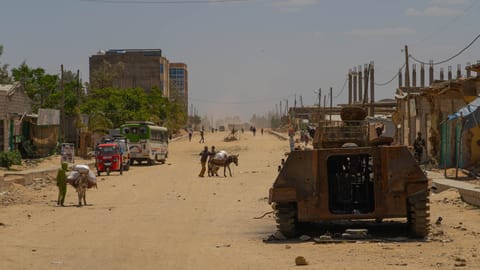
But this week, after months of mounting tensions in the Tigray region, Ethiopia's dominant ethnic Tigrayan political party has brought the country back to the precipice.
The announcement came on Sunday 19 April via a Facebook post, no less, when the Tigray People's Liberation Front, or TPLF, announced that it was taking back control of the regional government.
Since the signing of the 2022 Praetoria Agreement, the deal that ended the Tigray War and established terms for a more stable Ethiopia, Tigray's parliament has been suspended. But according to the TPLF, that suspension is now a thing of the past.
The party levied several allegations against the Ethiopian federal government to justify its decision, not least that Addis Ababa had provoked internal armed conflict within the Tigray region. The government was also accused of other violations of the Praetoria Agreement, as well as withholding pay for local civil servants across the region.
Even under the best of circumstances, this decision by the TPLF would be cause for serious concern.
Tigrayans make up roughly 6% of Ethiopia's population, but have long played an outside role in national politics, with the TPLF effectively dominating the government from the fall of the Dirk dictatorship to the rise of the current Prime Minister, Abiy Ahmed, in 2018.
They were also heavily armed, with Tigrayan forces able to call up hundreds of thousands of fighters, and Tigrayans currently helping the Sudanese armed forces fight their own civil war across the border.
Like the rest of Ethiopia's fighting factions, Tigrayan forces have earned a reputation for all sorts of war crimes, particularly during their invasion of Amhara region in 2021.
The federal Ethiopian response to the Tigray was even more shocking, with Ethiopian leader Abiy Ahmed ordering scorched-earth warfare so severe that today a death toll of 600,000 is considered a reasonable estimate from just two years of full-scale fighting.
Complicating matters further, neighboring Eritrea still occupies parts of northern Ethiopia, mostly in the Tigray region. In this part of the world, alliances are extremely fluid.
During the war, the Eritreans fought with the Ethiopian government against the Tigrayans, committing their own war crimes. Today, though, it's thought Eritrea… would be far more likely to back the TPLF in any renewed fighting. But, as unstable as Ethiopia's status quo might be, the developments of the last several months have made the situation even worse.
Starting in Tigray, the region has been embroiled in a political crisis since 2024, with the Tigrayan hardline faction ultimately taking control of the TPLF in an action that its adversaries condemned as a coup. Since then, the TPLF has accused the Ethiopian government of funding and supporting several anti-TPLF armed groups.
Those regional tensions then boiled over, and Tigrayan forces have clashed regularly with fighters from the neighboring Anahara region.
Airline services to Tigray have been intermittently suspended, the region has been cut off from elements of the banking sector and starved of humanitarian aid, and government drones have started to strike into Tigray with growing regularity. For ordinary people in the region, life is only getting worse.
Quoting a report released by Human Rights Watch this week, the Ethiopian government and their international partners seem determined to ignore the treatment of Tigrayans as effectively second-class citizens.
By February of this year, the Ethiopian government was fully engaged in a buildup of its forces along the Tigrayan border.
According to various conflict monitoring groups, Ethiopian convoys have stationed heavily armored units, long-range artillery, and thousands of soldiers, including troops pulled from Anahara region despite a large-scale insurgency taking place there.
The Ethiopian military called for a mobilization of its soldiers, and Addis Ababa has placed restrictions on journalists that mirror the measures taken just before the Tigray war half a decade ago.
The TPLF and its paramilitary Tigray defense forces responded by massing its own troops on the border, including heavy armor and artillery in Tigray's arsenal. But over the last couple of weeks, Abiy Ahmed and his government seem to have decided to back down.
Despite the buildup on the Tigray border, despite all the signs that a major conflict was imminent, Abiy never gave the order to move.
And it's only after Abiy seems to have blinked that the TPLF moved to restore its pre-war regional government. In its decision, the TPLF cited all the animosity and buildup of the last several months, the Ethiopian drone strikes, the attacks by anti-Tigray paramilitaries, and more as a clear sign that Ethiopia's post-war balance of power was falling apart.
As for why Abiy Ahmed chose not to invade, well, from a strategic perspective, there were several good reasons to call off an attack.
For one thing, military offensives require fuel and Ethiopia imports nearly all of its refined petroleum needs, but the world happens to be experiencing a rather acute prolonged energy crisis because of the Iran war and dueling maritime blockades in the Middle East.
On the 13th of March, Ethiopia instituted fuel subsidies and rationing to try and get ahead of social unrest, fearing price surges that Ethiopia's finance minister called "...terrifying." Under those circumstances, a full-scale offensive against the Tigray region would require such great expenditures of fuel that it couldn't be justified.
Making matters worse, Eritrean leaders have signaled that they intend to ally with the TPLF during this round of fighting, while the Amharan insurgency has already used the troop breakdown in their region to attack and even briefly hold several towns.
And then there's the spectre of Sudanese involvement. Ethiopia is currently housed in the causing training and resupply camps for the paramilitary rapid support forces that are trying to overthrow the Sudanese state, while the TPLF has actively buttressed Sudan's army.
A full-on meltdown in Tigray therefore risks turning the region into another theater in Sudan's catastrophic war.
Finally, a return to war would be a major problem for Ethiopia's economic partnerships with foreign backers, and while Abiy Ahmed may have been willing to strain those relationships under better circumstances, the pressures of the war in Iran are just too much.
For now, it appears that the TPLF has recognized the federal government's predicament and taken its opportunity to strengthen its own position while conflict is unlikely. While it's not guaranteed that the region will remain quiet in the near term, the TPLF do not appear to be interested in instigating a full-scale conflict if they can avoid it.
But two paths to all-out war still remain. One, if global energy markets return to normal and Abiy Ahmed chooses to act, or two, if the TPLF's assessment of Abiy's weakness is proven to be a grievous miscalculation.
After 80 years of nearly absolute commitment to the virtues of pacifism, it's easy enough to have to forget that the nation of Japan is a sleeping giant.
But this week, Tokyo made a decision that will bring the world's fourth-largest economy back into the defense sector, starting an overnight transformation that will turn Japan from a military-industrial afterthought to a kingpin of the global arms trade.
Japan's defense evolution began on Tuesday, the 21st of April, when Prime Minister Tsunai Takaichi's Cabinet of Ministers voted to end Japan's ban on the export of lethal weapons.
The ban was an artifact of Japan's militaristic history, culminating in the global devastation of the Second World War, and it was one among a wide range of policies that Japan had adopted in the aftermath, along with a ban on all nuclear weapons, a commitment to maintain only a small self-defense force, and more.
Before this week, Japan had voluntarily restricted itself to defense exports in just five key areas, technology meant to assist in rescue operations, military transport, alert networks, surveillance, and minesweeping.
Any other military hardware that Japan knew how to build, including the warships, combat jets, missiles, and other weapons that Japan has produced over the last several decades, were off-limits for the global market.
As of today, however, those restrictions no longer exist, and under its current leadership, Tokyo seems to have zero interest in easing itself gradually into the global arms trade.
Instead, the decision immediately clears the way for several major arms sales that were mostly finalized pending the conclusion of the export ban. Those include three advanced Megami-class cruisers for Australia, with eight more to be built on Australian soil, as well as the sales of combat drones.
The decision lures many of the barriers that had limited Japan's engagement with the GCAP program, a sixth-generation fighter being designed jointly with Britain and Italy, and it puts an eye to end the years of legislative and legal wrangling that Tokyo had been relying on to participate in limited lethal weapons manufacturing for hardware like Patriot
Missiles.
Under the new rules, Japan will still be subject to a handful of limitations........... sell to countries that have signed defense technology transfer agreements with japan with 17 nations on that list today japan will monitor the use of its weapons once they're sold and it will generally avoid selling to countries at war and it will implement strict export
Controls to ensure that exported equipment isn't resold to third nations that aren't allowed to receive that hardware but with those few limitations in place the japanese defense industry is now open for business domestically the change is expected to kickstart a surge of defense research and development across japan as the possibility of export completely
Changes the economic incentives for japanese firms for the last several decades japan's arms industry has been widely dismissed as a dead end since japan's own self-defense forces would be the only customer for any hardware that was designed domestically that's meant only a handful of major companies like mitsubishi toshiba or kawasaki have been able to
Justify the required investments to build military technology and even then only when tokyo is looking to acquire a specific new piece of hardware but now high quality japanese designs like the type 99 self-propelled howitzer the type 10 main battle tank the magani class frigate the taigi class submarine and a wide range of other products are all open to
Discussion with prospective customers japan can leverage its massive shipbuilding industry at a time when many of japan's close allies desperately need help constructing warships and its many high-tech startups and smaller firms can now justify a pivot to defense internationally japan's decision has mostly garnered a positive reception from its close
Partners in washington dc and from countries across the indo-pacific region like australia the philippines and others would love to start placing orders as quickly as possible one country however was a bit more critical and if you've been paying any attention to the indo-pacific affairs recently then it was precisely the country you would expect china
Condemned japan's decision as the last of what beijing describes as the obvious signs of a large-scale japanese rearmament something that a chinese foreign ministry spokesman described this week as quote reckless moves towards a new type of militarism for china japan is a key geostrategic rival as the only nation across asia in the indo-pacific with the
Combination of sheer economic power and military-industrial sophistication to challenge china directly and the prospect of a rapidly remilitarizing japan becomes all the more frightening for beijing if japan can sustain a defense boom through large-scale foreign investment at the same time a defense exporting japan would pose a unique competitive threat
Against china's own export prospects other than south korea japan is the only nation with the power to challenge china directly on naval shipbuilding and from strategic airlifters to missiles to air defense japan offers both the equipment quality and the manufacturing capability to compete with the added benefit of proximity to the asian and oceanic arms
Market from southeast asia to australia to the nations of nato japan is expected to welcome serious competition over the hardware it can produce japanese manufacturers are primed and ready to respond to the change and barring unforeseen catastrophe tokyo is on track to enjoy an imminent rise to defense industrial stardom Now, for our next story, we turn our
Attention to Madagascar, where one of last year's top stories appears to be repeating itself, but this time with a much different ending.
Regular viewers of Warfronts will remember the mutiny of the Malagasy, the One Piece-inspired Gen Z-led protests that led to the oust of longtime strongman Andriy Radulina. The protests happened because the Malagasy people were tired of frequent water and power cuts that had made life on the island nation unbearable.
And while the protests were effective in shining a massive spotlight on the issues that the people were dealing with, it was only when the military, specifically an elite division known as CAPSAT, switched sides that they became an actual force capable of ousting the government.
After CAPSAT joined, the protests quickly transitioned from a street revolution into a military coup, with the unit's leader, Colonel Michael Randrian Arena, being inaugurated as president. And if recent events saw any indication, this was not the future that the Malagasy Gen Z had in mind.
While Randrian Arena was initially popular with the protesters, he's since become so widely hated that the same Gen Zs who had initially supported him recently issued a 72-hour ultimatum for him to resign. In March, Randrian Arena abruptly fired his prime minister and the entire cabinet without explanation.
According to several analysts, the cabinet's brief tenure reflected the ongoing political instability that had been present since the October protests.
The Prime Minister, Henrin Salama, Rajina Ravello, had already drawn criticism because of his ties to the previous administration and because his appointment was done in a non-transparent manner without any consultations. The abrupt dismissal of the cabinet is only one of the missteps that Randrian Arena has made.
In late March, he announced that anyone seeking a ministerial position would need to pass polygraph tests, a theatrical anti-corruption measure that did little to address the fundamental governance issues that Madagascar faces.
These decisions, combined with the failure to deliver on basic service improvements, prompted Gen Z activists to issue the 72-hour ultimatum for his resignation. With that deadline passed, without response, they took to the streets again.
On 10 April, the Gen Z Madagascar movement organized a peaceful march in Antananarivo, ending at a central square in the capital that has historically served as a gathering point for major political demonstrations.
Demonstrators demanded the dissolution of the National Assembly, the High Constitutional Court, and the Independent National Electoral Commission. Randrian Arena, however, refused to dissolve them, arguing that such a decision was constitutionally impossible.
The irony of a man who carried out an anti-constitutional coup, now claiming to be upholding that same constitution, constitution was definitely not lost to the protesters.
Under the Malagasy Constitution, if the nation's president is unable to fulfill his duties, the High Constitutional Court can direct the president of the Senate to temporarily fill the vacancy, or if that position is vacant, the president of the National Assembly.
As the Amani Africa think tank noted, there is no provision in the constitution that vests authority in the court to assign such functions to the army. Yet, the court invited Randra and Rina to exercise.
The court invited Randra and Rina to exercise. precise functions of head of state and to hold elections within 60 days. Additionally, Ranger and Rina has announced the dissolution of all institutions except the lower house of parliament.
While this decision would eventually be reversed and the institutions restored, it demonstrated that constitutional constraints only mattered when they served as interests.
Then came the arrests. On the 12th of April, two days after the protests, four Gen Z activists were arrested. According to The Guardian, they have been accused of undermining state security and engaging in criminal conspiracy charges which they have denied.
The arrests were immediately denounced as politically motivated, with critics drawing parallels to the methods used by previous administrations to suppress dissent.
Tagare Chaguta, Amnesty International's Regional Director for East and Southern Africa, put it bluntly, saying, quote, These authoritarian practices constitute clear violations of the rights to freedom of expression, association, and peaceful assembly.
They are aimed at entrenching a climate of fear while evading accountability over government policies, appointments, and the management of public resources.
The government dismissed the criticism, with the president's spokesperson citing separation of powers to suggest Ranger and Rina had no role in the arrests. The arrests fit a broader pattern seen or whenever a military hunter overthrows an unpopular government.
In the initial days, they promise sweeping reforms and a swift return to civilian rule once reforms have happened, only to adopt the same tactics they condemn their predecessors for, and to cement their own grip on power by any means necessary.
Madagascar is scheduled to have elections in September of 2027, and concerns are already mounting that those elections won't be free or fair. One reason for this concern is the state of the High Constitutional Court, the institution that will certify the 2027 election results.
In December, Randri and Rina appointed three new judges to the court despite objections from the judges they replaced to disputed government claims that they had resigned from their positions.
Forcefully appointing your own judges to an important constitutional court doesn't exactly scream democracy, does it? The other reason is the arrest of the protesters.
If a government is willing to arrest protesters when the stakes are low, what is it going to do during the campaign period, or if the electoral results are disputed and there's a third mutiny of the Malagasy?
We also have to consider the possibility that Anton Erivo completely fails to hold elections. It won't be the first time that a military hunter promises elections in the not-too-distant future, then cancels them once they figure out that their interests are best served by, you know, abolishing elections altogether.
Now we hope we're being pessimistic here, but history doesn't really give us much optimism.
Whatever happens in Madagascar in the coming months, one lesson is already clear. Overthrowing a dictator is kind of the easy part. Building a democracy in its place is far harder, especially when the people who help you win the revolution have no intention of giving up power.
Unlock premium video briefings
Members get full access to premium reporting, in-depth briefings, and subscriber-only analysis.
Insiders Receive
- Full access to all premium articles and briefings
- Exclusive subscriber-only analysis and dispatches
- Support independent conflict journalism
From $5/month — cancel anytime