
Briefing Room 26.9.2025: Statehood Protests in India, Sahrawi Struggle Under Moroccan Expansion.
Briefing Room 26.9.2025: Statehood Protests in India, Sahrawi Struggle Under Moroccan Expansion — a Fronts video briefing on China & Indo-Pacific.
Simon Whistler • September 26, 2025
Members only
Note: this transcript was generated by AI and may contain errors or inconsistencies.
Welcome to the first ever episode of The Briefing Room, our brand new weekly show where we examine the war and geopolitical stories that have been ignored or overlooked. And it's not going to be coming from you when I'm at holiday every week in a children's bedroom. It just needs must.
Basically, it's for all of you who didn't find the Situation Room nerdy enough and watch our regular coverage of lesser known conflicts and things. You call the Carve Hotel Gardner insurgency obscure. You amateurs.
I'm Simon Whistler and this first week we're examining the impact spillover from Sudan's war has had on the Central African Republic. I told you'd be nerdy. What you expect is the stuff you pay for.
And thank you, by the way. As well as a wave of violent Gen Z protests in the Zlatka region and the ongoing struggle of Western Sahara as Morocco seeks to cement its long-standing but unrecognized control over the region. And with that intro out of the way, let's get into the good stuff.
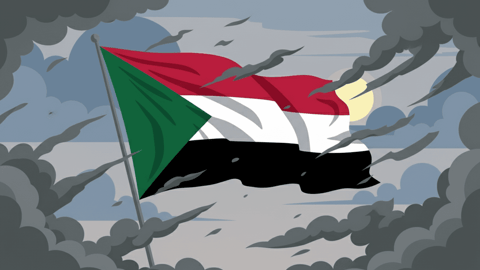
Sudan's war is spilling over into the Central African Republic. On Monday, the 22nd of September, an armed group of assailants crossed from Sudan into the Central African Republic, or CAR, with one target in mind. Billy Billy Village.
Panic swept through the community as clashes broke out and residents scrambled to find safety. Eyewitnesses report that several people were killed, with exact casualty figures unknown.
According to Humangol, a media organization that covers African conflicts, the attack was believed to have been a reprisal for the killing of four Sudanese Arabs by Russian mercenaries just days earlier.
This was the latest in a series of attacks that, according to Reliefweb, the leading global humanitarian information service, began on the 17th. More than 5,000 people have since been displaced, most of whom have taken refuge in the camp of the United Nations Multidimensional Mission in the Central African Republic, or MINUSCA.
What stands out is not just the scale of the displacement, but also where people chose to run.
They ignored the Central African Republic forces stationed in the area because, in the words of one civil society activist and quota here, they were convinced that their security could no longer be ensured by their national army. However, it's not just the army that has failed people living along the border.
The government has proven incapable of keeping them safe as Sudan's civil war spills over.
The poorest border between the two nations is the main cause of this problem. In early of 2022, a full year before Sudan collapsed into civil war, locals were warning that the ease with which the Chadians and Sudanese could travel across the two nations, often without any security techs, was becoming a ticking time bomb.
The government responded by deploying the army and Russian mercenaries, but as we've seen, their presence didn't make things better.
Sudanese conflict outlet Darfur24 alleges that Central African forces, often aided by their Russian allies, accused Sudanese residents of being members of the paramilitary rapid support forces before attacking them. Since early August, they have reportedly killed 12 of Sudanese during a violent campaign across border towns.
The survivors flee, plead for help from the RSF who respond in kind, perpetuating the cycle of violence.
While these clashes may seem like nothing more than provocation and revenge attacks, they represent an existential threat to the Central African Republic. It's a fragile nation in the midst of a 12 year long civil war.
Already the UN is reporting that the RSF isn't just launching occasional attacks into CAR's territory, they're actively recruiting from local militias.
Among these recruits are rebel fighters from the Popular Front for the Renaissance of the Central African Republic or FPRC, which controls parts of the Kanga prefecture in Northern CAR along the Sudanese border. In turn, FPRC fighters are using Sudanese territory to launch their own attacks in the CAR.
This has complicated the security situation for Bangoi, a place for which the security situation was already described as complex and bloody.
Beyond the increased violence and displacement, the spillover of the war into the CAR is affecting local trade.
Ismail Mohammed, a trader from Umdakun on the Sudan side of the border, told Dalfour24 that Russian activity has blocked vital trade routes that supply Dalfour with essential goods, worsening shortages caused by Sudan's ongoing war, shortages that have already tipped many parts of the nation into famine.
For a war that is already being described as among the worst humanitarian disasters in recent history, any shortages just feel particularly cruel.
Stepping away from the CAR for a moment, we can see that the risk of spillover affects the entire region. Chad is already under pressure. More than a million refugees from Sudan are taxing its social services and its resources.
It's ceased in provinces, which border Darfur and Cair are especially vulnerable to militia incursions or the spread of weapons. Another neighbor, South Sudan, confronts its own dangerous spiral. The economy almost collapsed following damage to the main ore transporting pipeline, which runs across Sudan.
Even now, with the pipeline fixed, the protracted economic crisis, it caused risks plunging the country into civil war, as President Salva Kiir remains unable to line the pockets of the elites whose support he needs to keep the nation in a semi-stable state. And it doesn't stop there.
The networks of logistics, recruitment and smuggling that the armed groups are building will outlast Sudan's conflict.
Weapons don't expire, routes don't vanish overnight, and experienced soldiers can always fight in the next battle, whether it's within their own borders or elsewhere. This is the real danger of the region. It's not just one cross-border skirmish in Cair or a few thousand people displaced.
It's a war that risks becoming the first domino in a whole series that destabilize the wider region for generations to come. Bilibili is just one village, but it may also be something else. It could be a warning sign, a red light blinking away on that dashboard, alerting us to a far greater catastrophe to come.
The collapse of one state, that's bad enough. The collapse of the region would be nothing short of apocalyptic. This week, the Indian region of Ladakh was rocked by popular violence as hundreds upon hundreds of locals took to the streets and engaged. time with fib поверхность
We'll be right back. fierce clashes with the police. Four people are dead at the time of writing and dozens more have been injured in what appears to be the latest in a series of escalating global protests. In this instance, India's protesters aren't pushing for regime change, they're pushing for statehood.
Ladakh is a relatively remote part of India, located at the nation's northern tip, where it's sandwiched by Pakistan to the west and China to the east. Home to less than 300,000 people in a territory where the lowest point is 2,550 metres above sea level, Ladakh is a cultural crossroads in the high mountains.
A bit less than half of the population of Muslim, about 40% are Buddhist, and a bit over 1 in 10 are Hindu in a land that bears cultural ties to Tibet and northern Pakistan as much as India.
But its location also makes it a highly strategic asset for India, not just because it's so close to a pair of powerful neighbours, but also because it's located just beside the disputed region of Kashmir. Formally, it was only split off from the rest of Kashmir in 2019.
The trouble, however, is that prior to 2019, Ladakh was run by an autonomous enclave, largely managing its own affairs with the support of the government in New Delhi.
When that changed, you'd assume that Ladakh would just become another Indian state, but that's not the case. Instead, Ladakh was designated an Union Territory, directly controlled by the Indian federal government, with no state-level government to speak of.
An Indian Union Territory is appointed a Lieutenant Governor, who basically acts as the executor of the federal government's will.
And as one might expect, that change was not received well in Ladakh.
In fact, Ladakh status has become a massive problem, not just because Ladakh has lost the ability to represent itself and manage its own affairs, but because of rising concerns over the extinction of local culture, the exploitation of the environment, and the government's apparent disinterest in ensuring that Ladakh residents are gainfully employed.
Over the last several years, Ladakh has demanded that it become an Indian state, and that it should be part of India's sixth schedule which would basically grant the region autonomy to act and self-govern as it wishes on its own internal matters.
Throughout the 2020s, so far, statehood and autonomy in Ladakh have been matters of intense debate and advocacy, but things really picked up earlier this year, culminating in the declaration of a hunger strike on the 10th of September. Since then, over a dozen people in Ladakh have continued that understrike, driving support from much of the region.
But then, on Tuesday the 23rd, two-thirds of them had to be hospitalised after they had collapsed.
Youth groups responded with outrage that India had ignored the hunger strikers for so long and called for a much larger strike across the region to shut down day-to-day operations until the people of Ladakh were hurt. On the following day, Wednesday the 24th, Ladakh residents took to the streets in force and all hell broke loose.
In this instance, the protesters quickly moved beyond the idea of a tranquil march or vigil instead, starting fires, throwing stones at police and burning down the offices of India's dominant political party, the BJP, in the region's joint capital city of Leh.
Police responded with tear gas and baton charges in formation, new curfews and bans on gatherings of more than five people in public spaces. The civil leaders who had augured the hunger strike decided that it was time to discontinue.
At the time of writing, protests are expected to continue and perhaps even escalate, and already it's clear that if the protests do continue, then it's because the people of Ladakh see their situation as an existential threat.
As we stated at the outset, four people are now dead, and dozens more have been harmed. As for how India could de-escalate the growing crisis, the answer is quite straightforward. Begin talks with Ladakh civil leaders immediately instead of dragging their feet, as they've done so far.
These protests are led by youth activists, similar to a growing number of protests in places like Indonesia, Nepal, and Kenya. And according to leaders on the ground, the youth decided to mobilise because it had become clear that peaceful protests weren't enough to bring change.
The government's response thus far, to blame local activists for the fighting, is unlikely to move the crisis forward toward a resolution.
Sahrawi struggle under Moroccan expansion. In Africa's last colony, the situation is growing worse by the day. After decades of occupation by the nation of Morocco, most of the land known as Western Sahara Territory is undergoing a process of rapid change.
But the people who once called that land their home, the ethnic group known as the Sahrawi, are under greater strain than ever. Weeks ago, UN Secretary General Antonio Guterres presented the International Body's Annual Report on Western Sahara, in which Guterres outlined just how bad things are getting.
Around 170,000 Sahrawi have lived for years, and a sprawling series of refugee camps just across the border in Algeria, near the town of Tindouf.
And while living in those camps has never been easy, the situation is rapidly getting worse. According to Guterres, malnutrition in those camps has climbed above 13%. Over 30% of children are stunted in growth, and a yawning gap in funding, about 104 million US dollars, shows no sign of narrowing any time soon.
As Guterres explained, humanitarian aid allocations for Western Sahara are dropping fast, food and clean drinking water are becoming scarce, educational programs are collapsing, fuel is nowhere to be found, and sanitation infrastructure is in shambles. As Guterres describes it, the problem facing the Sahrawi is twofold.
Morocco continues to occupy most of Western Sahara, preventing those people from returning home and building a functioning society.
And at the same time, the humanitarian arms of world governments are so apathetic that apply to the Sahrawi, and in this it's little more than a shrug. Certainly, that latter charge seems accurate.
Most nations simply do not care to give the Sahrawi, who haven't really been on the world's radar in decades, and who most Western voters wouldn't recall ever having heard about at any time.
But in the case of Western Sahara, apathy doesn't tell the full story. Instead, it appears that Morocco's dreams of complete control over the territory, and of the disappearance of international opposition, are now on the brink of becoming reality.
Starting in 2020, when the first Trump administration made America the first country to recognize Morocco's annexation of Western Sahara, a growing chorus of nations have chosen to throw their support behind the bat.
In 2024, France made a critical endorsement of Western Sahara's claims. This year. The United Kingdom did the same.
Spain went along with Morocco even earlier in 2022, Israel in 2023, and several other nations in the intervening years. Algeria, Morocco's longtime adversary, has pushed against that swelling support of Morocco's claims, backed up by Russia and Iran.
But Algeria's position, firm as it may be, doesn't have much effect on the regional balance of power, while Russia and Iran are far too busy with their own problems to really have had Algeria's back.
Nor has Algeria been able to support the Suwari refugees on its own territory, even with the support of the United Nations, which still recognizes the region as occupied and contested. Western Zara, Morocco, and its growing list of partners have been able to draw a very clear line between global diplomacy and the realities of global politics.
Western Sahara's annexation doesn't have anywhere near unanimous support from the international community, but all the nations who might have the combination of political will and geopolitical means to do something about it have decided that they'd rather not do so.
Pre-existing aid commitments have been easy enough to scale down or simply forget about, while nobody on the world stage other than Algeria is willing to stand in opposition. And in a world at a moment in history where money talks louder than ever, Morocco has been taking extra steps to sweeten the deal for nations that will support its annexation.
Right now, Morocco is overseeing the surge of domestic and international investment to Western Sahara, with the biggest and most emblematic example of that investment coming earlier this year.
In January, Morocco started flying direct routes from the Western Sahara city of Dakhla, known for its perfect kite surfing conditions, to cities all across Europe. Days later, it opened up a road from Dakhla to internationally recognized Moroccan territory at a cost of over a billion US dollars.
As The Economist writes of Morocco, quote, It's offering tax breaks and incentives for new businesses in Dakhla.
It is planning a desalination plant, as well as a huge new green hydrogen project, and it is building a $1.2 billion port. It's even encouraging a local film industry. Recently, The Odyssey, a Hollywood blockbuster, was filmed near the city.
Other nations have responded to Morocco's overtures, including this past May, oh, and France committed to pouring 150 million euros into the Moroccan-controlled parts of the territory.
As of now, it appears that Morocco's grand strategy is working very well, clearing the way for Rabat to tighten its grip on what it controls, and all but eliminating the opposition to the territorial capture that it has yet to achieve.
Only about 30% of Western Sahara remains outside of Morocco's grasp, but even that territory seems unlikely to escape Rabat's reach for much longer.
And with that, thank you for watching.
Unlock premium video briefings
Members get full access to premium reporting, in-depth briefings, and subscriber-only analysis.
Insiders Receive
- Full access to all premium articles and briefings
- Exclusive subscriber-only analysis and dispatches
- Support independent conflict journalism
From $5/month — cancel anytime