
Briefing Room 28.02.26
Congolese drone strikes kill M23's spokesman as Kinshasa closes in on the coltan town of Rubaya; plus Madagascar's tilt toward Moscow and China's dual-use export bans on Japan.
Simon Whistler • February 28, 2026
Members only
Note: this transcript was generated by AI and may contain errors or inconsistencies.
Welcome back to The Briefing Room, the subscriber-only show for people bored of the regular headlines and excited at the idea of diving into obscure stories that everybody else is missing.
I'm Simon, and this week, what the rest of the world is ignoring is a growing military offensive in the Democratic Republic of the Congo, where a supposed peace is fast unravelling.
Sticking with Africa, there were also signs that Madagascar's new post-coup president is attempting a tricky balancing act between France on the one hand and America and Russia on the other.
And then finally, we'll be heading to East Asia to check in on the rising tensions between Japan and China. As always, thank you so much for subscribing. Not only do your subscriptions help fund videos like this one, they also allow us to cover more niche topics over on the main channel.
Thank you so much. Let's go to the DRC. New Congo Offensive Takes Shape Officially, at least, the Eastern Democratic Republic of the Congo is still governed by a U.S.-led peace accord.
This week, however, the people who've actually got to survive in the Eastern Congo were reminded, yet again, the place is a war zone, no matter what Kinshasa, Kigali, or Washington might say.
The conflict broke through to international headlines this Tuesday because of a drone strike launched by the Congolese army near a mining town in the province of North Kivu. That town is called Rabaya.
Pre-war population, roughly 8,000. And for weeks, it's been the site of battles that have only grown in intensity. At roughly 3 o'clock in the morning, local time, a Turkish-made Congolese drone carried out a strike just outside the town.
It was in an area that the rebel group, M23, had been known to use as a local base of operations. According to an official from the UN, as well as the coordinator of a local rights group, the strike killed a man who's been the voice of M23 for years, military spokesman Willy Nagoma. High-level M23 leaders confirmed Nagoma's death for the Africa Report.
Nagoma had been synonymous with M23 since the end of the group's first attempt at large-scale rebellion back in the early 2010s. At that time, after a series of setbacks in the Congo, Nagoma was part of a group that fled into Uganda, and after the group's long dormant phase, he re-emerged as its primary spokesperson when M23 resumed fighting in 2021.
By the time of his death, he'd lived for years under European and UN sanctions and was, quote, involved in planning, directing, or committing acts that constitute serious human rights violations in the DRC.
While he wasn't operationally critical to M23's ongoing insurgency, he was a well-known face and voice across the Congo and frequently showed up in the most important frontline areas of a given period of fighting.
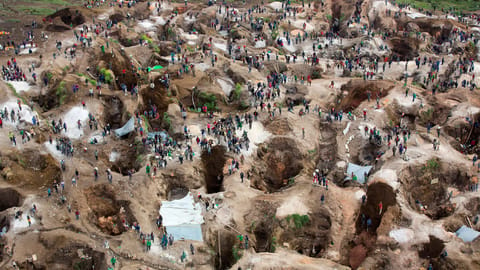
Nagoma's death comes as the town of Rabia has turned into the new epicenter of the Congolese conflict months after fighting in the disputed city of Avira Woundown. Rabia is home to roughly 3,500 artisanal miners who harvest a mineral called coltan from the town's large deposit.
Coltan is absolutely vital for the tech industry, particularly in laptops and smartphones. Anywhere between 15% and 30% of the world's entire coltan supply ZJFמעija's side is open by giving resonanceIVE fabric of hepatitis. And, in advance, let's a given year comes out of Rabia alone.
As such, control of the city is immensely valuable for anyone looking to sell off and harvest the Congo's critical mineral deposits, which are, in turn, the most valuable spoils by far that either the Congo or Rwanda-backed M23 can win during this conflict.
Over the course of the last week, M23 and DRC allied forces have traded control of the zone that surrounds Rabia. The town is under considerable pressure from Congolese forces who've tried to wrest it away from M23, and while that hasn't happened yet, it's clear that Congolese forces are getting closer and closer.
From the start of the week, pro-Kinshasa militia groups known as Wazalendo had captured several outlying villagers across two separate fronts before making several attempts to push into Rabia from the south. M23 reportedly pushed back those assaults on several consecutive days, but continued to lose surrounding villagers to the Wazalendo fighters.
By Wednesday, M23 fighters had massed reinforcements and equipment to attempt a counter-offensive and did successfully retake a pair of villagers that day, but the group is showing signs that it may not be able to hold that captured territory.
While Congolese forces have generally tried to advance behind Wazalendo fighters where possible in order to preserve the slim technicality that M23 and the Congo aren't fighting directly, Rabia appears to have become an exception.
Congolese drone strikes have become a recurring concern for the town and its residents, and local reports suggest that spokesman Willy Nogoma may not have been the only high-profile M23 death, or even the most important one.
According to some sources on the ground, the DRC also managed to kill Sultani Mekenga, who was a veteran of the Rwandan Civil War at both Congo Civil Wars and served as the military leader of M23 since its formation in 2012.
We should emphasize that Mekenga's death is just a rumor at this point, and conflicting reports suggest that he left the area just hours before the strike, possibly fleeing to a nearby church.
In any case, the Congolese drone strikes are known to have caused other casualties among M23's ranks, and Congolese forces have cut telecom's access while opening a new front in another outlying direction from Rabia.
There too, M23 has been battling DRC-backed Wazalendos for days, but although the group is putting up stiff resistance, it seems the walls around Rabia are closing in.
That's especially important for the DRC, because just last week, Kinshasa added the mine to a list of strategic assets it's offering to the United States.
The obvious question, of course, is whether Rabia was under Congolese control at the time that it was offered, and it really shouldn't be much of a surprise that at this point in the conflict, the answer to that question is a resounding no. The United States has demonstrated many times over the last year that it's disinterested in the finer details of the
Conflict as long as it gets its share of critical minerals.
But by offering Rabia to the U.S. before it controlled the territory, Kinshasa made Rabia and its central mine into the most important target in the entire Congo.
M23 now has reason to hold Rabia at all costs and break the trust between Kinshasa and Washington. while the DRC desperately needs to conquer the city to show that it can deliver as promised.
The Madagascar-Moscow Connection For our next story, we turn our attention to Madagascar, where President Michael Randrian Arena, who came to power last year after Gen Z protests led to the ouster of former President Andrei Rajalina, recently made a major statement on the diplomatic stage.
Unlike previous Malagasy leaders, Radrian Rina chose to go to Russia instead of former colonial master France for his first official state trip.
According to the investigative outlet Africa Intelligence, Radrian Rina traveled to Moscow on a Russian government aircraft for an official two-day visit on the 17th of February, after which he flew to France to meet President Macron on the 24th.
The decision to visit Russia first came as a surprise to some observers, especially because, despite recent tensions with France over its decision to help Radjelina flee the country, Paris is still Madagascar's most important trade partner. Bilateral trade between the two nations sits at about $1.1 billion annually.
Trade with Russia, on the other hand, is about half that at about $500 million annually. Despite the smaller trade footprint, Russia moved extremely quickly to build ties with the new Malagasy leadership, according to a Western diplomatic source that spoke to Radio France International, or RFI.
The Kremlin hosted an official parliamentary delegation from Madagascar in November, led by Sidney Randrian Sol... good lord, that's a long surname.
Randrian Solonyalko, the speaker of the National Assembly and a long-time Russian ally. And a month later, Madagascar hosted a Russian delegation led by Yunus Bech Yevkorov, Russia's deputy defense minister and de facto head of Wagner's successor group, the Africa Corps.
With that speed, then the obvious effectiveness of the Kremlin's diplomatic outreach have raised several questions, not least of which is what does Russia gain from deeper ties with Madagascar?
According to the defense industry outlet, critical threats at top of Russia's list of priorities in Madagascar is access to the Diego Suarez Naval Base, an abandoned former French facility with one of the best deep-water harbors in the western Indian Ocean.
Access to this base would secure Russia's presence in the Indian Ocean, making Moscow one of the leading naval powers in the region, which has long been a key goal of the Kremlin. Because of the base's location on the country's northern tip, Russia can use it to project power into major shipping lanes between the Atlantic and Indian Oceans.
Additionally, Russia seems interested in bringing Madagascar into its alternative financial system and securing investment opportunities which could help to mitigate or circumvent international sanctions.
According to critical threats, this explains why the Kremlin sent Mikhail Dorofiev, a banker described as a specialist in circumventing sanctions, to Anantrivo in late January. For Madagascar, Olmeyohan, the primary benefit to any partnership with Russia is security for the new regime.
Radrin Rina has said repeatedly that he fears a counter-coup and is yet to provide a transition roadmap. which would make Russian security guarantees particularly attractive.
Afroher Intelligence reports that Russia has deployed 140 military instructors to the country and delivered a stream of weaponry, including one-way attack drones and anti-tank rocket launchers. Beyond security, though, Russia would seem to have very little to offer Madagascar when compared to traditional partners like the US and France.
Still, Madagascar's pivot towards Russia was at least to some degree expected, especially because, as recent history has shown us, whenever there's a coup in Africa, the new military leaders almost always turn to Moscow for support.
Mali, Burkina Faso, and Niger are all perfect examples of countries where the Hunters turned to Russia as soon as they came to power, with nations like Gabon that stuck with France being the outliers.
Reader Laimori, a senior fellow at the Policy Center for the New South, told PBS that this is because the West often pressures coup leaders over democracy and human rights, while Russia prefers not to meddle in internal affairs.
This no-strings-attached approach has proven particularly attractive, especially in West Africa, where decades of French influence led to a surge in anti-French sentiment. Although less pronounced than in other former French colonies, similar anti-French sentiments exist in Madagascar.
However, unlike the West African nations that we just mentioned, Madagascar is attempting to balance working with Russia and the West.
As we mentioned at the start, President Randri Arena visited France shortly after his trip to Moscow, which was seen as the culmination of efforts to restore ties between Paris and Antone Rivo following the October coup. Most French projects in the country, including a $700 million hydroelectric dam, are expected to continue.
Madagascar has also explored a security and economic partnership with Washington, with President Randri Arena meeting U.S. officials and private military contractor Eric Prince to discuss possible regime protection measures and maximizing Madagascar's official tax revenues from imports and exports.
As Randri Arena told the press, quoting him here, "...we do not choose countries based on ideology. Any part of that could benefit Madagascar is one we are ready to work with." It remains to be seen whether this balancing strategy will be successful for Madagascar in the long run, or whether it will be forced to pick and choose a side.
For the strategy to be successful, competing nations would have to tolerate sharing influence on the island nation.
History suggests that they won't. Great powers rarely accept divided loyalties, especially in strategically important locations.
Japan-China military-industrial tensions rise When New Japan Premier Sunai Takaichi took office and immediately started picking fights against regional superpower China, both nations' interest in the diplomatic scuffle was made very clear.
But now, for both Beijing and Tokyo, it's time for shit to get oh so real, at the start of what's going to be a painful and highly complex economic decoupling.
Even though China and Japan are long-time geopolitical rivals, especially now that they find themselves on opposite sides of the US-China divide, the two East-A... and nations share a deep trade relationship. In 2024, the two nations traded goods worth nearly the equivalent of US$300 billion.
China is Japan's largest and most important trading partner, and Japan also enjoys an outsized importance in China's trade portfolio. That relationship has been under growing strain across the last several years. Japan and China no longer collaborate in high-tech areas in the way that they used to.
China has started to get very stingy about its critical minerals, and Japan has increasingly sought to avoid exporting technology to China that could be reverse-engineered and imitated.
But as China-Japan tensions hit a new modern peak under Sinai Takaichi, and then Takaichi surged to a massive legislative mandate with her citizen support, the inevitable falling out between the two nations finally arrived. That's what happened on Tuesday, when China placed a bevy of new export restrictions on a total of 40 Japanese companies.
Half of those companies went onto an explicit export control list, while the other half went onto a watch list, all because they were involved, according to Beijing, with Japanese remilitarization. The companies Beijing chose were telling.
Mitsubishi Heavy Industries, Kawasaki Heavy Industries, Fujitsu, the Subaru Corporation, and Tokyo's Institute of Science, just to name a few.
But just as important were the specific kinds of technology that China was focused on, so-called dual-use goods, which have clear civilian roles but can also be repurposed for military use. Dual-use goods are hardly a new addition to global economies. Really, they are a tale as old as time.
Many centuries ago, a dual-use good might be, say, a wood-splitting axe. Perfectly good at cutting firewood, but also useful if you've got to split the skulls of a few barbarian raiders open.
Today, dual-use goods might be truck engines, the hulls of ships, it might be sensor technology, semiconductors, telecommunications equipment, or artificial intelligence software.
China is known for its own love of dual-use technology. Its fleet of civilian ferries, for example, is built to transport heavily armoured vehicles and main battle tanks in times of war. Generally, restricting the trade of dual-use goods is a complicated decision.
Some dual-use goods that a given nation is good at producing are obviously too dangerous to send to an adversary, like the way that, say, the United States would hardly be willing to supply Iran with highly capable consumer-grade drones.
But when trade goods are more of an edge case, and when two trading nations aren't willing to openly regard each other as enemies, dual-use goods tend to get a pass. So when Beijing goes and imposes these kinds of export controls on a nation like Japan, that decision means something.
In its announcement of the measures, China did emphasise that its restrictions only targeted a handful of goods made by a handful of companies, and laid out its case that the restrictions were, quote, entirely legitimate, reasonable, and legal.
Never mind, of course, that China specifically banned the exports of critical rare-earth metals, of which China is the world's leading producer and seller. As Beijing put it, the new bans, quote, will not affect normal economic and trade exchanges between China and Japan, and honest and law-abiding Japanese entities have absolutely nothing to worry about.
In short, China was trying to calibrate one message for the world, that China doesn't intend to really start a fight here if it doesn't have to, and another message for the Japanese government. Shit is starting to get real, so tread carefully.
Dakaichi and a government, of course, don't really believe in treading carefully, and instead Tokyo has protested the decision with uncharacteristic force.
Japanese officials indicated that retaliatory measures were likely, meaning that Tokyo is willing to engage in a cycle that will, before long, see China retaliate in kind, and then Tokyo again after that. This is despite the fact that, according to a handful of the targeted companies in Japan, those companies didn't do very much business with China anyway.
But as China and Japan both understand, this isn't really about placing a few mild limitations on the export of a handful of dual-use goods.
After decades of coexistence as the two most important powers in East Asia, China and Japan are checking in with each other, each asking whether the other truly wants this fight, and signaling, when asked, that yes, they certainly do. This isn't the start of the growing economic conflict between Japan and China.
Back in November, when Dakaichi kicked off this entire rift by declaring that Japan could regard an invasion of Taiwan as a threat to itself and respond militarily, China engaged in all sorts of economic retaliation.
It sharply restricted the number of flights headed to Japan, discouraged Chinese tourism, canceled cultural exchanges and concerts, and more. But although Japan certainly didn't enjoy being hit with those prior restrictions, they were ultimately a slap on the wrist and nothing more.
These export controls are a limited escalation, but they are the escalation that really matters, nonetheless.
Not just because Japan is in the process of rearming itself, but because it sets both nations down a path where escalation will be rather straightforward.
Now that the precedent has been set, that Beijing and Tokyo are willing and able to cut into the really meaty parts of their trade relationship, both capitals have a neat avenue to punish the other for perceived transgressions in the future.
On the bright side, every day that Beijing and Tokyo are engaged in these kinds of economic shoving matches is another day that they're not engaged in a kinetic conflict against each other, and that's, well, that's got to count for something.
But in a moment when East Asia's two dominant powers seem to be setting the table for a mutual military buildup, a return to regional confrontation, and possibly even proxy conflicts, it's decisions like these that'll give their slowly emerging Cold War a bit more shape. Thank you for watching.
Unlock premium video briefings
Members get full access to premium reporting, in-depth briefings, and subscriber-only analysis.
Insiders Receive
- Full access to all premium articles and briefings
- Exclusive subscriber-only analysis and dispatches
- Support independent conflict journalism
From $5/month — cancel anytime