
Briefing Room 29.11.25
Briefing Room 29.11.25 — a Fronts video briefing on Strategy & Defense.
Simon Whistler • November 29, 2025
Members only
Note: this transcript was generated by AI and may contain errors or inconsistencies.
Welcome back to the Briefing Room, our weekly subscriber-only update. That is, for news junkies, what a complex craft beer from a microbrewery is for your average hipster. A sign that their tastes are both superior and deliciously obscure.
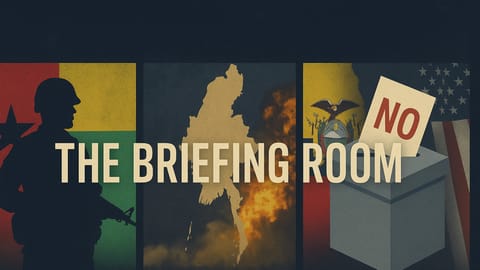
This week, the hoppy notes of the news include a faint pang of Guinea-Bissau, where yet another coup has rocked the West African nation, and a bouquet of Myanmar, where we check in on the latest developments in the Civil War.
Then it's finally down to the sediments at the bottom of the glass, and that would be comprised of the fallout from Ecuador's recent shock referendum result. And yes, that is the last time I will use such a tortured analogy in these openings.
Sediment at the bottom of the glass? I… Morris, you wrote this? What the hell, dude?
You're really stretching it. As always, thank you for subscribing, and subscription allows us not only to produce these exclusive videos, but also keep covering untrendy topics on the main channel, like Sudan or Haiti. With that other way, let's take a deep swig of the good stuff and get into the chaos of Guinea-Bissau.
Guinea-Bissau's Latest Coup It's time that we introduce what will probably be a general rule here on The Briefing Room. If we're talking about the nation of Guinea-Bissau, it's probably because Guinea-Bissau has had a coup.
In a very, very closely related observation, we'd like to note that we're now talking about Guinea-Bissau, and we'll give you one guess why.
This small, underdeveloped African nation, home to only about 2 million people, has seen over a dozen known or suspected coup attempts since it's gained its independence from Portugal back in 1974, and now it's happened again.
Of course, context matters, and to understand what went down in the capital city of Bissau on Wednesday, we've got to give a brief recap of recent events. Since February 2020, Guinea-Bissau has been led by President Amaro Sissoko Imbalo, a former military general, prime minister, and international defense expert.
Imbalo's rule has not exactly been easy. He weathered a coup attempt in 2022, dissolved his parliament a few months later, and then dissolved his parliament again because of an alleged coup in 2023. At that time, he was accused of trying to carry out his own self-coup, basically trying to turn himself into a dictator.
For a while, leading into 2024's presidential election cycle, it seemed as if Imbalo could at least read the writing on the wall, and that he might decide that since so many people wanted to overthrow him, he'd be best off deciding not to run for a second term.
But instead of stepping down, as one might expect, he chose to suspend the 2024 elections, overstay his mandate as president, call a 2025 presidential election, and then engage in all sorts of repression to try and ensure that he would win a second term.
The election ultimately took place on Sunday, the 23rd of November, when Imbalo went head-to-head, with a rising figure in the political opposition, Fernando Dias de Costa.
After votes were cast, both Imbalo and Dias attempted to declare victory, as stabilization forces from the economic community of West African states kept an armed guard over the country, and Guinea-Bissau awaited the official results.
Those results, at the time of writing, have still not been announced, but now it doesn't appear that Guinea-Bissau isn't going to need them. Three days after the election, and two days after both leading candidates declared victory, reports began to circulate worldwide that there was sustained gunfire outside the presidential palace.
The road to the palace was locked down, shootouts were reported at other critical government institutions, and before long it became clear that the national military was now in charge.
Within hours the apparent leader of the coup, a general named Dennis Nkarnha was undertaking that most West African of traditions, the reading out of a statement on the state-controlled TV service flanked by armed men announcing the removal of the president.
According to the general, the military had taken full control of the country, the borders had been closed, all media and political work was suspended nationwide, and the nation was now under curfew.
As for why a coup had been necessary, the military announced that they had uncovered what they had alleged was an ongoing plot in which national politicians had allied with, quote, a well-known American drug lord and domestic and foreign nationals to manipulate the results of the election.
Now, some of that certainly does make sense, given the wider context in Guinea-Bissau. The nation is home to key smuggling routes that fuel the drug trade across Africa and provide a conduit for Colombian product to arrive on the coast and then travel toward Europe.
And as such, the nation is home to some very influential drug traffickers. As for the concerns about election rigging, those make some sense as well. The results were due on Thursday, the day after the coup.
And the coup could have been triggered by last-ditch efforts behind the scenes to try and salvage a favorable election result when the election had already been lost. That concern only becomes more credible when you remember who would have been doing the rigging, a leader in Imbalo with a history of attempting to unilaterally seize power for himself.
But it was at roughly this same time that things started to get weird.
Imbalo was taken into custody at the presidential palace. But then, he was given access to the global media, including several French news outlets, and allowed to explain the situation himself. According to Imbalo, he had been taken into custody without any violence against him personally, and was now being held by the national military indefinitely.
We'll quote him directly here, I have been deposed. His opponent, Dias, had been in a meeting with international election monitors at the time that the coup began, and one of the members of his inner circle alleged that Imbalo was trying to manufacture the coup himself.
By that telling, Imbalo had realized that he had lost the election, and put together the coup attempt to reinstall himself in some way, although Imbalo and his close allies have accused Dias of being behind the coup instead.
The nation's military has hardly helped to clarify things. As of the time of recording, Imbalo has just been flown to Senegal, while those in military custody include his interior minister, his key staff, and the chief of staff of the armed forces.
They're joined in custody by the nation's opposition candidate, Dias, as well as the close DS advisor, Simos Perea, who accused Imbalo of orchestrating the coup himself.
Hopefully, by the time this episode is released, the situation will be a bit clearer, and if you'd like an update, and there is one that exists... de well, you'll be able to find it. As of right now, however, it's really not certain what the hell comes next.
General Horta Natam has been declared president for one year, although whether he'll relinquish power once that time is up is anyone's guess.
Either way, Guinea-Bissau appears to be just keeping up with the rest of the region, neighboring Guinea, the Sahel states of Mali, Niger, Burkina Faso, Chad, and one half of Sudan, and the more southerly nations of Gabon and Madagascar, all being under military rule following a string of coups.
While the so-called coup belt of states seems to have fallen silent in recent months, Wednesday's events show that military takeovers in Africa are still very alive and well.
An Update on the Myanmar Civil War Now for our next story, we head to Myanmar to check in on the long-ranging civil war that the world has, for all intents and purposes, tried very hard to forget.
Back in January, as the war entered its fifth year, it seemed that the rebels were on their way to victory. They had won significant victories in 2024, including capturing Kaakmei, a strategic city along Asian Highway 14, and were closing in on more cities and weapons factories vital to the military hunter.
A BBC World Service study found the hunter in full control of only 21% of Myanmar as of mid-November that year, a patchwork of rebel groups holding 42%, and both sides contesting the rest.
Matthew Arnold, an independent analyst tracking the war, told Voice of America, and we'll quote him here, the military has lost significant control, and in 2025, based on that trajectory, it will still continue to lose control. The military does not face rebels in this valley or that valley or this mountaintop or that mountaintop.
They say these rebels can now attack us across hundreds and hundreds of miles of contiguous territory where they have absolutely full control.
It just fundamentally shifted the nature of warfare in the country. End quote. Now you might remember this from our coverage of the civil war earlier this year, and given that this is an update, you're probably expected me to tell you about all the rebels' latest advances.
However, that's not what's happening. For much of 2025, the biggest story in Myanmar's civil war has been the military hunter retaking territory from the rebels. In May, rebel fighters quietly abandoned Lashio, a town in northern Shan State, which they captured in August 2024 at the cost of more than 500 rebel lives.
Once the rebels had left, a military convoy of 200 vehicles flying the national flag rolled into the city and reclaimed control. According to the Myanmar Peace Monitor, an independent watchdog tracking conflict and territorial control in Myanmar, by the 31st of July, the hunter had regained control of seven major towns.
As Sumon, the senior analyst for the Armed Conflict Location and Event Data told DW, the rebels had gone from being on the offensive to being on the defensive, and they were struggling at that.
Quoting her here, that's the major shift. They've gone from an offensive position to a defense position in their controlled areas. And since then, they are not able to defend those areas and are losing one town after another.
End quote. So we have to ask, how did Myanmar's military hunter go from being so on the back foot to being... able to retake vast swathes of territory across the country? Will they be able to fully recapture the entire country?
And most importantly, what's next for Myanmar? Well, let's start with the most obvious question. Why is the military scoring victories?
Well, according to most observers, the answer is threefold. More soldiers, increased airstrikes, and China. In February last year, the junta introduced compulsory military service for all young men and women.
Men aged 18 to 35 and women aged 18 to 27 would have to serve for up to two years, while specialists like doctors aged up to 45 can be called on for up to three years. During a state of emergency, which has been in place since the military overthrew the civilian government, the conscription period can be extended by up to five years.
Since this policy was implemented, more than 60,000 soldiers are believed to have joined the military ranks, bolstering a force that has been whittled down by casualties, desertions, and defections, allowing the military to throw far more troops into battle than before.
And where these troops went, airstrikes followed. According to the BBC, during their campaign to retake Kiao Kime, junta jets dropped 500-pound bombs, while artillery and drones hit insurgent positions outside the town.
Sumon told DW that the military is now using the air force at the very start of engagements, rather than after they've begun fighting the rebels.
And finally, China, perhaps the greatest force multiplier that the rebels have. China has long supported the junta, viewing it as a guarantor of the nation's stability, fearing that if the junta fell, Beijing would have to deal with perpetual turmoil along its 2,129-kilometer border with Myanmar.
There's also a feeling in Beijing that greater unrest in Myanmar could benefit China's rivals, including the US and Japan.
Interestingly, this desire for stability has occasionally led to Beijing offering quiet support to the rebels. One of the reasons for their successes in 2024 was China getting fed up with the scam centers the junta was allowing to proliferate inside Myanmar, which often targeted Chinese citizens.
Beyond this general support for stability, China has billions of dollars invested in energy and infrastructure projects across Myanmar that it is keen to protect and expand with the junta's help.
According to a report by the Special Advisory Council for Myanmar, an independent group founded by three UN officials and composed of international experts, bombs made with Chinese support are widely used by the Myanmar Air Force, including in indiscriminate attacks on civilians.
Apart from providing weapons, China is also directly applying pressure on the rebels to get them to abandon towns that they had captured.
Richard Paddock, a contributor to the New York Times, notes that to force the rebels out of Lashio, China blocked border trade, cut off power and internet service in nearby towns, and reportedly detained the commander of the main rebel group after he crossed into China.
With that explained, let's move on to the second of our questions. Will the military be able to recapture the entire country? At the moment, the answer does seem to be a firm no. Even after recent victories, the junta is believed to fully control less than half the nation.
Additionally, while the junta had significant success in some parts of the country, in others such as Rakhine and Chin's States armed groups are holding it at bay and, in some cases, even managing to push it back.
As several analysts told DW, despite its recent victories, the military is still not poised for victory, nor are resistance groups poised for defeat. And that leads us to our final question, what's next for Myanmar?
At the moment, the nation is gearing up for a national election in December, which UN experts have dismissed as a sham engineered to maintain the general's grip on power.
It's a feeling echoed by the young people in Myanmar, with Ku Kare, a Kareni youth, telling the Kantar Awari Times, an independent media organization based in Myanmar's Kareni state, quote, this election is not the solution for Myanmar. It is an election with no future.
The reason is that there is no participation from youth and no participation from the people. Even if people had to vote because they had no choice, they would be voting under threats and fear, end quote. So, if the military can't win, the rebels are on the back foot, and the elections are a sham, what's next for Myanmar seems to be more of the same.
A grinding, endless war that the world has grown just comfortably ignoring. The generals will cling to power through violence and sham democracy, the rebels will continue their resistance from the margins, and the people of Myanmar will remain trapped in a conflict without victors, without resolution, and increasingly, without hope.
Ecuador Votes Nayot Hosting US Military Base For our final story, we turn our attention to the South American nation of Ecuador, where a major vote has managed to slip under the radar of global headlines.
On Sunday, the 16th of November, Ecuadorians went to the polls to vote in a referendum on four issues, chief among them whether foreign nations should be allowed to have military bases in the country, which would reverse a constitutional ban that had existed since 2008.
The other questions posed to voters were on ending public funding for political parties, reducing the number of lawmakers, and creating an electoral body that would draft a new constitution. When the votes were tallied, Ecuadorians had rejected all the government-backed proposals.
The share of no votes ranged from 53.1 to 61.8 percent, a marked turn from pre-referendum opinion polls that had indicated the measures would pass comfortably because they enjoyed the support of President Daniel Noboa.
Now, while the referendum in and of itself is a major story, because it exposes a widening gap between Noboa's popularity and support for his policies, we feel that the vote against foreign military bases deserves particular attention.
Although the question applied to all foreign nationals, it was ultimately seen as a referendum on American military presence in the country, something that both Washington and Noboa have long wanted.
And by voting against it, Ecuadorians were broadly seen as making a statement against Washington. According to the President, the answer is simple. Foreign militaries could play a crucial role in the fight against drug trafficking.
Noboa's logic was straightforward. Ecuador has quickly become one of Latin America's most violent countries, with homicide rates spiking from 8 per 100,000 in 2020 to 5 per 100,000. Well, we made a very good resolution to be a good resolution to all of our family members Let's have a good idea.
Let's have a good, today. 50 per 100,000 in 2025, easily surpassing nations as murderous as Mexico, Colombia, and Honduras.
With roughly 70% of global cocaine flowing through the country, Naboa argued that Ecuadorian security forces simply didn't have the resources or capabilities to fight the transnational crime networks that were operating within the nation's borders.
According to reports by the Spanish news agency EFE, Naboa said the initiative would not necessarily limit the agreement to just military bases, but it would also include illegal fishing control bases and drug enforcement centers or facilities shared with multiple countries.
Quoting the president, the goal is to create an international cooperation hub for maritime security and anti-drug operations, end quote. Interior Minister John Reinberg echoed this view, adding that Ecuador must be aligned not only with the US, but with many nations in the fight against narco-trafficking and terrorism.
All of which naturally raises yet another question.
While this sounds all well and good for Quito, what was in it for Washington? And to answer this, you need a bit of context. In 1999, the US and Ecuador signed a 10-year agreement that allowed the US to establish a Forward Operating Location, or FOL, at Manta Air Base.
This base was ostensibly meant to support aerial surveillance and operations targeting drug trafficking routes in northwestern South America, but especially those linked to cocaine shipments from Colombia. Under the agreement, the US could station close to 500 personnel on the base.
In 2008, under the government of President Rafael Correa, Ecuador adopted a new constitution that barred foreign military bases and foreign troops from being stationed on Ecuadorian territory.
According to Major Abdon Garabriones, an assistant professor of military studies for the Reserve Officer Training Corps, or ROTC, writing for the journal Military Review, while the USFOL was active at Manta, U.S. forces significantly bolstered Ecuador's capabilities in counter-narcotics operations through enhanced surveillance, intelligence sharing, and
Training for local law enforcement.
Additionally, the deployment of advanced military assets, such as reconnaissance aircraft, allowed for improved monitoring of drug trafficking routes and facilitating the interception of narcotics shipments.
In Major Garabriones' view, establishing a US military presence in Ecuador would significantly enhance US strategic reach in South America, providing a critical foothold for military operations and regional stability initiatives.
For Washington, then, a base in Ecuador would align perfectly with the Trump administration's aggressive war on drugs in Latin America. And it's in that last sentence that you can start to see the glimmerings of an answer to one final question. Why did the Ecuadorian people vote no?
Now, on paper, the referendum should have passed. Noboa's government made a compelling case that Ecuador's internal armed conflict with its gangs demands drastic measures. And Noboa itself remains popular, enjoying more than 55% of public support, according to a recent poll.
Yet voters still rejected the measure. According to most observers, the decision boiled down to two reasons. One, is Michael Shifter, a senior fan? fellow at the Inter-American Dialogue and an adjunct professor of Latin American Studies at Georgetown University told Al Jazeera the Ecuadorian people don't trust America.
Quoting him here, The Trump administration saw Naboa as a key ally and assumed the Ecuadorian people would go along with restoring the military base that existed before on the coast. And this is clearly the Ecuadorians rejecting that. They prize their sovereignty, their independence.
They are very suspicious, very mistrustful of the US administration, especially as they are watching what's going on with the blowing up of boats and killing people in the Caribbean and in the Pacific as well." Second and maybe most important, most people were simply skeptical about whether foreign troops would actually help reduce the country's crime rates
And drug trafficking.
As Fernando Carrian, a security expert and scholar, put it in an interview with a local Ecuadorian outlet, When the 1999 agreement was signed, the homicide rate in Ecuador was 13 per 100,000. In 2009, when the Manta base left, the homicide rate was 17 homicides per 100,000.
In other words, during the 10 years of US military presence in Ecuador, homicides increased by four points." In addition, Carrian said that although there are seven US military bases in Colombia, cocaine production has increased by 53%. In other words, the seven US military bases in Colombia did not reduce drug trafficking.
This skepticism was reinforced by Noboa's own track record.
An international crisis group report released just before the referendum was damning, concluding that his Manodura crackdown has done little to undermine drug trafficking.
So, when Ecuadorians went to the polls on the 16th of November, they weren't just voting on whether to allow foreign military bases, they were voting on whether to double down on a security strategy that seems to be flailing.
All this against a backdrop of news stories accusing the Trump administration of killing innocent fishermen in Latin American waters in its strikes on suspected drug-carrying vessels.
So perhaps it's no surprise they voted no. And this leaves Noboa in a tough position. After coming to power as a hard-nosed centrist, the Ecuadorian president has recently pivoted in a more Trumpist direction, trying to gain the White House's favor. But what use is that favor if Ecuadorian voters soundly reject it?
He may still be popular, but this referendum can be seen as a warning to Noboa to change course in his nation's internal armed conflict, or risk losing his popular legitimacy. Thank you for watching.
Unlock premium video briefings
Members get full access to premium reporting, in-depth briefings, and subscriber-only analysis.
Insiders Receive
- Full access to all premium articles and briefings
- Exclusive subscriber-only analysis and dispatches
- Support independent conflict journalism
From $5/month — cancel anytime