
Briefing Room 3.21.2026: Serbia, Nigeria, Kazakh/Kyrgyzstan.
Vučić warns of an attack by three neighbors to shore up his embattled rule, Boko Haram exploits an ISWAP assault to bomb Maiduguri, and two Central Asian presidents tighten their grip on power.
Simon Whistler • March 22, 2026
Members only
Note: this transcript was generated by AI and may contain errors or inconsistencies.
Welcome back to the briefing room the show that our front steam started actually because it was ordered by a doctor prescribing our writers once weekly respite to think about something beside the war in iran rest assured once this episode is finished our team will be chained up to the iran desk until next saturday but i was told that i either allow them to
Write this or i've got to let them out for walks around the neighborhood and we can't be having that can we so you'll never escape so we'll start off in serbia then we'll head to nigeria where rival georgia artist insurgencies are exploiting each other's actions to make themselves even more dangerous than they otherwise were and finally we'll make a rare
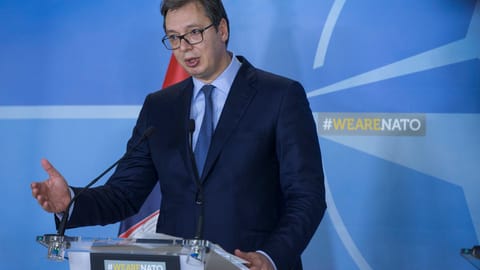
Visit to central asia where we've got not one but two stories from countries whose names start with a k and end with a stan let's get into it first up we touched down in serbia where a recent statement by the nation's president alexander vicich has put all of europe on edge in a recent interview the president told radio television of serbia that belgrade was
Expecting an ambush from three regional rivals croatia albania and kosovo quoting me they're waiting for a favorable moment we are preparing for their attack now according to multiple outlets president vicich always referring to a trilateral defense pact that the three nations signed in 2025 aimed at strengthening security cooperation and operational
Interoperability it's a mouthful among their armed forces operational interoperability it's a tongue twister as part of this pact croatia albania and kosovo will hold joint military exercises later this year two in zagreb and one in tirada reacting to this announcement president vicich told informa tv that these military exercises were directed against
Serbia he further accused croatia specifically of being hostile against serbia because it allegedly failed to hand over suspects accused of violent acts including terrorism so what's happening in the balkans then well according to ferret harkta albania's new chief diplomat it's possible vucic could be playing to two different audiences it's important to note
That these comments about a potential war came just days after vucic published a joint op-ed with albanian prime minister idi rama where both leaders proposed a phased integration of the western balkans into the eu common market and schengen zone for international audiences particularly in brussels and other european capitals vucic maintains the image of a
Statesman navigating difficult regional dynamics while keeping serbia on a pro-european path the op-ed with rama reinforces this narrative the domestic audiences however vucic can use the threat of war to rally nationalist sentiment justify military spending and position himself as the indispensable protector of serbian interests and this is important
Because according to ramadan illazai head of research at the kosovar center for security studies president vucic is facing a crisis of credibility and needs to consolidate his position that crisis began back in november of 2024 when a canopy collapsed at the novi sad railway station killing 16 people leading to widespread protests across the country
According to the conversation you nation, Vucic has attempted to smear the student-led movement as a Western-led color revolution aimed at politically motivated regime change, but that hasn't been successful in stopping it.
In January this year, DW reported that the protesters had turned their focus to the upcoming elections in a bid to remove Vucic at the ballot, as he has proven resistant to public pressure. Of course, that's just Serbia's side of all of this.
There's also the three nations that Serbia accused, and particularly the most powerful of the three, Croatia.
Croatian President Zoran Milanovic dismissed Vucic's claims about an attack on Serbia as crazy, pointing out that Croatia is a member of both NATO and the EU, while questioning where Serbia got the funds to finance the purchase of offensive weapons from Russia and China.
The subject was clear, why would NATO members need to form a conspiracy to attack Serbia when they already possess overwhelming military superiority through the alliance itself?
Vucic responded by telling Croatia to be careful about what it was doing and insisting that no one would dictate or control what Vucic says. While Croatian officials have been vocal in rejecting Vucic's allegations, Kosovo and Albania have been more muted in the immediate aftermath. Next, we have to discuss whether a war between the nations is even possible.
And at the moment, probably not. Croatia has been a NATO member since 2009 and joined the EU in 2013. Albania joined NATO in 2009, and Kosovo hosts NATO's peacekeeping force and maintains close security partnerships with the alliance.
Any attack on Serbia would immediately trigger a diplomatic crisis that would destroy decades of integration efforts and permanently derail EU accession prospects for Albania, Kosovo, and Serbia. Additionally, none of these countries have any strategic interest in military action against Serbia.
According to Ilazi, the military cooperation that Vucic cites as evidence of hostile intent should primarily be understood as a normal and legitimate form of defense cooperation between Kosovo and NATO member states, both of which also contribute troops to NATO's mission in Kosovo.
But this doesn't mean the region is particularly stable. In 2023, dozens of Serb gunmen dressed in combat uniforms killed a Kosovar-Albanian police officer and then stormed an Orthodox monastery in Kosovo near its border with Serbia. There they set off gun battles that left three assailants dead and inflamed tensions between the two nations.
Kosovo accused Serbia of orchestrating the attack, but Belgrade denied the charge, claiming that the gunmen had acted on their own. While the situation was eventually resolved, the underlying tensions remain.
In February this year, War on the Rocks warned that the region appeared to be quietly recalibrating for a war, given the rapid pace of regional military modernization and the fact that the forces that once prevented escalation are weakening.
The outlet argued that in an environment where external security guarantees feel less automatic, deterrence signals are increasingly inconsistent and Russia's war in Ukraine has unsettled assumptions about restraints, borders, and the cost of using force, militarization does not require aggressive intent to become destabilizing.
The only thing that was in Vietnam said that the US was no doubt. that's needed is misunderstanding and narratives that frame force as legitimate by framing routine military cooperation among neighboring states as preparation for aggression vucic contributes to an environment that makes misunderstandings more likely and diplomatic progress harder the balkans
Spent the 1990s in devastating wars the last thing the region needs is another violent war that can be easily avoided if leaders don't manufacture crises for domestic political gain we hope for the sake of billions of people living in the region that cooler heads do prevail next up we move to nigeria where ever since the rise of the boko haram jihadist
Insurgency in the late 2000s the northeastern borno state has been the target of near constant fighting but over the last several years the borno capital city maiduguri has become a far safer place to live and work than it was at the height of the boko haram uprising that all changed on monday when a trio of suspected boko haram suicide bombers left at least
23 people dead and over 100 others wounded but look a little closer and the situation in maiduguri is even more concerning than monday's attack would suggest far from a standalone attack or even a longer-term threat posed by a single insurgency the suicide bombings in maiduguri are worth a product of a deeper instability in a place where jihadist groups are
Now taking advantage of each other's attacks in real time to understand the bigger picture here we first got to understand monday's events in maiduguri a city with an estimated metro population of about two million people maiduguri as the capital of borno state has long been a target of boko haram and the other jihadist groups in the region and it gains
Notoriety during the mid-2010s as the site of a brutal detention center as the nigerian military based a fair share of their operations out of the city and its surrounding installations but the city has been mostly quiet since 2017 with one mass casualty event in 2021 and the next in late 2025 when a single suicide bomber killed five people at a local mosque
Although maiduguri is far from an easy place to live for a whole variety of reasons it's generally seen as one of borno state's most stable areas in a region where boko haram and the islamic state west africa province or iswap operating close proximity but maiduguri's sense of relative peace was shattered on monday evening when suspected boko haram fighters
Detonated what seemed to have been wearable explosives in civilian areas two of the bombers detonated at a crowded local market and a nearby business complex and the third struck the entrance of a teaching hospital affiliated with the city university just a few minutes previous no group has claimed credit for the attack as the time of writing but the attack
Pattern is consistent with boko haram's modus operandi targeting civilians in urban areas whereas the islamic state has tended to focus its fire on local military targets and civilian militias according to a range of nigerian and sub-saharan african security experts speaking to the global press the attack on maiduguri stands out both because of its death
Toll and its operational complexity.
For insurgents to carry out a coordinated wave of suicide attacks at multiple locations with security services none the wiser is a major statement on the jihadists' capabilities.
At the same time, the attack is likely to lower public confidence in Nigerian state forces at a time when recent military victories and growing support from the United States were supposed to mean that the military was gaining ground.
But the most concerning aspect of Boko Haran's attack actually has more to do with the Islamic state and a separate series of events that took place on the prior evening.
On Sunday night, ISWAP fighters launched what appeared to be an unrelated attack on the outskirts of Badaguri, engaging several groups of Nigerian soldiers and launching parallel attacks in Borno State Southwest.
Video footage from the area revealed heavy fighting just outside the city in locations that indicated deliberate efforts by ISWAP to focus on fortified targets.
In the group's attacks elsewhere in Borno, multiple military camps were set ablaze, including one that hosts Nigeria's 135th Special Forces Battalion, a unit that's been central to counter-insurgent operations in recent months.
Outside Bidoguri, ISWAP fighters eventually withdrew under unclear circumstances, and a death toll from those Sunday night battles has not yet been firmly established.
So imagine the situation in Bidoguri and across Borno State. 24 hours later, Nigerian forces were still picking up the pieces from the attacks on the prior evening, soldiers were in disarray, reinforcements and cleanup crews were traveling to and from the camps that had been hit hardest, and while the city proper had been spared, the situation in Bidoguri
Was unusually tense.
While we aren't able to provide specific insights on Nigerian security coordination on Monday night, the situation mirrors circumstances in which security forces are likely to be on high alert, but relatively disorganized and distracted, operating on the assumption that the main threat to the city was ISWAP, and the group would probably need days or weeks to
Reconsolidate its forces and attempt a subsequent attack.
And all of that would be concerning already if the implication were that ISWAP leaders had passed information along to Boko Haram, helped to coordinate a one-two punch of multi-day attacks, or perhaps even created cover for Boko Haram's suicide bombers to slip into the city.
But that's always certainly not what happens here. Boko Haram and ISWAP aren't allies, they are rivals, fresh off a series of highly unusual naval battles across Lake Chad that left hundreds of fighters dead across the two groups.
The groups are in direct and constant competition for recruits, resources, and territory, they follow different interpretations of jihadist ideology, and they leverage distinct tactical approaches in their respective insurgencies.
Of course, in a constantly morphing insurgent environment like Borno State, nothing is ever assured, but it is far more likely that the groups didn't coordinate their operations than that they did. For Nigeria, the implications are dire.
Not only can ISWAP and Boko Haram each launch well-timed, coordinated attacks across multiple locations, but they're able to respond to each... other's attacks dynamically taking advantage of security gaps on a 24-hour turnaround with little to no advance notice of the opportunities before them it's not inconceivable the boko haram's three suicide bombers
Were already planning a monday night attack in maidaguri that the bombings just happened to come one day after iswap's attacks and that both groups chose to launch their deadliest attacks in maidaguri in many years within a mere 24 hours of each other but it's far more likely the boko haram cells were already present within the city with the available
Explosives and the operational coordination to seize this opportunity when it presented itself at a moment when nigerian forces are struggling to deal with either insurgency even despite american support this is a threat level that nigeria simply is not prepared to address for our final story we're taking a look at central asia where two regional strongmen
Are making a concerted effort to secure their respective grips on power we begin in kazakhstan where this week the nation overwhelmingly voted for a new constitution and when we say overwhelmingly we mean it according to the country's central election commission voter turnout exceeded 73 percent and 87 of the voters supported the new constitution which
Merges the kazakh parliament's two chambers into one and gives the president the right to appoint key government officials with parliament's approval the new constitution also restores the position of vice president and creates a people's council a body whose members are fully appointed by the president and will be empowered to initiate legislation and
Referendums the constitution also proposes making kazakh the country's main language while retaining russian as another albeit downgraded official language this is the second constitutional change in four years and it was initiated by president kasem jamart tokayev who has been in office since 2019 according to the jamestown think tank the president said
These changes will allow for the regular change of power ending the risk that any one person could remain in power for a lengthy period part of this stems from the fact that the new constitution limits a president to a single term reaffirming a law passed in 2022 however some observers believe that the law paves the way for tokayev to consolidate his power
And reset his term after it expires kate mallinson an associate fellow at chatham house's russia and eurasia program suggested that tokayev could step down early and assume the newly restored position of vice president with his successor installed as president this would enable him to manage kazakhstan's complex foreign affairs without the pressure of
Day-to-day domestic duties temer omarov a fellow at the carnegie russia eurasia center presented another possibility telling the associated press and we'll quote him here if the transition of power doesn't go as tokayev would like then he will be able to say that with the adoption of the new constitution we have reset presidential term limits the new
Constitution could provide tokayev with a loophole for re-election to another term end quote apart from the reset the nation's opposition has taken issue with the new constitution you because they claim it dramatically expands presidential power, given the president's new ability to control dominant political parties and keep opposition groups fairly weak.
And it's not just the Kazakh opposition that doesn't like the new constitution. According to Mallinson, Russia will be wary of the new constitution because it cements Kazakhstan's sovereignty and territorial integrity in the face of increasing Russian attempts to assert its influence.
This will likely strain the relationship between Astana and Moscow, because until the passage of the new constitution, the Kremlin had viewed Tokayev as a productive partner and a guarantor against a wave of anti-Russian popular sentiment.
China also viewed Tokayev as a productive partner, and in Mallinson's view, is likely to welcome the transition to a more stable and institutionalized system similar to its own.
The new constitution is now in effect, and we will continue to monitor the situation in Kazakhstan to see whether President Tokayev uses it as an opportunity to consolidate his power, or whether the new constitution lives up to its promise of preventing any one person from ruling for too long.
And next, we move to Kyrgyzstan, where the nation's tax authority published a video accusing ex-security chief Kamchebek Tashyev of corruption.
Tashyev, previously the head of Kyrgyzstan's State Committee for National Security, or GKNB, was seen as the country's second most powerful figure until his abrupt sacking in February. He and President Sadir Jeparov had ruled the country side by side after taking power amid a wave of protests in 2020.
The two men bridged the deep divide between northern and southern Kyrgyzstan, which is important because Bishkek's politics can best be described as clan-driven and unstable.
Since 2005, three presidents have been ousted by protests. The partnership worked because each man brought something the other needed. Tashyev controlled the coercive apparatus and maintained regional support networks, while Jeparov held the presidency and managed international relations.
However, Tashyev's authority expanded steadily over five years, with Jamestown reporting that under his centralized control, the GKNB dramatically expanded its mandate, reaching all levels of Kyrgyzstan's society and possibly becoming the country's most influential institution.
Tashyev took the lead on many issues, nominally outside of the purview of a security chief, including those in the diplomatic, economic, educational, and political spheres, which led many to question whether Jeparov was still the head of the country or if Tashyev had eclipsed him.
This created a simmering undercurrent of tension between the two men, and the breaking point came on February 9th, when a letter signed by 75 public figures demanding early presidential elections was sent to the president.
The document listed the administration's key achievements, which were almost exclusively measures taken by Tashyev. Many observers interpreted this as an attempt by Tashyev, or at least his supporters, to secure the presidency for himself in the events of early elections. And the president couldn't stand this.
What followed was a systemic purge by Jeparov, targeting ministers and other key officials. Jeparov also moved quickly to curtail the influence of the security service, authorizing the arrest of the head of the GKNB's Bishkek office, and the time living in the residence of the law to prevent them from hurting the people.
And the administration's key is a huge part of the faculty and the defense, the way you can immediately take it to the government to the government. as well as several of its agents.
For his part, Tashiev has acquiesced to his sidelining without complaint. He told the press that his dismissal had been unexpected, because when it happened, he was in Germany, recuperating from an illness with the president's permission.
With Tashiev effectively sidelined, Jaberov has consolidated his power and has no immediate challenges for the upcoming elections.
However, whether that consolidation will hold is another matter entirely. Umarov told Eurasian Ned that while Tashiev has accepted his lot for the moment, that doesn't mean his supporters and other members of the Kursk elite, not allied with Jaberov, will simply forget.
The moment they decide there is an opportunity to renegotiate the status quo or that Jaberov is showing weakness, these old grudges will resurface.
When that happens, Kyrgyzstan's instability will return in full force.
Unlock premium video briefings
Members get full access to premium reporting, in-depth briefings, and subscriber-only analysis.
Insiders Receive
- Full access to all premium articles and briefings
- Exclusive subscriber-only analysis and dispatches
- Support independent conflict journalism
From $5/month — cancel anytime