
Briefing Room 30.05.26: Somalia's Slide into Chaos, And More.
Somalia's fragile nation is threatened by a growing political crisis, with President Hassan Sheikh Mohamud extending his mandate...
Simon Whistler • June 1, 2026
Members only
Note: this transcript was generated by AI and may contain errors or inconsistencies.
Welcome back to The Briefing Room, the weekly show for front subscribers who want to dig below the headlines and get the real stories shaping our world. I'm Simon, and this week we're checking in on Somalia, where a growing political crisis is threatening to plunge this most fragile of nations into renewed chaos.
After that, it's over to Kuwait, where a series of infiltrations by Iranian agents are raising serious questions.
And then we zero in on Colombia, where looming elections have been accompanied by some of the worst violence the country has seen in years. As always, thank you for subscribing. It's thanks to you that we're able to produce videos like this, covering the more obscure stories shaping our world, as well as less clickable topics over on the main channel.
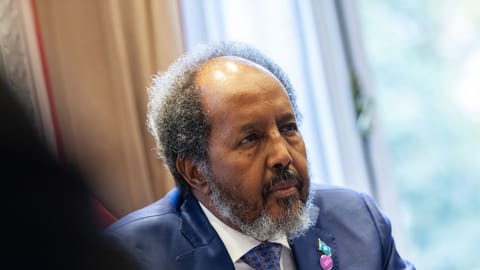
And now, let's get straight into Somalia's latest crisis. Somali president Hassan Sheikh Mohammed is playing a dangerous game. A bit over two weeks ago, on the 15th of May, 2026, Mohammed, who we'll refer today as HSM, reached the end of his presidential mandate.
In an ideal world, that's when he would have passed his power to an elected successor. Instead, HSM announced on that same day that he was unilaterally extending his mandate for another year, and in doing so, he plunged Somalia into a political crisis with no easy way out.
Now, as our team has explained in prior rounds of Somalia coverage, HSM's decision has felt practically inevitable for some time now.
Even at the best of times, Somalia is far from a unified nation. The northern separatist region of Somaliland made waves a few months ago, when it was granted formal recognition as an independent country by Israel, while the autonomous regions of Putland and Jubaland have charted their own respective paths away from Mogadishu's influence.
The Somali federal government, meanwhile, has been wrestling with what was supposed to be a reform to Somalia's indirect, clan-based election system, one in which the old system would be discarded in favor of a direct vote.
Among other changes, the reforms extended Somali presidential terms by a year, which Mogadishu claimed would apply to HSM, even though those weren't the terms under which had been elected. Back in March, the Somali government officially postponed elections that would have identified HSM's successor.
That move was, according to Somali leadership, supposed to give the government a bit more time to transition to the one-person, one-vote model they'd adopted.
The reality, however, appeared closer to a constitutional coup, and now the big question is whether HSM can get away with it. Even before the May 15th deadline, Somalia's disparate opposition was trying to raise the alarm over what was coming.
More importantly, they managed to unite around a consistent message, despite many years of internal divisions, differing priorities, and the distinct ambitions held by the opposition from Puntland, Jubaland, and Somaliland, respectively.
Dissidents and political leaders inside Somalia held a conference where they seemed to float the possibility of armed resistance to an extended HSM tenure. Meanwhile, abroad, Somali exiles and international voices rallied together in Kenya to support their allies back home. In the end, however, it simply wasn't enough.
HSM had no successor, and the country would have been leaderless after the 15th may the opposition's political power is too limited inside mogadishu to force hsm out peacefully the somali parliament had already dissolved a month earlier and without any other recourse hsm simply overstayed the end of his term as expected as the time of writing he remains in
Power with no clear publicly disclosed plan from across the somali opposition to unseat him and it's difficult really to overstate the seriousness of the situation unlike most global attempts to carry out a self-coup in which an established head of state abuses the levers of power to extend their term or ground themselves more authority hsm doesn't have to
Worry about an adversarial legislature just like there hasn't been a vote to replace hsm there hasn't been a vote to replace somali parliamentarians their authority was already illegitimized under the old constitution in mid april even before hsm's term expired meaning that this critical check on his power just doesn't exist like it should nor do hsm's
International supporters seem to have much of a problem with what he's done turkey in particular has greatly increased at support from ogadishu over the past year and ankara appears quite disinterested in forcing hsm out in fact the turkish ambassador to somalia met with hsm just one day after his mandate should have expired referring to him publicly as the
Somali president and reaffirming quote steadfast support for somalia's unity and territorial integrity somalia's other regional supporters including saudi arabia qatar egypt and others are willing to follow turkey's lead especially with their regional rivals israel and the united arab emirates clearly in support of the somali opposition meanwhile the african
Union is nowhere to be found after it expressed disappointment over the failure of political talks but failed to contribute to a resolution in any meaningful way as mogadishu slowly evolves into a venue for proxy competition between large middle eastern rival states hsm is turning into a political prop and he appears to be willing to allow that to happen
With their support and without meaningful institutional checks on his power from inside bogadishu hsm would face very few obstacles if he were to try and reimagine the somali government more broadly with power so completely concentrated in his hands hsm can try and abolish term limits amend the voting system to give himself advantages or even suspend
Elections indefinitely and rule using emergency powers worse yet the somali military appears content to stay out of his way especially after hsm has helped to acquire all sorts of new military hardware from those same foreign backers but the somali opposition has made clear that this fight is not over a few days after the end of hsm's four-year term the
Puntland regional government announced that it would no longer recognize him as a legitimate president the region accused mogadishu of using the levels of state power to intimidate and harass the opposition as well as ordinary people within the capital and called on the international community to do business with puntland directly a coalition of opposition
Leaders took the same stance and warned openly that somalia had moved into a phase of its history where conflict and open discord were much more likely unfortunately for the entire country there appeared to be few if any remaining paths to a peaceful resolution.
But if the Somali opposition decides to try and resolve the situation by force, then any armed conflict over HSM's fate would be less of a typical civil war and more of an unravelling.
Somalia still deals with a highly motivated asymmetric threat from the jihadist insurgency al-Shabaab, where recent reports suggest that the group is looking to change its tactics and mirror successful insurgencies like the HTS movement that took over Syria or the JANIM faction that's currently running rampant across the Sahel.
Nor is there an easy path for Somalia's political opposition to join forces with the Breaker in autonomous regions who disagree with each other as frequently as they disagree with Mogadishu.
Writing for Somali outlet Hiran Online, Dr. Ali Said Faki raised the possibility that the military may splinter due to clan loyalties, regional dynamics, or other internal problems, and that some parts of the Somali security apparatus could pivot to support the opposition.
Despite Somalia's perpetual state of crisis, the last two decades have brought real promise across the country.
Before HSM's power grab, Somalia seemed to be on the path toward a limited democratization and an improvement in its internal security. But we need only look back a few decades into history to be reminded of just how ruinous a return to all-out war could be.
Thanks to HSM, Somalia is back on the precipice, and nobody across the country seems to know how to avoid the devastation that could come next.
For our next story, we turn our attention to the on-again, off-again Iran war, and to an incident that managed to slip under most people's radar.
On the 12th of May, The New York Times reported that about two weeks prior, on the 1st of the month, six Iranians, believed to be members of the Islamic Revolutionary Guard Corps, or IRGC, attempted to infiltrate Kuwait's Bubiyan Islands, the country's largest.
The six allegedly arrived on the island aboard a rented fishing boat, before engaging in a gunfight with Kuwaiti forces, injuring one Kuwaiti officer.
Four of the Iranians were caught, while two managed to get away. According to Kuwait's Interior Ministry, the four confessed that they had been tasked by the IRGC with infiltrating Kuwait to carry out hostile acts.
The nation's foreign ministry went further, calling the incursion a violation of Kuwaiti's sovereignty, and summoned the Iranian ambassador for a formal dressing down.
For its part, Iran called Kuwait's accusations baseless, and tried to explain the presence of its soldiers in Kuwaiti territory as just a routine patrol gone wrong. But while all this diplomatic maneuvering might have been important on a governmental level, the bigger mystery was why Iran chose to infiltrate Bubiyan with such a tiny force.
The choice of the island itself makes sense.
Bubiyan is about 23 kilometers from Iranian territory, and it's also largely uninhabited. But what is there is extremely valuable. Bubiyan is home to the Mubarak al-Kabir Port Project, a major infrastructure development backed by China as part of its Belt and Road Initiative, designed to turn Kuwait's northern coast into a regional trade and logistics hub.
It's part of Kuwait's Vision 2035 plan, exactly the sort of place… place that they don't want to see attacked the island also hosts US forces who relocated there from Camp Arafjan after the latter was repeatedly struck by Iran Iran has previously attacked the forces at Boubyan with drones targeting the satellite equipment and munitions on the island now look
Don't get us wrong clearly there were obvious targets on the island for Iranian infiltration but the mystery remains as to what exactly they expected a mere six guys to do against these targets especially given the security presence on Boubyan what we do know is that this isn't the first time Iran has infiltrated its neighbors in early March just days after
The war began while Iran was bombing anyone and everyone within reach Qatar announced that it had arrested 10 individuals on suspicion of being connected to IRGC cells the Qatar news agency reported that at the time of their arrest the individuals had in their possession the coordinates of sensitive installations communication devices and specialist
Technological equipment Qatar alleged that seven of those arrested were meant to spy on military facilities and other sensitive installations while the others were to engage in sabotage my Joobs wary director of the Gulf Study Center at Qatar University told Al Jazeera that the most interesting fact about these cells was that they were operating in Qatar a
Country that has historically at least had a good relationship with Iran even acting as a mediator between Tehran and Washington to try and resolve the nuclear issue if Iran was willing to do this to its friends how much more was it doing to its enemies and that brings us to our final point for the Gulf countries Iran will continue to be a threat long after
The war with Washington and Jerusalem has ended at the time of recording Friday May the 29th at around noon Central European time the US and Iran are still negotiating an end to the war Axios reported that American and Iranian negotiators had reached an agreement on a 60-day Memorandum of Understanding or MOU to extend the current ceasefire and give them
More time to discuss Iran's nuclear program but the MOU has yet to receive Trump's approval if signed it will be the most significant breakthrough since the war began however the Gulf countries might not see it that way since the ceasefire began much of the conversation around the negotiations are centered on Iran's nuclear program and reopening the Strait
Of Hormuz and with good reason those are America's main priorities at the moment that has allowed Iran's proxy network which is something that Gulf countries would like to see dismantled to fall out of the conversation and it might not feature again if Washington gets what it wants from a deal which means that Gulf countries will have to find a way to live
Within Iran that while beaten still has levers it can pull to cause havoc across the region at the moment this election is released the nation of Colombia will be less than 24 hours away from a pivotal presidential election Colombia's current president Gustavo Petro won't be on the ballot instead Colombians will choose between the far leftist son of an
Assassinated senator and a right-wing populist in the mold of several recent Latin American American political phenoms and a national establishment that the country seems ready to leave behind but although colombia's next president will have to tackle problems from extreme poverty to rural malnutrition to economic malaise and regional relations the election
Is about internal security the problems that colombia has faced over the last several years are hardly unique to colombia itself all across latin america countries have faced a rapidly evolving threat from transnational criminal organizations who've adapted new tactics fused with national insurgent groups in new ways and corrupted ruling governments to
Better enable their illicit enterprise the regional security breakdown has opened the door for leaders like el salvador's naib bukele ecuador's daniel naboa or chile's jose antonio cast who've each pledged transformative crackdowns and then achieved varying levels of success but latin america's broader election trends don't map onto colombia as easily as you
Might expect partially because of the sheer magnitude of problems that colombia has to deal with the nation is home to a wide variety of armed non-state actors including rebel splinter groups that can trace a lineage back to the long-running far consurgency and drug arms mineral and human traffickers that see colombia as their gateway to central america and
Thus the united states while those fighting factions diverge sharply in their motivations and tactics most of them have been aligned in the decision to accelerate violence inside colombia in advance of election day in late april rebel groups staged upward of two dozen attacks against military bases and civilians across just a few days including an explosion
That left over 20 people dead authorities placed the blame on a group called the farc emc who political risk analyst sergio guzman claimed were quote establishing leverage towards the future or that is to say proving just how serious of a threat they were so that the colombian government would plan to make major concessions if they ever agreed to negotiate
In mid-may gunmen on motorbikes assassinated two presidential campaign staffers who worked for right-wing candidate abelardo de la esprea who's vowed a bicali-style policy of quote all-out war against criminal and rebel groups if he's elected the rate of drone attacks by non-state groups has been consistently rising year over year and the numbers in 2026
Thus far suggest that insurgent groups are on track to outpace their totals from 2025. in most latin american countries a security situation this bad would indicate that a hard right leader like esperela would be the front runner riding high on expectations that his post-election crackdowns will re-establish public order after all colombians largely agree
That the current situation is the result of failures of gustavo petro a leftist leader who advocated a policy of quote total peace with armed groups as colombian security expert maria victoria your rente explains to the guardian after the late april attacks quote when this government began there were six departments of the country under dispute today there
Are between 13 and 14. end quote but contrary to regional trends recent polling suggests that petro's chosen success is in the lead that's the far leftist candidate that we mentioned a moment ago ivan cepeda who his opponents deride as a political marxist and who is near universally regarded as the architect of petro's total peace plan cepeda has advocated a
Return to peace talks combined with greater social spending agrarian reforms and other changes instead of the hardline security strategy that his opponents are advocating nevertheless cepeda is in the lead and while he's not expected to draw the absolute majority of votes that would allow him to avoid a runoff he's likely to win the first round election by a
Comfortable margin in some ways cepeda's momentum traces back to his family history aged 63 today he's the son of a communist lawyer and a senator named manuel cepeda who was shot dead on the streets of bogota by colombian government agents as such he's seen as candidate with a firm a deeply personal understanding of colombia's decades-long history of
Constant conflict and he's regarded as someone who could implement total peace the right way while avoiding the many blunders that predictably tanked petro's attempt at the same time he seems to be benefiting from a growing skepticism of the united states something that cepeda has echoed across his own campaign to quote him we're open to having a
Constructive relationship with the u.s government but they can't treat us like they're lackeys like slaves like a colony end quote america's conduct in venezuela its closeness with el salvador's bukele and a host of other hardline governments and washington's conflicts with gustavo petro at a time when petro's popularity has rebounded somewhat all of these
Have contributed to colombian's willingness to support a candidate who isn't deferential to donald trump or his allies before the likely runoff however cepeda and his political adversaries will need to make it through the weekend as will the rest of colombia's population on the one hand the nation's largest rebel faction the central general staff suspended
Its operations starting on the 20th of may and has pledged to keep things quiet through the 10th of june another important faction the eln announced a self-imposed ceasefire to cover election day and the day afterward and pledged to respect colombians right to participate in a peaceful vote nevertheless the country continues to witness violent attacks
Including a land dispute in the country's southwest that left seven people dead and more than 100 injured in a confrontation between indigenous groups last friday colombians will cast their votes tomorrow under threat of a drone attack from above and fearful of ambushes that could come from all around them however the election plays out we'll return soon to
Explain what comes next thank you for watching
Unlock premium video briefings
Members get full access to premium reporting, in-depth briefings, and subscriber-only analysis.
Insiders Receive
- Full access to all premium articles and briefings
- Exclusive subscriber-only analysis and dispatches
- Support independent conflict journalism
From $5/month — cancel anytime