
The Briefing Room: Indonesia's Ignored Insurgency
The Briefing Room: Indonesia's Ignored Insurgency — a Fronts video briefing on China & Indo-Pacific.
Simon Whistler • October 31, 2025
Members only
Note: this transcript was generated by AI and may contain errors or inconsistencies.
Welcome to The Briefing Room, the show that hunts out the obscure, under-the-radar, geo-pol and defense stories each week, purely so you can feel like the giga-chat of current affairs knowledge.
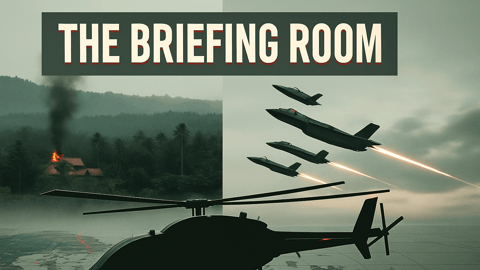
I'm Simon, and this week we're turning the spotlight onto the perpetually overlooked Papua conflict in Indonesia, a fascinating insurgency that almost no one ever seems to talk about. As well as that, we're taking stock of the current global controversy over the F-35, before finally delving into the new unmanned helicopter from Airbus.
As always, thank you for subscribing and supporting Fronts.co. Not only does your membership help fund exclusive content like this, but it also allows us to cover important and less lucrative topics on the main channel, so thank you again. Your support means a lot.
Now let's go to Indonesia. Escalation in Indonesia On October the 16th, the Indonesian village of Songama turned into a war zone. On that day, a detachment from the Indonesian military was stationed inside the village, making preparations in advance of a planned assault nearby on the island of Papua.
Their target was a rebel hideout used by insurgents loyal to a Papuan separatist movement that's fought a low-grade war against the Indonesian government since the 1960s.
While Indonesia's soldiers were making their preparations for the day's events, they were seemingly unaware of the dozens of rebels moving in their periphery, some armed with modern military-grade weapons and others with little more at their disposal than bows and arrows. The insurgents launched their ambush.
All hell broke loose, and from there, government and rebel accounts of what happened next are sharply divergent. According to the Indonesian military, its soldiers were able to rally in defense of their positions, engaging the rebels in a six-and-a-half-hour gun battle that left 14 of the rebels dead and eventually saw them routed.
Indonesia's forces won the day and absorbed zero casualties in the process.
According to the rebels, however, a total of 12 people had died, and only three of them had been combatants. The rest, according to the U.S. Papua Liberation Army, were civilians, including nine residents of the village.
As a spokesman for the insurgency described, the Indonesian soldiers had allegedly surrounded a civilian home that they thought was a rebel outpost and massacred the eight people who'd been inside.
The encounter was the latest in a wave of escalating clashes in the Papua region, as this half-century-old insurgency shows clear signs that it's picking back up. Human rights advocates have been sounding the alarm for the better part of a year now, implicating a cycle of violence that appears to be ramping up on both sides.
Speaking to a New Zealand outlet back in May, a researcher from Human Rights Watch attested that Indonesia is quietly surging troops into the region, and those troops are engaged in more raids and more counter-insurgent operations than they've carried out in decades.
On the other side of the conflict, the indigenous Papuan insurgency has swelled its ranks with new recruits, including not just fighting-age men, but boys who are convinced or coerced to serve as child soldiers.
Back in April, Separatist rebels slaughtered 17 gold miners, who they alleged were actually disguised members of the Indonesian military in a return to a life. level of insurgent violence that the region has not witnessed in quite a while.
Even compared to other global counterinsurgencies, Indonesia's military operations in the Papua region are shrouded in secrecy.
The entire region is a mess of thick jungles, deep river valleys, and remote highlands, where access to the outside world is minimal, and news rarely makes its way to even the Indonesian national press. Partially, that's by design.
Indonesia's military and its federal leadership work very hard to restrict media access, and have banned journalists from traveling into the area or investigating the conflict close up.
Domestic outlets routinely self-censor their coverage of the insurgency, local communities lack the tools to make their voices heard, and internet speech on the subject is sharply restricted on Indonesian social media.
What the world does know is that the escalation of Indonesia's counterinsurgent efforts coincide with the rise of the nation's current leader, President Prabowo Subianto.
Although Prabowo is in his 70s now, he got his start as a leader in the Indonesian special forces back in the 1970s, where he served as the nation's youngest special forces commander at the time, and played a major role in counterinsurgent efforts in East Timor, today the sovereign nation of Timor-Leste.
In the early 1980s, Prabowo was accused of leading a massacre of over 200 civilians, and then building a concentration camp where survivors were held, abused, and slowly starved. To this day, those accusations have never been officially substantiated.
By the 90s, Prabowo's military career had taken him to the Papua insurgency, where he's accused of having led a reprisal campaign attacking Papuan villagers after insurgents took an international group of 11 scientists hostage and killed two Indonesian members of the group.
As such, although Subianto's path is dotted with a number of other human rights abuses, he's made clear that he has a deep and abiding interest in scorched-earth, counterinsurgent warfare. With that sort of context, it should be no surprise that the intensified counterinsurgent campaign across Papua coincided with Subianto's rise to the presidency.
Right now, it's hard to say how intense the fighting might be in the Papua region on a day-to-day basis.
The Indonesian government takes pains to conceal whatever might be happening there, while Papua's rebels are often tight-lipped about their own operations, and especially their own defeats.
In Papua, government-enforced silence about the situation is a way of life, government neglect is to be expected, and judging by the bits of news that do leak out, wartime atrocities are common on both sides.
Any insight into what might happen next comes from historical precedent, where, when this crisis does occasionally flare up, massive numbers of people are likely to die very quickly.
After a round of intense violence wound down in the mid-2000s, one South Pacific scholar and expert on the conflict estimated that between 1 in 300,000 Papuans had died since the conflict began.
As recently as 2022, the United Nations condemned the regular killing of children and the endemic use of torture. and forced disappearances by the Indonesian government.
If Papua is headed back to another cycle of violence like that one, it's not clear that the world will be able to learn about it in real time, but the results are practically guaranteed to be devastating.
Global F-35 Controversy Since the start of Donald Trump's second administration in the United States, even relatively routine U.S. arms export deals have become a subject of international controversy.
Longtime U.S. allies, traditionally quite content to rely on America's military-industrial complex, have become uncharacteristically hesitant to sign new agreements or, at times, stick to agreements that have already been formalized. The reasoning is fairly straightforward from a military procurement sense.
Signing up to receive U.S. military equipment means signing up for an extended, years-long procurement process, decades of collaborative sustainment, and dependence on the United States for everything from software updates to spare parts, even to sign-offs on military operations that leverage equipment the United States provides.
At a moment when a more volatile administration in Washington seems as if it might exert all sorts of leverage against its long-time allies, fewer and fewer nations are willing to hand Uncle Sam an additional set of pressure points, especially in the form of a war machine as advanced as the F-35.
Coming up on a full year of Trump's second term, the F-35 has turned into an emblem of growing international fears about Washington's commitment to its allies, and over the course of the last several months, a range of long-time American customers have decided to snub the jet.
In August, Spain announced that it had ruled out any purchase of the F-35. Its neighbor Portugal had done the same already.
Also in August, Switzerland announced that it was weighing cuts to its F-35 procurement deal after initially ordering 36 copies of the aircraft back in 2022, but learning more recently that the aircraft will be delivered with considerably less firepower than anticipated at a higher cost than was originally promised.
Most damning for the program of all, however, is the drama playing out between the United States and its northern neighbor.
Back in March, Canada's newly elected government under Mark Carney had announced that it was going to review its planned purchase of 88 aircraft as a result of growing tensions, not least because of Trump's repeated statements about annexing Carney's entire country.
Although the jury is still out, Canada is reportedly exploring the possibility of slashing F-35 numbers dramatically and offsetting the loss of American jets by buying the latest version of Sweden's Gripen.
Canada is actively looking to deepen its relationship with Europe in other ways, including the purchase of various forms of military equipment, and the low-maintenance, low-cost Gripen is an ideal alternative to fill roles where the F-35 stealth technology wouldn't be necessary.
Although current estimates suggest that Canada might still try and procure somewhere between 40 and 50 F-35s, the nation is still slashing a program that it was committed to less than a single year ago.
Of course, if- If F-35 deals are a sort of proxy indicator for the health of various nations' relationship with the United States, then it's also important to examine which nations are looking to grow their F-35 fleet and why they'd be looking to do so.
Most notable is the nation of Denmark, where national leaders announced less than two weeks ago that they'd purchase an additional 16 copies of the jet, adding on to an initial deal for 27 jets that were stated to be fully delivered by next year. Denmark doesn't exactly have a rosy relationship with the Trump administration.
Trump has been vocal about his desire to annex some of Denmark's territory, in this case the autonomous island of Greenland.
Denmark's decision to lean into American technology instead of away from it might be a shrewd one.
According to Danish defense officials, the country is hoping to demonstrate that it can take good care of Greenland itself and thus eliminate part of Trump's justification to annex the territory as a way to protect the Arctic and the North Atlantic from Russia and China.
To that end, Denmark is also looking to buy maritime patrol aircraft for Arctic operations, as well as collaborative combat aircraft or loyal wingmen drones to fly alongside its F-35s.
Elsewhere in Europe, Germany announced in late October that it will purchase another 15 F-35 airframes for itself, bringing its total count to 50 copies of the jet.
The nation of Turkey is only intensifying its push for the jet despite flying a fifth-generation aircraft of its own in the indigenously designed Khan in order to make up a gap with the nation of Israel, which Turkey is engaged in a growing regional rivalry with.
Saudi Arabia has been hunting for a contract, and so have Egypt, Qatar, and the United Arab Emirates.
Notably, the United States has prohibited all five nations from trying to purchase the jet, but each one of them has enjoyed a growing closeness with Washington since the start of Trump's second term.
So is Morocco, where Rabat appears to be engaged in late-stage discussions to pick up 32 of the jets, partially to counter Algeria's upcoming order of Russia's Su-57s. And if you'd like to get a window into the grand push and pull of geopolitics, there might be no better place to look than at global arms deals.
And right now, there is no weapon more important on the global stage, or more contentious, than the F-35. 5.
Unmanned Helicopter Revolutionizes American Military Logistics And for our final story today, we turn our attention to the United States, where recent developments in helicopter technology and artificial intelligence promise to revolutionize a key element of its military success — logistics.
For development, a new unmanned helicopter from Airbus, the Airbus MQ-72C Lakota connector, equipped with artificial intelligence from Shield AI, a tech company that uses machine learning to develop defense tools and software.
The MQ-72C was unveiled during the Association of the United States Army, AUSA, annual meeting held from the 13th to the 15th of October in Washington. And while we don't know all the details, what we'll we do know paints the picture of a versatile plane, which, if it lives up to the hype, could be a game-changer.
So let's talk about what we know about this plane, what we don't, and the role it could play in future operations.
First, let's start with the design. According to NextGen Defense, an outlet that covers the tech shaping the future of warfare, the MQ-72C is about 13 meters long, 4 meters high, and can reportedly travel more than 650 kilometers at altitudes of up to 6,100 meters. The MQ-72's most distinctive feature is the absence of a cockpit.
Airbus traded in the cockpit for more fuel volume to provide an increased range and endurance to support long-range logistics support operations. Additionally, the absence of a cockpit will greatly enhance cargo capacity, allowing for modular cargo bays specifically designed to deliver essential supplies with a maximum takeoff weight of around 3,800 kilos.
The MQ-72C is based on the H-14-5 72, which is the same platform as the 72 Lakota, which has performed reliably for the U.S. Army since 2006.
As we mentioned previously, the MQ-72C will use artificial intelligence and shield AI, specifically their hive mind autonomy software. It also runs Helionics, its proprietary avionics we developed by Airbus to provide operational flexibility.
Airbus also announced a partnership with L3 Harris Technologies that will see the latter provide their platform system integration to the MQ-72C.
This, combined with Airbus's modular design, will allow operators to rapidly integrate third-party, commercial, off-the-shelf hardware that will enable maximum system versatility and mission adaptability. Basically, what this means is that the plane is as customizable as a character's outfits in the game of Tekken.
Army Recognition notes that the MQ-72C can operate independently in denied communications environments, a critical capability for contested logistics operations where traditional communication links may be unavailable or compromised.
So, how does that stack up against the competition? For this comparison, we're going to go with the Sikorsky S-70 UAS U-Hawk, another plane that was unveiled at the AUSA meeting earlier this month. Sikorsky is a subsidiary of Lockheed Martin.
We're doing this instead of comparing it to a model that's already in use, because A briefing room segments are usually brief, and B we want to show you what's on the cutting edge of military technology. The S-70 UAS is 19.76 meters long, 5.13 meters high, and can reportedly travel up to 1200 kilometers at a maximum altitude of 5,800 meters.
Like the MQ-72C, it features a cockpit-less design for the exact same reasons and has a maximum takeoff weight of about 10,600 kilos.
The S-70 UAS will come equipped with Matrix, Sikorsky's custom-designed air autonomy system. So what do these numbers actually mean? Well, the U-Hawk is a significantly larger aircraft. and can carry a lot more weight for longer distances.
The MQ-72C, on the other hand, is smaller, lighter, and built for a different kind of mission. The numbers indicate that it's designed for agility and cost-effectiveness in medium-range missions.
Now, while we can't compare the effectiveness of the two artificial intelligence models being used, because there haven't been public tests pitting the two against each other, we want to note that the defense industry is perhaps the greatest adopter of AI tech, even ahead of the porn industry.
In 2024, Shield AI used the Hive mine to fly a modified F-16 through a dogfight, and more recently, they unveiled the Expat, a multi-role fighter jet that the company says can take off without a runway from container ships and remote islands. Think of it this way. If the U-Hawk is a freight truck, then the MQ-9 is more of a delivery than.
And that takes us to our final question. What role will the MQ-72C play in future missions? And to answer that, we need to talk about logistics, which in our introduction, we said has been a key element to U.S. military victories.
And that's not an exaggeration. There's a saying in military circles that amateur study strategy, while professional study logistics. The ability to get the right supplies to the right people in the right place at the right time has always been America's secret weapon, and it's been the key to a lot of victories, including during World War II.
However, adversaries know this and have devised, are devising, or will devise, strategies to counteract Washington's inherent advantage, which makes it imperative for Washington to have the ability to quickly and cheaply deliver supplies to the front lines. Being able to do this without risking any lives is an added bonus.
That's why planes like the MQ-72C and the S-70 UAS are a game-changing technology.
Because logistics is more than just moving items from one place to another. It's about giving soldiers the tools they need to fight, even when they're being besieged. Thank you for watching, and thank you for supporting France.
See you next time.
Unlock premium video briefings
Members get full access to premium reporting, in-depth briefings, and subscriber-only analysis.
Insiders Receive
- Full access to all premium articles and briefings
- Exclusive subscriber-only analysis and dispatches
- Support independent conflict journalism
From $5/month — cancel anytime