
Could China and Japan Go to War?
Could China and Japan Go to War? — a Fronts video briefing on China & Indo-Pacific.
Simon Whistler • December 19, 2025
Members only
Note: this transcript was generated by AI and may contain errors or inconsistencies.
Welcome back to The Situation Room, the every now and then show, where we take your questions about the state of the world and give our, well, inevitably depressing answers.
In this end-of-year edition, we're going to be covering fun, Christmassy topics like Sudan genocide denial, whether Mexico could be classified as a failed state, and what we've recently learned about the violence and predations of Assad Syria.
And if that wasn't enough Christmas magic for you, we're also going to be touching on the raw power of the modern Trump doctrine, as well as answering your questions about another terrifying concept, known as nuclear landmines.
But first, let's start with a suitably apocalyptic topic, albeit one which we think is at least a somewhat soothing answer, the question of whether China and Japan could go to war. Here's the question from Sultan D. Sajid.
I would like to know how unlikely is a war between China and Japan right now, since we recently had Chinese and Japanese incursions in Okinawa Island. Will there be any foreign intervention, or will the Japanese and Chinese settle this by themselves? Big fan.
Keep up the work. Thank you. Every so often, we actually get to provide a bit of good news on this channel, and while nothing in global affairs is ever truly certain, we can say with quite a bit of confidence that China and Japan will not be going to war anytime soon.
And yes, now would be a good time to furiously knock on wood. As for why a war between China and Japan is practically unthinkable right now, well, neither side has any real incentive to consider a proper military conflict, and there are an abundance of disincentives on both sides.
To remind both China's Xi Jinping and Japan's Sine Takeuchi that a continued peace is just in everybody's common interest.
We'll start with the easier perspective to explain, the nation of Japan, where it comes down to the simple fact that Japan is just not ready to fight a war right now, and Tokyo knows it.
In fact, that's a major part of what's made the country's new leader, firebrand Sine Takeuchi, so interesting from a geopolitical perspective, since she's forcefully arguing that Japan finally ends the limitations on its military strength that it's abided by since the end of World War II.
Japan's military is highly advanced, it's well trained, and it's got robust technological capabilities on air, land, and sea.
But it's nowhere near as large as you would expect from the world's fourth largest economy, and it's expressly prohibited from engaging in any form of offensive warfighting.
Granted, Japan would probably find a way to get around that prohibition, no matter who's in charge in the case of an all-out war with China, but that prohibition has guided its spending decisions, its force architecture, and its limited size for decades.
China is one of the world's largest militaries, it's quite advanced in its own right, and Japan knows very well that trying to fight China would be a losing proposition.
Not only that, but Japan is facing one of the most acute demographic crises of any nation on Earth. It simply cannot afford to lose young people for any reason, and throwing their lives away at an avoidable military conflict would be unthinkable.
On the other side, China does have clear advantages in numbers, overall military strength, economy, industry, and more.
But at war with Japan… would be a very poor decision for China to make. For one thing, Japan is one of China's biggest and most important trading partners. For another, there's absolutely no way that Japan would be fighting alone.
Tokyo is one of the only global capitals right now that can at least be fairly confident that Washington would maintain its security guarantees, and thus its nuclear umbrella. And given that the entire region understands what it would mean for Japan to fall, South Korea, Taiwan, Australia, and other Indo-Pacific nations would almost certainly join the fray.
In fact, because of the sheer seismic after-effects that would come from China eliminating Japan as a counterweight in Eurasia, nations that don't align strategically with Japan but that fear China as a long-term threat might feel compelled to fight as well, including India and perhaps even Russia.
And even if China did manage to corner Japan into a one-on-one contest, Japan would be able to inflict horrible losses on China over the course of a conflict, even if it were to lose in the end.
Japan possesses some of the world's best fighting hardware, and it's the world's premier nuclear-latent nation, meaning that even though it doesn't technically possess nuclear weapons right now, it's got all the requisite technology and expertise to become nuclear-capable in a very short amount of time.
And from a strategic perspective, a war against Japan would go against everything that China has spent the last several decades trying to achieve.
China doesn't do war. It's got a world-class, superpower-level military that hasn't even taken part in a minor conflict since the 1970s. And if China did try and fight a war for the first time in half a century, then it would almost certainly focus its efforts on Taiwan.
Yeah, a Taiwan invasion would also bring Japan into the fight, but starting a war with Japan, while the Taiwan question remains unresolved, would be one of the biggest unforced military blunders in history.
Even assuming an eventual victory, a war against Japan would set China's Taiwan timeline back by decades, considering the degree to which it would ravage China's economy, destroy high proportions of its military hardware, and eliminate any shred of trust or reliability on the international stage. China can hardly afford setbacks as it is.
It faces its own impending demographic crisis, it's juggling way too many other priorities right now, and it's having to focus more and more on stability in order to maintain as much economic momentum as it can before things do inevitably slow down. And look, it's obvious why this question would be on all of our minds.
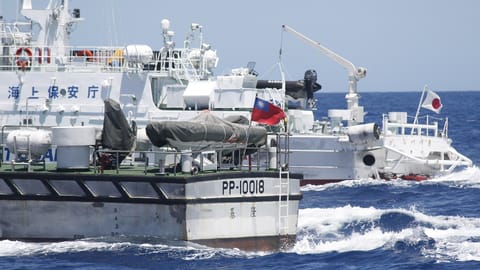
China and Japan are embroiled in a growing series of disputes right now, stemming from Japan's new prime minister openly asserting that Japan would take part in a military defense of Taiwan.
When the world's second largest economy and its fourth largest economy start fighting on the diplomatic stage, that's always going to make waves. But even in this instance, the focus is on a hypothetical conflict fought over Taiwan, not between Japan and China directly.
China's leaders and now Japan's more militaristic hardline administration both stand to gain from the perception that they're standing up to each other, and that they won't allow their respective nations to be insulted.
But it's important not to miss the deeper reality. Neither Japan nor China has any intention of engaging in a direct conflict if they don't have to, especially considering that, more likely than not, that conflict would see both nations blunder their way into starting World War III.
Evaluating Syria's New Leadership And now GTM9164 asks us, Thoughts on Syria's civil war one year after it ended?
Are you less skeptical of Al-Sharaa? Are you hopeful that the country can finally move past the violence? Okay, well, regarding the end of the civil war itself, we've been keeping up with the gradual work to uncover some of the worst abuses of the Assad regime, and unfortunately, the world has learned that it really was as bad as outside experts had feared.
For example, a recent Reuters investigation revealed a mass grave in the open desert that may well have held tens of thousands of bodies, while records obtained by the German outlet NDR have revealed over 100,000 new photos documenting the torture and killing of around 10,000 prisoners within just those records alone.
As for Syria's new transitional leader, Ahmad al-Sharaa, and his government, the results thus far have been a bit of a mixed bag. On the one hand, there's genuine cause to celebrate some of Damascus' achievements over the last year.
Syrian reconstruction is progressing quickly in many areas, parts of the country are more stable today than they've been in a decade or more, and Syria is in the process of reintegrating with the rest of the world.
At the same time, Sharaa's time in power has been defined by multiple large-scale massacres of Syrian minority communities, where pro-government groups have operated alongside fighters from Syria's security forces.
At best, even if Sharaa and his inner circle aren't complicit, they've been unable to prevent or stop those atrocities, and at worst, they are complicit.
Making matters worse, it appears that Syria could soon see multiple larger waves of violence.
Damascus and its Turkish partners have issued Syria's autonomous Kurdish region an ultimatum to integrate by the year's end, and forces are massing in multiple areas, as we speak, in apparent preparation for a military offensive that may begin once that deadline has passed.
Meanwhile, in the Southeast, the Islamic State has been more and more active over the last few months, despite high-profile arrests and raids, and there are growing indicators that an ISIS attack on sensitive prison installations could come very soon.
So, are we less skeptical of Al-Sharaa now than we were before? No, not really. The idea that Syrian reconstruction would be an easy process has always been rather far-fetched, and it's equally improbable that any post-war leader would come along and simply spread sunshine and rainbows.
Syria is deeply for actions. The end of the war left many of its internal tensions and divisions basically unaddressed, and while Al-Sharaa has presided over a lot of improvements across Syria, he's also presided over horrific atrocities, with the high likelihood that there's more violence on the way.
All that said, he's certainly better than the last guy, by multiple orders of magnitude, and- To the extent that Syria has a chance to build itself back, its odds are better in the last year than they've been in a really long time.
Also, as an aside, we'd like to take this opportunity to share that apparently, in his exile in Moscow, Bashar al-Assad has entirely given up any hope of reclaiming his nation. Much to the chagrin of members of his family who would like to plot a return to power, Assad now spends many hours each day binging video games in his luxury apartment.
He rarely travels further than the shopping mall in the lower floors of his building, and seems to have lost all interest in international effects.
What's such a bizarre image? And now from one mass-murdering dictator to a paramilitary outfit that is even crueler and wilder than anything in Assad, Syria. We're talking, of course, about Sudan's rapid support forces.
Sudan Genocide Denial And next up, we have this one from the United Arab Emirates. Sorry, sorry, I mean Dave. David Bennett, 2062, who asks, You keep referencing the blood-from-space thing when it has been debunked as a watering hole surrounded by cattle.
Don't you think you need to be more careful about not undermining your credibility when speaking of genocide? Be wary of creating fodder for future deniers. Okay, at this point, most of you are likely thinking of something along the lines of cattle, blood, genocide.
What's this guy talking about? So before we tackle the main point, let me back up and explain. Back in late October, the Sudanese city of Al-Fasha fell to the paramilitary rapid support forces after an 18-month siege.
While access to the city has been extremely limited, past conquests by the RSF were accompanied by major atrocities, such as the massacre of between 10,000 and 15,000 people across two separate incidents in Elginina in 2023. So those monitoring the conflict expected the worst. But even the most hardened cynics were likely shocked by what happened next.
When Yale's Humanitarian Research Lab tried to track violence in the city via satellite, they found not just empty markets, destroyed buildings, and evidence of mass graves, but bloodstains that were vast enough to have appeared on satellite imagery, what commonly got referred to in the media as pools of blood visible from space.
That phrase was striking enough that it managed to cut through into public discourse. For a very brief period, Sudan was all over social media in a way that it hadn't been since the war began in April of 2023.
Unfortunately, that meant a lot of well-meaning, but stupid people started to pile on. This being the internet, those well-meaning, but stupid people went looking for evidence of atrocities visible from space.
But rather than simply go to Yale HRL's website, where the photos in question are available to view for free and downloadable reports, they instead went to Google Earth, found what appeared to be a pile of bodies around a pool of blood, and posted it all over Twitter.
The problem, of course, is that Google Earth is not real-time satellite imagery. What these stupid but well-meaning people had found was an old image of cattle around a watering hole. So far, so classic social media.
But then... things took a far darker turn rather than be all like jesus some people on twitter are dumb anyway now let's discuss genocide in sudan a whole different bunch of stupid but extremely malicious people like david bennett 2062 seized upon this one mislabeled photo as proof that no genocide was underway at all but rather than bloodthirsty psychopaths
Who happily upload videos of themselves torturing and murdering civilians videos that you can go and watch right now with a tiny bit of googling please don't the rsf were instead misunderstood nice guys who just wouldn't hurt a fly to be clear this is weapons grade horse while the estimated death tolls in al fascia do vary wildly everyone agrees that it was
A massacre in britain parliamentarians have been briefed that at least 60 000 were killed in the city nathaniel raymond executive director of yale's humanitarian research lab told al jazeera that quoting here more people could have died in 10 days than have died in the past two years over the war in gaza meanwhile a guardian report from december the 5th
Noted that 150 000 residents of the city still remain unaccounted for while some may have fled or been taken prisoner it's also possible that many of them are now dead in short al-fash's fall was likely the worst war crime committed this century a slaughter that is widely attested to in satellite photos in eyewitness accounts and in the videos that the rsf
Themselves have posted to social media so why you might ask would someone like david bennett 2062 so willingly believe that it was all just a hoax now one possibility is that this is just a sad fact of life about the modern world the internet is full of people who distrust quote unquote official narratives from say genocide scholars almost as much as they
Happily trust one random guy with a blue tick on x writing lol that photo is cows there's no genocide in sudan remember this is the world which guy managed to spin a billion dollar media empire out of pretending that the grieving parents of murdered kids were crisis actors we live in a depressingly stupid age but another possibility is that this is part of a
Deliberate and deeply cynical campaign to confuse ordinary people about the genocide in sudan to muddy the waters enough that regular folk assume there's some legitimate doubt about what happens in al-fasha and therefore don't pressure their political leaders to do something and while we can't say for certain who'd be running such a campaign we can say that
The rsf has one major backer with deep enough pockets to easily fund it a backer that has so far funneled arms and money to the rsf even as their fighters commit genocide the united arab emirates sadly as this question shows there's no shortage of people happy to play the role of useful idiot and that's likely the hope of the rsf and the uae so long as doubt
Exists among enough of the general public the killing in sudan can continue a process those like david bennett 2016. are helping facilitate, one blood-stained step at a time.
What is the Trump Doctrine? After that, let's take a slightly more abstract one from Bob's Burgers 4678.
People still referencing that show. Does Trump have an actual plan for his military strategy in becoming increasingly friendly with autocratic powers, Saudis, Russia especially, or why abandon such long-time military allies?
Okay, before we answer this, we should start with the caveat that there's a certain degree of geopolitical randomness to Donald Trump and his administration, and we'd have to dedicate a fair amount of time if we wanted to really flesh out all the twists and turns of Trumpian geopolitics.
But in a broad sense, Trump's approach to foreign policy does follow a consistent set of principles, and those principles help to explain both his friendliness with global autocracies and his hostility to many of America's traditional allies. Principle number one, mind your damn business.
If Trump has made anything clear about his foreign policy approach, it's the idea that America's business is America's business.
But that understanding also extends to everyone else, with some exceptions. Under Trump's political philosophy, a given nation's treatment of its institutions, its economy, its culture, and its own people are fundamentally that nation's choice.
If the United States wants to seal its borders and screen foreign tourists for anti-administration opinions they've expressed online, then, well, damn it's going to.
If a nation like, say, Pakistan wants to imprison its main opposition figure so that he can't pose a threat to the government in power, then by all means, the US won't get in the way. If a nation like Saudi Arabia wants to take a bone-saw to its own dissidents, then those are Saudi dissidents being dealt with by the Saudi government. Nothing to see here.
Principle number two, when nations do choose to get involved in somebody else's business, those decisions are dictated by the relative power of the nations involved. That is to say, more powerful nations can choose to get involved in the business of less powerful nations, but not the other way around.
A mission like Russia can choose to expand into a nation like Ukraine, because Russia is bigger and stronger.
And unless Ukraine can stop Russia, it doesn't much matter what Ukraine's objections are. A nation like the United States can assert itself in a place like Venezuela, or a place like Greenland, because the US is vastly more powerful than either Venezuela or Greenland, or indeed any other nation that would intervene on their behalf.
But for a less powerful nation to try and involve itself in a more powerful nation's business, for, let's say, the French, or the Canadians, or the Swedes, or the Germans to lecture the United States, then that's unacceptable, because it goes against the dictates of the power dynamic between those nations.
And principle number three, when nations interact as peers, the base assumption is that all parties involved are motivated by profit and self-enrichment.
If the United States, under Trump, wants to get closer with a given country, then it creates that closeness through new economic deals, resource extraction agreements, investments, etc. If the United States wants to broker a peace between the United States and the United States, two nations, then it finds a way to make peace more profitable for those
Nations, and especially for the more powerful of the two nations, than war ever could be.
Under Trump's philosophy, a nation that's cut a lot of good, lucrative deals isn't going to engage in conflict, or escalation, or subterfuge, because those actions and the consequences that come with them will compromise that nation's ability to keep on growing its wealth.
And of course, when we talk about the wealth of a nation under Trumpian philosophy, we're also talking about the wealth of its leaders, enriching one is enriching the other.
Of course, you'll notice that this entire framework runs counter to ideas like international law, universal rights, a meaningful United Nations, and other hallmarks of the US-led liberal order that used to exist.
But Trump clearly recognizes that for nations that weren't part of that US-led liberal order, those institutions and ideas have been irrelevant for quite a while, and that the rest of the world outside that order plays by a very different set of rules.
As it turns out, the more cutthroat, asymmetrical version of international politics, where the strong do what they can and the weak suffer what they must, is in much closer alignment to the way Trump prefers to interact with the world.
Washington is becoming closer with nations like Russia and Saudi Arabia, and moving away from its old military allies, because in this Trumpian view of the world, it's far more effective to deal with nations like Russia and Saudi Arabia as self-interested, self-enriching actors.
They can be incentivized to keep the peace, on the grand international scale, by ensuring that peace is more profitable than war.
And as for trying to ensure that those nations avoid smaller-scale conflicts, well, under Trump's own philosophy, that's not really America's business. After all, it's none of those nations' business what America chooses to do in its own backyard.
As for how effective this approach will actually be, once it's had some time to play itself out, well, we're all going to learn the answer to that question together.
Is Mexico a Failed State? Now, likely a very controversial one from Captain Kobuk3200. Why is Mexico not a failed state?
And why doesn't the U.S. fortify, slash, seal the border with the military, which is their job? Okay, that second question actually is the much easier one to answer, because as of 2025, the United States actually has been in the process of sealing its southern border using the U.S. military. On our sister channel, Political Fronts, check it out.
We recently published an episode on that very topic, the military is taking over the Mexican border. So, go ahead and check that out if you'd like to learn more. We also discussed the other implication of your question, why wasn't the U.S. military doing that already, in that episode, so give it a watch once you finish this one.
As for your first question, though, why is Mexico not regarded as a failed state? It's certainly a fair thing to ask, considering that in many parts of the country it's the cartels that are in charge, not the Mexican federal government. And although, as we're going to explain, Mexico ultimately doesn't qualify as an outright failed state. it.
It's certainly an edge case. When analysts discuss a failed state, they're referring to a situation where a given national government has been rendered basically ineffective.
It can't provide basic services to a large proportion of its people, it's unable to control the presence of insurgencies or warlords who dominate certain regions, it's reached a level of unbelievable corruption, etc., etc. Modern day examples would include Yemen, where the internationally recognized government controls only a few pockets of populated land,
Or Haiti, where the capital has been essentially overtaken by a coalition of gangs.
Myanmar, Libya, the Central African Republic, and a few other nations also fit the bill. Mexico deals with many of these same challenges. Entire regions are dominated by drug cartels, including the Sinaloa-dominated Northwest, a belt around the country's center that Jalisco's New Generation control, the Gulf Cartel in the Northeast, and others.
In those areas, local government institutions are fundamentally corrupt and can basically be assumed to be on the take, whereas the national government is known to have deep corruption issues of its own. But in Mexico's case, there are a few key differences that pull it back from that failed state category.
For one thing, while the Mexican government lacks true control over a fair portion of its territory, it does retain direct control over its federal institutions, its business and trade hubs, more.
Although you could certainly argue that its leadership, its military or its political parties have been corrupted by the cartels, they're fundamentally separate, strong institutions with no risk of collapse.
The country doesn't deal with any serious separatist problems, its cartels aren't even somewhat attempting to offer a rival claim to national governments, and when Mexico wants to go in and assert its authority in a given area, it's generally able to do so, even if it can't be everywhere at once. Take the recent deployment of troops to the state of Mejojan.
Their job certainly isn't easy. They've faced armed opposition. But in a true failed state, Mexico wouldn't be able to deploy those troops to Mejojan, and certainly not with any reasonable expectation that they could even gain entry to the region.
And it's important to note here that the cartels benefit from Mexico not being a failed state. Although at times they might participate in infrastructural or even humanitarian work to ensure that local populations are willing to live alongside them, Mexico's cartels don't have any real ambition to rule over territory.
Their objective is profit, and setting up an autonomous administration or making a sovereignty claim is really expensive.
Mexico has all the local and state-level governing institutions that these areas need to keep themselves running, and although the cartels buy those institutions off, their fundamental objective is to ensure that those state and local officials don't make trouble.
The goal is to shut them up, keep them out of the way so that the drug trade can continue to flow, and the same is true at the federal level. Because of that deep, endemic corruption, we could certainly call Mexico a very fragile state, and even a compromised state.
But ultimately, the nation of Mexico still functions, and everybody, England, is a very including the cartels, wants to keep it that way. What the heck are nuclear landmines? And speaking of political fronts, we've got a quick one from P.Hontis.
Firstly, loving everything getting put out, keep it up. The question is from the sister channel Political Fronts from a recent video on Israel. What in all seven hells is a nuclear mine, and what's its purpose?
In short, a nuclear landmine is, well, really bad news. For a bit of context, this is from an episode on Israel's not-so-secret nuclear weapons episode. And in that episode, we discuss that among the various ways that Israel has integrated its nuclear technology into its defense equipment is that Israel has built and apparently deployed nuclear landmines.
The technology involved is exactly what it sounds like. You take a landmine, an explosive device built with a pressure or proximity trigger, and you make it nuclear. These were first alleged by American investigative journalist Seymour Hersh back in the 1980s, although Israeli sources have tacitly acknowledged their presence since then.
Back in the 80s, those nuclear landmines were deployed in the Golan Heights, the Israeli-occupied lands that most of the world recognizes as Syrian territory.
In essence, Israel would place nuclear landmines there, because the Golan Heights are an invasion corridor for nations trying to attack Israel, and blowing up an attacking force with nuclear landmines is a fairly dependable way of suggesting that those forces should maybe just turn around.
Operationally, those nuclear landmines are purportedly lower-yield devices, what you're typically described as a tactical warhead.
Their yield is anybody's guess, although it's important to note that their destructive potential is probably lower than what a warhead of the same size would otherwise be, since it would be detonated at or slightly under the ground, instead of in an airburst explosion.
There's also some chance that they could be attached to infrastructure, like bridges and dams, as an easy and definitive means to destroy that infrastructure in one go, and create obstacles, collapses, floods, or other catastrophes that could impede enemy forces. Whether or not they're still deployed, that's anybody's guess.
China's Endless Advances And to round off the GeoPulse section before we move on to other business, here's one from Nathanielzani1176. How does China technologically advance so quickly?
So many other countries in the West are flat-lined in productivity, yet China can somehow build the best battery technology, the best military tech with their sixth-gen aircraft, and now lead the world in renewables.
How do they do it? Well, China's approach to its economic development can, and really should be, an extended and nuanced conversation. But identifying the main driver of China's effectiveness, in contrast to the flat-lining productivity of so many other world nations, is actually pretty straightforward.
Most of the world, and especially the global West, makes its economic decisions as dictated by global markets. China makes its economic decisions as dictated by the Chinese Communist Party. Now this really isn't a capitalism vs. communism discussion, since it's a pretty massive stretch challenge to call China's modern economy a communist system.
Instead, it's a discussion on the management of economic simple anti-behindemonialism. So I can also say, for example, it seems just like the US does not be a practical resources. In those Western nations we're discussing, where there's a clear delineation between governments and private enterprise, economic resources can certainly be harnessed by the state.
To use a military-industrial example, Washington can go to Lockheed Martin and sign a massive contract for fighter jets, thus providing Lockheed Martin all the incentives it needs to operate in a way that serves Washington. But ultimately, Lockheed Martin is going to do what makes sense for Lockheed Martin.
If at some point Washington's and Lockheed Martin's economic incentives diverge, Lockheed Martin is going to follow its own path.
In China that's not the case at all. Industry still needs money to function, but the flow of money isn't dictated by the free market, and industry isn't an independent state actor outside the state. Instead, industry is beholden to decision makers at the highest levels in Beijing, and industry itself is a resource of the state.
In essence, that means that when China makes a decision about how and where to spend its money, that decision doesn't have to make economic sense for individual companies. It has to make sense overall, but money is moved around much more easily to support different needs.
If, say, France's tourist industry is making lots of profits, Paris can't just take those profits and dump them into the defense industry unilaterally.
China can, and China does. China can invest more money in advanced battery technology, or invest in lots of high-tech aircraft programs, because those decisions don't have to make economic sense by themselves. If the US wants to recruit industry to a given project, it must make that project profitable for industry.
If China wants to leverage its brightest minds to build better batteries, it can issue that directive and get those people working until the project is done, regardless of whether or not that effort will be profitable anytime soon. Whether that system yields better or worse results in the long term, that's another question.
But because China treats its industry as a state resource instead of an outside partner, it can operate completely differently.
Writer Burnout on Warfronts Okay, now we get to the last and looser part of the episode, the part where we invite our writers, Morris and Evan, out of the basement to help answer some behind-the-scenes questions. So let's start with a writer-focused one from Recursive Cube 44.
I really love the daily informative videos about current events, but I'm curious, how do you manage such a high production rate without burning out your team or writers?
A lot of channels struggle with that, and I really hope you're able to keep it sustainable since I love the content. Okay, first up, Morris' answer. It isn't easy.
There was a period in February into March when it was all just overwhelming. We had the prep for our first major interview with former Lithuanian Foreign Minister Gabriela Slantbergis, and then we were just unwinding from that when there was the infamous Oval Office meeting between Zelensky and Trump, and our schedules just blew up.
I was so burned out by the end of March that I needed to take a day off to just do nothing but ignore the news and pretend global events weren't happening.
And that wasn't even the heaviest week. That honor goes to the week immediately after Iran and Israel went to war. The entire team was so exhausted by the end of it that we all agreed that the only way we'd work that weekend would be if something truly major happened.
And then on Sunday the 22nd of June, the US went ahead and bombed Iran. But I can't really complain. Part of the reason we all do this job is to feel like we're helping guide people as best we can through crazy, fast-paced events.
And if that means pulling super long weeks when things go nuts, then well, so be it. And now Evan's answer. For me, I try to keep it in perspective that although this is obviously my job, it's a voluntary decision to take on a high workload as a writer.
Simon, if you'll forgive me for saying, is actually a fantastic person to work for? I put that in myself. It sounds like I did.
It sounds like I did. I didn't. It's nice of you to say, Evan.
And there's no doubt in my mind that if at some time in the future I need to scale back or rethink my workload, denoted to avoid burnout, that's something we'll be able to facilitate. For sure.
Speaking as somebody who's worked a lot of intense jobs with long hours that weren't optional, it really does make a massive difference knowing that I'm writing a lot because I choose to and knowing that I work for someone who genuinely has my back.
Aww. In this kind of environment, writing this often isn't a burden. It's a privilege.
To which Morris would quickly like to add, oh well, didn't realize the aim of this was to suck up to the boss. There goes the promotion. I'll answer this myself.
I mean, I'm not writing, so it's a little bit different for me, but it's easier for me, to be honest. But I don't know. I don't really have a good answer.
I suppose burnout is something that should affect me. I mean, I've been doing this for a long time. I make a lot of videos, but I have a great team.
I have Morris and Evan and others elsewhere, of course, and video production and all of that stuff. So that helps me a lot. I also, I'm just a workaholic.
I'm just a demon. Like, I don't know. I just like working.
I just like it. I just, I don't know. I just don't burn out.
I just keep going. How many people work at Warfronts? Next up, another production question from TevinHill6401.
I hope someone doesn't answer this, because I genuinely don't know. How large is the behind-the-scenes production staff? Because you'll put out very long and detailed videos on a range of topics very quickly.
Just wondering how many people are contributing to the production. Oh no, it's just me. It says, insert Simon answer.
I genuinely don't know. I would guess 15. It would be a guess.
It would definitely be a guess. Revenge of the Weaves. And now this one from Depressed Traffic Cone.
And it's about Weep Fronts. First, give us Weep Fronts. We demand it.
That or Simon has to where cat is. I don't understand. Second, how do you and your team view the AI boom?
Is it a tool or a hindrance? So on the Weep Fronts first stuff, I have no idea. Second, no spoilers, but check back here on Christmas Day and there might be a little present under the tree slash on your YouTube subscriptions page.
Okay? No promises. As for the AI stuff, well, I mean, it says insert Simon answer.
I haven't prepped this at all. I think it's a good opportunity and it's also a big threat.
I think, I don't know, I go on Twitter and now I don't know what's real and what's not in terms of videos, which is kind of intense and it makes me wonder like what else am i missing out there in the world that's just being made up or is just really convincing but also it's it's useful i don't know the number of like letters and legal things that i've had
Chat gpt drafts where it's like i'm just unhappy with something and it'd be like hey chat gpt paralegal what up i don't know it's it's a tool it's a it's a very powerful and useful tool unreleased videos a bit of a behind the scenes peek here as baba rudra asks have any scripts been read but the video not been released for some reason and evan will take this
One this doesn't happen every so often for fairly boring reasons sometimes we'll take on a script from a new writer try and record it and it's just not really where we'd like it to be or very occasionally we'll record something and then by virtue of the news cycle it just goes out of date on one occasion we've written two alternative versions of this episode
That was for america's 2024 election where we published our episode on the global implications of donald trump becoming president and had another version ready to go in case kamala harris won you can actually watch the harris video today on fronts.co our special members website fronts.co check it out but there are also a couple of occasions where very rarely
We've decided not to publish an episode because of the subject matter part of the way through the recording process in one instance before the start of the full scale i know where this is going i know exactly what evan's talking about this i hate to step on your toes here evan but we were recording this video about the wagner group i'd never heard of the
Wagner group wagner group was not something in common parlance and basically recording that episode i was like ah we don't know about this because they just murder journalists all the time everywhere and i was like that i'm a coward not for me now obviously back to evan obviously we could have known back then that they'd end up becoming a globally recognized
Force but we did know that they had a thing for picking off journalists and other people who decided to talk about them ultimately we decided it wasn't really the worth the risk considering what the channel was at the time still primarily focused on war history another instance of this happened a bit more recently we were going to release an episode on a
Major hacking operation that had been found and dismantled but the story ended with a couple of kingpins going down as the vast majority of people thought to be involved in the organization just scattered into the wind eventually we came to the conclusion that if we were in their shoes we probably wouldn't love the idea of random youtube channels sharing the
Story with hundreds of thousands of people and well they happen to be pretty good at hacking we're such cowards we're such cowards beardless simon we're cruising into the end stretch now so just time for this one from big would you ever shave your beard simon no what does a baby face simon look like or better yet would you shave it into a mustache no i don't
I don't have a chin like it's the it's the it's the best hack of men who have weak chins just grow a mustache grow a beard and it really helps so no I like this, it covers my chin.
Very Merry Christmas. And finally, to see out of the year, this seasonal one from Bogden HR5JD. Winter holidays are coming, any specific foods you guys are looking forward to?
I'll go first, stuffing, and not the weird American stuffing, British stuffing with meat in it. Yes, there's something weird there isn't, stuffing meat. That's what she said.
I don't know, it's not quite there yet, is it? Morris says, not so much looking forward to as nostalgic for, and not much of a food or drink, but whatever. Many years ago, a Swedish guy I was pally with introduced me to a drink that he told me was a tradition, and in his words, tastes like Christmas.
My reaction was, what are you talking about? How can anything taste like Christmas? Dude, Morris, mulled wine, my dude.
But I drank it, and lo and behold, the Swedish guy was right. Ever since, I've been vaguely wondering what that drink might have been. I asked ChatGPT, but all it came back with was stuff like eggnog or mulled wine, which isn't quite right.
So, if any Swedes are watching this, and could tear themselves away from their flat back furniture long enough to comment, please let me know. Evan says, in my household, we're going to attempt a pretty elaborate pork roast this year, so I'm very excited to see how that turns out. We'll also have some of the standard American sides, like stuffing.
American stuffing, which is weird, Evan. And I learned completely. I went to a Thanksgiving dinner, and I was assigned to make stuffing.
And I arrived with stuffing, British stuffing. And the Americans were like, what the hell's this? And I'm like, it's stuffing.
You asked for stuffing. And they're like, this isn't stuffing. But they liked it, so that was good.
We also have some standard American sides, stuffing, sweet potatoes, vegetables, all of that. But really, the objective is to eat light until the desserts come out. Once that happens, I don't recommend being between me and the crumb cake.
Oh, for me, I already answered. Thanks for watching. Merry Christmas.
Unlock premium video briefings
Members get full access to premium reporting, in-depth briefings, and subscriber-only analysis.
Insiders Receive
- Full access to all premium articles and briefings
- Exclusive subscriber-only analysis and dispatches
- Support independent conflict journalism
From $5/month — cancel anytime