
Could Poland Stop a Russian Invasion Alone
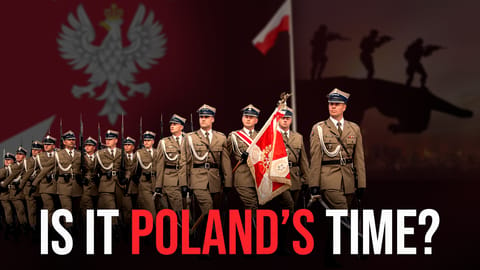
Could Poland Stop a Russian Invasion Alone — a Fronts video briefing on Europe & NATO.
Simon Whistler • August 12, 2025
Members only
Note: this transcript was generated by AI and may contain errors or inconsistencies.
On the rolling plains of Poland, the drums of war are beating with a thunderous intensity. Ever since Vladimir Putin's Russia launched its full-scale invasion of Ukraine, the nations of Europe have had a choice to make. Lay down, submit, and allow the Kremlin to do with the continent whatever it pleases, or stand firm and make ready to fight.
That second choice is quite clearly the right one, but it isn't easy, and it requires that the nations of Europe take part in a painful two-step process. Resurrect their atrophied militaries, and bring them fully into the modern era.
For Poland, war with Russia is an existential threat, and after decades split between empires before World War I, years of brutal Nazi occupation in World War II, and the better part of half a century under the Soviet boot, Poland has absolutely zero intention to submit.
Right now, Warsaw is building its forces into a new defense powerhouse, with the full understanding that if Europe goes to war with Russia, then it'll be Poland that becomes the bastion of a grand European defense. But does Poland even need its NATO allies to defeat Russia?
After the pain that Moscow's experienced in Ukraine, after three and a half years bogged down and tired, could the forces of the Russian Federation deal with the behemoth that Poland is trying to create?
Today, we're not asking whether the Poland of 2025 could defeat the Russia of 2025, but whether the Poland that's currently being built could stand against the Russia that's pushing itself face-first against the Ukrainian grindstone. Okay, turn the clock forward to about the year 2030, and we can reasonably expect to find Europe transformed.
If the Russia-Ukraine war still rages, then it'll be coming up on a decade of continuous fighting, a far less likely outcome than either a Ukrainian defeat, a Russian economic collapse and withdrawal, or a stalemate of some kind.
Although right now, there's no way of knowing which of these options will ultimately play out, we're going to take the middle path in order to build a hypothetical scenario today. Russia's economy continues to overheat and risks faltering.
Ukraine's losses continue to rise as the country's pool of available fighters contracts, and at some point, by or before roughly 2027, the two sides choose to establish an uncomfortable armistice.
Similar to the situation on the Korean peninsula, we get a demilitarized zone, continuing animosity, and a few years for both sides to fortify themselves.
With that in mind, we're going to handle the central question of this episode, Poland against Russia, as if both sides have had a few years to continue the military buildup that they're currently engaged in.
Poland gets some time for its current procurement deals to go through, its ongoing defense initiatives to take effect, and its military-industrial complex to kick into gear.
Russia gets a few years to rest and recover its troops, repair or replace a portion of its military kit, and keep its war economy running, but devoted to the process of rearmament in advance of a future war.
And although there are real-life factors that would mitigate this, we're going to discuss a straight contest today between Poland on the one side and Russia on the other.
Realistic or not, we're going to assume that Poland is fighting by itself without the invocation of NATO's Article 5 and that Russia is routing its attack through Belarus, Kalingrad, and the Swarkey Gap, meaning that Ukraine doesn't have to be directly drawn into the battle either.
With our terms of engagement set, let us discuss what each side can reasonably expect to have in its arsenal by the 2030 deadline that we've set out. We'll begin with Poland. Poland, currently expected to spend a full 4.7% of its GDP on defense in 2025 and is in the process of making some of the most aggressive purchasers of military equipment in the world.
Poland is working to build a military of 500,000 troops with plans currently in place to start training 100,000 volunteers each year into a force of reservists. That's due to begin in 2027.
As such, with Poland's current armed forces numbering well over 200,000, we're going to assume that Poland does make it to the finish line by our 2030 deadline, making it able to muster half a million troops in the event of a full-scale Russian invasion.
Of those half million, well over 50% will be part of the Polish land forces. At its disposal by 2030, we can expect the Polish army to field a well output of 1,200 main battle tanks, including somewhere between 500 and 800 copies of the Korean-made K2 Black Panther, hailed by many analysts as the best main battle tank in the world today.
Poland expects to start building its own K2s in 2026, meaning that by 2030, it should control a highly robust supply chain that could sustain those 500 to 800 tanks during frontline service.
If the K2 is not the best tank in the world, then Poland doesn't have very much to worry about. By 2030, it'll also have, in its arsenal, over 350 upgraded M1 Abrams tanks from the United States, plus more than 200 upgraded Leopard 2 tanks from Germany.
The nation expects to field at least 500 copies of the Korean-designed K9 Thunder, self-propelled howitzer by then, and probably more.
That's in addition to about 300 South Korean Chun-Mu and 500 American High Mars multiple rocket launchers, with the High Mars proving particularly effective in Ukraine, despite Ukraine only having about 40 of them.
By 2030, Poland is expected to field over 1,500 infantry fighting vehicles, along with around a dozen new British-made air defense batteries and eight Patriot defense systems from the United States.
The Polish army will have nearly 100 American-made Apache attack helicopters at its disposal, plus a range of surveillance, reconnaissance and strike drones, and probably multiple tens of thousands of kamikaze attack drones by that time, if Poland's most recent purchases are any indication.
In the air, Poland is expected to have a total of 30 combat-equipped F-35 lightning jets from the U.S. by the end of the decade, allowing it to leverage advanced stealth multi-role aircraft to fulfill its fighting needs.
The nation is reportedly considering the prospect of doubling its order, or placing a new order for different air superiority fighters that could defeat Russia's best, potentially including the Eurofighter Typhoon or the F-15 EA. Eagle 2.
Whatever Poland decides, they'll be backed up by at least 36 combat-ready upgraded F-16s, although it may receive more in the course of the next several years, along with 48 copies of South Korea's light multi-role fighter, the FA-50 Golden Eagle.
Poland may also sign onto South Korea's Boromai program to build a cutting-edge fighter jet that's just barely short of fifth generation, and it flies its own airborne early warning aircraft, a handful of tactical airlifters, and both the American Mark IX Reaper and the Turkish Bayraktar TB-2 strike drones.
The Polish Navy comes equipped with two guided missile frigates, two corvettes, three fast attack ships, and a single attack submarine, although it's expected to have two out of an expected three additional frigates and possibly up to three submarines delivered by 2030 when a hypothetical battle kicks off.
It's also actively developing a range of sea drones and is likely to procure them in large numbers from Ukraine if a war with Russia were to be paused. On the other side of this hypothetical battlefield is the nation of Russia, which currently claims to leverage about 1.3 million active duty troops, although those numbers are subject to some debate.
Despite a hypothetical end to the war in Ukraine, Russia is not expected to substantially downsize its military in the aftermath and may actually take that opportunity to raise the quality of its troops, many of whom have been conscripted with minimal training or ability to specialize before getting sent to fight in Ukraine.
The quality of troops that Russia could offer by 2030 and the consistency of their quality by that time is anybody's guess, but we consider it a reasonable assumption that at least a large share of Russia's troops will be properly trained by then.
Russia's ground forces number about half a million, not counting paramilitary forces, and while the specifics of the Russian army's equipment inventory are nearly impossible to pin down because of battlefield losses, we know that a large share of its more advanced equipment has been destroyed.
We also note that as Russia's current capability, the nation has the ability to build or modernize about 300 T-90M tanks a year, so after our estimated three years of peacetime, we can suppose that it'll have at least 1,000 or so T-90s if we include tanks that haven't yet been destroyed.
It's similarly able to produce a constant stream of T-80 and T-72 tanks, about 200-400 BMP-3 infantry fighting vehicles a year, and smaller numbers of self-propelled and towed howitzers and rocket artillery.
Russia is known to be struggling to build or replace artillery barrels and multiple rocket launchers, and will assume that Russia will thus have a lesser capacity to reproduce that equipment by 2030.
Russia's T-14 Armata tank and its T-15 infantry fighting vehicle have been very slow to materialize, and so we won't count on their involvement, but we will count on Russia procuring thousands upon thousands of kamikaze drones.
Russia's navy, particularly its Black Sea fleet, has taken quite the beating during the war with Ukraine, but because Russia structures its navy into several discrete fleets, we'll only be talking about the two most likely to take part in a war with Poland.
The Baltic Fleet, based in the exclave of Kalingrad bordering Poland, and the Northern Fleet, based in Mamansk above. of the Arctic Circle.
The Baltic Fleet is the weakest of Russia's four fleets, with two frigates plus two more that are thought to be undergoing repairs, a bit over a dozen corvettes plus a couple being modernized, and just a single known attack submarine.
The Northern Fleet is considerably stronger, fielding numerous attack submarines, a pair of battlecruisers, at least three active destroyers, and a number of smaller combat ships, although as we'll discuss later, geographic factors may prevent them from playing a substantial of a role.
Where airpower is concerned, the Russian Aerospace Forces fly several hundred fourth-generation fighter jets from the Sukhoi Su-27 and Mikyan MiG-29 base aircraft, as well as an established 30 copies of its Su-57, which Russia claims to be a fifth-generation fighter. Whether it is, we don't know.
Russia has 52 Su-57s on order at the time of writing, and claims it'll have a couple of dozen purportedly advanced MiG-35s in its arsenal by 2030.
Russia flies dozens of supersonic and subsonic strategic bombers, even after the damage to its fleet caused by a recent Ukrainian surprise attack, but it can only produce new bombers in very small numbers, and its purported stealth bomber, the PAK-DAR, is not expected to enter production by 2030, even if it's actually, you know, a real thing.
Other elements of the Russian Aerospace Forces are under-equipped, particularly its fleet of command and control jets, but it does fly a respectable fleet of ground-attack helicopters.
Russian air defenses appear to be in a rather sorry state if Ukraine's constant successful drone attacks on Russian territory are any indication, but it possesses a considerable arsenal of ballistic and cruise missiles. All in all, the head-to-head comparison gives us a mixed bag.
By 2030, Russia's soldiers will still badly outnumber Poland, but as is the case in Ukraine, Russia must station troops across its entire vast territory, while Poland can concentrate its forces to face a nationwide threat.
When it comes to its ground forces, Poland is at a numeric disadvantage, but its stores of advanced main battle tanks should be able to rival Russia's, not to mention Russia's continued reliance on tanks that have been proven vulnerable to specific sorts of attack in Ukraine. The same is true for artillery.
Poland should be expected to have less kit overall, but what it does have should both be more advanced and better concentrated at the front lines.
Assuming that both nations continue on their current trajectories, we can expect that Polish air defenses and up to 64 combat-ready F-35s will be able to deny Russia control over Polish airspace, as it's been denied control of Ukraine's, despite Ukraine using a far lesser and considerably inferior kit.
In a head-to-head naval contest, Poland is no match for the combined power of Russia's Baltic and Northern fleets, but it's a more even contest if Russia only has the Baltic fleet at its disposal, and for that matter, it's not terribly likely that naval power would be a game-changer on either side.
Any showdown between Russia and Poland will be a land war, first and foremost, with neither nation placing significant enough naval power in the Baltic to meaningfully shift the course of it.
For all those reasons, while we're not able to claim that Poland could turn the tables on Russia and start marching toward Moscow, we can say that on the basis of military might, Poland by 2030 will be more than capable of meeting Russia in a head-to-head conflict than Ukraine.
And considering what Ukraine has already accomplished, that should give Russia some serious pause. Now, of course, there's more to a war than simple numbers of troops and hardware, and if Russia and Poland were to face off head-to-head, then there are a range of other factors we'd have to consider before rendering a verdict.
We'll start off with geographic and terrain issues, where Poland comes in at a disadvantage. Much like the eastern Donbass region of Ukraine, Poland's territory largely consists of flat, open plains, where an army rolling across from the east would run into few natural barriers, though mountain ranges, no particularly thick forests, and few rivers.
Even worse, the terrain would be easiest for Russia on the way to the capital, Warsaw, situated less than 200 kilometers from the Belarusian border.
Nor has Poland helped itself infrastructurally. Its road network in the east is extensive enough that a rapid Russian advance could crosscut it in various directions, allowing Russian forces to rapidly cascade through a sequence of flank attacks and partial encirclements, and force a collapse of Poland's front lines.
Granted, Poland is already well on its way to fortifying its Belarusian and Kalingrad borders, building a so-called east shield of bunkers, minefields, anti-drone systems, and more.
But it's not clear that those defenses will be ready in time. If they aren't, and Russia remembers the not-insignificant lesson that you've got to refuel your tanks while you're invading somebody, then Warsaw could be captured after just a few hours' drive if Polish resistance did collapse across the front.
But unlike its 2022 situation in Ukraine, Russia will also have to account for a particularly dangerous mitigating factor from Poland, and that's prep time.
Other than the paltry forces stationed at its Kalingrad exclave, Russia cannot march troops onto Ukrainian soil from its own territory. Those troops, their military equipment, and their supply chains must run through Belarus.
While Russia could draw a limited benefit from the fog of war in its build-up to attack Ukraine, the same can't be said for the preparations that would have to come before a strike on Poland.
At its widest point, Belarus is some 650 kilometers across, and you can bet whatever you've got that Western military intelligence will be able to see what's coming toward Poland in detail.
That, in turn, would allow Poland crucial time to station its assets properly, concentrate its forces in the right spots to stonewall the most dangerous parts of a Russian advance, and prepare all manner of retaliatory strikes against Russia's back lines, its supply chains, and even Russian territory itself.
With the distance involved in crossing Belarus, Russia would have to maintain long vulnerable supply chains for as long as a war persists.
At a moment in modern warfare, when cheap Kanakazi drones can fly in the thousands at a given time, vulnerable supply chains are... are a problem that can quickly turn into an Achilles' heel. Now, when it comes to population, Russia is the nation with more to worry about.
The nation's poorer and more minority populated areas are war-weary and overtaxed, with too many young sons already sent to die in Ukraine, while the wealthier population in the major cities has been largely insulated.
It's not clear how much longer Russia could hold off from imposing the costs of war on its more favored citizens, or whether it could force civil society into yet another war of expansion so soon after several stray years in Ukraine. Poland, however, has no such problems.
Public polling has repeatedly found that over 9 in 10 Poles consider Russia to be a major threat, 3 of every 4 support considerable expansions to the military, and 7 of every 10 are in favor of mandatory military training in schools.
The nation's people are broadly committed to the idea of facing down Russia if Putin ever came calling at Poland's doorstep, and while the population is aging, the problem isn't nearly so extreme as the situation that Ukraine faces.
And then there's the question of indirect support, because while in a hypothetical scenario NATO for some reason isn't coming to Poland's defense, it's not as if the rest of the world has disappeared.
Frankly, the idea that Poland would fight without the support of any NATO ally is ludicrous enough, and it's simply not worth our time to consider a situation where NATO would support Kyiv but get stingy when it's Warsaw's turn.
For that reason, we've got to factor in the provision of Western material support, almost certainly including stocks of artillery ammunition, air defense interceptors, consumer-grade drones, and other technology that's proven so effective in Ukraine.
Speaking of Ukraine, Kyiv would likely lend its own support in the form of all manner of innovative drone equipment that's expected to come out of a post-war Ukrainian defense industry. Keen observers of Europe's military situation have already realized that we haven't mentioned Poland's stocks of ammunition in this episode.
And that's precisely why not only is Poland expected to be producing hundreds of thousands of artillery shells a year in peacetime by 2030, but in a scenario where the rest of NATO isn't fighting, Poland will benefit from the entire alliance's increasing ammunition production capacity.
In addition to supplying military equipment, NATO allies could also take another indirect but very meaningful step to help Poland's cause. Namely, a blockade of the narrow point to the Baltic Sea, keeping Russia's far more powerful northern fleet out of the area and thus equalizing the standoff between Russia and Poland on the water.
In that situation, Russia would be largely unable to use naval vectors of attack against Poland, whereas in unrestricted seas, they might have parked a portion of the northern fleet in the Baltic and pounded Poland from the coast.
Finally, there are economic factors to consider, where Poland has been a continental leader for Europe in the effort to break dependence on Russian energy exports. By 2030, Poland is expected to have few, if any, direct economic ties with Russia that would be of consequence, and the same can be said to a lesser extent for the rest of NATO.
Poland's economy, more broadly, is in a period of dramatic growth, lowering inflation and rising investment, at least for now. And if those factors hold steady, then Poland should be in solid economic shape heading into 2030.
Russia, on the other hand, has compromised large portions of its economy in order to sustain its war effort and has, in turn, transitioned to a war economy that requires the demands of conflict to keep from collapsing.
That's a very sensitive situation at the best of times. And even if Russia were to swear off future wars and focus on digging out of its economic quagmire, it would still be expected to encounter unpredictable knock-on effects for many years.
Throw itself into another war, probably inviting a new round of sanctions not long after the current sanctions might have been lifted, and that is a recipe for disaster.
So, in this hypothetical scenario, a 1v1 face-off half a decade from now, could Poland stop Russia? Well, it wouldn't be clean, it wouldn't be quick, and it certainly wouldn't be easy, but on balance, we'd have to pick Poland in that fight. To explain why, we've got to get our heads around an uncomfortable but probable outcome.
That no matter whether Poland ultimately survived or collapsed, it would take a major beating in the process. If Russia makes the decision to concentrate invasion strength forces on the Polish border with Belarus and then gives the green light, the first little while is going to be rough.
Poland doesn't have the natural obstacles to slow Russia down, and to a certain extent, it's going to be drawn into the artillery-based, long-range, mass-casualty fighting that Russia prefers.
As Ukraine has had to learn the hard way, there's really no other path to stopping that kind of adversary, except playing the game with them, unless an adversary nation is truly overwhelming force, which Poland doesn't.
In the events of a Russian invasion, before Polish border defenses are ready, it's not impossible that Moscow's forces could push deep into Polish territory, so far, in fact, that even a place like Warsaw could come under imminent threat.
But what we can say is that even if Russia had some early success, Poland could start to make Russia regret its choice very quickly, and the situation for Moscow would only grow worse from there.
As we've mentioned, Poland has the prep time in this scenario to ready a strong and well-trained response. It has the intelligence to station the right assets in the right places, concentrating artillery or mechanized troops or infantry divisions in the right spots in order to counter what will be coming.
It has the economic strength, the defense industrial support from its allies, and the size and ideological conviction of its population to enable it to be confident in its ability to meet Russia in a fair fight, regardless of who ultimately comes out on top.
Its border will be at least partially fortified, providing the means to slow Russia down and inflict losses against static, unmanned defenses like minefields, buying Polish forces time and space to respond.
It would have its pick of long, vulnerable Russian supply lines way out past the air defense systems that Russia stations on its own territory, and without the protection of the advance command to control aircraft that are Russia won't be able to replenish by our deadline.
It'll have ample kamikaze drones to get the job done, plus several dozen highly advanced stealth fighters that have already been proven in combat against nations like Iran.
Yes, in a worst-case scenario, Russia could threaten places like Warsaw, but Poland has the resources and military acumen to build a layered defense that allows it to keep fighting after even a potential short-term loss of the capital.
And in that scenario, Russia would find itself holding on to a massive city that the enemy knows like the back of its hand, while Russian supply lines have to stretch even further for little practical benefit. We've said it before on war fronts, and we'll more than likely say it again in the future.
Right now, in the 21st century, we live in a world of deterrence, not a world of conquest, despite what Vladimir Putin and the Kremlin might want to think. Poland might take heavy losses in an attack from Russia, but those are losses that, by 2030, Poland will be entirely prepared to take.
And in return, Poland is building itself into the sort of military powerhouse that Russia would be incredibly foolish to attack.
It's the same porcupine defense strategy that we've seen be effective in Taiwan. Make yourself so utterly unappealing to an adversary, so obviously a complete pain in the ass to deal with, that they realize on their own that an invasion would be a silly, avoidable mistake.
Poland is well on its way to building up a deterrent threat that should make Russia lose its appetite for conquest.
And with five more years to work, we have to imagine that the Polish invasion will stop sounding like a good idea, even to Vladimir Putin. And of course, there's a reason that this entire discussion has been a hypothetical one.
Poland is highly unlikely to have to fight Russia without the help of its NATO allies, and so the scenario we've laid out is little more than a fantasy.
But as we hope you'd come to expect from us by now, there's a certain method to our madness. Yes, we lay out this scenario in detail, Poland against Russia in 2030, because of what the scenario tells us about real life.
If we're picking 2030 Poland in the midst of its massive rearmament drive to counter and ultimately turn back a Russian invasion, then imagine what the entire NATO alliance could be capable of by that time.
Over the last few years, we've focused on the urgency of European rearmament, and this is why. A continent that actually does the work of rearmament, following the commendable example that Poland is setting out, is a nation that doesn't have to game out just how bad it would be to face Russia as a unified front.
With the right investments, the right planning, and a real readiness to fight, NATO versus Russia could be a foregone conclusion.
In a world of deterrence, a whole lot less people end up dead. Let's hope that Europe can re-establish that sort of world, and let's remember that it never should have disappeared in the first place. Thank you for watching.
Unlock premium video briefings
Members get full access to premium reporting, in-depth briefings, and subscriber-only analysis.
Insiders Receive
- Full access to all premium articles and briefings
- Exclusive subscriber-only analysis and dispatches
- Support independent conflict journalism
From $5/month — cancel anytime