
Could the Gulf States Defend Themselves Without America?
The Gulf states' reliance on American security guarantees has been tested by Iran's aggression. Can they defend themselves without US support?
Simon Whistler • May 5, 2026
Members only
Note: this transcript was generated by AI and may contain errors or inconsistencies.
For the all-rich nations of the Persian Gulf, the events of 2026 have been a rude awakening. Glitzy petro-states like Saudi Arabia, Qatar, and the United Arab Emirates have come under relentless fire from Iran, and decades of security guarantees and arms transfers in Washington haven't been enough to stop the missiles and drones of the Revolutionary Guard.
Before this crisis erupted, the Gulf states' logic was clear.
They hosted American bases, they welcomed foreign protection, and they kept the supply of oil, natural gas, and other petrochemical products flowing out across the globe. In exchange, well, major conflict was supposed to be impossible. Now the Gulf states' entire geostrategic approach has been blown apart.
Regime change in Iran is highly unlikely, if not impossible, and now Iran understands that it can force the entire world into compliance by threatening destruction across the Gulf, even when Gulf nations were not active participants in a conflict.
American defensive stockpiles will take years to replenish, but Iran has hundreds or even thousands of missiles and drones ready to use, and Iran's arsenal will only be growing now that a new hardline supreme leader is in control. For Riyadh, Abu Dhabi, Doha, and the other Gulf capitals, there is no choice but to face the facts.
The Gulf of the last decade, with its fantastical cities and its hyper-ambitious development projects, oh, is an illusion, and the cold, hard realities of the Middle East have not changed. It's time for the Gulf to take its defense into its own hands, but whether or not they're capable of that is an open question. Display only, do not fire.
To say that the Middle East's Gulf states were undefended before the start of the Middle East conflict simply wouldn't be accurate. Each and every one of those nations, including Saudi Arabia, Kuwait, Bahrain, the Emirates, Qatar, and Amman, possessed standing militaries of their own.
The smallest Bahrain comprises nearly 20,000 active-duty and paramilitary troops, while the largest, Saudi Arabia, includes more than 280,000.
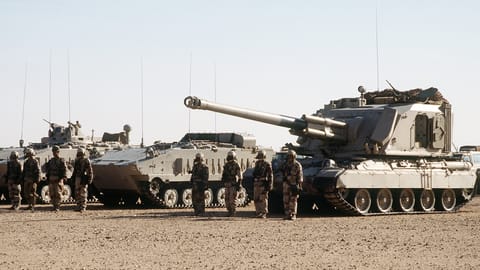
Those militaries are equipped with high-quality fighting machines predominantly sourced from the United States and Europe. Their arsenals include new naval frigates and corvettes, advanced fighter jets, and all the other types of fancy, highly capable kit that you would expect to see in a modern military.
On paper, the power of the Gulf states combined, and indeed the power possessed within some of the Gulf's individual militaries, are more than enough to overcome any threat in the region, whether from Yemen's Houthi rebels, unstable and rogue elements in Iraq and Syria, or, in a worst-case scenario, the Iranian regime.
In practice, however, Gulf state security isn't as simple as the on-paper balance of power might suggest. With a small handful of notable exceptions, the Persian Gulf is a region that, generally speaking, hasn't had to experience open warfare like the rest of the Middle East.
Sure, there was the Iraqi invasion of Kuwait in 1990, followed by the Gulf War to push Saddam Hussein back to his own territory.
Then the Gulf states enjoyed their vantage point to watch the Iraq War, which eventually metastasized into the war against the Islamic State. And of course, there were the Houthi rebels to the south, who took over part of Yemen and prompted a drawn-out counterinsurgency led by the Saudis and the Emiratis, with limited success.
There were three agitators in the Nazis.
Read the family members on here, and then watching me back up the threat against Kuwait in the early 90s and a small handful of direct Iran-backed Houthi attacks in the late 2010s, the Gulf states themselves have been untouched by the chaos of the last several decades.
Some Gulf nations, especially Saudi Arabia, have had their quiet, running cold conflicts with both Israel and Iran simmering constantly in the background, but those hardly ever turned kinetic and certainly not through any direct confrontations.
Just as important, most of the world's rich and powerful nations have a vested interest in keeping the Gulf stable and secure.
Washington has led the way, building or moving into military bases across the region and positioning some 40,000 to 50,000 of its own troops there, even in peacetime.
European powers station smaller numbers of troops in the Emirates, Bahrain, and Amman, and they work together with the United States to ensure that the Gulf has all the high-caliber fighting equipment it could possibly desire, from F-16s and Eurofighters in the sky to Challenger tanks and Caesar howitzes on land.
The US, China, France, Japan, and Italy all keep watch from across the Red Sea at bases in the African nation of Djibouti, while both Beijing and Moscow continually make it clear to the Gulf states that they're very interested in maintaining the status quo.
Anything else would throw global energy markets into turmoil and risk jeopardizing the entire world economy. And at least in ordinary times, nobody wants to see that.
The combination of their money, their energy resources, their international partners, and their relative stability in a restless part of the world have created an unusual combination of incentives for the Gulf states to think differently about their armed forces.
Based on the assumption that their militaries generally wouldn't see much action, the Gulf has had the luxury of turning their armed forces into vanity projects.
Domestically, Gulf militaries tend to be highly centralized, with important royals, notable elites, and other politically influential figures governing military decisions, despite sometimes being less than qualified for the job.
Opposite roles tend to go to privileged, ambitious young men who treat military service as a stepping stone, and who tend to come up in cultures where the prospect of actually getting their hands dirty would be undignified.
Militaries are intentionally watered down or weakened to prevent their use in coups or elite power struggles, and in some nations, they're designed to balance clan participation and centralized loyalty instead of being optimized for combat.
Their soldiers tend to be inexperienced, their highly limited track record in recent conflicts is spotty at best, and most Gulf governments lack any ambition to use their militaries abroad.
The sole exception in the United Arab Emirates uses its military to support unconventional and proxy wars abroad, but it almost always relies on foreign mercenaries and non-state actors for the actual fighting part.
The problem also extends to the Gulf states' fighting equipment and force composition. When nations like Saudi Arabia or Qatar place weapons orders, they generally aren't anticipating that those forces will be used in battle. Instead, they're often just chasing the defense contracts themselves.
When a nation purchases, let's say, a new bundle of fighter jets, they aren't just making a one-time transaction. After an order is placed, it takes several years for all the aircraft to arrive, and then the purchasing nation will spend decades sourcing spare parts, software, for upgrades and compatible weaponry.
Nations tend to remain strategically aligned after they strike those sorts of deals.
Nations selling equipment enjoy lots of geostrategic leverage over nations that buy. For the Gulf states, those arrangements are an insurance policy, especially with Western nations who quibble over personal freedoms and human rights and are less willing investors in other sectors than, say, Russia or China.
Western nations sell weapons and gain powerful leverage, while the Gulf states really don't mind giving that leverage away as long as they're provided security guarantees.
Because of that unusual dynamic, Gulf states are incentivized to buy Western military equipment even though they might not need it or it might be redundant. After all, the Gulf states are really buying the relationship and don't intend to ever use the hardware.
Or do they intend to build their own defense industrial bases when they can buy defense industrial capability from a foreign partner, plus all of the perks that come with it.
Unfortunately for the Gulf states, that entire approach to military and geopolitical affairs only works as long as they're never actually threatened by a military aggressor. Serious geopolitical analysts, both in the Gulf and across the globe, understood that reality even before the events of 2026.
They could cite successful Houthi strikes against Gulf refineries and oil fields as evidence that regional governments shouldn't ignore defense entirely.
But those governments have hardly been receptive. Instead, they shifted assets and made small changes so that they could feel as if they'd patched their security gaps without actually having to change anything about their approach.
They signed more extensive defense deals, obtained stronger security guarantees, and used their geopolitical leverage to lobby for stability, including in the lead-up to the joint US and Israeli air campaign against Iran in 2026.
In fairness, it's not impossible to see how that would have felt like a winning bet for the Gulf capitals, where before this year they could cite decades of precedent and overwhelming geopolitical incentives as evidence that a major regional conflict was impossible.
But all that calculus came apart as soon as Iran's first wave of drones and missiles began to slip through Gulf air defenses. In practice, the Gulf states' multi-layered armor simply wasn't ready to deal with the realities of a full-scale war.
Washington flew in extra defense systems and interceptors in extraordinary volumes, even taking away from much-needed ballistic missile defense on the Korean peninsula, but American and Gulf air defenses combined still weren't enough to do the job.
Those defenses intercepted well over 90% of incoming Iranian munitions, but at the volume of munitions that Iran was launching, even a 3 or 4% success rate meant that dozens of projectiles slipped through.
Those munitions struck high-rise buildings, international airports, oil and LNG refineries, and much more, jeopardizing global energy flows and breaking the illusion of the Gulf states as a sanctuary for foreigners in the Middle East.
All of the geopolitical incentives that the Gulf had cultivated with powerful world nations after decades of management and diplomacy still weren't enough to stop Iran from targeting cities, energy infrastructure, and even threatening to destroy people's communities. Once again, it didn't happen to the Gulf states' all desalination facilities.
Interceptors started running low much too quickly, and when the Gulf states tried to convey desperate messages that Washington didn't want to hear, the Americans simply didn't listen.
For as long as the conflict lasted, the Gulf states had no other option but to hang on for the ride and hope that they could emerge with their own nations relatively intact. Rethink an overhaul As the time of writing, there are no guarantees that the unstable ceasefire in the Middle East will hold or that it can evolve into a more sustainable peace.
But whenever the Iran conflict winds down, and even while tensions remain high, the Gulf states are going to need to adapt, building the arsenals, the connections, and the safeguards to ensure that this sort of crisis can't happen again.
These nations are almost completely dependent on the energy sector to prop up their economies and desalination facilities to sustain habitable cities. Their futures in the world that comes after oil are dependent on their ability to portray themselves as a safe, secure destination for foreigners and global industry.
They cannot afford for these cities to turn into a pattern, and the tools they believed would prevent this crisis in the first place simply are not sufficient.
Now, to be clear, we do need to emphasize that there are no guarantees that the Gulf states will take the urgent action that's required. Their incentives are complex, their internal power dynamics make things complicated, and they may decide to ignore their problems and just hope for the best.
But if we assume that the region's leaders are going to take charge and ensure that their countries are never threatened like this again, then they've got a laundry list of complicated tasks to accomplish.
The most critical priority for the Gulf states to address is the problem of air defense. Iran can pursue military development, defense industrial growth, or better security guarantees, but in the short term, it simply cannot afford not to protect its airspace.
The Iranians in the east and the Houthis toward the south each rely on a combination of long-range ballistics and cruise missiles and one-way kamikaze drones to threaten their adversaries.
Those systems are high volume and relatively low cost and are managed indigenously, whereas the Gulf's existing air defense systems are high cost, using limited interceptors, with a partial dependence on foreign hardware, and a near-complete dependence on foreign resupply.
In the short term, the Gulf is already working on addressing the issues of cost, volume, and technological capability. Over the last several weeks, Gulf states have started to decide defense deals with Ukraine, the undisputed world leader in both using and stopping one-way attack drones and long-range cruise missiles.
Ukraine's drone interceptors are cost-effective, easy to produce, and easy to deploy in large volumes. In the short term, Ukrainian operators on the ground are already using the limited number of drone interceptors that could be shipped to the region under the circumstances and advising their Gulf partners to use their technology by themselves.
On a timeline of several months to a couple of years, Gulf nations could license production for these drone interceptors, ideally using assembly lines on their sovereign soil.
They can also take advantage of their greatest tangible assets. their sheer wealth to buy up available air defense systems from the US, Europe, China, and anywhere else while outbidding the competition for those critical limited resources. Whatever these countries acquire, sovereign control is going to need to be a priority.
They've got to stockpile as many interceptors as possible, acquire as many systems as possible, and ensure that their troops are able to operate those systems in a crisis without any help from other nations.
While air defense is the most immediate priority for the Gulf states to address, they've got bigger problems waiting for them once air defense is in passable shape. The largest problem of all is an institutional one.
Gulf state militaries have been built to do lots of things other than fighting a war, while their ability to actually fight a war is lacking at best.
For each of the Gulf states, a full-scale military overhaul will be a very long and drawn-out process, both for practical and political reasons, if such an overhaul is even possible in the first place.
But each Gulf nation, and especially those with large populations and pre-existing arsenals, can work to create reliable, high-quality, quick-reaction forces in a much shorter span of time.
In a well-designed, well-equipped force, even a relatively small share of available troops could make a massive difference, responding quickly to foreign aggression and delivering a sovereign response, instead of waiting for action from an international partner.
Equally important to capability is the Gulf states' will to respond in a crisis. Take a step back and it is extraordinary that after Iran launched large-scale attacks against each of the six Gulf states, as well as Iraq, that none of those nations attempted to retaliate.
Not only did they decide not to carry out their own operations, but they haven't even accompanied U.S. forces in an offensive role, aside from unverified reports of small-scale airstrikes in the waning days of the conflict.
While Gulf leaders seem to assess that by not antagonizing Iran, they may have avoided further damage. The inverse is also true. Iran correctly calculated that even after striking the Gulf states directly, it was not at risk of meaningful retaliation from any of them.
That meant its war could remain neatly contained with the U.S. and Israel without any risk of other nations starting to pursue their own objectives and taking the fight to Tehran in unexpected ways. Gulf capitals have undoubtedly noticed that their supposed influence failed repeatedly to get them their way in Washington.
And they failed in February, oh, and they urged the U.S. not to start a war in the first place, and they failed in April when they urged the U.S. to finish what it had started and permanently destroy Iran's offensive capabilities, only for the U.S. to go ahead and declare a ceasefire.
The Gulf states have already started to recognize their general lack of strategic capability by threatening strikes as a measure of, quote, self-defense in the final days of full-scale fighting. But as of now, those threats don't have any real weight behind them.
That's not to say that the Gulf states need to start preemptively bombing Tehran to make up the lost time or otherwise demonstrate their willingness to retaliate against Iran through military action of their own.
But prior to the start of hostilities in 2026, it was patently obvious to Iran that there was zero risk of a major Gulf state response.
Sticking with the concept of quick reaction forces, Gulf militaries could build forces that are intended to be on standby, say, a squadron of heavy strike aircraft at a well-protected air base within range of important Iranian targets. Gulf navies could create a joint force based near the Strait of Hormuz, ready and prepared to strike the waterway.
To be clear, each of those actions would introduce real risk. Strike aircraft flown by inexperienced pilots under unfamiliar combat conditions could be shot down, while naval vessels could be harassed by fast boats and bombarded with drones.
But at the very least, the guarantee of a quick response would force Iran to change its calculus, especially because Iran can't be assured that sovereign Gulf militaries will always act in alignment with Washington's will.
And while the Gulf states would be opening themselves up to the possibility of troop and equipment losses, the war of 2026 has shown that there really isn't a good alternative. Even when the Gulf states weren't going to take part in the hostilities, Iran attacked their energy infrastructure and their population centers anyway.
The Gulf states preemptively raised a white flag, and Iran just didn't care.
Moving out to a timeline of several years, the Gulf states could work to build a much more comprehensive, meaningful deterrent capability than they currently possess. One option could be to copy Iran's approach directly and invest in missiles and drones with a long enough range to strike back if Iran were to reopen hostilities.
If instead, the Gulf states wanted to focus on air power, many of them possess sufficient firepower already, but none of them possess enough air-to-air refuelers, airborne control aircraft, or other non-combat support to sustain a long-term air campaign.
If they were to prefer the naval route, they could invest in properly sized frigates or better yet, unmanned surface and underwater vessels in great enough numbers to deter swarms of Iranian fastboats.
While it's not technically impossible that the Gulf states could invest in amphibious landing forces or other ground warfare capabilities to deter Iran, those missions would place a much greater strain on manpower and substantially raise the risk of losses, whereas aerial and naval capabilities are each a bit easier to build up.
At the same time, Gulf nations would be wise to invest in an expansion of their respective defense industrial bases, where again, some capitals have already demonstrated an understanding of what needs to change.
While these are not countries with the ability to design complex offensive weapons systems indigenously or build them at scale, like other nations could build naval frigates or fighter aircraft, they are countries with the ability to build production lines, hire foreign labor, and start churning out less complex but high-tech equipment.
That might include air defense interceptors, interceptor drones, and defensive munitions like missiles, UAVs, and sea drones, probably using licensed designs from other countries at first.
It might also include cutting-edge technology where non-defense innovation could come in handy, like in building directed energy weapons to bring down incoming projectiles.
Heavy armored vehicles, combat aircraft, or large vessels may still come from other nations, but the Gulf states can take on the challenge of arming, resupplying, and maintaining those volumes. systems using equipment they build on their own soil.
In a geostrategic sense, the Gulf states are in clear need of a series of difficult conversations, starting with the discussions they'll need to have with each other. These countries are far from a geopolitical monolith.
Saudi Arabia and the Emirates have a growing rivalry. The Gulf blockaded Qatar just a short few years ago, and there are countless other issues that these countries will still be fighting over, like a bickering pack of siblings long after their current leaders are dead and gone.
But the Gulf states wouldn't be the first group of countries to figure out how to keep their disputes internal while showing a reasonably unified front for the outside world.
It's one thing for these countries to compete, even fiercely, but quite another for their internal divisions to be exploited as a pressure point from the outside.
Borrowing inspiration from other international defense blocs, the Gulf states can work to create a unified strategic command architecture, pool their quick reaction forces, and establish at least a minimum deterrent that they can all agree to present together for the rest of the world to witness.
Their deterrent doesn't need to be complicated or comprehensive like NATO, and in fact, that might defeat the broader purpose.
As long as they can convince the rest of the world that by messing with one Gulf state, they'd be kicking the entire hornet's nest, that collective deterrent will start to grow. Then there are the conversations that Gulf will need to have with other outside partners, particularly the United States.
Already, debate across the Gulf is heating up over the risk-reward balance that's come from hosting American bases.
Most of the time, those bases have functioned as a decent enough deterrent, but now they've failed to stop an Iranian attack, and they've even been used as pretext for Iran to call the Gulf states collaborators and start attacking their cities or energy infrastructure.
Even worse leaks from Washington and the Gulf suggest that many of those bases are now uninhabitable, meaning that the Americans didn't just fail to deter Iran, but they failed to preserve even their own strategic assets.
At this stage, Gulf states may assess that they're better off asking the U.S. to leave, so that Iran or another aggressor has no pretext to carry out a similar attack in the future.
They might also pressure Washington to start making concessions on defense so that, say, Saudi Arabia can produce Patriot interceptors on its own soil like Japan does. Reporting from Washington suggests that America is already very concerned about losing its Gulf clients to competitors like Ukraine.
Under the right amount of pressure, American defense corporations may find themselves more willing to offshore some of their production if it means that they don't lose lucrative Gulf contracts completely.
Moving away from the U.S., Gulf nations may want to think more seriously about inviting other security guarantors, like Saudi Arabia did in 2025, when it signed a mutual defense pact with nuclear-armed Pakistan.
After decades spent languishing in comfort and prosperity, the Gulf states are going to have to radically reconsider their approach to their own security. As individual nations, and as a collective, it's obvious that transgressions like Iran's cannot be allowed. stands in the years and decades to come.
Unfortunately, it's also obvious that their transformation will be an uphill battle and one that requires an expensive and painful rethink of their entire approach to the 21st century. It isn't going to be easy, and it's certainly not going to be fun, but the alternative is to spend the foreseeable future as Iran's hostage.
If the Gulf states have any sense at all, then that won't be allowed to happen again.
Unlock premium video briefings
Members get full access to premium reporting, in-depth briefings, and subscriber-only analysis.
Insiders Receive
- Full access to all premium articles and briefings
- Exclusive subscriber-only analysis and dispatches
- Support independent conflict journalism
From $5/month — cancel anytime