
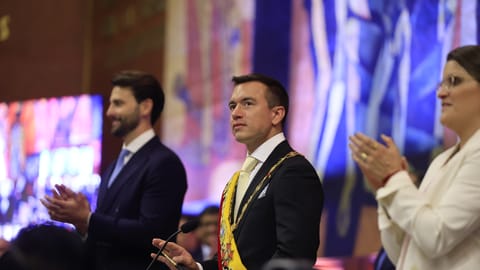
Does Daniel Noboa Have a Future?
Simon Whistler • July 14, 2026
Members only
Note: this transcript was generated by AI and may contain errors or inconsistencies.
Over the last several years, a select few Latin American leaders have become emblematic of the region's shift to the right.
In Argentina, Javier Millet's mop of hair and his chainsaw have become as iconic as a red hat over in America, while over in El Salvador, Nayib Bukele's crackdowns and sweeping constitutional reforms have set him on a path to becoming president for life. In 2026, several new faces have joined their ranks.
Jose Antonio Kast in Chile, Laura Fernandez in Costa Rica, Keiko Fujimori in Peru, and Abelardo de la Esperea in Colombia. But across the entire Western Hemisphere, there is no leader on the Latin American right who has followed a path like Ecuador's Daniel Naboa.
Just 35 years old on the day he was elected, Naboa seized power in Ecuador at what seemed to be a perfect moment.
Bukele's crackdowns in El Salvador had been ongoing in full force for about 18 months. Crime in Ecuador was rising quickly, but Naboa had pledged to use those same Bukele tactics to regain control.
Elected for an abbreviated first term after a snap election, Naboa would be able to finish his short term and then be re-elected twice, meaning that if he played his cards right, he wouldn't have to worry about stepping down until well into the 2030s.
After a bit less than three years in office, Naboa's time as president has not gone to plan, but it also hasn't gone horribly either. His crackdowns were a failure compared to El Salvador, but he secured the military backing of a very powerful ally in Washington.
He underwhelmed in his first term relative to expectations, but he still won re-election in 2025.
Across the Latin American right, he's at risk of becoming the runt of the litter, but he's in the right place at the right time to capitalize on a continental shift in his favor. Looking at Naboa today, it's like looking through a shifting kaleidoscope.
At times, he seems to be one of the weakest leaders in the Western Hemisphere, but every so often, the world catches a glimpse of somebody who could rule over Ecuador for decades.
When Daniel Naboa first captured the Ecuadorian presidency, he had all the makings of a young, dynamic leader who could provide a real breath of fresh air for his people. Heir to the banana exporting Naboa Corporation, Daniel was U.S. educated and had started his first company at just 18 years old.
By 2021, he was a national assemblyman, making a name for himself as a right-leaning centrist, and two years later, he was in the right place at the right time to capitalize on the impeachment of the nation's then-president.
That man, ex-banker and economist Guillermo Lasso, had suffered from a range of problems that were, shall we say, undercoming of an established money man, a spike in food and fuel prices, austerity measures that his people struggled to accommodate, and connections with unsavory dealings via the Panama Papers.
The citizens of Ecuador took to the streets in protest, Lasso's government responded with crackdowns so severe that they were condemned as human rights abuses, and eventually, the president dissolved the national assembly to trigger a general election, where Naboa quickly became a leading candidate.
By the time Naboa announced his candidacy, it was already clear that Ecuador's elections would be about internal security.
After decades in which Ecuador was among Latin America's safest countries, Quito's reputation had been deteriorating since the late 2010s, when a rise in drug trafficking demand under. Peace. deal with the FARC organization in neighboring Colombia and several other factors coincided to push transnational criminal groups onto Ecuadorian soil.
The country's location within South America and the capacity and corruption of its port cities made it an ideal export hub for cocaine and coca flowing in from Colombia and Peru, while its dependence on the U.S. dollar created a perfect opening for money launderers.
In December 2020, the leader of one of Ecuador's oldest and best-established crime syndicates, Los Treneros, was gunned down in a shopping mall, kicking off a massive gang war that started in the country's prisons before exploding outward.
Between 2020 and 2023, when Naboah was elected to the presidency, Ecuador's homicide rate quintupled, with Mexico's Sinaloa Cartel, the Jalisco New Generation Cartel, and a wide variety of Latin American, European, and Asian syndicates all trying to move into the vacuum that the gang wars had created.
A first Naboah was thought to be something of a fringe candidate, promising, young, and well-spoken, but it experienced, probably the sort of person whose best days in politics was still far ahead of him.
The first round's election took place on the 20th of August, and in the first week of that month, there wasn't a single poll that showed Naboah above 3% support. But 11 days before the vote, the election was marred by violence. After surging in the polls, candidate Fernando Villavicencio was assassinated just after a campaign rally.
Before the killing, he had received death threats from the Sinaloa Cartel and other groups. The attack was captured on video, and all but guaranteed that a tough-on-crime candidate would end up winning.
A first, it seemed to stiff the man to capitalize on that would be Jan Topic, a businessman who had served as a mercenary soldier during the 2000s and 2010s, especially after another criminal group, Los Lobos, claimed credit for the assassination and threatened that Topic would be next.
But after a very strong debate performance at the 11th hour, Naboah rode a wave of youth support and seized second place in the crowded first round, advancing to a runoff against powerful leftist candidate Luis Gonzalez. The second round was close as Gonzalez's international political apparatus tried to blunt the momentum of a less connected newcomer.
But in an election that was ultimately about crime, the tough-on-crime candidate secured a predictable victory.
In his victory speech as Ecuador's youngest ever president-elect, Naboah pledged to, quote, return peace to the country, a promise that would define the next several years of his life for better and for worse. Naboah was inaugurated on the 23rd of February, 2023, to a term that would expire in mid-2025.
Because his first term would be quite short, Naboah was entitled to run in that 2025 election and the coming elections in 2029 for a total tenure of nearly 10 years, if the next vote swings his way, that is.
From the first hours of his presidency, Naboah kept his focus on organized crime, directing the creation of new treatment programs for drug abusers and closing regulatory loopholes that helped traffickers.
He raised inquiries into the creation of El Salvador-style maximum security prisons, addressed the UN Security Council on Ecuador's internal crisis, and secured some very good press from Ukrainian President Volodymyr Zelenskyy.
But the honeymoon phase of the naboa presidency ended within about six weeks in early january of 2024 the new leader of ecuador's los generos gang jose masas vilamar escaped from prison masias was thought to be the mastermind of the assassination of naboa's campaign rival and after he escaped cross-country prison riots gave way to open revolt two days after
Masias disappeared los generos and several other cartels unleashed hell across the country in attacks against hospitals state institutions prisons police stations and civilians in one instance gangs took journalists hostage live on air at a television studio several other gang leaders were broken out of prisons and high-profile politicians including a public
Prosecutor were assassinated of course ecuador's internal crisis had already been a roiling boil before any of those attacks took place but it was then that the country devolved into open internal conflict to give you an idea of scale and severity of the fighting the conflict monitoring group acled reported that over 3600 people were killed in gang violence
From january 2024 until november of 2025 with a full 71 percent of ecuador's population exposed to violence across 2025. remember ecuador is not a large country it's home to about 18 and a half million people meaning that the 400 000 people who fled the country since 2021 according to acled's numbers and make up more than two percent of the overall
Population counting civilians the death toll has climbed well over 6 000 by the end of 2025 and it's only risen further in the month since los generos fight other established ecuadorian gangs like los lobos while both gangs fight and do business with a range of international syndicates but all of these groups are also fighting the ecuadorian government at
The same time the gangs are splintering internally while also being infused with cash and support from cartels in colombia and peru who in turn manage trafficking networks that spider their way across latin america that conflict has dominated naboa's time in power and the collateral damage has spilled into most of the other major challenges his
Administration has had to deal with including everything from chronic energy shortages to unemployment poverty and corruption as for his ability to handle the conflict and its associated challenges well the reviews vary widely naboa's proponents point to his success in lowering homicide rates while his detractors point out that the murder rate is still far
In excess of what it was before ecuador's internal crisis loyalists blame a portion of his trouble on a political establishment that's been unwilling to work with him as well as the very real challenges that come with such a short first term in office by the time naboa was up for re-election many voters agreed expressing a willingness to give him more time
To carry out the promises that first brought him to power critics however have had all too easy a time tearing naboa down with comparisons to naive bukele of el salvador not only do many of naboa's detractors oppose the use of bukele-style measures in their country but to hear them tell it naboa isn't even capable of implementing an ecuadorian version of
Those policies under a state of emergency naboa did bring the nation's military to the streets and managed to win a constitutional referendum of the introduced extradition policies expanded criminal penalties permitted the nationalization of seized assets and more under what nabur called the phoenix plan the country brought in the united states in an armed
Counter-insurgent role and collaborated with international security experts and mercenary contractors to create a new national intelligence service overhaul the nation's prisms secure its airports and infrastructure and designate more than 20 criminal groups as terrorist organizations but unlike piquely and el salvador those measures just haven't solved the
Internal crisis ecuador's gangs are better armed more organized more transnational less willing to bargain than el salvador's ever were and as the time of writing naboa hasn't managed to carry out anywhere near the levels of mass incarceration that piquely has ecuador's syndicates have proved to be much more resilient and creative in the face of adversity
And the systemic issues that fuel ecuador's crisis the poverty the food insecurity the broken down healthcare system and so on remain mostly unresolved nevertheless 2025 saw naboa cruised to re-election begin his second term that year's election was a rematch against leftist luisa gonzalez who split the first round vote with naboa in what looked like it
Might be a close contest just 0.2 percent of the vote more for naboa than for gonzalez but once all the other candidates left the race naboa seized most of the remaining vote share eventually thrashing gonzalez by an 11 point margin given ecuadorians appetite to see their country's crisis resolved the second round outcome is hardly a surprise gonzalez
Represented a complicated legacy on the left one that created the conditions for the crisis without offering a comparably clear vision on how to solve it on the right meanwhile a few fringe candidates could offer an alternative to naboa but none could legitimately claim they had a better shot at making progress and nor could they wield the power of the
Presidency itself as the time of writing naboa is a bit over a year into his first full term or roughly the 31 month mark of his presidency overall in the time since his re-election naboa has started to ramp up his counter-insurgent efforts against the gangs and cartels of ecuador most notably by welcoming direct american air support just two months after
Washington's ouster of nicholas maduro a couple of borders away naboa has also become a prominent cheerleader for american operations in the caribbean the pacific striking alleged narco trafficking boats as they make their way north skirting the ecuadorian legislature naboa has welcomed u.s troop deployments at several key bases without signing any new
Formal treaties although it was repudiated by voters shortly afterward when they refused to endorse a referendum that would have allowed the return of foreign military bases in the country at this point in his presidency naboa has started to settle into an awkward political position one where he may struggle to really deliver on the one hand he secured
Re-election with a stronger mandate than when he won his first term and he's clearly earned a measure of trust and a measure of patience from his supporters his most credible political challenger from the left he's now defeated twice and he doesn't seem to have any natural predators on the right at the same time it's been over two and a half years now and he
Can no longer claim to be either a political novice you or a politically underpowered president.
In April of 2026, Naboah claimed that crime in the month of March was down 28% compared to March of 2025, but that's because 2025 saw homicides spike by over 30%.
In reality, Ecuador's gangs continue to adjust their tactics, shifting away from the coasts and toward the interior and dispersing their operations now that American airstrikes are a real but relatively infrequent threat.
From the height of his popularity in early 2024, when he recorded a peak approval of roughly 81%, Naboah has dropped precipitously in the polls.
In late June 2026, less than 25% of Ecuadorians said they supported Naboah's presidency, while two of every three said they consider him a poor leader. As regional expert James Bosworth wrote in May, quote, In some ways, Naboah is proving to be a distorted mirror image of Pekeli.
His security policies are failing, and his efforts to suppress his political opponents are being done from a position of vulnerability rather than strength.
But it's too early to declare that Naboah's presidency is done. Because the other side of the story of Daniel Naboah is the story of a rising autocrat. Go back to the recent referendum that we mentioned on allowing foreign bases in Ecuador.
The other main question on that referendum was telling a request for voters to approve a national assembly that would rewrite the Ecuadorian constitution. That ballot measure failed to pass despite intense pressure from Naboah and his allies, but the underlying trend is clear.
Naboah is aggregating power whenever and however he can in a dynamic that's looking more and more like a slide towards authoritarianism.
Earlier in his tenure, Naboah was the sort of figure who Latin American experts generally regarded as a non-threat, despite his clear affinity for heavy-handed security measures.
Sure, Naboah advocated policies that sounded very similar to the policies of regional leaders who were starting to overstep, and Naboah himself hardly seemed interested in a power grab.
When, in the 2025 election, Naboah's leftist rival claimed the vote was fraudulent, the Organization of American States, the European Union, and other international monitors supported Naboah, insisting that the election had been free, fair, and entirely above board.
Naboah's record wasn't entirely unblemished. The Panama Papers had revealed him to be the owner of multiple offshore companies, and he seemed to be helping his father stay out of the way of the Ecuadorian tax system before he was elected.
But, once he secured the presidency, Naboah's early scandals and controversies seemed to have little to do with a hunger for power.
Even before his re-election, however, the people who'd been watching Naboah closely already had their suspicions. For example, when we mentioned that Naboah doesn't have any major competitor on the political right, that's not exactly true.
We've already mentioned the man who was expected to capitalize on Ecuador's desire for militarized national crackdown back in 2023, the former soldier of fortune, Jan Topik.
Funnily enough, Topik did intend to run for president again in 2025, where he would have been the most credible right-wing challenger Naboah faced by a wide margin. But instead, he was disqualified from candidacy before the election took place, on the basis that he had failed to divest his businesses from state contracts.
Granted, topic was just one candidate in an election that saw well over a dozen candidates put their names forward but topic posed an electoral threat to neboa that none of the others could even the eu which eventually rated ecuador's runoff election free and fair raised concerns over topic's situation and the irregularities of his treatment by the elections
Tribunal we point out topic's case not despite the fact that it's difficult to tire his disqualification directly to neboa but because that's how a lot of neboa's authoritarian creep tends to manifest unlike so many other leaders around the world neboa seems to have a vested interest in making sure he won't rock the boat too much even with battles that he's
Likely to win during the 2025 campaign neboa did push meaningful boundaries and he got away with it on several occasions refusing to take a leave of absence from his presidency in order to campaign as is required by the ecuadorian constitution and seeming to use ecuador's electoral commission to sideline his estranged vice president while appointing an
Acting alternative by decree after himself alleging fraud in the first round of the 2025 elections neboa declared a state of emergency in several provinces ahead of his runoff victory a harsh legal measure that served as the foundation for his opponent's fraud allegations in every case there are two ways to read neboa's actions if we choose to be generous we
Can point out that ecuador's mandate for a presidential leave of absence during campaign season is a national oddity that there's no direct evidence that the country's electoral commission was deliberately leveraged against either yarn topic or the vice president and that under the state of emergency before the runoff eu observers emphasized that candidates
Campaigns journalists and political supporters all moved and acted freely the other read of neboa's actions of course is that he violated the dorian constitution managed to use the nation's compliant legal system to defeat his rivals and used his state of emergency to tip the scales militarizing the election in a move that couldn't help but swing the vote as
For why neboa would choose to be so subtle when latin american leaders like bukele malay and most recently de la asperela seem to revel in fights with the political opposition well several factors seem to be constraining neboa all at once for one thing neboa is keenly aware that he just doesn't have either the power or the political capital of him lay let
Alone of a kelly the results of his promised crackdowns just aren't there yet and as a leader who went from being a relative nobody to being president almost overnight he lacks any real pre-election following that would be willing to back him in difficult moments for another neboa is well aware that the institutions of the ecuadorian state are relatively
Strong and while they're certainly corrupt in their own ways they're far from say a peru or a mexico finally neboa knows that he has time especially as long as his main rivals come from the ecuadorian left a group that is still held responsible for creating the internal security mess in the first place move outside of national elections and the boas growing
Hold over ecuador remains quite subtle in a way where his relative unpopularity and his tendency not to make headlines actually seems to help you But for outsiders watching Latin America for signs of democratic backsliding, Neboa doesn't set off alarm bells in the same way that Pekeli or Della Esperea do on a regular basis.
He seems harmless enough, almost boyishly ill-equipped for the role at times, a watered-down, dire version of Pekeli that just doesn't have the same ability to produce results. But although we here at France can't see inside Daniel Neboa's mind, we suspect that he would agree with the idea that there's more than one way to consolidate power.
When Neboa's authoritarian drift is discussed, it's in his use of domestic and international levels of power to build up a level of momentum within government and diplomatic institutions, regardless of his approval ratings from the Ecuadorian public.
Quoting expert James Bosworth again, No single thing that Neboa does is a giant coup against democracy that serves as an easy hook. Instead, it's a slow, steady drip of institutional weakening that is emptying the bucket. End quote.
Take Ecuador's National Assembly, where Neboa's ruling National Democratic Action Party is slowly but surely securing the loyalty of individual legislatures from other parties, not building a coalition with their political parties so much as converting key figures into reliable outside allies.
With their help, Neboa's legal reforms pass more easily, but the power of Ecuador's multi-party political system as a reliable check on central authority dwindles into nothing.
Neboa's national prosecutor is ostensibly independent budget and accounting officers, and the body in charge of political appointments all seem to have been brought into alignment with Neboa's goals.
The same could be said of his national electoral council, but in every case the signs are understated. Neboa doesn't use those institutions to pick fights, and while they frequently operate in uncharacteristic ways to support his goals, they tend to avoid taking action at moments of scrutiny. Again, there's a generous read and a less generous one.
We could look at that trend and suppose that the institutions aren't actually corrupted, or we could say that they're operating in a way that's consistent with Neboa's broader playbook, aligning behind the scenes but avoiding the public battles that could undo his progress.
When Neboa does pick fights, it's typically with the Ecuadorian constitutional court which pushes against many of his popular or politically divisive initiatives. The court is a critical check on Neboa's power, and it receives regular support from global institutions of justice and accountability.
But Neboa has been increasingly successful in making its rulings a politicized issue. Meanwhile, Neboa's consistent use of states of emergency has started to raise real concerns. It's difficult, politically speaking, for the Ecuadorian opposition to really criticize Neboa in this area.
After all, the nation does still have its internal conflict to worry about, and it's all too easy for the opposition's objections to be dismissed as yet more evidence that they're too soft an organized crime.
But Neboa's turned Ecuadorian states of exception into a regular feature of his leadership, where the military and the police are able to assume unusual powers, forced disappearances have become increasingly common, and oversight is minimal. Against the press, Neboa hasn't overseen crackdowns exactly, but he's fostered an explosion in the next one.
That's so cool. digital outlets that tend to align with his policies and chosen narratives, oversaturating the national media environment and drowning out reliable outlets.
In some cases, Naboa has taken direct action against individual outlets, including the important newspaper Diario Expresso, where the government has alternately attempted to seize around 40% of the paper's ownership shares, use tax and judicial authorities to investigate key members, and then intervene in the paper's ownership directly.
On the international stage, Naboa also avoids picking fights unless he knows he can win.
But his decision to raid the Mexican embassy in Quito, for example, to try and arrest a former vice president who'd been sentenced on corruption charges, was a prime opportunity to start a showdown with an outgoing leftist president in Mexico who had lost his own fair share of credibility on the international stage.
Meanwhile, Naboa has been very eager to increase the support he receives from international backers, even when it might harm internal perceptions of his leadership. But take the decision to cooperate with the U.S. on anti-narcotic trafficking operations.
While about half of Latin America has pushed back against U.S. action and friendly presidents like Bukele have tried to portray themselves as equal partners in their relationship with Washington, Naboa has just invited the Americans in.
He's followed the Trump administration on Venezuela, Cuba, trade and narco-terrorist designations, while appealing to Washington around one of the concessions American governments love most, the possibility of a U.S. military base on Ecuadorian soil. The results speak for themselves.
Naboa and Donald Trump have gotten very cozy with each other in a way that's likely to yield real political returns for Naboa in the future.
And if we operate on the premise that Naboa is a savvy political actor, deeply interested in consolidating power, but smart enough to avoid risks he can't get away with, then recently his actions would suggest that he believes that he has real momentum.
Take the recent allegations made by Ecuadorian rights activists around the death of 41-year-old anti-corruption activist Monica Silva Koniuszek.
Polish in origin, but a long-time Ecuadorian resident, Silva Koniuszek spent over a decade working against environmental crimes and corrupt leaders alongside local journalists.
Recently she'd been after Naboa Trading, the fruit export conglomerate owned by Daniel Naboa's family, and chasing allegations that, quoting The Guardian, several tons of cocaine have been seized in the Boa Trading banana containers, but high-ranking Ecuadorian judicial officials were stalling the investigations." On the 8th of June, Silva Koniuszek was
Found dead in her home with a noose around her neck, in which was initially ruled a, but a post-mortem investigation found that she was killed by a blow to the head, followed by strangulation.
Quoted The Guardian again, surely before she was killed, she told friends that she had delivered a dossier of allegations to the U.S. Embassy in Quito.
She had received multiple death threats and had told friends that Ecuador's cartels had placed a bounty on her head. This is the most high-profile story of an activist's death under Naboa, but it's far from the only one.
Indigenous community leaders have been shot dead under his watch, sometimes by unidentified armed men, but sometimes by the military during states of emergency.
Naboa has leveraged the country's judicial system. against activists with increasing force and has recently started to label those same activists as terrorists quoting prominent journalist carol noronia who led an investigation into the killing of 19 year old at a military checkpoint and the subsequent decision for the boas government to claim he was a
Terrorist quote the boas presidency has been marked above all by a radicalization against human rights end quote as with the deeper insinuations within this most recent story that naboa's family would have ties to drug trafficking and would have been after the same woman who was being hunted by the cartels that would be a new development for naboa in
Particular but it's hardly a new phenomenon for latin american heads of state to have ties with organized criminal groups as for the alleged killing of silva kanushek well given his past conduct it would be unusual for naboa to oversee something this brazen unless he knew he could get away with it but if he does believe he can win here and the political
Calculus is important because his confidence wouldn't be coming from his poll numbers naboa doesn't seem to have the broad support of the ecuadorian public but nor does he seem to be chasing it instead he seems to be drawing his confidence from his ability to escape or minimize the penalties he'll face from the ecuadorian legal system the press and other
Institutions that might hold him accountable so as we take a step back and examine this relatively understated relatively unpopular ecuadorian leader we can't just dismiss him as a diet naib bukele naboa is far less brazen but his actions suggest that he is interested in consolidating his power for the long run rather than public support he's focused on
Institutions seizing and building on his control of the governmental bodies that can protect him and diminishing the power of the bodies that might have a shot at bringing him down that effort is still in its early stages and it's not clear that naboa could cling on to power tomorrow if the ecuadorian opposition were somehow able to force the issue but here
We find one of naboa's greatest strengths time this is a president with nearly three more years to work before he has to secure his next term and who can rely on a disorganized ill-equipped less than credible ecuadorian left to capture another vote share to make it to the runoff but not enough to win as complex and hard to solve as ecuador's security crisis
May be naboa will always be a more appealing leader on that issue than the ecuadorian left and as his conduct in 2025 has demonstrated naboa is able to nullify potential challenges from the right even as flagging poll numbers don't really matter at this stage when he's just one re-election and can afford to sacrifice a public support in the short term only
To win it back in the nearly three years before the next vote at this point naboa's greatest risk is that ecuadorians simply won't tolerate a president consolidating power no matter who that president is or how they do it there is some cause for limited optimism here ecuador was a latin american oasis for decades before the internal crisis and every
Ecuadorian can agree that they want those times back regardless of their disagreements around how to get there perhaps that combination of nostalgia and knowledge that things can and should be better will be enough to encourage ecuadorians to stand in naboa's way but as of now That's just political theory.
In practice, Naboa has managed to divide the Ecuadorian public, and even if voters believe that his authoritarian creep and his inconclusive crackdowns are not a winning combination, many still concede that it's a better combination than the national opposition has come up with.
Naboa has time, he has subtlety, he has patience, and he might already have established control of the key institutions he needed to get first to put himself on a glide path and gain control of all the others.
Daniel Naboa might not have the same future as Nayib Bukele or Abelardo de Esperea, but he does have a future as Ecuador's leader, at least until his final term expires in 2023. But quite possibly, a lot longer than that.
Unlock premium video briefings
Members get full access to premium reporting, in-depth briefings, and subscriber-only analysis.
Insiders Receive
- Full access to all premium articles and briefings
- Exclusive subscriber-only analysis and dispatches
- Support independent conflict journalism
From $5/month — cancel anytime