
How Powerful are Mexico's Cartels, Really?
How Powerful are Mexico's Cartels, Really? — a Fronts video briefing on Strategy & Defense.
Simon Whistler • October 7, 2025
Members only
Note: this transcript was generated by AI and may contain errors or inconsistencies.
In the harsh Mexican badlands, the cartels rule all. Decades into an asymmetric war against each other and the nation's government, Mexico's sprawling criminal syndicates show no sign of collapse anytime soon.
They preside over an illicit industry that's worth billions every year, exerting unilateral control over territory, local governments, and the people unlucky enough to live in their path.
The idea that Mexico's cartels are powerful, that's not up for debate. But the question of just how powerful they've become, that's another matter entirely. How formidable are their fighting forces when they're sent into the fray against Mexican state security?
How deep are their roots across Mexican communities, especially in areas that haven't known true government control in many years? How deeply have they infiltrated Mexico's political system, buying off opponents, elevating allies, and silencing those who would try to stand against them?
At this point, does the Mexican government have any hope of defeating them for good?
And would the Mexican government even want to? Now, in our examination of the cartels, we're going to explore their power along three separate but deeply interconnected dimensions.
We'll examine their power in a military sense, the foot soldiers and leaders at their disposal, their armament, their heavy weapons, and their tactical and strategic proficiency in combat.
We'll take a look at their position within Mexico's political system, the patronage networks and systems of control they've established at the local level, and the deep corruption that runs through Mexican state and federal politics.
And finally, we'll zero in on the millions of ordinary people in their path to explore how the cartels keep them in line, lean on their support, and when necessary, keep them silent.
But first, we're going to establish the lay of the land in 2025, to get our bearings in a conflict where the balance of power constantly shifts in favor of one cartel or another.
Now, right now, the Sinaloa cartel is the most powerful across all of Mexico, but it's far from the situation of its heyday. The modern cartel is now splintered into warring internal factions. The Chapitos, a faction led by the sons of the legendary drug lord El Chapo, maintain a power base in Mexico's Sinaloa state along the Pacific coast.
They are highly influential all up and down the coast, particularly in the states of Sonora and Baja, California. Opposing them from within the cartel is a faction formerly under the control of a high-ranking Sinaloa leader known as El Mayo, and now under the control of one of his sons.
They largely control the north-central landlocked state of Durango and go to war with the Chapitos in Sonora and the Baja, California.
Multiple other splinter groups wield power of their own, the Gente del Guano in parts of Durango and Chihuahua, the Cabrera Sarabia in the state of Zacatecas.
In addition to drug trafficking, primarily fentanyl, the Sinaloa cartel and its various splinter groups make money from arm smuggling, oil and mineral theft, human trafficking, prostitution, extortion, petty crime, and more. Balancing out the Sinaloa cartel at the top of Mexico's criminal hierarchy are the Jalisco New Generation Cartel, or CJNG.
The C- CJNG maintains at least a limited presence across two-thirds of Mexico, and they've made their name less from any warring internal factions and more from the sheer brutality by which they've made a name for themselves.
Even in comparison to other Mexican cartels, CJNG are not the sort of people you would ever want to run into, leveraging credible violence to make competitors rethink the idea of challenging them and keeping civilians from deciding to make trouble. These guys are bad, even compared to Mexican cartels.
The group is highly active in Mexico City and Guadalajara, and they concentrate their power base in the state of Jalisco, although they're constantly fighting for control against a range of other syndicates in various Mexican states.
Beyond fentanyl trafficking, CJNG is a major player in the methamphetamine market, while extending its criminal enterprise into fuel theft, human trafficking, racketeering, extortion, cybercrime, financial fraud, and much more.
Elsewhere across the landscape of Mexican organized crime are a handful of other major operators in control of significant chunks of territory as a power base.
The Gulf Cartel maintains a power base in the state of Tamaulipas, while Los Zetas, a Gulf Cartel splinter faction, holds scattered pockets of land across the country, although they've been both diminished by infighting and disproportionate targeting by Mexican and U.S. law enforcement.
The Beltran-Lavia organization is less a coherent organization than a loose coalition of autonomous groups, but each of those groups are powerful players at the local level and frequently ally or turn on their fellow cartels.
The Juarez Cartel, based in Chihuahua, and La Familia Micoacana, based in Miocan, have also fractured over the last several years, but on the ground, the people involved with their operations remain active.
As convenient as it would be, for an episode like this, Mexico's cartels aren't nearly as organized or neatly geographically contained as they used to be. Gone are the days of half a dozen major land-holding cartels dividing Mexico up in a clean patchwork of territory that could be colored in reds and greens and purples on a map.
Instead, the vast majority of Mexico's cartels are in the process of enduring some form of internal fracture, rivalry, or splintering.
But that doesn't mean that they've been weakened. Instead, this shift represents two changes at once across Mexico. The decline of traditional ideas about how a cartel operates or what it should be, and the rise of digital tools to enhance both money-making opportunities and warfighting capabilities.
Today's cartels in Mexico aren't just focused on drugs. Instead, they're sprawling, multi-dimensional criminal enterprises operating with one foot in the real and one foot in the digital. Alliances and partnerships are easily made, easily broken, and mostly contingent on profit instead of factional loyalty.
That approach has come with some costs for the cartels, many of which don't exercise complete control over their own sourcing, smuggling, or distribution operations in the way they used to. But it's also made them far. harder for Mexican authorities to keep up with and far harder to stamp out.
There are too many of them operating in every direction and with every goal at once, and although Mexican efforts to defeat the cartels have always been a game of whack-a-mole, the nation now has to try and keep track of a hundred little moles at once.
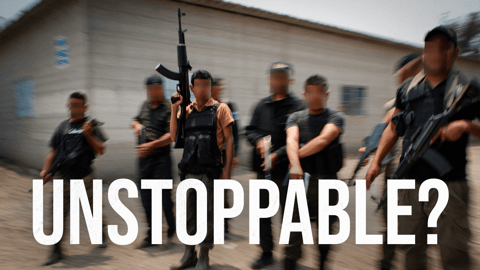
The first layer of cartel power that we have to consider is the hard stuff, the guns, explosives and tactics that allow Mexico's cartels to wage war against each other, local and state governments, and Los Federales all at once. I feel very cool saying Los Federales for some reason.
And when it comes to the question of armament, most Mexican cartels rely on the same foundational principle – buy everything that you can get your hands on.
In today's Mexico, it's a base assumption that cartel soldiers have automatic rifles, hand grenades, side arms, body armor, and small explosive or incendiary devices at their disposal. Not all of them will have that gear, of course.
It's just as common to see some poor kid from the slums trying to appease his local bosses in a t-shirt and sandals, waving around an empty revolver as it's ever been.
But the sheer volume of proper, highly lethal firearms at the cartel's disposal is stunning.
Hundreds of thousands of firearms have streamed into Mexico over the years, largely from the United States, where buyers can peruse gun shops at their leisure before smuggling weapons southward, taking advantage of pathways that are much more heavily monitored to find a flow of drugs moving in the opposite direction.
Estimates on the number of guns moving across the border range from 200,000 on the low end to almost 600,000 every year, with a high and growing proportion of that being rifles.
But that's just the light armament at the cartel's disposal. Today, cartels routinely call upon heavy-caliber machine guns, often mounted on trucks that are then up-armored in custom jobs to afford them a level of survivability in combat.
Cartels have had access to rudimentary air defenses, including rocket-propelled grenades, for years, first shooting down a military helicopter in 2015.
They're known to have dedicated anti-aircraft guns at their disposal, night vision goggles, belt-feeding mechanisms to get the most out of their machine guns, and accessories like holographic sights to increase the effectiveness of their rifles.
They've proven increasingly talented at designing and building so-called narco tanks, trucks or tractors that have been modified far past the point of recognition with steel plating, gun turrets, and other hardware that makes them lethal in a fight.
These narco tanks, especially the ones owned by the CJNG, are evolving rapidly, with 360-degree CCTV to control mounted guns, lightweight armoring that relies on new steel alloys, and the internal space to carry handfuls of fighters.
They're also learning how to use consumer-grade drone technologies with stunning efficacy.
The U.S. reported in mid-2025 that over the first six months of the year, cartels had flown drones along the way. along the U.S. border on 60,000 separate occasions, while in Mexico the first use of drones to drop explosives and kill soldiers was reported in August of 2024.
As for personnel, it's very difficult to get a read on just how many people a given cartel could call upon to serve as their foot soldiers, but at the very least, it's safe to say that altogether Mexico's cartels can call on many tens of thousands of gunmen.
The biggest of the cartels, Sinaloa, CJNG, and the like might have upwards of 10,000 fighters each, although the quality of those fighters can be wildly divergent.
On the high end, cartels are increasingly able to call on the support of mercenary ex-soldiers from Colombia, deserters from the Mexican armed forces, and at times paid soldiers of fortune from other parts of Latin America.
Several of the large cartels are known to have elite units at their disposal, fighting in small units with the precision and capability of a modern military, with full body armor and heavily modified firearms at their disposal.
Insider reports suggest the presence of former American special operators, including Navy SEALs and even Delta operatives, at cartel training camps, relaying precise tactics to cartel fighters who will put those techniques to use against government forces.
According to Kyiv, Mexican cartel members have even showed up in support of Ukraine in its war against Russia, joining the Ukrainian military so that they can be trained as drone operators, and then bring that knowledge back to serve their own syndicates.
Altogether, the cartels appear to be developing tactical capabilities that would put them on par with small national militaries, with everything from heavily armored vehicles, to anti-aircraft systems, to advanced small unit operators, to modern FPV drone technology at their disposal.
Not only that, but each of the cartels, no matter their internal divisions, appear to agree on the general outline of a common winning strategy, occasional high-powered local offensives relying on concentrations of fighters and vehicles, while mostly maintaining a reactive, highly-guarded posture that makes it difficult for their rivals or the Mexican
Military to sneak up on them.
Mexico's government has done its best to respond, with President Claudia Scheinbaum working to overhaul the mostly unsuccessful hugs-not-bullets policies of her predecessor and creating new elite units to battle the cartels in targeted assaults.
But in a broad sense, Mexico isn't even close to undertaking large-scale, well-coordinated operations to push the cartels off the territory they control, and if they were to try, they'd likely be condemning hundreds or even thousands of their own troops to an early demise.
While the cartels do not agree on much, they certainly agree about the manner in which they would prefer to respond to the federal government, with an overwhelming, all-out, bloodthirsty armed response if they are attacked on their own turf or in contested areas.
The cartels are not going to ally together and overthrow Scheinbaum any time soon, but they've made themselves into an immensely effective porcupine across much of the country, too dangerous for them to risk Mexico unifying. Take Antique Sensei.
I mean, in a fight against a government offensive after the question of arms conflict there's the question of cartel influence seeping into the mexican government at the state and federal level the true level of influence that the cartels have at their disposal is a matter of some debate but at a minimum they are deeply enmeshed in systems of political
Governance and state control just like their capabilities on the battlefield the cartels are learning quickly in the realm of national politics and for the nation and its people that's a hell of a bad omen of course the cartels are just as happy as ever to show up and start playing their greatest hits targeted assassination and outright bribery for many
Years cartel sicarios hitmen have been more than happy to deliver a nine millimeter reminder to the back of the head for politicians who forget to account for the cartels interests or try to make a name for themselves off an over enthusiastic approach to curtailing their power promising candidates across mexico have targets on their backs just as much today
As ever with those who talk the biggest game about dealing with the cartels directly also being the least likely to actually live until election day it's entirely common for political scandals to implicate important state or national figures either in politics or in civil administration for having accepted large chunks of cash in order to implement programs
That help the cartels assist the cartels in siphoning off money or information or otherwise make themselves an accomplice to cartel activity paying off a state or federal official to look the other way on drug smuggling routes ignore a shipment of weapons or ammunition or conveniently forget a piece of sensitive information is typically much less expensive
Than having to do things the hard way at the same time the cartels have chosen to step up their overt involvement in mexico's most recent round of nationwide elections when those elections took place in 2024 ultimately elevating claudia scheinbaum to the presidency the cartels engaged in unprecedented levels of political violence they strafed the campaign
Rallies of disfavored candidates with automatic weapons they burned ballots and instructed local residents on who to vote for and they even engaged in propaganda efforts to throw their open or thinly veiled support behind the candidates that they like best during the course of the campaign season over 30 candidates were killed in targeted attacks nearly all
Of them running in mayoral races because of the pressure from gangs nearly 200 polling places across the country had to be closed for security reasons still a small fraction of the overall total but a troubling figure nonetheless nor is that the full extent of the methods the cartels use to assert control over politicians and the political system itself
Anti-cartel candidates who survive election season are not safe with a national track record of those new officials being killed or disappeared just before or just after they take office others are liable to be approached by the cartels to find out exactly what the required price point would be to purchase their support those who set a price too high or
Refuse to cooperate are in great danger and even those who aren't killed outright are likely to suffer repeated threats and acts of intimidation at the same time the cartels have learned and to manipulate campaign finance systems, using cooperative voters or their own members to swell the coffers of their preferred candidates with legal donations, using
Money provided through illegal means.
The Sinaloa and CJNG cartels are, unsurprisingly, the most active in their political meddling at the federal and state level, where, given the extent of territory and population that they control, they have the greatest incentive to get active.
After recent reforms from the shine-bound government, the corruption problems may only get worse, with Mexican citizens now expected to directly elect hundreds of federal and local judges as well as their Supreme Court, rather than having judges appointed by the government.
The initiative was framed as a move to reduce crime and criminal influence across Mexico ahead of the first implementation of the system in June of this year, but in reality, the system comes with a massive potential for abuse.
With citizens electing their judges directly, elections in cartel-controlled or disputed areas are now just as likely to be influenced or manipulated as any other election. Already in 2025, several nominees had ties to organized crime, but with more time to prepare, it's likely that the problem will be far worse in the next set of judicial elections in 2027.
Also under the shine-bound government, the cascade of narco-corruption scandals has only continued.
Most recently, as of the time of writing, shine-bound is facing intense public backlash after two officials in Tabasco State, a secretary of security and the chief of the state police, have gone on the run after being accused of leading a criminal drug trafficking enterprise.
Those two officials were tied to a prominent senator in shine-bound's own political party, Adán Augusto López Hernández, and although shine-bound and political allies have come to his support, they've done so at great political cost.
The scandal has become just the latest reason to accuse Mexico's political elite of systematic corruption, widespread collaboration with the cartels, and an absolute refusal to face accountability.
Shine-bound has been under pressure from the U.S. Trump administration for months, urged to investigate and prosecute politicians with links to organized crime, with the potential punishment for non-compliance being the start of targeted U.S. military operations south of the border.
And finally, there's the power of the cartels on the local level, where the reality on the ground sometimes matches up with popular conceptions of brutal criminal gangs coming after innocent communities, but not always.
In truth, many of Mexico's cartels have mastered the same technique that authoritarian regimes, separatist movements, and even jihadist insurgencies have used to gain compliance from local populations. Fix things, and people like you.
Mexican cartels have invested significant resources to bring new amenities to the places they control, from new or improved schools, to well-stocked medical clinics, to food distribution programs that help the most vulnerable parts of the population.
Under cartel authority, communities have often seen their roads fixed or paved for the first time, their poor sanitation systems overhauled, and their electrical grids upgraded and maintained, to say nothing of the spread of internet connectivity that people in those zones frequently experience. the internet, but I'm not waiting for them to tell them.
Let me know your questions. That's what I'm going to see.
Have a little bit of this warning, I'm going to listen to my comments. Everyone's going to see you, and I'm going to see you guys Cartels also serve as arbiters of local disputes, mostly to keep the peace between civilian populations, but sometimes to keep communities safe, even from their own people.
In one video that went viral in January of 2024, a group of indigenous women dressed in masks issued a public plea to the CJNG cartel asking them to kill a local boss who had been engaged in egregious violence against the local community.
There was no corresponding plea to the Mexican government. And although the cartels play a significant role in state-level and federal Mexican politics, they exercise the greatest degree of control on the local level.
A cartel that can ensure their favored mayoral candidate takes office can work out lucrative contracts through shell corporations to siphon away a share of municipal budgets.
A cartel that can choose a local police chief can operate with impunity and even the protection of uniformed officers. A cartel that controls a city's financial manager can collaborate to construct elaborate laundering schemes that would slip past anything less than a full, diligent audit from federal authorities.
And when the cartels come to local communities looking to coerce voters, they often have a very easy time getting that done.
The food distribution projects, the medical programs, and the infrastructure repairs that we mentioned earlier are often seen as a worthwhile trade-off for citizens who are asked to support the cartels favored candidates each election cycle.
After all, it's not as if those same programs and local improvements would have happened if non-cartel-affiliated local politicians gained control and brought their towns back to an underwhelming status quo. The cartels' attention doesn't stop with individual private citizens either.
Instead, they're well aware of the financial returns that come from extorting, blackmailing, and forcing partnerships with legitimate businesses, including everyone from the Papusa seller on the street corner to massive multinational conglomerates that operate in cartel territory. I mean, allegedly, of course.
Many businesses are forced to enter the classic coercive relationship with local organized criminals, the protection arrangement, paying steep fees in order to, in theory, protect themselves from the dangers of the outside world, which are, in turn, delivered onto businesses that don't cooperate or don't make their payments by the cartels themselves.
Businesses that deal in hard products are more likely to attract cartel attention, whether they're farms growing crops, textile manufacturers making clothes, or even hotels and resorts drawing in tourists.
Companies that deal in oil and fuel, including local gas stations, can face some of the greatest risk of all, with their products stolen and resold by the cartels on a whim. And whatever the cartels can do to businesses, they can do to people.
The quality of life in cartel-controlled areas can be stark, comparing areas under the supervision of relatively lenient community-minded cartel bosses against those under the supervision of some truly bloodthirsty actors.
Depending on the cartel and the local boss they live under, ordinary civilians can be forced to give protection money, they can be expelled from their homes at gunpoint, they can be robbed, beaten, and if they become inconvenienced or happen to be in the wrong place at the wrong time, they can be killed.
How old are they had a safety祖nan gia If that attacked achmaler?
How old are they? How old are they? How old are they?
How old are they were told? What else were exactly whatnasios 230 people would say? How old are they?
They, or their family members, or even their children, can be forced into all manner of illicit enterprise, working as anything from drug mules, to prostitutes, to patsies meant to take the fall for the cartel's actions.
Impoverished communities, or rural communities far from help, are among the most vulnerable, especially when poverty and distance from state structures coincide with poor education and a lack of opportunity.
In those places especially, cooperation with the cartel isn't just a matter of life and death, it can be the only real path with even a slight chance that it could lead to something better.
Although cartels can and will invest in social and infrastructural programs to better the circumstances of the people who live under their rule, they will also mete out the harshest possible forms of violence when ordinary people dare to cross their paths.
Take a horrific discovery in March of this year, when activists uncovered a ranch in a rural zone outside Guadalajara that was practically overrun with human remains, ashes, purported homemade crematoriums, and hundreds of shoes and backpacks.
Although the Mexican government has indicated that the site was a training facility where people who resisted recruiting into the CJNG cartel were tortured and executed, activists and some experts have insisted that it was an extermination camp where hundreds or even thousands of people were killed in the most brutal ways possible.
The fact that the Mexican public found the idea of a death camp in Jalisco so plausible should hardly be surprising.
Over 124,000 people in Mexico are currently listed as missing, and the vast majority of them are believed to have been intentionally disappeared by the cartels, with their remains probably somewhere in mass graves or at the bottom of lakes or rivers, or simply burned to ash. So how powerful are Mexico's cartels?
Well, really that depends on where you are and who you are. If you're one of millions of ordinary people living in areas firmly under government control, not involved with any business or travel that would bring you into contact with them, then they're practically aliens from another world.
But if you live in the areas that the cartels control, they aren't just powerful.
They are everything. Whatever power the cartels have, we can say with some certainty in 2025 that their power is growing, their criminal enterprises are thriving, and they're adapting quicker than the Mexican state or its international partners have any chance of keeping up with. Thank you.
Thank you for watching.
Unlock premium video briefings
Members get full access to premium reporting, in-depth briefings, and subscriber-only analysis.
Insiders Receive
- Full access to all premium articles and briefings
- Exclusive subscriber-only analysis and dispatches
- Support independent conflict journalism
From $5/month — cancel anytime