
In a War Against China...Where Does Australia Belong?
Simon Whistler • July 15, 2026
Members only
Note: this transcript was generated by AI and may contain errors or inconsistencies.
If Australia goes to war in the next decade, then it will fight for the future of Taiwan. Like every other staunch US ally in the Indo-Pacific, from Japan to South Korea to the Philippines to Vietnam, Australia is all too aware of the new superpower on its doorstep.
China wields the economic power, the military might, and the geopolitical ambition to threaten the entire region one day if only it can deal with Taiwanese de facto sovereignty.
For Australia, Taiwan is about more than Beijing's pride. The island is a linchpin for regional trade, a vital technological asset, and an expression of the geopolitical world order that Australia wants to be a part of. But if the world were to go to war over the future of Taiwan, where would Australia fit in?
Would the nation have anything to offer, or would it be as much of a drag on its regional allies as the worst NATO spenders would be in Europe? Australia has the technology, the weapons systems, and the fighting history to suggest that it could stand up for itself, but the people of China outnumber the people of Australia 50 to 1.
Perhaps Australia is just too far away and too underpowered to play a significant role in a modern conflict.
So if China makes a move against Taiwan, and Australia's moment of truth arrives, what happens next? A Pragmatic Outlook Like most American allies across the globe, Australia fell into a well-known trap around the end of the Cold War. With the Soviet Union defeated, the global era of major conflict was thought to be over.
Militaries could shrink, defense budgets could be shifted toward higher priorities, and countries like Australia, with no natural geopolitical predators in their immediate vicinity, could rest easy.
But to Australia's credit, the nation has been among the most proactive in Washington's orbit once it became clear that the world wasn't so stable as the prior generation had hoped.
Today, Australia is pushing forward on the largest peacetime defense spending increase in its military history, and the country is expected to reach a full 3% of GDP spent on defense by 2033.
That spending is manifesting itself in new and meaningful ways. Well, over a dozen major warships incoming to Australian arsenals, plus massive investments in nuclear-powered submarines, undersea drones, and long-range missiles.
The country is revamping its air defenses, increasing its overall number of troops, and becoming a real competitor on the high-tech side of the defense industry.
But look a little closer, and the picture gets a bit more complicated. For the nation's size, both in terms of its population and its geography, its military remains quite small, just under 60,000 active duty personnel, set to expand to around 70,000 before 2035.
At its closest point, the Australian mainland is located more than 7,000 kilometers from the Chinese mainland, in a part of the world where nations that are relatively close to each other are still quite distant in absolute terms.
Worse yet, you need only give a moment of scrutiny to Australia's defense spending numbers for the maths to start falling apart. Australia's 3% target by 2033 accounts for all sorts of spending that's included in the NATO member standard, like military pensions, but that doesn't actually reflect an investment in the active duty force.
If we're only looking at relevant military investment, then even by 2033, Australia will spend just around 2% of its GDP on defense instead of the 3% figure. points of attention.
Theιαe karting and retrojudging, does not agree with that workforce?
ItContent. that canberra prefers what australia does have however is a clear strategic focus while the nearby nation of papua new guinea and indonesian papua are on the other half of the same island each home to low intensity self-contained conflicts australia otherwise enjoys a remarkably stable region to the north malaysia indonesia the philippines and
Singapore form a nice barrier between australia and the states of continental southeast asia even there marma's civil war and the recent hostilities between thailand and cambodia have each had precious little bearing on australia itself to the east lies new zealand country with neither the will to engage in hostilities of any kind nor a military that's
Capable of well anything really scattered around australia's periphery are island nations like fiji tonga vanuatu and others countries that australia would likely protect if ever it were necessary but countries that have no intention of going to war with anybody in the next century or more to the west lies the vast mostly empty indian ocean and to the south
Lies antarctica where if there's ever an active conflict in the future it'll only be after the ice caps melt and the world's equatorial population decides to relocate the overall security of the region means that australia can focus fully on the threat that china presents as a world power with both the means and the ambition to become a global hegemon here
We should at least acknowledge the differences between china and other recent superpowers china historically prefers to avoid open warfare at all costs and certainly isn't threatening to conquer australia at least in the near future instead china presents a near-term threat to australia in three interrelated areas first beijing is quickly expanding its
Long-range strike arsenal including land-based submarine and strategic bomber assets with the potential to reach australian territory second china possesses the naval and air power to interrupt the global system that australia depends on by cutting off australia's maritime trade routes attacking undersea telecommunications cables targeting australian or
Related digital infrastructure and more third there's the risk that china would attack taiwan thus creating the point of strategic friction that would prompt china to deploy long-range weapons or attack australian interests australians are clear-eyed about the risks that china would pose to their country in the event that a taiwan war did break out publicly
Canberra opposes any attempt to change the status quo over taiwan and given its close relationship with the united states it's highly likely that if america goes to war over taiwan then so does australia in a poll by the laoi institute in june 2026 some 57 of australians listed a u.s china war over taiwan as a quote critical threat to australia itself and 60
Said that if the united states were to deploy its navy to prevent china from blockading taiwan then the australian navy should join in that's despite australians fracturing trust in the united states where according to the same poll barely 30 of the country regards the u.s as a responsible global actor for the record that's two points higher than the rating
China received on the same scale where even though its numbers are still quite dismal china is at least gaining in trust from the australian public while the u.s is losing out as for donald trump and xi jinping themselves australians were in agreement only about 20 believed that they could trust each man to do the right thing on the world stage so despite
Low trust for the united states and a worsening view of the world that seems to reflect a real cynicism about both of the world's preeminent powers australians remain united on the likelihood and the importance of a conflict over taiwan as the author of the aforementioned poll charles lyon jones puts it australians are quite pragmatic about the geopolitical
Environment our country faces recently australian leaders have taken care to reiterate that they do not commit to a defense of taiwan but it's worth emphasizing here that they're essentially mirroring america's strategic posture on the issue despite the high likelihood that both countries would take action if china were to actually invade australia's
Enduring and immensely favorable view of japan also helps matters as japanese prime minister sinei takaichi leads her nation into a much more confrontational posture against chinese ambition but understanding how australia thinks about the taiwan war is just one part of the puzzle just as important is the question of what australia could actually do if their
War broke out in the near future high value low volume as we've already mentioned the australian defense force is far from the largest military on earth with only about 59 000 active duty personnel and another 33 000 reservists compared to other wealthy comfortable nations located in geo strategically isolated regions with few or no nearby threats australia
Actually does all right its military makes up a larger proportion of the overall population than it does in britain brazil canada or spain but those countries aren't exactly role models in the world of defense and indo-pacific defense experts broadly agree that the australian military remains undersized and underfunded compared to what the nation would need
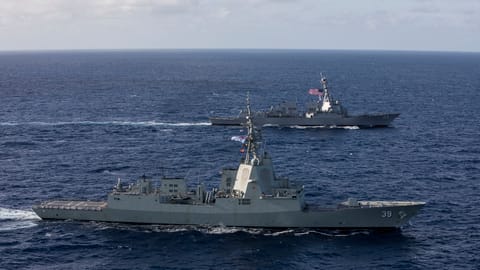
If it were really serious about defense as for what australia is currently working with its arsenal is undeniably high-tech even if the sheer numbers might leave something to be desired canberra sales three dedicated destroyers optimized for warfare against aerial targets a fleet of six diesel electric submarines seven frigates and a pair of amphibious
Helicopter carriers that could conceivably be used to launch f-35b stealth fighters australia doesn't have any active plans to incorporate f-35bs onto those ships currently however but as mentioned before it will be acquiring 11 new frigates to replace its current fleet of seven plus another six heavy frigates and a fleet of five nuclear-powered submarines
Built under the orcas program with america in the uk australia will soon acquire a trio of virginia-class submarines as a stopgap from the united states with the first submarine set for delivery in 2033 canberra is well on its way to building an autonomous and optionally manned surface fleet including the underwater ghost shark by anduril and the so-called
Large optionally crewed surface vessel developed alongside the u.s navy in the air australia flies a very high-tech combat arsenal surface vessel including 72 f-35s so 5As, along with 24 twin-seat copies of the F-A-18F.
Soon those F-35s will fly alongside unmanned loyal wingman craft, specifically the MQ-28A, a Boeing Australia project known as the Ghost Bat.
As speaking to Boeing Australia, the corporation has also provided Australia with substantial command and control capabilities via the E-7 Wedgetail, a highly successful design with a full six copies in Australian service.
The nation also flies six air-to-air refuelers, not counting a model set aside for VIP transport duties, plus a full squadron of EA-18 electronic warfare jets. Over the water, Australia flies 14 copies of the P-8 Poseidon, an anti-submarine aircraft that can fire a wide variety of missiles, bombs, and torpedoes while flying at long range.
But where the Australian military starts to run into real weaknesses is in its ability to project power past its own territory. Those 72 F-35As, for example, are highly formidable in a fight, but Australia has only a fraction of the air-to-air refueling capability it would need to get even those aircraft into the vicinity of a Taiwan conflict.
At best, if Australia had to react quickly to a Chinese invasion, it might manage to ferry a handful of those jets toward a combat zone so they can poke at the fringes of an overwhelming mass of Chinese air power.
If Australia did want to contribute a more substantial force to a China conflict, then its air power would have to be deployed to foreign soil well in advance.
Canberra could make that threat if China were engaged in a long, obvious military buildup on its coast, but in the event of a surprise attack, Australia simply won't have the opportunity to make itself relevant. Australia's naval capabilities are not much better.
At any given time, the country might have two destroyers and four frigates in deployable shape, along with just one of its two helicopter landing craft. Its submarines are badly limited in range, and whether on the surface or undersea, new Australian capabilities won't start coming online until the early 2030s, even without any further procurement delays.
And you'll notice that we haven't even discussed Australia's land army, where to its credit, the nation fields roughly 28,000 active duty soldiers, just short of 50 main battle tanks, nearly 300 infantry fighting vehicles, and a handful of artillery pieces, multiple rocket launchers, air defense systems, and attack helicopters.
But we haven't paid the Australian army the attention it deserves, because it can't get anywhere.
The nation lacks any real sea lift capability at the distances required to support Taiwan, and while its eight American-made C-17 strategic airlifters are great for long-range transport, there are far too few of them to transport a meaningful force within a limited span of time.
Like so many other American allies, Australia relies predominantly on the United States to fill those gaps, whether in terms of airlift, sealift, or air-to-air refueling.
But as the United States' recent war in Iran has demonstrated, the nation struggles to meet the logistical requirements of a large-scale conflict halfway across the globe, while still setting aside capacity to support any other operations.
In the event of a Chinese attack on Taiwan, where the United States did choose to intervene, Washington's primary task would be to get in China's way as quickly as possible, with as significant a fighting force as possible. getting to Australia to pick up what other forces Australia can provide, just wouldn't be a major priority.
Nor does Australia's membership in international partnerships confer any real advantages in the event of a regional war.
Australia's place in the trilateral AUKUS partnership is quite important from a military-industrial and geostrategic perspective, but it's largely focused on the development and procurement of technologies that won't be ready for a few more years at least.
The Five Eyes intelligence sharing program with America, Britain, Canada and New Zealand is immensely valuable in terms of global surveillance and information gathering, but beyond its ability to alert Australia of an impending conflict, Five Eyes doesn't have very much bearing on the course of an active military conflict.
From its membership in the Quad to its Five Power Defense arrangement, Australia is part of enough geostrategic frameworks to know who its friends are, especially with its strategic bilateral partnerships alongside the United States, Japan and India.
But in the event that Australia is a single player in a conflict happening elsewhere instead of a nation coming under direct attack, the nation will face real barriers in turning its on-paper military capabilities into a practical asset.
Australia to the rescue On the basis of Australia's limited strategic capabilities, we can rule out the idea that Canberra would be especially relevant in a head-to-head confrontation with China over Taiwan, but only under specific circumstances.
If China were to take action against Taiwan, it would have bigger problems to address than the risk that Australia could insert itself into the conflict.
But if China did want to make Australia into as much of a non-factor as possible, its best bet would be a surprise attack. The less time Australia has at its disposal to move its military into position ahead of a Chinese invasion, the better for Beijing.
In a worst case scenario, where a Chinese attack could be open and shut within the span of a few days, Australia might succeed in harassing Chinese airpower from the south using a handful of stealth fighters, but nothing more.
If Australia does have time, however, then the country quickly starts becoming relevant, starting with its ability to project naval power. A war over Taiwan would of course be primarily concentrated around the island itself, but it's a war that would rapidly expand outward, especially into the dimension of trade and commerce.
Among the financial weapons at Australia's disposal are sanctions, which Canberra would probably leverage rather quickly as part of a worldwide effort to punish the Chinese economy.
But Australia can also use its naval fleet to enforce a blockade against China, especially by sailing as quickly as possible toward the Strait of Malacca. A critical maritime trade route, the Strait of Malacca is responsible for roughly 80% of China's crude oil imports and over half of its total maritime trade volume.
The Strait is very narrow, passing through waters where Indonesia, Singapore and Malaysia can all exert direct control thousands of kilometers away from China's biggest seaports.
All of the nearby alternatives are in Indonesian waters, and many of them are too shallow or aren't developed enough to allow the biggest maritime trade vessels to pass through. In the event of a regional conflict, Australia could deploy ships to the Strait a lot quicker than it could deploy to Taiwan directly.
Nebraska- the role those three southeast asian nations and especially indonesia in a regional war is a matter of substantial and ongoing debate most likely indonesia would keep to its strict policy of maritime neutrality protecting its own borders and waterways while trying not to take a side in the conflict but australian naval power could improve the
Situation in and around the strait in one of a few ways say that indonesia were to take a passively neutral posture in the conflict truly not lifting a finger in either direction in that case australia could send its ships northwest from its own territory through the indian ocean around indonesia to the waters just south of the andaman sea there even a
Handful of australian ships could be a major asset to american forces probably deploying from the middle east or the island base at diego garcia depending on how the conflict goes they might enjoy additional support from thailand or even india blockading the international waters that lead into the strait of malacca rather than barricading the trade itself if
Instead indonesia were to choose to enforce its neutrality more actively then that would present australia with a real strategic opportunity because of its trade and economic dependence on china indonesia is unlikely to refuse passage to vessels supporting china without also restricting other trade but if indonesia does want to support taiwan the us japan
India south korea and other indo-pacific partners against china while maintaining some plausible deniability and hedging its ability to maintain decent relations with china in the future then indonesia could conceivably shut down the strait completely nobody goes in or out regardless of who or what they're supplying if indonesia were to take that route and
Perhaps draw upon the support of malaysia and singapore in an act of pure regional stabilization then australia might choose to sit out the main conflict around taiwan and lend its support to indonesia instead the two countries share a comprehensive strategic partnership indonesia would likely welcome australian support to protect its sovereignty and because
Of the ability to hop across indonesia's island geography australia would have a much easier time getting its combat aircraft and warships to the strait in comparison to the difficulty of getting them to taiwan it would of course be a rather underhanded trick of international diplomacy allowing indonesia to take a side in the conflict by cutting off vital
Chinese trade without actually taking a side at all but australia is uniquely well positioned to help indonesia make that choice without putting its own military at risk in a direct confrontation as an alternative australia could also make a major impact on a taiwan conflict in the event that china opted against a surprise attack and instead chose to engage
In an overt obvious military build-up beijing's strategic rationale in that case would be easy enough to work out by massing an overwhelming concentration of force within striking distance of taiwan china would be attempting to demonstrate that the outcome of a war is a foregone conclusion the nearest american forces are in okinawa and for now the
Philippines while taiwan lacks the air defenses to withstand what would be a combined barrage of long-range missiles naval vessels air power and tens or even hundreds of thousands of long-range drones leveraging china's sheer industrial real might.
The message that China would be trying to send is a simple one, that it wouldn't even be worth Washington trying to get in the way because China would be overwhelmed and defeated before the US could even break through.
With the current administration in Washington, China might believe that it has a real chance of success given Russia's ability to dissuade Washington from giving its full support to Ukraine since early 2025.
But in the event that China were to start massing its forces, Australia, along with Japan, South Korea, and a couple of other close US allies in the region might be able to use the inverse of that very same strategy.
With time, Australia stands a better chance of building up its forces in the region between its combat and command aircraft, its ships, and perhaps even a small land-based complement.
Those forces could gather on the territory of, say, the Philippines, not on Taiwan itself, but close enough that they could either intervene or draw Chinese fire in a preemptive strike. To the north, Japan and South Korea are each capable of the same, moving enough of their military assets into the area that China just cannot afford to ignore them.
Australia would certainly face intense pressure from China in response, probably including serious cyber attacks, economic coercion, disinformation campaigns, and quite possibly the testing of long-range missiles or the deployment of a naval strike force to threaten the Australian mainland.
But that, in turn, may simply underscore the importance of opposing China around Taiwan, while Australia and its allies still have the chance. Those forces wouldn't be enough to deter China, but they would be enough to signal that these nations are okay with being dragged into the conflict, and that puts the United States in a tough position.
Despite all the arms sales, despite all the diplomatic support, and despite all the other informal U.S. commitments that have, practically speaking, guaranteed that Washington would come to Taiwan's aid, there's still just enough wiggle room for the White House to try and dodge a Pacific conflict, especially if China made it easy for the U.S. to point to the
Strategic balance around Taiwan and claim that U.S. intervention just wouldn't make a difference anyway.
But it's one thing for the U.S. to skip out on Taiwan, and quite another for the U.S. to watch China engage militarily with several vital Indo-Pacific allies at once—Australia, Japan, South Korea, the Philippines, and perhaps Vietnam, Thailand, Singapore, or others.
Unlike Taiwan, those are formal strategic partners that America just cannot justify backing away from, and if China were to attack them directly, then the U.S. would have little choice but to intervene.
So, Australia and its regional allies transformed themselves into a geo-strategic tripwire, making it impossible for America not to intervene, and thus making it impossible for China to count on a war where America does not get involved. 10 or 20 years from now, Australia might be a much more important strategic player in the Indo-Pacific than it is today.
The Australian military is expanding, and its capabilities and global reach are being enhanced. For now, though, Australia's place in a war against China remains highly circumstantial.
Given time, Australia's relatively small fighting force can make an outsized impact, even in Australia. of malacca or in taiwan's immediate vicinity in the event of a chinese surprise attack however australia risks being left behind an outcome that would almost certainly save australian lives but that might clear the way for more devastating battles in the
Decades ahead thank you for watching
Unlock premium video briefings
Members get full access to premium reporting, in-depth briefings, and subscriber-only analysis.
Insiders Receive
- Full access to all premium articles and briefings
- Exclusive subscriber-only analysis and dispatches
- Support independent conflict journalism
From $5/month — cancel anytime