
India's Endless Insurgencies.
India's Endless Insurgencies — a Fronts video briefing on China & Indo-Pacific.
Simon Whistler • December 17, 2025
Members only
Note: this transcript was generated by AI and may contain errors or inconsistencies.
Every country on Earth has its dissidents. And as the world's most populous nation, it should be no surprise that India has plenty of them.
From Narendra Modi's political opposition, to the country's Muslim and Sikh minority groups, to the many disenfranchised ethnic groups that call India home, there are no shortage of people with their bone to pick with New Delhi, all with their own arguments, their own injuries, and their own idea of what a better future might be.
But, as modern-day observers of India already know, the idea that the country would host dissidents at all, even the vast majority who work to peacefully advocate their discontent, is a bit of a sore subject for Modi and his inner circle.
India is not a place where dissent is impossible, like North Korea or Russia, but it's often a place where dissident ideas are often seen as being dangerous, and the dissident ideas that lead to insurgencies are the very worst of all.
There are nearly one and a half billion people in India today, and only a minuscule proportion of those people are part of any active, ongoing insurgency, but in a nation that large, even a tiny percentage of the population will comprise enough people to do real damage and spawn many insurgencies at once.
Those insurgent groups aren't something that India likes to talk about, and most of the time they don't make global headlines. But they are out there, all across the nation, plotting and carrying out acts of destabilization that break through the cool facade of control that Modi cultivates. Because make no mistake, India is still a nation at war with itself.
So, well, this is who India is fighting, and what they're fighting for. Now, before we get into the range of insurgent groups that we will be discussing today, we've got to give a quick acknowledgement to the ones that we won't be discussing.
There are a truly massive number of rebel groups and separatist factions that have risen and fallen across India since the nation gained independence, including many of them that have since agreed to peace deals, died out, or just slowly faded into obsolescence.
For the purposes of the episode today, we're only going to be covering insurgencies that are still active today with at least a few hundred suspected members and a history of militant activity within the last five years.
So historically important organizations like the Babakalsa, the Kampapur Liberation Organization, or the many historical separatist movements that have agreed to peace deals in the north-eastern state of Estam won't be part of our discussion today.
As we write this episode, in the waning days of 2025, the clear best place to start our breakdown is in the disputed region of Kashmir.
It's a land at the very heart of the decades-long animosity between India and Pakistan, claimed by both nations and divided along a de facto border called the Line of Control. The region is home to insurgent groups that target India and other groups that target Pakistan, with both capitals accusing the other of funding the respective attacks against them.
In general, the stated motivations of Kashmir resistance groups are separatist in nature, with some groups seeking to break out from the control of the country. one nation and join the other, while some advocate for the establishment of a sovereign nation.
In a practical sense, the presence of murky finance and support networks and the very active intelligence agencies of both India and Pakistan can often make the truth of things difficult to pass.
In India's case, former Pakistani officials have admitted to supporting Kashmiri separatist groups in the past, although Islamabad officially denies any connection with their activities today.
Kashmir is host to a wide array of rebel factions, but broadly speaking, the ones that India has to worry about most are the ones that fall into two umbrella groups, Lashkar-e-Taiba and Jaish-e-Mohammed.
Each of these organizations is less a unified rebel paramilitary and more a collection of smaller, ideologically aligned groups that intermittently coordinate with each other, but most of the time they tend to work towards the same operational goals. Both of them are jihadist organizations.
Both seek to merge the entire Kashmir region with Pakistan, and both of them were allegedly created and are allegedly guided today by Pakistan's Inter-Services Intelligence, or ISI, again allegedly.
Jaish-e-Mohammed is newer, and it has carried out more attacks in the 2020s, whereas Lashkar-e-Taiba is responsible for some of the most notorious attacks in Indian history, including the 2006 and 2008 attacks in Mumbai and the 2025 attack in the tourist town of Pahagam that led to the recent several-day conflict between India and Pakistan.
In their attacks, both Lashkar-e-Taiba and Jaish-e-Mohammed tend to engage in similar sorts of operations.
For the most part, their attacks tend to fall into two distinct groups, strikes in Kashmir itself, where they typically target military personnel, federal buildings, and other symbols of Indian state control, and strikes in the rest of India, where they're more willing to select civilian and highly symbolic targets.
Those aren't hard and fast rules. The 2025 attacks in Pahagam drew such an intense response from India because, among other reasons, it targeted Hindu tourists in a civilian area that was generally understood to be immune from the violence.
But the guidelines do generally hold true, and they provide insight into what exactly the two groups are trying to achieve.
By targeting symbols of state control in Kashmir, they clearly identify their intended target. The Indian federal government in New Delhi and its regional instruments of control, while ensuring that Kashmir residents, who the group would prefer to see integrated into Pakistan, would generally not think of these rebel groups as a threat.
Conversely, their attacks elsewhere are intended to pressure the Indian government by imposing both physical and political costs on the Indian population, making it harder for New Delhi to justify its Kashmir operations because of the threat that those operations pose to the well-being of ordinary people.
Tactically, both groups are known for their use of suicide bombers and large explosive devices, often directing those suicide bombers to operate in tandem with small groups of armed gunmen who can take advantage of the chaos and inflict mass casualties in the process.
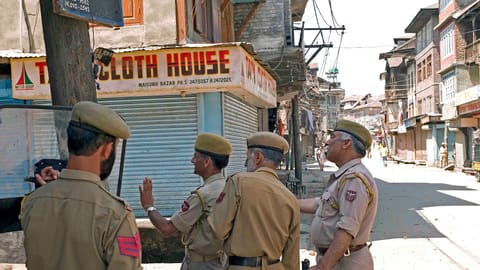
Over the last couple of decades, India has attempted to respond to the threat by locking down the Kashmir region, flooding it with military and law enforcement personnel in order to track and dismantle insurgent cells and respond to attacks quickly if they happen. Airstrikes are relatively commonplace, and military raids on small cells occur regularly.
On any given day in Kashmir, it's unlikely that either group or other insurgents in the region would stage an attack, and in a sense, that could be taken to mean that India's counterinsurgent operations are largely working.
When attacks do take place, however, they tend to result in considerable casualty figures, and in 2025, those attacks are coming with a growing frequency. India has blamed Pakistan for the rising violence, claiming that Islamabad and the ISI are ultimately responsible for the fact that these groups still exist and still have the capability to launch attacks.
If that is truly the case, however, then India's efforts in the intelligence sphere, in international diplomacy and in its Kashmir operations have not been enough to get Pakistan to disengage.
And while major attacks are not particularly frequent, smaller-scale incidents are very common, including the targeted killings of Hindus, skirmishers with soldiers around the line of control, and the intermittent use of improvised explosives. In the aftermath of the 2025 India-Pakistan clashes, the problems in Kashmir show no sign of ending anytime soon.
India launched mass crackdowns across Kashmir in the wake of the fighting, arresting thousands, beefing up its military presence, and seizing and destroying the assets of people believed to be connected with insurgent groups.
On the other side, however, the insurgents are still recruiting new fighters, including young people who are disenfranchised and disillusioned with India after the latest government actions. And while New Delhi has taken recent steps to be more efficient in its counter-insurgent actions, the rhetoric from Modi and his party have been clear for years.
They, understandably, would simply like all of this to be over. Their goal is to stamp out the remainder of these groups wherever they may be, and that cannot be fully achieved until they are wiped out entirely. But for the insurgents, and they are likely backers in Pakistan, allegedly, the mission is simple.
As long as some of them endure and go on to fight another day, India will continue to pour resources and lives into Kashmir, giving those insurgents all the targets they need in order to carry on the fight.
The Naxalite Maoist Insurgency Now, as frustrated as India clearly is with its intractable insurgent problem in Kashmir, its counter-insurgent efforts in other places appear poised to achieve victory.
The area in question is a stretch of inland territory in the country's eastern central region, primarily concentrated over the last few years into two pockets, a group of districts northeast of the city of Hyderabad and a group of districts including and surrounding the city of Ranchi.
These are the last remaining holdout zones for India's Naxalite Maoist insurgency, a scattered collection of groups that have been fighting against the Indian government since all the way back in 1967.
As such, they are among the oldest active insurgencies in the world today, led by the fighting wing of the Communist Party of India, the People's Liberation Guerrilla Army.
As their name and affiliation would suggest, the Naxals, named for the Naxabari village, Naxalate where their movement first started in 1967, and Maoists, communists influenced by China's Mao Zedong.
First, an organized peasant rebellion, the Naxalite insurgency draws most of its support from India's scheduled tribes, tribal groups whose ancestors were among the first people to inhabit the Indian subcontinent.
At the time that they took root against the tribal population, the Naxalites were trying to rally peasants from the tribes together in a war for the working class, particularly the rural working poor who, according to India's constitution, were essentially living as squatters on their own tribal lands because of India's emphasis on legal landowner rights.
Mired in poverty, deprived of electricity, running water sanitation services, and other basic services, those rural poor were generally open to hearing the Naxalites' message, especially when the Naxalites were able to organize at the community level and provide some of those services when the government failed to do so.
By the 1980s, the ideology was present all over India, with fighting groups engaging in the frequent kidnapping of landlords in order to extract concessions and repayments for ordinary people. India's government responded with force, terror attacks and massacres became more common, and by the early 2000s, the Naxalites were attacking all over India.
Over a thousand people died each year at the very peak of the insurgency in 2009 and 2010.
Fast forward by about 15 years, however, and the Naxalite insurgency is far from the asymmetric threat that it once was.
The 2010s were a very productive time for Indian counterinsurgent efforts, with tens of thousands of soldiers deployed to comb through impacted districts, identify and dismantle cells, and try to dissuade potential new recruits from joining the movement.
The Indian government helped itself along with a carrot-and-stick approach, so to speak, working to expand infrastructure and food programs and raise people out of poverty, thus eliminating possible incentives to join the group, while also restricting media, assembly, and other social factors that were seen as being potentially inflammatory or helping the
Naxalite cause.
Rebel attacks continued nonetheless, including major ambushes in which dozens of Indian security personnel might be killed, but the frequency of these attacks dropped sharply over time. The group's former senior leadership was slowly wiped out.
Indian troops got better at responding to ambushes and chasing down the offenders, and one by one, Indian districts and municipalities were taken off the list of impacted areas.
Perhaps most important of all, India was largely able to cut off the Naxalites' recruitment pipeline, convincing potential fighters that it was unwise or even against their interests to join the group, and offering programs to pull people back if they'd started to engage with the rebels, but weren't yet in too deep.
As a result, the Naxalites have grown older, on average, as the years have gone by, and many of the group's surviving members are now middle-aged or even elderly. That is to say, the sorts of people who you really wouldn't expect to be doing any fighting.
The group's tactics have changed to match, as the Naxalites now largely avoid attacks on security forces directly, especially their old mass ambushes, and instead rely on the use of explosives and other indirect violence.
They continue to apply pressure to local civilians, who are seen as collaborators. with the Indian government, partly because those locals are simply easier to target and will put up less of a fight.
But they aren't capable of the sort of attacks that they used to carry out regularly, and members of their communities, including young people from the same tribal groups that the Naxalites claim to represent, are no longer swayed by arguments that violent resistance is the best way to improve their collective lot in life.
In 2024, India began a series of counterinsurgent operations that may go down in history as the Naxalites' last gasp, a major campaign of eradication that's known as Operation Kagar.
The operation sent large-scale troop deployments into the few areas left where the Naxalites still maintain a presence, and it's focused specifically on militant hideouts, typically in secluded, forested areas where senior leadership have been able to hide out and avoid any real attention.
During their operations, Indian troops have taken to encircling those areas and using a combination of highly concentrated personnel and modern sensor technology to ensure that people can't escape the area without being detected and tracked.
In May of 2025, Indian troops shot and killed Nibbala Keshava Rao, who had been General Secretary of the Indian Communist Party since 2018 and who was believed to have coordinated or been involved in a vast majority of the major Maoist attacks in this part of India over the last decade and a half.
After his death, rebel casualties spiked dramatically, in a trend that's still ongoing today.
As of now, India's goal appears to be total victory, rather than a group surrender and any sort of amnesty arrangements, and with a number of remaining rebels now estimated to be in the low hundreds, it's unlikely that they'll be able to turn the tide back in their own favor.
The Khalistan Conflict From the Naxalites, we turn to a separatist insurgency in India's northern Punjab region known as the Khalistan movement. Unlike the Naxalites and the Kashmiri insurgencies, the insurgency in Punjab has largely died out today, although, as we'll explain, intermittent low-grade violence is not unheard of.
But it's also an insurgency that carries a very powerful legacy in India today, and its legacy has brought India into conflict with a range of world nations in the modern day.
The Khalistan movement advocates the idea of a sovereign state, known as Khalistan, that would sit on the historical homeland of India's Sikhs, followers of a religion, Sikhism, that accounts for about 24 million people in India, and roughly 3 to 7 million more around the world.
While the geographical placement of a sovereign Khalistan is the subject of some debate, it's generally understood to include most or all of the modern Indian state of Punjab, where Sikhs form a local majority.
This idea of a sovereign Sikh nation has been politically relevant in the modern day since the 1930s, but it was in the late 1970s and early 1980s that Sikh separatism spawned a large-scale insurgency.
Ultimately, that movement was quelled by the Indian police and military after an intense set of crackdowns helped along by infighting within the movement that compromised its fighting ability. Public support for the movement has largely disappeared across Punjab and many of the relevant Sikh separatists who survived the crackdowns relocated abroad.
But although the 21st century brought the end of the Punjab insurgents, it was not the end of the story for the Khalistan movement.
In the early 2000s, reports from international human rights groups levied damning allegations against Indian security forces claiming that India had engaged in the regular torture and summary execution of Sikhs, including civilians, and that family members of those targeted had even been forced to watch their torture in order to force a confession.
Indian forces were accused of carrying out massacres and modifying the scene after the fact to make deadly encounters look like there'd been gun battles. Those and other investigations have led to a reckoning within the Indian military and law enforcement apparatus.
And while for the most part, discontented Sikhs have not responded by advocating a return to organized insurgency, the actions of law enforcement have left deep wounds on the global Sikh population. And while attacks by Sikh separatists are now rare, they're not unheard of.
Social unrest bubbles up occasionally, descending into riots, threats and intimidation of public officials, and a return to confrontational rhetoric at times.
Small extremist cells have intermittently been brought down and accused of plotting attacks, and on occasion they've managed to set off explosives. At the same time, India has treated the international pro-Khalistan movement among the Sikh diaspora as an extension of the insurgent threat that Khalistan separatism posed during the 1980s.
In places like the UK, Canada, and the United States, officials have received overtures from New Delhi to crack down on pro-Khalistan protests and demonstrations, and to treat associated groups as a terror threat to India.
Indian intelligence services are known to keep a very close eye on pro-Khalistan organizations abroad, to the extent that their actions have resulted in multiple international incidents.
In the most prominent example, several Indian nationals shocked at a man by the name of Hadeep Singh Nijjar, who was, at the time of his death, a known pro-Khalistan activist.
But the killing took place in Canada, not India, and over the course of their investigation, Canadian law enforcement alleged that the Indian government had ordered Nijjar's assassination, citing, quote, "...irrefutable evidence in the case." Another Sikh activist, Sukhdul Singh, had been shot a few months afterward, and that death was also blamed on Indian
State actors in what became an extended diplomatic firestorm.
India also got into hot water with the United States in that same year, after Washington alleged that the Indian government had created a plot to assassinate a Sikh separatist living in New York. Internationally, pro-Khalistan activists do, at time, take part in acts that would seem to offer India confirmation of its deepest suspicions.
In 2023, weeks after Nijjar's death, pro-Khalistan crowds set the Indian consulate in the US city of San Francisco on fire, while in 2024, crowds in Toronto cheered the memory of a suicide bomber who had killed the Punjab region's former chief minister during a parade.
Every so often, more radical, pro-Khalistan political figures rise to prominence in the Sikh community and advocate a return to the use of violence against New Delhi. I'm sorry. As a result, the Indian government has been hesitant to accept the idea that Sikh extremism no longer poses a threat to New Delhi.
Instead, India's interpretation of the situation holds that it's because of India's actions and its continued efforts to repress and stamp out any talk of Sikh separatism in India itself that an insurgency hasn't resurfaced.
Nagaland, Manipur, and Arunachal Pradesh Finally, we've got to tackle the mess of asymmetric insurgencies that India deals with in its northeast in the collection of states that connect to the rest of the Indian mainland only through a small strip of territory around Bangladesh.
This is a highly ethnically diverse part of the country where the desire for collective sovereignty shared by several groups in the region combines with low representation in the Indian federal government, a pervasive state of underdevelopment, and a number of historical grievances all at once.
As a result, this part of India deals with several independent insurgencies, each attempting to break New Delhi's hold on the region. The most prominent of those insurgent groups represent India's Naga people, who live in the state of Nagaland, Arunachal Pradesh, and elsewhere.
They've been fighting the Indian government by way of various armed organizations since the 1950s, although by the end of that decade, the group had largely gone underground.
Battle changed in 2021 after an Indian army unit ambushed and killed 14 Naga and drew the outrage of the entire Naga population.
From that point forward, the Naga have been making clear that they're ready to resume the separatist fight, and while they haven't yet formalized their return to violent resistance, Naga cells are known to be active, stockpiling weapons and carrying out isolated attacks in this part of the country.
During 2023 and 2024, dozens of armed Naga militants were arrested by Indian law enforcement under varying circumstances, and firefights and killings by Naga separatists are becoming increasingly common.
Then there was the violence that rocked the northeastern state of Manipur for the last two and a half years as of the time of writing. In Manipur, the Indian government is actually a third party in the ongoing violence, deeply engaged, but not the primary target of most rival fighting factions.
Instead, Manipur hosts an ethnic conflict between two groups, the Meitai and the Kuki, who began a deadly armed rivalry in 2023 as a result of a court order that would have granted the dominant Meitai status as a protected tribe.
After a brief period in which dueling peaceful protesters attempted to make their voices heard, the rivalry descended into widespread violence, with arson attacks and mob killings claiming dozens of lives within the first month of the fighting.
Both the Kuki and the Meitai began stockpiling weapons, building bunkers and organizing militias, while the Meitai managed to raid and loot multiple state police armories with the assistance of complicit law enforcement. Officially, over 250 people have died in the violence thus far, although the death toll is thought to be a good deal higher.
Over 60,000 people have been displaced, and both the churches of the predominant Christian Kuki and the temples of the predominantly Hindu Meitai have been targeted at large scale.
Although the Indian government is formally involved in a peacekeeping role, their forces have been accused of both inflammation of the fighting and human rights abuses while attempting to intervene and defuse the conflict.
And finally, there's another Kuki faction to take into account, a rebel group that holds territory not on Indian soil, but in the neighboring nation of Myanmar.
The Kuki ethnic group is present on the border zone between both countries, and while in Myanmar the Kuki National Army has represented and defended the ethnic group in confrontations with Myanmar's military since the 1980s, it was granted far greater latitude to operate by nature of Myanmar's ongoing civil war.
Far from the military's base of power, the Kuki National Army has long since dealt with any nearby regime outposts, and in essence, they're able to do as they please on the land they control.
After that, they've turned their attention westward toward the ongoing violence in Manipur, where the Kuki National Army adds a distinctly transnational element to the conflict.
The KNA has become a critical arm-smuggling to fuel not just Kuki resistance in India, but insurgencies nationwide by transferring weapons collected in Myanmar across the border.
While they lack the strength to take action against New Delhi directly, or even against the local government in Manipur, the KNA plays a critical role in sustaining India's insurgencies, especially in the northeast. Overall, India's track record on its insurgencies is mixed at best.
In some cases, as with the Naxalites and the Sikh separatists, India has managed to vastly diminish insurgent capabilities. Elsewhere, it seems that violence is only ramping up, or worse, that insurgencies that were supposed to have been buried a long time ago are now flaring up again.
As New Delhi faces the prospect of renewed battles with Pakistan and attempts to transform itself into a power that can stand up to China, its many internal conflicts will remain a thorn in India's side.
If India can't maintain the balance it needs and ensure that those groups are kept in check, then any act of destabilization, even from the outside, will be that much more dangerous if quiet, patient insurgents decide to take advantage.
Unlock premium video briefings
Members get full access to premium reporting, in-depth briefings, and subscriber-only analysis.
Insiders Receive
- Full access to all premium articles and briefings
- Exclusive subscriber-only analysis and dispatches
- Support independent conflict journalism
From $5/month — cancel anytime