
Iran is Now More Dangerous Than Ever
Simon Whistler • August 12, 2026
Members only
Note: this transcript was generated by AI and may contain errors or inconsistencies.
When a reporter asked Donald Trump back in March whether regime change was the goal in his campaign against Iran, his answer was pretty hard to forget. He had actually already regime changed Iran. Twice.
We're not quite sure about the maths there, but in the main, he actually seems to have been onto something, just not at all in the way that he intended it. The bombing campaign that was Operation Epic Fury killed many of the Islamic Republic's top guys, and the transition has been enormous.
Those new guys, though, are overwhelmingly the ones who were insisting that Iran's mistake in the first place was ever entertaining the idea that they could have negotiated with Washington.
Now, they've got the run of the place, and so far, they've been so extreme on domestic and foreign policy alike that one has to imagine that the US president is beginning to miss the Islamic Republic of years gone by. And he's not the only one.
Everyone in the Gulf spent the war warning Washington that a wounded Iran would be more dangerous than the one before.
And guess what? It's starting to look like they just might have been right. On the morning of February 28th, American-Israeli aircraft kicked off the campaign that killed Iranian Supreme Leader Ali Khamenei, along with much of Iran's top military and political leadership.
By the time that the dust had settled on that campaign, well over a month later, Iran was practically putting out help-wanted signs across the country for all the positions that have been left vacant.
But staff up they did, and almost all of the new promotes are where members of the Hardline Islamic Revolutionary Guard Corps, or IRGC, along with its strongest supporters.
There's been a lot of attention paid to Ali Khamenei's successor, Mushtaba, and his background as a hardliner himself, though given that we still do not have any proof of life from him, it's hard to really tell just how involved he is.
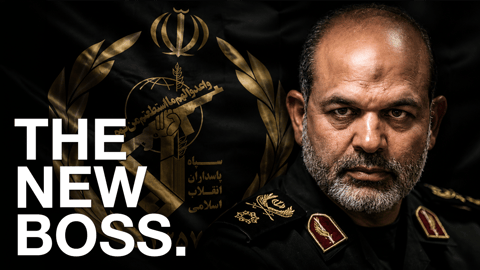
In his absence, Ahmad Vahidi has largely been running the show, the IRGC's commander-in-chief, who has been largely responsible for insisting that the country not make any concessions towards Washington. But once you dig deeper beneath the guys at the very top, the situation gets a whole lot more bleak.
Just the other day, Iran appointed six separate senior military commanders, including the Secretary of the Supreme National Security Council, the guy who oversees Iran's most important national security body with Moshe and Rezae, who is just about as hardline as they come.
The man who replaced, Muhammad Baga Zalgadir, is no moderate himself either, and both of them took over the top swap from a man named Ali Larjani. Larjani, who was assassinated in an Israeli airstrike back in March, which is noteworthy given that he was an outspoken advocate for negotiations with Washington.
While we want to be careful with just how sincere these claims are, Larjani was reportedly pushing from within not just to enter into negotiations with Washington, but also even willing to make concessions on both Tehran's foreign and domestic policy.
Even if some of those reports might be a bit too charitable, they suggest a completely different Tehran than the one Washington finds itself staring down currently. Rezae, for his part, has no intention of being so conciliatory. He's about as close to a founding father that the Revolutionary Guard has.
He joined them when they came. They were first created in 1979, the same year of the revolution, and is widely accredited with being a chief architect of Hezbollah in Lebanon in the 1980s. Since then, he's consistently been pushing for some of the most maximalist positions imaginable.
The man has been wanted in Argentina since 2006 over the bombing of the Israeli embassy in Buenos Aires that killed 29 people, along with the AMIA Jewish Community Center that killed another 85. So, yes, that is the guy that is running Iran's security body. Good call blowing up his moderate predecessor Israel.
No way that could backfire, right? So it should probably be no surprise that same body, the SNSC, is pushing for an absolutely unrelenting series of concessions from Washington.
Chief among them, before they'd even consider reopening the Strait of Hormuz, include a complete lifting of the blockade on Iran, withdrawing American military forces around Iran, paying war reparations, and a guarantee to stop attacking Tehran's allies across the Middle East.
Iran had previously been discussing a similar proposal back in May, which White House Press Secretary Caroline Levitt said they, quote, literally threw in the garbage. As much as the U.S. might prefer the situation to be different, those proposals from that bin might be the only things that would make the Iranians willing to open the Strait.
On Monday, an advisor to Parliament Speaker Mohamed Bahar Garlabaf announced that if the U.S. did not accept each of them, the Strait would simply remain closed through 2029 when Trump's successor would take over.
Iran has some precedent on this will-wait-you-out approach.
In the immediate aftermath of the revolution and the subsequent kidnapping of the American embassy staff in Tehran, they decided that President Jimmy Carter wasn't someone they were willing to negotiate with, and simply held the hostages for 444 days, right up until the very day that his successor, Ronald Reagan, was sworn in.
As high-profile as that kidnapping was, and as embarrassing as it was to Carter's legacy, it didn't have the same geopolitical implications that Hormuz does.
But all this is just where the new Iranian officials have actually flexed muscle so far. Worryingly, it might just be a warm-up act for what they have next. Big plans ahead.
Now, when it comes to the views of the rest of the Middle East on this war, it's easy to assume that, since they were largely opposed, they must therefore be outright supportive of Tehran, or at least neutral.
While this may be true for countries like Qatar, which has long maintained a close relationship with the Islamic Republic, it is not the case when it comes to the rest of the Gulf.
Their concern from the outset was more that Washington didn't have the resolve to see the mission through, that the air-only campaign wouldn't work, and that they would ultimately be left in the region with a wounded, seriously pissed off Iran.
The thing is, this didn't require levels of incredible foresight and regional knowledge. That was always going to be the case if the Islamic Republic's system of governance was left intact.
Remember, this was the second campaign against Iran in under one year, during which their missile and defense systems were proven to be essential. useless and the deterrence effect of their proxy forces in Lebanon and Gaza had already been weakened.
Clearly, Tehran's old strategy was no longer working. Previously, that strategy had been to either get or come right up to the threshold of getting a nuke. And from an Iranian security perspective, it made sense why.
Once you're a part of the nuclear club, nobody touches you. Just look at North Korea. Throughout the war, it became clear that Hormuz could fulfill a similar function.
An easy lever with which Tehran could hold the world hostage and would make the once mighty United States bend the knee. That's a big enough concern, as is. But the way things are looking right now, it seems as though Hormuz is simply just one of the levers Iran now has at its disposal.
We at Warfront have covered in the past the escalating conflicts between the Iran-backed Houthi rebels in Yemen and Saudi Arabia, which so far has taken the form of the rebels trying to score domestic wins against their own enemy, rather than jumping into the wider conflict on behalf of Tehran.
On Monday, sources close to the rebels told the Emirati outlet The National that the rebel group wants to level up and be a true regional powerhouse by taking on a more active role in the war, including by eyeing future attacks on Israel and other US allies across the region.
So far, in 2026, the Houthis' attacks on shipping in their equivalent of Hormuz, the Bab al-Mandeb, have been exclusively on Saudi, US, or Israeli shipping.
Everyone else has been able to go through without issue. If they decide to make good on these rumors to defend their buddies in Tehran by shutting the waterway off their coast, you're looking at a shutdown of an enormous share of the energy and commercial traffic moving between Asia, Africa, and the Middle East.
Given how well-armed the Houthis are, this would be a dramatic escalation beyond even what Iran's other proxies can do.
Hezbollah is a shell of its former self, but even in its heyday, it was always specifically an anti-Israel force that had one mission and one mission only.
The Houthis, by comparison, are every bit as anti-Israel as Hezbollah and then some, remember their slogan is literally, death to Israel, curse me upon the Jews, but they're also willing to turn their missiles on their Muslim neighbors as well.
Given just how much Iran has escalated its attacks across the Middle East this year, that is a serious new threat that the region has to contend with.
You know, on top of everything else. In past exchanges between Washington or Jerusalem and Tehran, fighting almost always impacted only Iran and Israel with the occasional spillover, like the Iranian attack on Qatar during the 12-day war. But it was always minor, and always targeting U.S. military installations.
This year, it's a completely different story. Tehran says that they're targeting U.S. bases in the Gulf, but in reality are just blindly shooting whatever they have across the region in attempts to see what sticks.
If the Gulf now has to contend with incoming fire from both Iran and the Houthis, along with various blockades by the two, things start to get real messy real quick.
There's one even nastier possibility on the cards too, even if it's more unlikely.
Iranian officials have begun openly floating the possibility that any American operations in the region could be met with an Iranian ground insurgency into Kuwait, specifically targeting U.S. and U.S. and U.S. and U.S. f Poor Stephanie the US bases at Camp Arifjan and Camp Behring.
Analysts are largely skeptical that Iran would be able to actually pull off an invasion and subsequent occupation of the country.
Iran's speciality is, after all, asymmetric warfare. But the Iranian conventional military, the Artesh, is nearly half a million men strong and have been sitting on the sidelines throughout this entire conflict, waiting for that one order to come down.
All of which makes Tehran's foreign policy more aggressive than any point in the Islamic Republic's history.
But the regime's newfound hardball approach isn't just being applied to their neighbors and the United States. It's arguably even worse for the people now living under it. Pity the Nation Now, perhaps the biggest tragedy of this war has been for the Iranian people, who are essentially stuck between a rock and a theocratic dictatorship.
The Islamic Republic's track record on freedom of expression has always been abysmal and was already trending in the wrong direction before this war even kicked off. There were 1,639 executions in the country last year alone, which is a 68% jump from 2024 levels and the highest total since 1989.
That number, spread every year, by the way, comes out to four or five executions every single day.
Even this, though, seems to be something that would likely be doubled down on by the newly empowered IRGC officials. Since the war began, there has been a reported sharp spike in the number of executions for political crimes, people accused of spying for Israel or belonging to banned opposition groups.
And the trials that they were given weren't exactly winning any awards for fairness, either.
Forced confessions under torture are widespread, and from there, the execution is often carried out in a matter of weeks. And in case the standard execution wasn't deterrence enough for any would-be protester, Iran raised the stakes here once again. As of July 27th, they have once again brought back their public execution campaigns.
These methods, which are done in broad daylight to send a clear message to any potentially rebellious areas, have been largely shelved in recent years. But their return, usually in a public square in broad daylight, is designed to send a very clear message about what happens to those who fight against the regime.
We've already seen them make good on this, too.
Scaffolding went up in Nalakani Square, which had been the site of the January protests in the city, and they brought in a crane to serve as the gallows. Amir Hussein Safari, 27, and Abul Farsi Sa'pahi, who was just 23, were both hanged.
Now, if you find yourself asking, but Simon, if Iran survived the war and is trying to project strength again, wouldn't they want to celebrate the victories rather than publicized dissent?
You know, move on from what happened to January? Well, dear viewer, that might have been the previous approach by previous Iranian ministers. But with the new sheriff in town, nobody's getting off that easy.
The protests that reportedly led to the massacre of tens of thousands of civilians back in January weren't some random outbreak that came from nowhere.
No, they'd been going on since late December, when smaller protests broke out over the end economic turmoil the country was in we're not going to say that the regime didn't push back on them then they did but they took a comparatively mild starts relative to the crackdown that was to follow given that the subsequent crackdown was the thing that ultimately
Greenlit the us and israel's joint operation against the country the regime learned all of the wrong lessons it was the fact that they even let the protests get to that point where demonstrations were breaking out all over the country that was the mistake not the underlying circumstances that iranians were protesting so moving forward what they have to do is
Make sure these protests are stopped in their tracks before they cause an international outrage and that really does leave the iranian people in one of the most unenviable positions we can imagine it'd be one thing if the regime was taking an ever harder line abroad while times were good back home but the iranian economy was already in dire shape before the
First bombs fell tehran's long-standing insistence on maintaining a nuclear program and funding proxies across the region has led it to be under some of the world's most intense international sanctions which have dramatically escalated given the ongoing u.s blockade save for the brief lull during the short-lived memorandum of understanding in late june
Through mid-july to ram has been completely cut off from naval exports of crude and given that nearly 90 of what it historically sold transits via ships that's been an absolutely crippling blow during the first blockade exports fell from close to 2 million barrels per day to below 300 000 in may the result of all of this is by design an economy in free fall
Inflation is approaching 90 percent the real has never been worth less and bread lines have begun to form in the major iranian cities this is a new low even for iran so if washington actually calls tehran's bluff on the 2029 time frame over hormuz ordinary iranians are looking at years of this under a regime that has already shown it considers their
Well-being just mere afterthought in short by killing so many officials that only the hardest of hardliners are left in america and israel may have ensured that life in the middle east will be far worse for everyone the gulf states are now living under the constant threat of attack one and possibly two vital waterways may be closed long term with devastating
Economic consequences the iranian people are suffering more than ever and the region is less stable than at any point during my lifetime the iran war began with the trump administration thinking it could bag a quick easy win before turning its attention to cuba or elsewhere instead it appears that it may have poisoned the regime for years to come the regime
For years to come thank you for watching
Unlock premium video briefings
Members get full access to premium reporting, in-depth briefings, and subscriber-only analysis.
Insiders Receive
- Full access to all premium articles and briefings
- Exclusive subscriber-only analysis and dispatches
- Support independent conflict journalism
From $5/month — cancel anytime