
Is China's Influence in Africa Waning?
Beijing's lending to Africa has fallen 90% from its 2016 peak, stalling projects and fueling resentment — yet China is pivoting to arms sales and military training to keep its grip.
Simon Whistler • February 17, 2026
Members only
Note: this transcript was generated by AI and may contain errors or inconsistencies.
China and African countries are destined to be good friends, good brothers, and good partners. These are the words of Chinese President Xi Jinping, who during a BRICS event in 2018 perfectly captured the growing bonds between China and the continent.
In that year, Chinese Foreign Direct Investment, or FDI, into Africa hit a higher $5.4 billion, and President Xi committed $60 billion to the continent through a combination of grants, interest-free loans, concessional loans, and investments by Chinese companies.
Much of this money was tied to the Belt and Road Initiative that saw the development of massive infrastructural projects. But it wasn't just infrastructure spending.
China had quickly become the continent's main trading partner, with two-way trade amounting to hundreds of billions of dollars each year, and was also investing in cultural and educational influence long seen as the domain of the West.
Through its Confucius Institutes and an aggressive scholarship program, China became the top destination for Anglophone African students studying abroad. On the military front, Africa represents several significant firsts for China.
Djibouti was the site of the First People's Liberation Army PLA Overseas Military Base, and the waters in the Gulf of Aden saw the first rotational deployment of PLA Navy anti-piracy ships.
All of this paints a picture of a relationship poised to make Beijing the most influential player on the continent. However, according to a recent report by independent media outlet Semaphore, this might not be the case for long.
Boston University's Global Development Policy Center showed that Beijing loaned the continent $2.1 billion in 2024, a figure nearly half that of the previous year, and a staggering 90% drop from its 2016 peak.
And here's an even more startling figure. Only five African nations received Chinese loans in 2024, despite 53 countries being part of the Belt and Road Initiative. And that raises an interesting question.
Why is China tightening its purse strings, and how will this affect the relationship between Beijing and the continent? Tightening purse strings According to Brian Eiclin, a former research fellow at the Institute for Security and Development, Chinese investments in Africa began declining after 2018.
From 2018 to 2022, Chinese FDI to Africa plummeted by 66.7%.
Aid from Beijing also decreased after 2016, with fewer new projects being launched and many existing commitments either scaled back or left unfulfilled. Islin suggests that there are several possible reasons for this decline. First, China's economic slowdown.
China's economy, once a juggernaut posting double-digit growth rates, has been steadily losing steam. GDP growth dropped to around 6% in 2019 and has continued declining since the COVID-19 pandemic. The country's grappling with a struggling manufacturing sector, weak domestic consumption, and a property market crisis that saw giants like Evergrande collapse.
These internal pressures have forced Beijing to prioritize domestic economic stability over foreign adventures. The second factor is debt. Multiple African nations have accumulated unsustainable Chinese loans, with Zambia defaulting on its sovereign debt in 2020, becoming the first African country to do. so during the pandemic.
Ethiopia and Kenya have similarly struggled with repayments. Beijing, facing mounting losses, has grown risk-averse, unwilling to pump money into countries that may never pay it back. The third reason is increased competition.
Western powers, alarmed by China's expanding footprints, have launched their own initiatives. The EU's Global Gateway, envisioned as a counter to China's Belt and Road Initiative into America's renewed engagement this year, following a sharp pullback in 2025, have provided African nations with alternatives to Chinese financing.
For African nations, the impact of this pullback has been significant.
Kenya, for instance, borrowed $5.08 billion from the China Import-Export EXIM bank for the construction of two phases of the standard gauge railway, a project that was supposed to transform the transportation between Mombasa and Nairobi.
The railway generates insufficient revenue to cover its debt service obligations, leaving the Kenyan government struggling with repayments while Chinese financing for follow-up phases dried up.
Nairobi was so desperate for financing that it reportedly proposed a new funding structure to Beijing, where Nairobi would fund 30% of the project instead of Beijing footing the entire bill.
And it's not just Kenya where projects sit incomplete or stalled. Zambia had a stalled hydroelectric power station, and Ethiopia saw the construction of a major road halted after Exim Bank withheld the disbursement of a loan. This has created what amounts to a development financing vacuum.
African nations that have pegged their infrastructure plans around the expectation of continued Chinese financing now face hard choices. Some of them lack alternative funding sources at comparable scale and find themselves saddled with debt obligations that consume government revenues without corresponding economic returns.
The promised roads, ports, and power plants that were supposed to drive industrialization remain unrealized, while the bills keep on coming.
This vacuum has weakened China's ability to influence the continent's economic priorities. When Beijing was extending tens of billions annually in infrastructural loans, it could effectively steer where countries invested, which sectors received attention, and which Chinese state-owned enterprises won contracts.
African governments had little choice but to align their development plans with what Chinese banks were willing to fund.
This leverage, while still present, is not as potent without China's financial muscle backing it up. This vacuum also weakens Beijing's influence by fueling the rise of anti-China sentiment on the continent. Take Zambia, for instance, where China holds roughly one-third of Lusaka's total external debt.
According to analysts from Chatham House, Zambians widely blame China for the lack of impact that government borrowing and infrastructure investment in general has had on living conditions and employment opportunities.
China has also faced criticisms from Lusaka over accusations of exploitative labor practices and environmental violations including toxic waste spills that have contaminated water sources.
This wave of anti-China sentiment propelled former President Michael Sata, an avowed China critic, who once said that the Chinese were infesting Zambia, and be at power, although he would later soften his stance on the country.
The same pattern has emerged across multiple countries. Rising anti-Chinese sentiment in Ghana and Zimbabwe has become potent enough that politicians now campaign on reducing dependence on Beijing. In Kenya, opposition to Chinese projects has intensified as details about opaque loan agreements have leaked.
Reports in 2020 suggested that Kenya risked losing control of the Mombasa port, the nation's most important maritime hub, if it defaulted on the standard-gauge railway loan, sparking public outrage.
The lack of transparency around these deals feeds suspicions about debt-trap diplomacy, where China deliberately extends unsustainable loans to developing nations in order to seize strategic assets when they default.
This debt-trap narrative, while disputed by many scholars, including Deborah Bradcomb, professor of political economy at Johns Hopkins University, has gained significant traction in public discourse.
Part of this, as the Institute for Security Studies, or ISS, has noted, was because half of Chinese loans in sub-Saharan Africa are not disclosed in sovereign debt records. While this wasn't just limited to loans taken from China, it compounds an already existing problem for Beijing, where local populations often see it as a bogeyman.
Still, despite the shrinking economic footprint and growing popular resentment, China has managed to preserve much of its political influence.
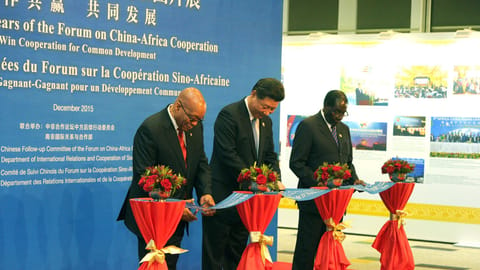
In September 2024, China hosted the Forum on China-Africa Cooperation, or FOCAC, an event, which brought together 53 high-level African delegations, 36 of which were led by heads of states and prime ministers. This was a sign that Beijing still commanded attention, even though lending had plummeted.
Beijing also commanded support in multilateral institutions.
At the UN, African votes were crucial in defeating a 2022 resolution that would have held a UNHRC debate on alleged violations in Xinjiang. Part of this is obviously the impact of China's economic policies on the continent. Professor Carla Jones from Sam Houston State University found that Chinese investment in Africa led to 78% greater voting alignment.
A greater part of it might stem from decades of diplomatic groundwork that have made Beijing a favored ally for African states. China's policy of non-interference in African domestic politics remains attractive to governments, wary of Western conditionality, as noted by a 2022 Friedrich Naumann Foundation survey of African decision-makers.
A Multipolar World Now, in the previous chapter, we mentioned increased competition, particularly from Western powers, as one of the main reasons why China was lending less money to the continent.
But that is barely scratching the surface. Because of Africa's strategic importance, primarily from its natural resources, vast population, and access to crucial waterways, everyone wants a peace.
Locally, the biggest competition for influence comes from Egypt, which, while not having China's financial muscle, has been expanding its influence in the Horn of Africa.
Emmanuel Gadebo, a researcher at the Klingendal Institute, wrote that Egypt a- been expanding its military, diplomatic, and economic presence in the Horn. These developments come at a time when Egypt is currently locked into a feud with Ethiopia over the Grand Ethiopian Renaissance Dam.
Additionally, Ethiopia's quest for direct sea access has strained its relations with its neighbors, some of whom appear to be aligning with Cairo as a counterweight to Addis Ababa.
China is also competing with Russia, which primarily interacts with the continent through the Afrika Korps, a paramilitary force formed to replace the Wagner unit following the death of the Union's founder, Yevgeny Prigozhin.
The Afrika Korps is particularly active in the Sahel, where, after military hunters kicked out Western allies, a security vacuum arose that Russia was willing to fill. Russia's influence is limited, however, since its troops have struggled to improve regional security.
In some countries, like Mali, the presence of Russian forces has had a negative impact as violence has soared since their arrival. High-profile defeats, such as at the hands of the Taregs in Mali, have also dented Russia's image as a guarantor of security on the continent.
And that might explain why Turkey has become a preferred destination for African countries looking to shore up their security.
Through what analysts have dubbed drone diplomacy, Turkey has built a significant footprint across the continent, from Nigeria in the west to Kenya in the east. Turkish Bayraktar TB2 drones have become ubiquitous across Africa because they are much cheaper than Western alternatives.
What China does have its own drones, some of which, such as the FH-95, have been used in Sudan's ongoing war, the continent seems to prefer Turkish drones.
And it's not just Africa. According to a 2024 report by the US-based Center for a New American Security, CNAS, while the US, Turkey, and China were the world's leading drone suppliers, Turkey accounted for 65% of the sales. Apart from drone sales, Turkey has also expanded its soft power footprints on the continent through humanitarian aid.
Ankara played a vital role in Somalia by delivering aid during a devastating famine in 2011 and cultural and educational initiatives. Another country that has followed a similar route is the UAE.
In 2025, Abu Dhabi announced that it would invest a billion dollars to expand AI infrastructure and AI-enabled services across Africa with the aim of helping countries meet national development priorities.
This comes on the heels of a 2023 initiative where the UAE partnered with the World Food Programme to Accelerate the Digital Schools Initiative in Southern Africa.
Simultaneously, despite multiple denials, the UAE has been credibly accused by multiple international organizations of funding the Rapid Support Forces, the RSF, a paramilitary group that is currently fighting the Sudanese Armed Forces, or SAF, and controls about 40% of Sudan, particularly in the West.
The RSF has been accused of carrying out a campaign of genocide after the fall of Al-Fasha, where tens of thousands were killed after the city fell to the group.
Nor is it just Sudan. UAE has funded warlords in places like eastern Libya, bankrolled Ethiopia's new presidential palace, and opened strategic boards in places like the breakaway state of Somaliland, part of a new scramble for Africa in which the UAE battles for influence alongside its frenemies Saudi Arabia.
And speaking of Saudi Arabia, it has been one of the main supporters of the SAF and more broadly has also positioned itself as a major player on the continent.
Apart from supporting the SAF, Riyadh has committed hundreds of millions of dollars in loans and investments to African countries in a bid to expand its influence. In 2023, Saudi Arabia hosted the Saudi Arab African Economic Conference in Riyadh, which rivaled the Forum on China-Africa cooperation for high-profile attendees.
During the event, Saudi Arabian Finance Minister Mohamed al-Jadhan reaffirmed his nation's commitment to Africa, saying, and we'll quote him here, "...the kingdom is keen to consolidate its relations with the African continent, which is one of the most important axes for the future of the global economy." India has also positioned itself as an important
Strategic ally to Africa, leveraging their shared economic interests and long-standing historical ties.
Two-way trade has grown from $5.3 billion in 2001 to over $100 billion in 2024. Well, this is obviously an impressive figure. It's barely a third of Africa's trade with China, which in 2024 grew by 4.8% to reach $295 billion.
And finally, there's the Western powers, which have a pretty complicated relationship with Africa, burdened by the shadows of colonialism and fears of exploitative arrangements. And we can't forget the cuts to USAID by President Trump, which have had an outsized impact on Africa.
The Michigan Journal of Economics estimates that the cuts could have potentially pushed more than 5 million people into extreme poverty.
China has previously leveraged these anxieties to grow its own influence on the continent. But, as we've mentioned, China is now itself grasping with similar concerns from African nations.
The West is actively working to improve its relationship with Africa through trade deals, such as the African Growth and Opportunity Act, AGOA, which gives thousands of products from eligible sub-Saharan African countries duty-free access to American markets.
Washington has also invested in infrastructure projects in Africa with the direct aim of countering China. It offered a $553 million loan to upgrade and rehabilitate more than 1,300 kilometers of rail connecting the city of Luau, on the border of the DRC, to the port city of Lubito in Angola.
This, alongside plans by the U.S. to take a stake in a new partnership to market Congo's minerals, represents a direct challenge to China's control over the critical mineral supply chain.
Europe has similarly ramped up its engagement through the Global Gateway Initiative, which pledged €150 billion in infrastructure investments for Africa.
The initiative focuses on renewable energy projects, digital connectivity through submarine fiber-optic cables, and strategic transport corridors, with the EU also partnering with the U.S. on the Lubito Corridor Project. What's next?
So all of this, taken together, paints a picture of a relationship at a crossroads. Beijing's economic muscle, once its primary tool of influence, has weakened considerably, and there are serious concerns whether its political influence can survive for much longer without the financial backing.
And that might explain... why china is pivoting towards security engagements to maintain its presence on the continent paul nantulia a research associate at the africa center for strategic studies points to the fokak beijing action plan 2025 to 2027 as proof of this evolving strategy the plan is notable because it contains more security commitment than any
Before it china has also become a major training hub for the continent's military officers trading more than 2000 annually nearly a tenfold increase from the year 2000 when it admitted fewer than 200 african officers in its military schools and did not conduct military drills in africa this security focused approach sidesteps the debt sustainability concerns
That have plagued china's infrastructure lending military training programs and defense equipment sales don't create the same visible backlash as stall railway projects or unpayable loans they also build dependencies that are harder to unwind an african military trained on chinese doctrine and equipped with chinese weapon systems becomes locked into
Beijing's orbit for the long term countries like mozambique namibia seychelles and tanzania receive more than 90 percent of their arms from china creating long-term reliance on chinese spare parts maintenance and technical support however there are limitations to this model security cooperation alone cannot replace the economic foundation that initially made
China attractive to african leaders african governments facing domestic pressure over debt burdens and incomplete infrastructure projects cannot simply pivot to military ties and expect public discontent to disappear those that do are almost guaranteed defeat at the ballot box and this is why the era of multi-polarity is important for the continent the
Competition for influence has given nations options meaning that countries could forge new partnerships without severing existing ones while avoiding being overly dependent on any single partner china realizes this and knows that even if its influence has reduced from its peak it still has a massive presence on the continent lots of friends and a lot of
Favors it can cash in none of that is going to go away anytime soon and neither is china's influence thank you for watching
Unlock premium video briefings
Members get full access to premium reporting, in-depth briefings, and subscriber-only analysis.
Insiders Receive
- Full access to all premium articles and briefings
- Exclusive subscriber-only analysis and dispatches
- Support independent conflict journalism
From $5/month — cancel anytime