
Life at War: The People of Iran.
War coverage has fixated on power struggles and oil prices. This episode turns to ordinary Iranians — enduring airstrikes, blackouts, and shortages while daring to hope for a new beginning.
Simon Whistler • March 10, 2026
Members only
Note: this transcript was generated by AI and may contain errors or inconsistencies.
When the Israeli Defense Forces launched the first wave of attacks against Iran on Saturday, the 28th of February, they accomplished three things. One, they ensured that the Front's team wouldn't know what a weekend is for the foreseeable future. Two, they eliminated Ayatollah Ali Khomeini, someone who had been a thorn in their side for decades.
And three, they ensured that Iran would remain in the news for the foreseeable future. Since the war began, Iran has dominated global headlines, and with good reason. It's not every day that nations, even sworn enemies like Iran, the US, and Israel start a war that has the potential to spill over into the entire region.
Coverage started off with questions about whether the Ayatollah had survived, and once it had been confirmed that he hadn't, the conversation turned to questions of his succession. Not long after, the world watched the ascension of Mushtar al-Khamenei.
All the while, there were the constant stories about the strikes being carried out by America, Israel, or Iran, and the impact they might have on global oil markets.
While all of these stories are undoubtedly important, and deserve all of the airtime that they are receiving, they are all focused on power. How America and Israel are projecting it, how Iran is trying to salvage its place in the region, and within Iran, who can manage to wrangle enough support to try and protect the regime?
And when the headlines are not focused on power, they're focused on oil.
The prices jumped at new highs with each passing day, and the impact those prices might have on the upcoming mid-term elections in the United States. What often gets overlooked are the stories of ordinary Iranian people, who were going about their lives that fateful Saturday, when everything changed.
The people have to find a way to continue their lives in the midst of war.
This episode is about them. The Immediate Aftermath Now, before we begin, we have to acknowledge an important fact. Getting a clear picture of what is happening on the ground has been difficult, because the Iranian government imposed a nationwide internet shut down soon after the first strikes landed.
Within hours, the country's internet traffic had dropped by 98%, according to Cloudflare Radar, a network measurement platform that provides real-time information on internet traffic.
Compounding the issue is the fact that international news organizations often refuse visas to Iran, which severely limits their ability to gather information about what is going on inside the country.
What this means is that everything we know about what ordinary Iranians are experiencing comes from the lucky few who managed to find brief windows of connectivity through VPNs and satellite internet, or from those who made it across the border into neighboring countries like Turkey.
While their stories are undoubtedly valuable, they still offer a very limited picture of what is actually happening on the ground. The internet blackout has done more than just prevent information from flowing out of Iran. Without access to real-time information, civilians have no way of knowing where the next strike might land, or how to get to safety.
When the missiles, laws started falling on Saturday morning, most Iranians had no idea what was happening. And from that point forward, information has only been more scarce. The exception was Saturday night, when reports of Karmanyi's death began to spread through the nation.
For many, the first emotion was disbelief. One person wrote on X, quoting them here, I'm crying, laughing, screaming, and experiencing every feeling in the world in three seconds. Across Tehran and other cities, people who had lived under Khomeini's repressive rule for nearly four decades celebrated the news of the Ayatollah's death.
Videos verified by the Associated Press showed dozens jeering and dancing, and cars honking their horns in the streets of Quraaj, a city near Tehran. In neighborhoods across the capital, residents leaned out of windows or gathered on rooftops whistling and shouting.
For many, particularly those who had taken to the streets in January only to watch thousands of death by protesters killed, this felt cathartic.
A source in Tehran told a journalist at Slate magazine that they were partying hard in celebration. But the celebrations were not universal, and those who did celebrate were not without fear. The besieged paramilitary, the same force that had killed thousands of protesters just weeks earlier, was quickly deployed across the country in response.
A doctor in the northern city of Rasht said that besiegers pulled one man out of his car after he honked his horn in celebration, according to PBS News. The regime made it clear through mass text messages that any street presence would be treated as cooperation with the enemy and would be met with severe consequences.
Then came the news of the bombing of Sharjah Tire Bear Girls Elementary School, where more than 175 people, mostly young girls, were killed.
According to Al Jazeera, a missile struck the school at the start of the school day, destroying the building and causing the roof to collapse on top of the children and their teachers. Video footage from the scene seems to depict an American Tomahawk missile impacting the school.
First responders described an unimaginable scene, with one medic telling Middle East Eye that they saw bodies without heads, without hands, without legs.
For Iranians who had celebrated Karmeini's death just days earlier, the bombing complicated everything. The war they hoped would liberate them was now killing Iranian children. Across Iran, not everyone was celebrating Karmeini's death.
State media broadcast images of large crowds gathering in Tehran, Ish-fahan, and other cities to mourn the supreme leader. Black-clad mourners wept, beating their chests and clutching portraits of the man who had ruled Iran for nearly four decades.
For regime loyalists tied to the system through religious conviction or decades of patronage, Karmeini's death represented a major loss.
In the days since the initial attack, the UN has estimated that more than 100,000 people have fled the capital to Iran to safer areas. While this may sound like a massive number, we have to point out that before the war began, about 9 million people lived in the city, and close to 17 million lived within the wider metropolitan area.
Most of the people who couldn't escape are choosing to stay within their homes to avoid the worst of the airstrikes, which, according to NBC journalist Yasmin Vosovian, has left the city feeling like a ghost town.
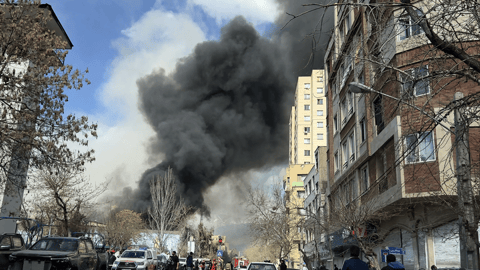
Quoting her here, That sense of fear has become deeply embedded within Iran, particularly in Tehran, which has become a key target for Israeli and American airstrikes. fear and hope after an israeli attack over the weekend that targeted oil depots and a petroleum logistics site in the capital residents reported feeling extremely afraid as black clouds of
Toxic smoke blanketed the city speaking to the guardian negin an activist and former political prisoner described the situation as apocalyptic she was experiencing severe shortness of breath and burning in her eyes and throat after exposure to the toxic smoke with many others reporting the same symptoms later a 27 year old teacher in tehran told time
Magazine that after breathing the contaminated air for just 15 minutes the skin on her face was sore and raw she compared it to breathing diluted tear gas and then the rains fell black rain saturated with what appeared to be oil rain that the iranian red crescent society warned could be contaminated with toxic compounds and the rain wasn't just limited to
Tehran people who spoke to time reported that the black rains had been spotted in cities more than a hundred kilometers from the capital turning cars and pavements black and contaminating the air although it has borne the brunt of the attacks tehran hasn't been the only city targeted by american and israeli airstrikes attacks have been reported in multiple
Cities including shiraz where 20 people were killed and 30 injured in a single attack every explosion every missile every airstrike has created a situation where the iranian people are forced to find a way through fear in pursuit of survival the survival is about more than just avoiding airstrikes even before the war began iranians were dealing with food
Prices that had nearly doubled in the span of a year now with the strainer form was largely shut down and cargo ships rerouting to avoid it the situation is getting worse one tehran resident told the independent the prices had surged in an unprecedented way with many items experiencing extraordinary increases in just the past week iran's healthcare system is
Also under severe strain according to the world health organization at least 13 hospitals and other healthcare facilities including khatam hospital and abazar children's hospital have been hit with four healthcare workers dead and scores more injured the damage to medical infrastructure comes at the worst possible time because hospitals and clinics in
Affected areas are reporting growing patient demand while simultaneously dealing with fuel shortages and constrained supply chains that limit their ability to provide care conditions inside iranian prisons have also deteriorated sharply with wards being locked and prisoners facing acute shortages of food and medical care at evan prisoner facility that is
Infamous for hosting political prisoners the iran human rights society reported that administrative staff closed the gates and abandoned the premises after the strikes began guards left their posts cell doors were locked and prisoners were left confined inside with iran international reporting that food distribution and medical care have largely been
Suspended while the prison shop a key source of food and drinking water for inmates has also closed vidah merania is the wife of an iranian swedish academic ambaz draysa tjlali who is detained at evan recently she managed to speak to her husband for just two minutes and told the afb quoting her here he told me they don't have food the situation is really bad
It.
They are afraid of what will happen. Dijalali, who was sentenced to death in 2017 on espionage charges, reportedly told his wife that prisoners inside the jail felt hopeless as explosions continued nearby.
Foreign detainees are also caught in this quagmire. British couple Lindsay and Craig Foreman, sentenced to 10 years on espionage charges that they deny, could hear jets and explosions during a brief phone call. Their son told Reuters that they were hearing bombs hitting surrounding areas outside of Evin.
The crisis extends far beyond Tehran. 120 prisoners, including 38 political prisoners, were transferred under heavy security from Mahabad prison to Mahendaya prison, where they are being held in quarantine under extremely harsh conditions. The transfer followed protests by prisoners after areas near Mahabad prison were bombed.
The nation's mental health has all stick in a nosedive.
Mental health professionals have described a society already worn down by years of instability now facing acute war anxiety. Turkey Today reported that demand for counseling services has surged. The state-run counseling hotline handled more than 90,000 calls during the 12-day war in June 2025.
While the number of calls made after the 28th of February is not publicly available, private counselors have described increased demand tied to anxiety and trauma. Despite those challenges, ordinary Iranians are still trying to continue with their daily lives.
In the United States, Al Jazeera reported that people in Tehran were flocking to blood donation centers, responding to growing fears that the nation's blood banks could be emptied.
Several shopkeepers across the country have told international outlets that they're staying open despite the constant dangers, believing they have a duty to provide basic commodities to their community. Ali Zali, a shopkeeper in Tehran, told CNN that he couldn't close his shop and he had to work even though he was afraid.
Marjan, who lives in a neighborhood in western Tehran, told Al Jazeera that she usually goes on a short walk to get essentials after the bombing stops.
One of the main reasons why people in Iran still remain hopeful is because there is a possibility that once the war is over, a new government will take over, one that won't continue the policies that have made Iran a global pariah state.
If this happens, it could lead to the lifting of sanctions, which would see a marked improvement in the lives and fortunes of the average Iranian. The hope for a new beginning coincides with Nauruz, the Persian New Year, which falls on March 20.
The word Nauruz literally translates to New Day, and for a nation that has endured so much, the symbolism couldn't be more fitting. Diaspora And finally, we need to discuss the Iranian diaspora, because even if they are not in the country, they are still deeply affected by what's happening.
According to Iran's Ministry of Foreign Affairs, about 4 million Iranians live outside the country, and for most of them, the war has meant one thing above all else, an inability to reach their loved ones back home.
One University of Cincinnati graduate student, Mahbouba Davodifar, was on the phone with her sister when the strikes began. She shared the news with her sister about the attacks, and then, in an instant, her sister had disappeared from the call. She hasn't been able to reach her sister since.
Her entire family remains in Iran, spread across several cities, and she has no way of going knowing if they're safe. Bahareh Sahabi, an Iranian clinical psychologist based in Chicago, wrote that for most in the Iranian diaspora, the first thing they look at in the morning isn't the headlines.
Rather, it's two checkmarks on their phone, sitting under a message sent hours earlier.
If they don't blue, their shoulders drop in relief. If they stay gray, that relief never comes. For most Iranians in the diaspora, this anxiety has become a daily ritual, compounded by the fact that even when messages do get through, they often only offer fragments of information.
Exile journalists have described the psychological pressure stemming from threats against family members still in Iran, while verification of any information coming out of the country becomes increasingly difficult amid deliberate information blackouts. Despite this anxiety, many in the diaspora have been vocal in their support for the strikes.
In the west side neighborhood of Los Angeles, known as Tehranjeles, hundreds of Iranian Americans celebrated when news broke that Khomeini had been killed, carrying American-Israelian-Iranian flags and dancing to loud music.
As Justin Halberic and Iranian-American told Straight Arrow News, many members of the diaspora had been calling for a militarized intervention to topple the Ayatollah's regime, but they were unsure if they would ever get it.
After watching the regime kill thousands of protesters in January, many feel the strikes represent the best chance they have ever had at seeing real change.
The prosecutor general's office issued a warning to Iranians living abroad who could sympathize with, support, or cooperate with America and Israel, stating that they would face confiscation of all their properties and other legal penalties.
The warning referenced the law adopted after the 12-day war, which allows the government to seize assets belonging to individuals who cooperate with hostile governments.
According to the Jerusalem Post, newly established channels on Telegram have shared details of prominent Iranians living abroad who have posted comments critical of Iran's clerical authorities, and who could presumably face the confiscation of their property. But for many in the diaspora, these threats have done little to change their stance.
Mayan Agharani, an Iranian who works at a shop in London, told Reuters that he didn't think any Iranian outside the country was truly worried about their property when people inside Iran were standing in front of live ammunition, barehanded, and getting killed. Still not everyone in the diaspora supports the war.
Abbas Milani, director of Iranian studies at Stanford University, noted that some people were willing to remove the regime at any cost, while others wanted to get rid of the regime, but not at the expense of war.
Online debates have intensified since the attacks began, with those perceived as supporting military action being labeled Zionist, a term that since the October 7th Hamas attacks on Israel has increasingly been used as a slur against Jews. Conversely, anti-war voices have been accused of being pro-regime.
Beneath these divisions lies a shared desire to one day return to their homeland.
Justin Hauberich told Straight Arrow News that the war meant his family might finally be able to see their country again after 47 years.
Joshua Fine, a 15-year-old student from New York, said that when his grandmother heard the news of Karmany's death, she broke into 10-year-old. tears because she hadn't been back to Iran since the revolution, and her last wish before dying was to go visit.
It remains to be seen whether those in the diaspora will be able to go back to an Iran where the regime no longer holds power, but for the first time in decades, that possibility feels real, and so they keep refreshing their screens, hoping for blue checkmarks and news that the regime has finally fallen.
Unlock premium video briefings
Members get full access to premium reporting, in-depth briefings, and subscriber-only analysis.
Insiders Receive
- Full access to all premium articles and briefings
- Exclusive subscriber-only analysis and dispatches
- Support independent conflict journalism
From $5/month — cancel anytime