
Over Two Weeks After Maduro's Capture, What is Life Like in Venezuela?
Over Two Weeks After Maduro's Capture, What is Life Like in Venezuela? — a Fronts video briefing on Strategy & Defense.
Simon Whistler • January 20, 2026
Members only
Note: this transcript was generated by AI and may contain errors or inconsistencies.
At the start of the year when american special forces burst into caracas captured maduro and spirited him and his wife off to the uss iwo jima they did three things one fulfilled a long-held goal of president trump and secretary of state marco rubio two proved a ton of predictions wrong proving that accurately reading the geopolitical tea leaves is no easy
Feat and three they guaranteed that venezuela would remain in the news for the foreseeable future since the raid on the 3rd january a news item about venezuela has dominated the news cycle nearly every day this year whether it's questions on who would rule in maduro's absence speculation on why the opposition was snubbed or questions about the viability of
Venezuela's oil the situation in caracas has cast an unavoidable shadow however almost all of those stories have been about power who has it who wants it who's gonna get it next the stories have been about trump's motives rubio's strategy delcy rodriguez's precarious position as interim leader and carina machado's increasingly desperate attempts to appeal to
President trump and when they are not about power they're about oil and its ability to reshape global markets and geopolitical calculations lost in the geopolitical maneuverings the ordinary venezuelans who woke up in the middle of the night on the 3rd of january to explosions blackouts and uncertainty in the days and weeks since the attack they have had to
Live with the constant fear of whether another american attack was on the horizon and in the worst case scenario whether their nation would disintegrate into a full-blown civil war between rival factions and amid all this uncertainty at high stakes drama are the millions of venezuelans simply trying to live their lives going to work feeding their families
And making sense of a reality that changed overnight this is a video about them status quo when the news of maduro's capture first spread on social media the venezuelan people were jubilant according to time magazine they banged pots and pans in celebration with many chanting expletives at the deposed strongman the assumption among many was that it wasn't
Just maduro who had been captured rather that his entire political operation had been toppled so once it became clear that it was only maduro and not the entire government that had been captured that initial wave of joy turned into something else entirely fear as al jazeera noted the repressive machinery that maduro had spent years building was still in
Place the same people who had enforced his rule were still in their positions wielding the same power they had always wielded and the machinery's main weapon the collectivos pro-government armed groups that have long served as the regime's unofficial enforcers formed during hugo chavez's presidency these armed groups call themselves defenders of the
Bolivarian revolution but in practice they function as a paramilitary force that patrols neighborhoods and maintains social control through violence during the 2017 protests the new york times reported that they were one of maduro's main tools for repressing dissent in the days after maduro's capture videos of armed collectivos flood the streets of caracas
Began to spread on social media some were patrolling on motorcycles others setting up checkpoints where they demanded to see people's phones to the venezuelan people it sent a chilling message that even though maduro had been arrested the government and its allies had not lost their teeth that fear slipped into every aspect of daily life especially when 15
Teenagers were reportedly detained for celebrating maduro's capture in barcelona city about 300 kilometers away from caracas according to a local outlet the teenagers were charged with incitement to hatred treason of the homeland and association to commit crime just for celebrating although they were released after intense backlash this confirmed most
People's worst fears that the government was going to punish dissent as harshly as it had done during the worst of the maduro years because of this several venezuelans told time that they were leaving their phones at home to avoid the authorities searching them and finding anything incriminating those who do venture out with their devices have taken to
Avoiding main roads deleting texts scrubbing their photo galleries clean of anything that could be interpreted as anti-government sentiment self-censoring on social media and in some cases deleting the apps altogether much of that fear traces back to one person and that would be dulcie rodriguez venezuela's current president in 2018 while serving as vice
President she headed the bolivarian national intelligence service or seven during one of the most repressive periods of maduro's rule the u.n accused seven of torturing dozens of opposition figures including at el helia side detention center a prison as infamous as el salvador's secot and her actions as the new head of the government haven't been
Particularly reassuring after taking office she appointed gustavo lopez former director of sebin to head of the general directorate of military counterintelligence or dgcin which was also accused of human rights abuses by the u.n laura christina dibb venezuela's director at the washington office on latin america or wola told al jazeera that this appointment
Was not a step in the right direction because lopez has a track record of violent repression he was in charge of the liberation of the people olp a years-long operation which rooted out dissent using abuse and extrajudicial killings resulting in the deaths of hundreds and possibly thousands of people mostly in poor neighborhoods despite all of this rodriguez
Has been trying to sell herself as a reformer part of that pitch has been the release of political prisoners which the trump administration has pointed to as proof of cooperation in a speech rodriguez said the message is very clear it is a venezuela opening up to a new political moment that allows understanding amid divergence and ideological political
Diversity the government has claimed that more than 400 political prisoners have been released however human rights groups dispute that number with for a penna saying that it only confirmed the release of 139 with hundreds more still behind bars whether this will be enough to convince venezuelans that changes this here is hard to say the releases are a step
In the right direction but they are a small step they are a little bit smart because we don't believe that we don't believe that we knew that our For every person freed, there are multiple others still locked up for doing nothing more than opposing the government.
And the fact that Rodriguez felt the need to make this gesture at all suggests that she understands how tenuous her position is. She needs the Trump administration's approval to avoid, in Trump's words, suffering a fate worse than Maduro.
She also needs the Venezuelan people to believe things might actually change. But believing requires trust, and trust requires more than speeches about a new political moment. Especially when trust is already so low that millions have been forced to flee the country.
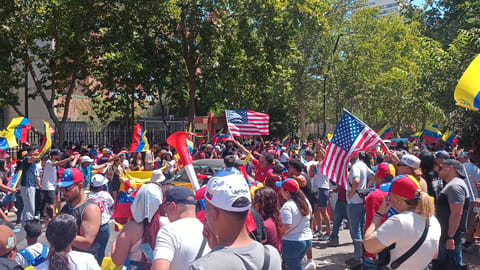
The Venezuelan Diaspora For the more than 8 million Venezuelans living outside the country, the reactions to Maduro's capture were wildly different. In Doral, a suburb of Miami with the highest concentration of Venezuelans in the United States, the celebration started before dawn.
People took to the streets with Venezuelan flags draped over their shoulders, chanting liberty, liberty, liberty, and singing both the American and Venezuelan national anthems.
Similar scenes played out in Madrid's Puerta del Sol, the city's public square, where thousands gathered under a massive Christmas tree to celebrate. However, for many, the joy was complicated by worry for the family members they had left behind.
This sentiment was echoed in Doral, where a young man told NBC that his family, while excited, was scared about what would come next.
Apart from the fear of what would come next, some in the Venezuelan Diaspora expressed discomfort with the manner in which the operation was carried out. Even some Venezuelans who despised Maduro bristled at perceived American imperialism.
Guillermo, a Venezuelan living in Chicago, told the conversation that he was conflicted because on one hand, he was happy that Maduro had lost power, but on the other hand, he was worried about the impact of the U.S. taking over Caracas.
This was a concern that was amplified, especially after President Trump announced that the U.S. would be running Venezuela. What does that mean? We're in charge.
So while Washington might be an ally because they're a common enemy, many were cautious about how far that partnership could go, especially in light of the administration's decision to keep Delcey Rodriguez rather than oversee a handover to Maria Corina Machado.
The ambivalence towards Washington has been further compounded by the Trump administration's immigration policies.
Throughout 2025, the administration had worked to strip hundreds of thousands of Venezuelans of their temporary protected status, a designation that allowed them to live and work legally in the U.S. In October 2025, the Supreme Court ruled in favor of the administration's efforts to end TPS for approximately 600,000 Venezuelans.
By the time Maduro was captured, more than 13,000 Venezuelans had already been deported. The administration's message was clear.
They wanted Maduro gone, but they also wanted Venezuelans… of the us this put the diaspora in an impossible position many had fled venezuela precisely because of maduro's persecution and now the same administration that toppled him was threatening to send them back for those facing deportation returning to a country where the chavista machinery was still
Intact was terrifying regardless of whether maduro himself was behind bars in new york while some are facing deportation others such as luis valdez who hasn't seen his family since 2010 are weighing whether to go back voluntarily as soon as it's safe enough to do so apart from the question of safety there's also the simple fact that many venezuelans had
Already rebuilt their lives in their new countries they have jobs communities they're a part of and children who have never been to venezuela and even those who are having a difficult time making ends meet still express optimism about their family's futures in their host countries according to studies by the center for global democracy at vanderbilt
University for these people returning to venezuela even in the wake of maduro's capture might mean starting over from scratch and that's a daunting prospect in a country whose economy can best be described as shambolic the economy for much of the 2010s the story of venezuela's economy hasn't been one of complete chaos years of mismanagement under chavez and
Maduro left the country in ruins the nation that once boasted the highest standard of living in latin america now struggles with hyperinflation that has destroyed the value of its currency let it speak inflation hit 130 000 eroding savings and making basic supplies scarce while inflation has cooled from these dramatic highs the country is still in the grips
Of a crisis as the new york times noted the biggest challenge for the nation at the moment is the price of food a challenge that was compounded by the special forces raid at the start of the year as it set off a new wave of inflation and currency woes caracas resident naya granado summed up the situation succinctly telling the times prices are rising every
Day it's completely out of control and she isn't the only one feeling the pinch phil guns and a venezuela-based analyst of the international crisis group told the times that the people have tightened their belts until there are no more holes left it's a grim reminder of just how desperate the situation in the country became under maduro for rodriguez fixing
This mess is not going to be easy the reforms venezuela needs are straightforward on paper but could have a lot of unintended consequences two things that the government can do in the short term is lift price controls and stop printing money to cover its expenses but each of those reforms comes with risks lifting price controls could send food costs even
Higher in the short term and stopping the printing presses means finding other ways to pay for everything from salaries to social programs and we really do need to stress again that rodriguez is a paid up member of the regime that triggered this economic collapse in the first place none of this gets easier when you factor in trump's demands the
Administration wants access to venezuelan oil and a government that will prioritize america interests Rodriguez needs to keep Washington happy to avoid her own removal from power but she also needs to address the hunger and desperation of her own people those two goals don't always point in the same direction the oil deals that Washington is trying to secure
Could eventually help if American companies invest the billions needed to rebuild Venezuela's energy infrastructure that money would flow through the economy more dollars would circulate jobs would return inflation might finally cool but the timeline on all of this is measured in years not months Venezuelan oil is heavy crude which means it's thick difficult
To extract and requires specialized equipment the infrastructure needed to produce it at scale has been rotting for decades pipelines are corroded talent has fled to other countries experts estimate that it would take billions and at least a decade to restore production to meaningful levels and that's assuming Venezuelan oil can find a willing buyer in a
Market that is already saturated so the oil wealth isn't coming to the rescue anytime soon and people need relief now not 10 years from now but it's not all bad news Camila the medical professional in Caracas told Time magazine she feels lighter since Maduro's capture outside the country the optimism is even stronger Pedro Rojas Arroyo an entrepreneur told
Me we are expecting great things for the future one in which economics thrive and we finally go back to democracy and capitalism so for now the post Maduro era is one where fear and uncertainty loom large but hope remains hope that this time finally Venezuela can change for the better thank you for watching
Unlock premium video briefings
Members get full access to premium reporting, in-depth briefings, and subscriber-only analysis.
Insiders Receive
- Full access to all premium articles and briefings
- Exclusive subscriber-only analysis and dispatches
- Support independent conflict journalism
From $5/month — cancel anytime