
South Korea has Made the Best Tank on Earth
South Korea has Made the Best Tank on Earth — a Fronts video briefing on China & Indo-Pacific.
Simon Whistler • September 18, 2025
Members only
Note: this transcript was generated by AI and may contain errors or inconsistencies.
South Korea's military industry is on another level. At the start of the 2010s, Seoul only built and exported fighting hardware to a tiny handful of nations, predominantly a medium-sized regional power in Turkey.
But fast forward by just a decade and a half, and South Korea is among the biggest arms exporters in the world, with hopes to be one of the global top four by just 2027.
From aircraft like the F-A-50 Golden Eagle to the upcoming KF-21 Boromai to formidable submarines and naval frigates, to the immensely popular self-propelled howards of the K-9 Thunder, South Korea has gone from an afterthought to a leader in the defense world in absolutely record time.
The nation's commitment to making affordable, high-quality kit, its immense production capacity, and its unapologetic pursuit of an international clientele have placed South Korea's arms exports on a pedestal alongside the very best in the world.
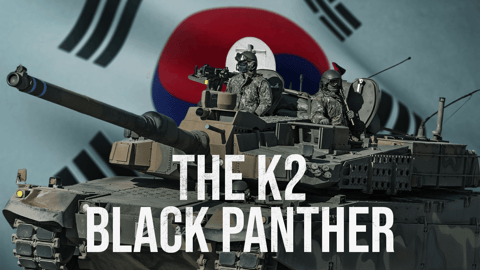
But as impressive as South Korea's ships and fighters and artillery might be, it's the nation's prized main battle tank that might be the most formidable of them all.
It's known as the K-2 Black Panther, an entirely modern, highly sophisticated design with the firepower, the mobility, and the heavy armor to make it a menace on the 21st century battlefield. South Korea has entrusted the K-2 with its own national defense. The rising European power, Poland, can't get enough of them.
And by all outwards indicators, Seoul is about to open the floodgates for a massive influx of international customers. The K-2 Black Panther has the potential to be one of the most important tanks in the world, and it appears to be one of, if not the very best, the tank.
South Korea is a nation with a long, proud military history, and it's the sort of nation that fully understands the importance of self-sufficiency whenever possible.
Locked into a generations-long Cold War with its northern neighbor and fully aware that its Cold War exists inside a much larger Great Power conflict between China and the United States, modern South Korean society is structured on the premise that while conflict should be avoided if possible, the specter of war is always close at hand.
For that reason, South Korea has spent decades working to ensure that it can design, build, and rely on its own weapons systems, ensuring that it can guarantee its own sovereignty by force if it's ever necessary.
It's for that very reason that South Korea's main battle tank from the 1990s through the 2010s was regarded across much of the nation as a bit of an embarrassment.
It was called the K-1, alternately known as the 88 tank, and in fairness, it was a perfectly good tank, but it wasn't a Korean platform. It was a derivative of America's M1 Abrams, and although General Dynamics added some modifications and ensured that the K-1 could be physically assembled in South Korea, that simply wasn't good enough.
As a foreign product, the K-1 was subject to American export controls, meaning that South Korea couldn't modify it on its own, couldn't build extra copies for export, and had to depend on American supply chains to keep the tanks running.
To make matters worse, South Korea was wedded to the K-1 through- the Asian financial crisis and couldn't convince its politicians to build a new, better indigenous design for far too long. South Korea would eventually put nearly 2,500 of the tanks into service in various upgrade models, and they still form the backbone of Seoul's armored divisions today.
But despite the fact that their military was dependent on an American design and an American defense corp for the K-1, South Korean engineers were hard at work even during the most discouraging stretch of K-1 dependence, building the technologies that would allow the nation to build the replacement that they really wanted.
The nation's military planners knew that they wanted to optimize their new tank for high-speed maneuver battles, and they knew that their tank should be outfitted with the requisite tools to become part of an information network on the battlefield, less an individual, self-sufficient piece of hardware than a node in an interconnected fighting system.
Over time, the new tank became a key priority for South Korea, and no expense was spared in its development, sourcing insights and expertise from defense leaders all over the world.
After over a decade of development, years of prototyping, and discarded early iterations, and the integration of dozens of indigenously designed technologies, the K-2 was declared fit for combat by 2008.
And fit for combat it was.
Measuring 10.8 meters, or 35 feet long, including the main barrel, and weighing in a grand total of 55 metric tons, the Black Panther is a three-seated tank, demanding the services of a driver, a gunner, and a commander, but relying on an automatic reload system that allows it to fire up to 10 rounds a minute, eliminating the need for a soldier to serve in
The dangerous loader position.
The tank relies on a 120mm 55 caliber smoothbore gun with 40 rounds of self-sharpening anti-tank ammunition, or chemical energy rounds at its disposal, plus a heavy machine gun and a coaxial machine gun.
It can deploy smart-fire-and-forget munitions that deploy a parachute and then fire downward onto the tops of enemy tanks, and it's precise enough to hit a target just 30 centimeters wide at a distance of a kilometer.
The K-2's onboard technology is among the very best in the world for any main battle tank, with advanced fire control technology, locking and target tracking capabilities at nearly up to 10 kilometers, and the requisite tech to target and bring down low-flying aircraft.
Its gunner's sight can zoom in on targets up to 60 times, while its firing systems are built to ensure that the tank can compensate for irregularities in terrain and still hit its target while in motion.
The K-2 features an automatic friend or foe recognition system, a battle management system that integrates it with every other piece of South Korean kit on the battlefield, and a data link that allows it to harness the power of real-time intelligence gathered through other systems.
The tank is coated in a specially designed armor plating, the details of which South Korea guards with extreme prejudice, along with the requisite systems to be invulnerable to chemical, biological, and even indirectly radiating nuclear weapons.
It's got automatic systems to track and fire back when it's being targeted, plus systems to disrupt incoming attacks from anti-tank missiles, all while traveling at up to 50 kilometers per hour off the ground! road using a unique adjustable suspension system that's unlike anything else on the planet according to some reports the tank is fully operable by
Just a single soldier if need be and it's known to leverage an advanced snorkeling system allowing it to cross rivers that are up to twice as deep as the tank is tall all without help or preparation from anybody outside the tank crew themselves all in all the black panther is an immensely impressive piece of hardware and even after that lengthy description
Of its capabilities we've only scratched the surface but suffice it to say that between its unique onboard systems its advanced technology and its performance specs the k2 attributes combine to create a platform that outperforms the vast majority of competitors outright it's improving continually with new upgrades to enhance its effectiveness and
Survivability in combat and while it's also among the most expensive main battle tanks in the world today it's widely regarded as being well worth the sticker price the reception now it's one thing for the k2 to come with impressive capabilities and it's quite another for the tank to be a success on the international export market after all the k2 would be
Far from the first combat platform to have all the world agree that it's really quite advanced but then find precisely zero customers willing to sign on the dotted line and indeed once it was introduced to service in 2014 the k2 spent over half a decade looking as if it was doomed to that very same fate the tank was constrained by a few early problems at
Once with production lines that could only push out a few dozen copies each year and technologies that were still in the process of maturing making the k2 the sort of weapon that looked really promising on day one but would clearly be a hell of a lot more impressive after its developers had a few more years to cook its production had to be paused for two
Years in the late 2010s due to issues with the transmission and perhaps most important of all south korea also wanted the k2 for itself with the goal of ultimately building a vanguard force of well over a thousand today just over a decade after the k2 was introduced to the south korean military seoul only has about 250 of the tanks in its own arsenal but by
2020 the k2 was finally ready to start exploring the export market and its timing couldn't possibly have been any better early that year south korea began talks with poland to make the k2 its new main battle tank meaning that south korea was in an excellent position two years later when poland and the rest of the nato alliance watched in horror as russia
Launched a full-scale invasion of ukraine for poland a nation with a long history of invasion and foreign occupation the idea of a conquering russia in the 21st century was intolerable and before long warsaw had made clear that it would refuse to accept the international order that russia was working to impose in order to fight back poland would need to
Rapidly grow its military and become a new european leader on defense and luckily it had already developed a healthy working relationship with the world's fastest rising arms exporter south korea over the course of the next several years south korea and poland would become fast friends with poland benefiting from south korea's cost-effective kit and highly
Efficient production lines while south korea benefited from gargantuan polish clean kitchen В kitchen kitchen term investment in its arms industry.
Poland would pick up South Korea's canine thunder to be its new self-repelled howitzer, its chunmu to serve as its multiple rocket launcher, and its golden eagle to serve as a new multi-role fighter.
But it was the Black Panther that would become the centerpiece of the remade Polish army. 180 of the tanks are expected to be delivered to Poland by the end of 2025, built on South Korean production lines, with 96, more than half, expected to be built just this year.
Then, Poland's own production lines are going to take over, after the nation agreed to a deal to produce the K2 under license, starting in 2026, with South Korea producing about 120 more on its own production lines before its building obligations are finished.
Notably, this is the same deal that South Korea found so onerous when it was dealing with the US and its license-built Abrams. But it's a deal that Poland is more than happy to accept, largely because South Korea has made a point of giving Poland a better collaborative experience than South Korea itself had with the United States.
Using its own production lines, Poland will build a grand total of 1,000 of the tanks for its own use, and it may end up producing more for export across Europe, while there are already plans in place for Poland to become the maintenance and refurbishment hub for K2 sold to other European customers.
Poland has even signed on to a successor initiative, the stealthy K3 next generation battle tank with Warsaw already committing to produce hundreds of K3s, despite this tank still just being in the design phase.
And now that the production lines it devoted to Poland are about to become available again, South Korea has encountered growing interest from a range of potential buyers. Just since 2024, five nations have either started the process to have the K2 bid for a procurement deal or already signed on the dotted line.
The nation of Peru intends to procure about 100 of the tanks to replace the Soviet-era models currently in service, with the K2 noted for its unique ability to thrive in both Peru's low-lying coastal areas and its mountainous interior.
Morocco is looking to purchase both the K2 and Korean-made air defense systems, plus a possible investment in South Korean submarines, as the nation looks to get the edge in an arms race against neighboring Algeria.
Iraq is looking at picking up over 200 copies, while Romania may want anywhere from 300 to 500 of either the Black Panther or its German competitor, the Leopard.
In the Caucasus region, Armenia is considering the K2 as it tries to shift away from Russian-made hardware, and with global interest rising around the K2's potential, more nations are expected to come out of the woodwork real soon.
Its engine and transmission have been adapted into a Turkish tank called the Alte, and South Korea has made clear that it's open to a wide range of technology-sharing agreements if other nations are interested. Way of the Future Whether the K2 is the absolute best tank on planet Earth is still a matter of opinion.
The Abrams, the Leopard, and a range of other tanks all have their defenders. Russia continues to insist that its T-14 is some kind of Star Wars-esque superweapon, despite being absent from the battlefields of Ukraine, and Japan's Type 10 is quite impressive in its own right.
And naturally, South Korea's closest geopolitical rivals, North Korea- and China aren't about to give the K-2 even the slightest bit of credit that it deserves.
But the Black Panther is widely recognized as the most technologically advanced tank in active service, and among independent analysts, the K-2 routinely gets the nod as the very best there is.
So if South Korea's Black Panther is currently the world-leading main battle tank, then what can other nations learn from its design, its development, and the way that Seoul has gone about sending it to the export market? Well, obviously, part of the answer is simply that it's a more advanced piece of technology than other global offerings.
It outperforms America's Abrams, and it can match Germany's advanced Leopard versions while being built and exported in far greater numbers, to say nothing of its ability to outdo the sad little ghost of the Russian T-14. Indeed, it's now regarded as the most advanced tank in NATO's arsenal. But even that's not the whole story.
Perhaps even more important than how advanced the K-2 may be is how functional the design really is. The K-2's onboard tech doesn't just give it greater processing power.
It integrates the tank into a wider battlefield data network, allowing it to work seamlessly with allied forces and tap into a higher form of situational awareness than it could achieve as a single machine.
Its programming prioritizes self-defense tools to ensure that it can rely on as few human operators as possible, keep them safe when they come under threat, and compensate for human error in a way that transforms the Black Panther into a far more effective war machine. Then there's the question of versatility.
There are some sorts of battlefields where the K-2 will never thrive, on the steep slopes of the world's highest mountains, or deep underwater, or in impenetrable jungle.
But short of that, the K-2 is meant to be highly adaptable, conforming easily to the advance of its environment, with as little a need for outside technicians, engineers, or other support crews as South Korea could possibly manage. It's meant to be altered easily, to go underwater or climb steep slopes.
It's meant to be maintained easily, with a highly modular design and a relatively basic skill level required to work on it.
And on the export market, it brings several advantages over other international competitors. Unlike some exporter nations, South Korea has not only the advanced designs to catch buyers' attention, but the production capacity to churn out its tanks at high volume, at good quality, on relatively short timelines.
It's willing to offshort the bulk of production for a given nation to that nation, without weighing that nation down with unnecessarily strict export controls.
It could keep up consistent, high volume supply of spare parts to keep tanks in working order, something that can't be said of the German Leopard, even in its own home country.
And it's easily and happily modified by South Korean engineers to conform to the requirements of nations who anticipate fighting on different sorts of battlefields than the base K2 is designed for.
A nation that purchases the K2 purchases not just a great platform, but a certain degree of freedom in how they use it, which can't always be said of main battle tanks supplied by other nations.
And while the K2 is a particularly expensive tank compared to the rest of the market, it provides a more obvious return on that investment than many other nations could claim. The Black Panther isn't cheap, but the cost of buying the platform matches the capability that comes with the platform.
In a world where modern military equipment is meant to be one part functional war machine and one part international showpiece, the Black Panther stands out.
This is a weapon that hasn't been designed to look cool in propaganda videos or to dissuade enemy forces from attacking, simply based off its name value and the reputation of the country that designed it.
In the K2, South Korea has made a tank that's not just advanced, but leverages advanced technology to conform to the needs of the battlefield, whatever they may be, instead of making a platform that presumes that it'll do battle in ideal conditions. M10, Booker, and T-14 Armata, we are looking at both of you.
With the K2 Black Panther, South Korea has produced the best tank on the market right now, not just because it's got cutting-edge technology, but because it's built to ensure that its technology is put to maximum effective use.
The world could learn a lot from a main battle tank like that, and if the global market has anything to say about it, that's precisely what's gonna happen. Thank you for watching.
Unlock premium video briefings
Members get full access to premium reporting, in-depth briefings, and subscriber-only analysis.
Insiders Receive
- Full access to all premium articles and briefings
- Exclusive subscriber-only analysis and dispatches
- Support independent conflict journalism
From $5/month — cancel anytime