
The Collapse of the Franco-German FCAS Fighter
The Collapse of the Franco-German FCAS Fighter — a Fronts video briefing on Europe & NATO.
Simon Whistler • December 30, 2025
Members only
Note: this transcript was generated by AI and may contain errors or inconsistencies.
When it was first devised, the Future Air Combat System was intended to usher in an era of European dominance in the skies.
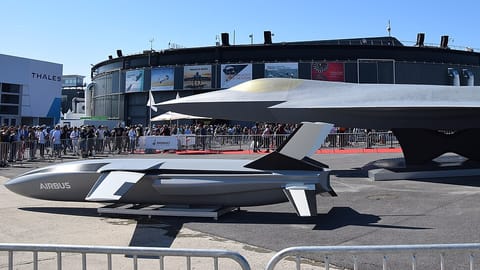
A three-nation aerospace initiative between France, Germany, and Spain, the Future Combat Air System Program, better known as FCAS, would unify the brightest minds of the Dassault and Airbus corporations for what The Economist recently called Europe's biggest military project.
Their objective was to build a sixth-generation fighter aircraft, along with the sense of technology, the loyal wingman drones, the artificial intelligence, and all the other assets that could turn an eventual fighter into the very best in the world.
Now, though, the entire FCAS program is on the verge of collapse, and while it's not dead yet, it's certainly not far from dead.
A combination of international rivalries, diverging visions, and spiraling cost overruns have led all participating nations to rethink their participation, even as French, German, and Spanish leadership can all agree that a sixth-generation fighter is vital in the years ahead.
So here's what the FCAS fighter was supposed to be, what went wrong, and what these three nations can do to bring it back.
The Platonic Ideal When Paris, Berlin, and Madrid agreed back in 2017 that they would start working toward a new proposal for a sixth-generation fighter jet, it was already clear to all three European governments that the world of combat aviation was changing quickly.
While at the time the United States was far and away the dominant force in fifth-generation aviation, between its closely guarded F-22 and the F-35 that had recently started rolling off production lines, competition was on the horizon.
China's J-20 had just been introduced to service, and a prototype of Russia's Su-57, at that time still thought to be a real threat, was approaching its introduction to service.
The nations of Europe understood, by that time, that they weren't going to build a fifth-generation aircraft of their own. Instead, fourth-gen fighters like France's Rafale, Sweden's Gripen, and the Eurofighter would be refined and modernized over time.
But even though Europe had missed its window to develop a fifth-generation fighter, that didn't mean that it was out of the running to build a sixth-generation jet.
Whereas fifth-gen fighters are generally known for a combination of stealth technology, high situational awareness on the battlefield, and supercruise capability, sixth-generation fighters are a whole other beast.
In addition to all those fifth-gen attributes, a sixth-generation fighter is expected to integrate highly advanced artificial intelligence and data fusion technologies, optionally man designs with the support of drone wingmen, highly advanced stealth technologies, and potential sci-fi bells and whistles like directed energy weapons, and even suborbital
Flight capability.
For European nations, after years with full access to America's F-35 as a sort of bridge design, leaping directly to a sixth-generation fighter like that wouldn't be easy, but it wouldn't be impossible either.
Such an effort would allow Europe to leverage some of its greatest strengths, including the immense high-tech design and manufacturing capabilities at the continent's disposal.
And in 2025, amidst fears around the world, around the United States' growing friendliness to Russia and Europe's reliance on American advanced technology, sixth-gen fighter programs have become an even greater priority. Failed to develop a technology like this, and Europe could find itself dependent on Washington for the rest of the 21st century.
So for France, Germany, and Spain, the ultimate objective was straightforward, if not exactly simple, build a fighter aircraft that could serve in a sixth-generation role with all three nations using an indigenous design and indigenous manufacturing capabilities whenever possible.
A technology demonstrator was slated to take its first flight in roughly 2027, with the expectation that after more than a decade of refinement of both the fighter itself and its companion technology, the aircraft would go operational by or before 2040.
When it entered service, it would replace the Rafale in French service and the Eurofighter in German and Spanish service, operating alongside not only loyal wingmen drones, but swarming drones that align with the lessons learned about drone warfare in the Russia-Ukrainian war.
Alongside Airbus and Dassault, the company Safran would build the jet's engines, the company Indra Systemas from Spain would lend its expertise, and a wide range of other companies across all three nations would take part in the design and development process.
A Troubled Partnership Unfortunately, almost as soon as the FCAS program really got off the ground in the early 2020s, it took almost no time for cracks to start showing in this European tripartite alliance.
Although those cracks would ultimately start spidering their way outward from multiple sources of strain, the biggest problem thus far has been the same one that's plagued European defense for decades.
Bureaucracy. As it turns out, the leaders of Airbus and the leaders of Dassault have proved utterly incapable of settling on a work-sharing situation, essentially meaning that because they can't agree on a division of labor, they can't agree on how to do the work that needs to be done.
For France, and particularly Dassault, FCAS has created a difficult situation.
Dassault fashions itself as Europe's premier defense aerospace company, and logically, that would mean that it should take the lead in the project. After all, it's the company with direct experience designing its own fighter in the Rafale instead of designing the Eurofighter as part of a wider international consortium.
Dassault, by its own evaluation, should be the prime contractor on the project.
But it also doesn't want to lose its intellectual property, it doesn't want to give away technology to the Germans or the Spanish, and it doesn't want to waste time waiting for German and Spanish designers to finish dicking around in service to what Dassault would regard as an inferior final product. France knows how to do this.
France believes that its technology and design will yield the best product, and France will be damned if it allows Germany or Spain to compromise the FCAS in the name of letting Berlin and Madrid feel as if they've done something.
As Dassault's firebrand CEO, Eric Trappier, explained it to the international press, quote, I don't mind if the Germans complain, here we know what we're doing. If they want to do it themselves, let them do it themselves. And that's not even accounting for the Spanish, where in France's view, Madrid's contributions will probably be minimal.
Of course, that description of the problem is one that Germany and Spain would reject out of hand, because after all, they are equal players in the entire project. Airbus, although not a defense giant, is a world-leading aerospace company, and France, while it's certainly got good ideas, is just one-third of this project.
So it's fundamentally unfair that France should get to boss around Spain and Germany, when they feel that they should take over two-thirds of the work and two-thirds of the responsibility.
Not to mention, Germany and Spain were really looking forward to getting their hands on that French technology for the benefit of their own defense industries, and it is completely unreasonable for those nations to add a fighter jet to their arsenal, which they nominally played an equal role in designing, without getting access to all the technology and
Intellectual property that's wrapped up in the fighter itself.
The way France describes it, Germany, would just be subsidizing a French jet. But work-sharing hasn't been the only problem that's beset the F-cast so far.
Already, the program has been hit with cost overruns, as technology has become more expensive, manufacturing has become more difficult in light of other European defense needs, and the world has learned more about the complex systems that a sixth-generation fighter will have to integrate.
Germany's decision to free up funds and pivot toward military rearmament has stoked interest in the F-cast program, but it's actually making the work-sharing disputes worse, as Germany is now attempting to get France to agree to German demands in order to unlock the available funds.
The SAU has more on its plate today than it's ever had, with international orders streaming in for the Rafale, and Paris eager to prioritize that program in the short term.
For its sixth-generation fighter, France all want something lighter, with carrier capability. Germany favors heavy, long-range systems. France wants to be able to export the jet once it's available.
Germany wants to keep it exclusive. The companion drones that are supposed to fly alongside an eventual fighter, as well as the integrated combat cloud that the F-cast will rely on, have spawned separate disputes that will be difficult to resolve. Timelines on the F-cast are moving back.
France and Germany are increasingly pulling in opposite directions, and as of December 2025, the program appears close to a total breakdown. Speaking at a conference in mid-December, Dessau's CEO admitted that he didn't know whether the F-cast would happen at all, a state of affairs that was already becoming more widely understood before those comments.
French lawmakers have indicated that they aren't willing to allow a work-sharing compromise with Germany, citing the fact that the typhoon, a project Germany was heavily involved with, eventually ended up costing twice as much as France's Rafale, showing that Germany shouldn't be allowed to get in France's way on the F-cast.
Rumors have recently been spreading that there's been some talk of splitting the program to produce two fighter aircraft under a common umbrella, something that Dessau's CEO currently denies, and that would be guaranteed to send costs skyrocketing yet again.
All the two nations could have ended most of the collaboration. and keep only the Combat Cloud element as a joint project, but as we'll explain, that decision comes with major problems too.
According to anonymous sources in the know, the FCAS project is now quote, highly unlikely to survive, per reporting by Reuters, and while talks to recover the program and progress into its next phase are still ongoing, the outlook for the program is looking increasingly bleak.
Can the FCAS recover? It's time that we ask the most important question of all. Can the FCAS survive?
Now, obviously, things are not looking good, for all the reasons that we've laid out, but as a certain miracle-working old hermit once said, there's a big difference between mostly dead and all dead. Despite the FCAS project's myriad problems, there's still a distinct possibility that it will eventually be built as France, Germany, and Spain have envisioned.
If that does happen, then the conditions of an eventual agreement are more likely to disadvantage Germany than France.
After all, France does have the technical expertise required to get this done, whereas Germany is simply less equipped to handle the challenge alone.
Germany would need to make a pragmatic, difficult decision to fund, or what would be, an essentially French FCAS program with limited German participation, and accept that it's worth withstanding a few major insults in order to guarantee access to a European-made 6th Gen aircraft.
For all the reasons we've laid out, however, it's not particularly likely that Germany would agree.
Then there's the possibility that this three-way consortium could split up, but simply going their own way would present problems for all nations involved. Germany and Spain, quite frankly, just lack the technological expertise to build a 6th Gen fighter by themselves, even if they continue to work together after cutting out Paris.
They could probably work it out eventually, but that effort would involve massive expenditures, major delays, and a clear gap in their respective defense capabilities through the coming decades.
There's a chance that they could boot out France from the program, and accept a replacement member, ideally Sweden and its Saab corporation, but Sweden, much like France, takes its intellectual property very seriously when it comes to military aviation.
France, meanwhile, could probably build a 6th Gen fighter by itself, if we're just discussing technology, and in fact that's what France did back in the 1980s, when it broke off from the eventual Eurofighter program to build the Rafale. But this time, money and political will are France's real issues.
Right now, Paris is in dire financial straits, facing a budgetary crisis with no clear way out, as talk of a bailout starts to bubble up, across Europe.
France's national rally and its far-left political coalition are each gaining in strength, as the nation's political center hemorrhages support, and even if the funding issues could be worked out, there's no guarantee that either of France's rising political forces would continue to support the program once they came into power.
There is a hidden third option for any or all of these nations, but most likely Germany and Spain, to join forces with the other sixth-generation fighter program in Europe, known, in shorthand, as the GCAP.
It's a joint initiative between Britain, Italy, and Japan, and the GCAP is meant to produce a similar combination of an optionally manned fighter. aircraft, unmanned companion drones, and the many associated technologies that would come with them. And while the GCAP does have a few problems, it's been smooth sailing in comparison to the F-CAS.
As of now, the demonstrator aircraft could fly as soon as 2027, and the GCAP nations are targeting an extremely ambitious introduction date of 2035.
The problem, however, is that at this point, the GCAP program is already in its development stage. Work sharing has been figured out, all the money is already there, and the participating nations have the technology they need. So, in essence, there's not really a place for new partners.
According to Politico, Germany has been seriously exploring a place in the GCAP program since the autumn of 2025, with Canada, Australia, Saudi Arabia, and Portugal all having recently expressed their own interest in the project.
But even in a best-case scenario, while Germany and some of those other nations might be able to enter as observers and eventually get their hands on a finished product, there simply won't be any reason for those nations to allow Germany to peek behind the curtain.
Germany's ambitions with the F-CAS have been just as much about accessing technology as accessing the fighter jet that F-CAS will eventually produce.
And the nations of GCAP just don't need to give that technology away. So, as of now, the F-CAS program is an impasse. Neither Berlin nor Paris appears willing to compromise.
Spain is mostly along with the ride at this point. And if Germany and France fail to find a way through their many disagreements, there's a real possibility that none of these three nations will get a sixth-gen fighter in the end. Thank you for watching.
Unlock premium video briefings
Members get full access to premium reporting, in-depth briefings, and subscriber-only analysis.
Insiders Receive
- Full access to all premium articles and briefings
- Exclusive subscriber-only analysis and dispatches
- Support independent conflict journalism
From $5/month — cancel anytime