
The Houthis are Back in Action.
Simon Whistler • July 22, 2026
Members only
Note: this transcript was generated by AI and may contain errors or inconsistencies.
When it comes to the recent conflict in the middle east there's one key player that's been quiet suspiciously quiet we're speaking of yemen's houthi rebels who despite being all the talk in foreign policy circle a few years ago have basically been keeping to themselves save for a few rocket launchers to remind the world that they are still there that is
Until yesterday according to their own leadership the houthis are very much back in action and while their target this time seems to be exclusively saudi arabia their entry is raising all sorts of alarm bells as to what exactly this could mean for their role in the region going forward blockading the blockade in the early hours of monday the houthis chief
Military spokesman went on television in sanar and declared that his forces would be imposing a naval blockade of saudi arabia ostensibly focusing along their shared border in the red sea this is actually a tad shy of the worst case situation that international observers had long worried about but we'll get to that dark prospect later on that the houthis
Seem to hold back a little bit isn't much of a relief saudi arabia is one of the world's largest oil producers after all and has been enormously dependent on the red sea along its west coast to be able to bypass the clogged strait of hormuz to the east after iran closed homers down at the end of february saudi arabia put their east-west pipeline carrying
Crude to the western city of yanbu into overdrive that pipeline has been essentially maxed out ever since because of just how severe the stoppage in hormuz has been nearly 75 percent of saudi exports have been flowing through yanbu in recent weeks all things considered this has worked out relatively well for riad it hasn't totally replaced hormuz and their
Oil cells remain depressed compared to pre-war levels but when compared to the likes of kuwait qatar and bahrain countries that have no alternative at all the saudis are practically rolling in cash the downside of this system of course is that it's essentially putting most of their eggs in one basket once the oil arrives in yanbu it still has to be shipped
Out and there are only two options to do that to the north sits the suez canal which remains open for business that's not the issue here so shipments to north africa europe and the americas remain in the clear it's the shipments to the south that are the issue they have to pass along the coast of yemen most of which is controlled by the houthi rebels and
Most dangerously to get out of the red sea and into the open ocean shipments have to transit through a precariously narrow body of water called the bab el mandeb so when it comes to this new blockade it's highly unlikely to actually impact saudi shipping heading north the houthis have an impressive ability to punch above their weight but that one's not
Really in the cards it's the bab el mandeb that's going to be their enforcement spot of course it might be a bit surprising that the catalyst for this houthi blockade appears not to be the iran war instead the houthis are framing this as a counter-action to the blockade that riyadh has imposed on them for over a decade at this point back in 2015 a coalition
Of arab states including saudi arabia intervened in yemen's civil war against the houthis and put all shipping and flights to the country under blockade that operation was significantly expanded to be a total blockade two years later after a missile landed on the outskirts of riyadh itself while conditions have improved somewhat since the 2022 ceasefire the
Blockade remains in effect to some extent in case the houthis had forgotten this yemen's internationally recognized government bombed the airport in sanar last week in an effort to block an iranian plane from landing the houthis claimed that the plane was later able to land in another city blamed saudi arabia for the incident and retaliated by firing drones
And missiles at the aber international airport across the border by that point the fragile truce that had been holding the country together was essentially over so the fact that houthis are willing to escalate by blockading saudi arabia doesn't directly tie into the broader war with iran which means that yemen is learning all the wrong lessons lately the
Wider world has watched as two of the world's most powerful air forces pounded iran for over a month only to largely come up empty and then spend the next three months trying without success to reopen or moves iran crippled as it may be by the relentless bombing campaign has ruled it straight for basically half a year at this point given all this the
Question the houthis seem to have been asking themselves is how hard could a blockade of just saudi ships really be now that is actually a valid question to be asking the rebel group is surprisingly well armed and organized to the point where they can certainly pull off coordinated operations that said though there are real limitations to just how much they
Can pull off here the group has no conventional navy at all and only a modest collection of helicopters and other aircraft with which they can intercept vessels what they do have in abundance though are drones and missiles again the iran playbook so when it comes to blockading saudi arabia it's all but guaranteed to be a relatively scaled down version of the
Humus situation nothing that would encircle saudi arabia entirely the houthis themselves only control the western parts of yemen to begin with and amman takes the eastern side of the peninsula like we said though that's only one component to what the houthis could actually do and it's the more restrained side of the story it's the more maximalist option
That's been keeping war planners awake at night bigger issues that more maximalist position just happens to be replicating what iran did just carrying it over to the bab al-mandeb where it's not just saudi shipping that can't get through but any shipping if blockading saudi exports represents another hit to international energy markets a total shutdown would
Be something akin to a knockout blow remember the strait of hormuz has been more or less closed for months now and it's had a big impact on oil supply and pricing alike in fact this is reportedly the largest disruption in history at its worst the roughly 20 million barrels of oil a day that normally move through homers collapsed to under 3 million and crude
Has seen prices as high as 144 us dollars per barrel for context that's more than double its pre-war price it's since come down in part because of the ill-fated memorandum of understanding between washington and tehran that was supposed to open the strait again but given that the two have returned to all-out war the current 90 a barrel may seem cheap in no
Time so the concern here boils down to what sort of impact an iran-style operation in the bab al-mandeb mandeb would actually have on international markets and no matter how you read it ain't pretty the straight still carries about seven percent of the world's oil much of it saudi in origin and when combined with hormuz they're supposed to be carrying
Something like a quarter of the world's oil and more than a third of its container traffic any full closure of both straight simultaneously would be nothing short of catastrophic and would have serious implications for countries across the world in the united states inflation clocked in at 4.1 back in may driven in no small part by heightened oil prices on
Account of hormuz's closure but the states which have become the world's largest oil producer still have it easy when compared to parts of the world more dependent on energy imports take europe where a major concern following russia's invasion of ukraine back in 2022 was the prospect of an energy shock that could trigger a recession or even leave people
Without heat in their homes during winter part of the answer to that especially in regard to liquefied natural gas came in the form of a pivot towards the middle east qatar in particular is the world's second largest lng supplier and ramped up both production and sales to help meet the demand with the straight blockaded that qatari lng is off the table
Meaning that europe is already strapped for options even before potential action against the bab al-mandeb even still the us and europe are better off than many other countries when petrol products really start to get scarce there's an inherent competition for who is both willing and on some level able to pay such elevated prices that's a contest where the
Us and europe are likely going to emerge on top rich countries do rich country things after all other poorer countries come out on the losing end and we've already started to see the impacts of this synthetic fertilizer for example is made from natural gas so any lasting shortage like the one we seem to be living through today is inherently going to make it
Harder to grow the basic crops needed to sustain everyday life back in march the world food program warns that oil going and staying above 100 a barrel could push as many as 45 million more people into acute hunger while oil hasn't consistently maintained prices above 100 a barrel it still had a significant impact as a result of these shortages they now
Estimate that an additional two and a half million people in somalia 1.3 million in sri lanka and 2.3 million in afghanistan are struggling to meet basic food needs if that's the price of a closure the obvious question is whether one can be prevented at all and the initial answers to that are not looking promising no good options all right so it's clear that
We might become unpleasantly familiar with the term bab el-mandeb in the months to come so if the houthis do pull a full iran here what is there that can be done well the track record is not very encouraging the houthis carried out a smaller scale campaign starting in 2023 which ran for nearly two years after israel began their war in gaza in response to the
October 7th attacks the houthis declared that they would attack shipping passing through the strait they made good on that promise too per akhled they tried to hit well over the 100 chip you and ended up sinking four separate vessels.
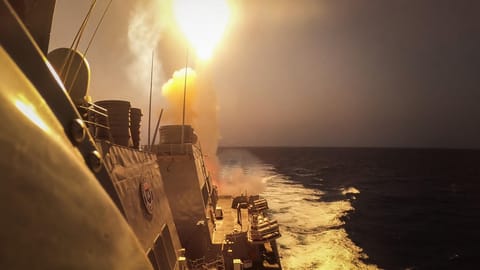
The United States and the United Kingdom finally had enough and entered the foray to put a stop to it the following year, in 2024. The operation saw some 1,100 strikes over the course of seven weeks and did pretty substantial damage to the Houthis in conventional terms.
Despite this, though, the war on shipping continued throughout it all. While the Houthis' pace did ease up from their peak before the US cracked down, ships were regularly coming under attack until the ceasefire between Israel and Hamas came into effect in October last year, finally bringing things to a close.
If that sounds familiar, well, it certainly does strike a parallel to the way the war with Iran has been going lately.
The Houthis are widely considered to be part of Iran's axis of resistance and for good reason. They share many ideological similarities, even if Yemen's Shiite population doesn't look to Tehran with any particular loyalty on religious grounds. Beyond that, the two have proven to have each other's backs for years at this point.
Iran supplies the Houthis with weapons, training, financial support, and a range of other helpful goodies. But unlike other members of the axis of resistance, like Hezbollah, the Houthis have regularly exercised more independence from Tehran.
Whereas Hezbollah was basically firing its entire arsenal at Israel mere hours after the war with Iran broke out earlier this year, the Yemen front has been suspiciously quiet.
Realistically, if Tehran had the ability to snap its fingers and make Sana'a close the Bab el-Mendeb, they likely would have, if not in the first round of Operation Epic Fury, then certainly in the more recent wave of attacks, where Iran has proven to be far more willing to target critical infrastructure like desalination plants.
Indeed, their blockade of Saudi Arabia seems to be proof positive of precisely this sort of independence. They'll throw their hat in the ring for themselves, but less so for Iran.
That's not to say that the Houthis are isolationists. Part of why they've been so quiet is that they've been nursing their wounds from last year's Operation Lucky Drop, which was Israel's ultra-coordinated attack on their upper leadership. Unlike the US-UK one, it seems to have had a real impact.
The damage Lucky Drop did was genuinely impressive and a testament to Mossad's intelligence prowess abroad. It was the single most damaging blow to the Houthis since the war broke out in the first place, involving a reported 200 separate Israeli intelligence operatives, and it all came in one day.
The Israeli Air Force took out no fewer than a dozen top officials, including Prime Minister Ahmad al-Rahawi, Defense Minister Muhammad al-Atifi, and Military Chief of Staff Muhammad al-Ghamari.
The Houthis have pulled themselves together a bit since then, and they do have a particular affinity for the Palestinian cause, which was the thing that got them involved in the attacks on shipping in the first place. Or perhaps, more specifically, they have a deep hostility to Israel.
Their slogan is, after all, God is great, death to America, death to Israel, curse on the Jews, victory to Islam.
And if you've watched our coverage of the situation in Gaza lately here on France, you'll know that the peace plan essentially stalled out months ago and has backtracked since then.
The Board of Peace's plan inherently stacked the easier-to-achieve goals in Phase 1, including the return of all living hostages in exchange for a Palestinian prisoner release and an increase in aid to the enclave. That's not inherently... an issue.
Getting the low-hanging fruit out of the way can buy time and help build even the slightest trust between warring sides, proving that the other is at least committed to the process. Phase two was always going to be a way tougher task, as it called for both a disarmament of Hamas and a full withdrawal of the idea from Gaza. Neither of these has taken place.
Quite the opposite, actually. Hamas is very much still kicking, even though they're ruling over an ever smaller chunk of the Gaza Strip. Israel, for its part, has steadily expanded the area it occupies, now clocking in at roughly 70% of Gaza, up from 50% at the start of the year.
Meanwhile, the international stabilization force that was supposed to provide security in lieu of Hamas has never been deployed, and the governance handover to the so-called technocratic committee hasn't gotten off the ground. In fact, the committee isn't even in Gaza. It's instead stuck in Cairo.
Just because the war on Iran wasn't enough to drag the Houthis into the fray again, on the scale of 2024, doesn't mean that they've made their decision to avoid a fight. The group has repeatedly made clear that keeping them out of the Red Sea is entirely conditioned on Israel's behavior in Gaza and beyond.
Given that there's been no fewer than a thousand deaths in the Gaza Strip since the ceasefire came into effect, we're not going to be placing any wages that the suspiciously quiet Houthis will choose to stay quiet, and yesterday's blockade very well could be the first stage of them re-entering the fray.
Thank you for watching.
Unlock premium video briefings
Members get full access to premium reporting, in-depth briefings, and subscriber-only analysis.
Insiders Receive
- Full access to all premium articles and briefings
- Exclusive subscriber-only analysis and dispatches
- Support independent conflict journalism
From $5/month — cancel anytime