
The Mosaic: Understanding Iran's Defensive Strategy.
Tehran spent two decades building a military designed to lose battles and still survive. Three weeks into the war, its bet on outlasting American willpower appears to be holding.
Simon Whistler • March 17, 2026
Members only
Note: this transcript was generated by AI and may contain errors or inconsistencies.
If you have even the slightest interest in geopolitics, and given that you are here, you probably do, then you will probably have heard a politician refer to a rival nation as a snake. And, well, you know what often comes next, calls to cut off the head of the snake. A Trump ally recently used that phrase in an interview with CNN.
Trump could bring peace in Iran by cutting off the head of the snake. The idea isn't just limited to political rhetoric. It shaped modern military doctrine, particularly in the West, for decades.
The idea that by eliminating the people in charge of a regime, you can eliminate the regime itself. According to Dr. Chukai Arudani, an international relations scholar, modern warfare is often fought under the belief that destroying an adversary's political or military corps can produce rapid strategic collapse.
The best examples of recent wartime success are Iraq and Afghanistan, where, after the American military targeted the command structure in each nation, the system fragmented and the regime fell quickly.
More recently in Venezuela, after Maduro was captured, the remaining members of his regime quickly fell in line with American interests. The success of this doctrine hasn't gone unnoticed by America's enemies, most notably Iran, which, according to the nation's foreign minister, Abbas Ar-Gachi, has spent decades brewing a system to counteract it.
Quoting him here, We've had two decades to study defeats of the U.S. military to our immediate east and west.
We've incorporated lessons accordingly. Bombings in our capital have no impact on our ability to conduct war. Decentralized mosaic defense enables us to decide when and how war will end.
End quote. And so, as we enter into the third week of war, let's examine Iran's mosaic defense doctrine, how it works, and whether it's going to be enough to withstand American and Israeli pressure. A Decentralized War Major General Muhammad Ali Jafari That is the man who is widely credited with coming up with the Mosaic Defense Doctrine.
A veteran of the Iran-Iraq war, Jafari quickly rose through the ranks of the Islamic Revolutionary Guard Corps, or IRGC, before being appointed director of its Strategic Research Center in 2005. There he was tasked with coming up with new strategies to deal with evolving threats in the Middle East.
According to multiple outlets, this is when he conducted a SWAT analysis that strengths weaknesses, opportunities, and threats of the U.S. interventions of Iraq and Afghanistan, and developed many of his ideas on unconventional warfare.
Ideas he would implement when he was appointed commander of the IRGC two years later. Jafari understood that America and Israel would always have two key advantages, numerical and technological.
As a result, Jafari believed that in the event of a conflict with either country, Iran should rely on asymmetrical warfare capabilities similar to the tactics Hezbollah used in its 2006 war with Israel.
One of Jafari's key moves was dividing Iran's military command and control into 31 distinct units, each of which could function independently in the case others were hit or destroyed. If Iran's senior leadership was taken off the table or communications severed, the local units still retained the ability to act independently.
Additionally, he incorporated the units of the Siege paramilitary military. volunteer militias can mobilize hundreds of thousands of forces under the command of the IRGC.
According to Al Jazeera, these changes had two main aims. One, to make Iran's command system more difficult to dismantle by force, and two, to make the battlefield itself harder to regulate. The plan turned Iran into a layered arena of regular defense, irregular warfare, local mobilization, and long-term attrition.
The Wall Street Journal reported that Mosaic Defense is part of a broader strategy that Tehran activated following the 12-day war in June last year, because Iran felt trapped in a cycle of conflict with Israel and the U.S. The country had emerged from each round weaker, more exposed, and with enemies more emboldened to strike again.
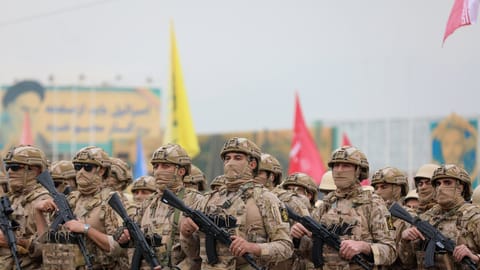
When Mosaic Defense was eventually activated, it would fix the problem, with tactics that went something like this. First, the Regular Army, also known as the Artesh, is expected to absorb the first blow.
Its armored, mechanized, and infantry formation serve as the initial line of defense, tasked with slowing enemy advances and stabilizing the front line. While this is going on, air defense units try to blunt enemy air superiority as much as possible.
Concurrently, Tehran will be using its own missile forces to try and cause as much damage to the enemy as possible.
Eventually, the IRGC and the Besiege are meant to turn the war into an attritional quagmire through decentralized operations, ambushes, local resistance, disruption of supply lines, and flexible operations across varied terrain, including urban centers, mountains, and remote regions.
Away from the land battle, naval forces are expected to limit access to the Persian Gulf and the Strait of Formos, disrupting one of the world's most sensitive maritime lanes, thus increasing the cost of the war.
Finally, we have to talk about Iran's proxy network, whose role is to widen the conflict and make sure that it's as painful for other countries in the region as possible.
That's how it was expected to work, but if there's one thing modern warfare has taught us, it's that no plan survives first contact with the enemy. So, here's how it's actually working. A Mixed Bag First, this war has, so far, been fought almost entirely from the air.
At the time of writing, there has been no land invasion of Iran, which means the Artesh hasn't had the chance to fulfill its role as the first line of conventional defense, and the IRGC and Besiege haven't had the opportunity to transition the conflict into the kind of drawn-out ground war the doctrine was designed for.
Given how quickly the war is evolving, the ground invasion could have happened by the time you watch this video. Although the ground troops haven't really had a chance to do anything, they are still being targeted with devastating consequences.
They have been the focus of multiple strikes, including on the 15th of March, when according to the Institute for the Study of War, the combined force reportedly targeted an Artesh air base in Khuzestan province, an IRGC Navy ammunition depot in Bushair province, a law enforcement command station in Tehran, and unspecified besiege sites.
But the strikes aren't the only problem phasing the ground forces. Iran International reported that the long-simmering tensions between the Artesh and the IRGC are worsening, mainly because of the treatment of wounded Artesh soldiers.
Sources
told the outlet that the IRGC refused to transport injured Artesh soldiers to hospitals, citing shortages of ambulances and blood supplies. Additionally, the Artesh are dealing with acute supply shortages, with one source saying that they had been issued 20 bullets for every two soldiers. The supply issues aren't just limited to the regular army.
Even within the IRGC missile units, traditionally among the best-resourced parts of Iran's military, there have been reports of communications, equipment failures, and shortages of food and other basic supplies.
The point here is that even if American and Israeli forces launched a ground invasion right this very minute, it's unclear whether the ground forces would be able to resist for very long. Next, let's look at the sea, where the combined force has sunk or damaged more than 60 Iranian vessels since the war began.
Despite this, Iran is still trying to put pressure on maritime routes through naval mines and attacks on commercial shipping. Still, according to the Institute for the Study of War, Iran's mining strategy appears restrained, deploying fewer than 10 naval mines in the Strait of Hormuz.
That it hasn't deployed them en masse suggests Tehran remains hesitant because of the political and economic costs it would face.
A mass deployment would damage Iran's relationship with China, its largest oil customer, and severely harm the Iraqi economy which Tehran relies on to evade sanctions.
On the missile and drone front, the combined force has systematically degraded Iran's infrastructure, with the Jerusalem Post reporting that Iran's ballistic missile launch rate has fallen approximately 92% from its day one peak, collapsing from 480 launches on the 28th of February to just 40 on the 9th of March. But there is a catch.
Even as Iran's offensive capacity is cratered, the cost of defending against what remains is becoming a problem. Semaphore reported that Israel informed the US this week that it is running critically low on ballistic missile interceptors, having entered the current war already depleted from last summer's conflict. And it's not just Israel.
Gulf countries told Washington that they were running critically low on receptors, and they were having to choose which objects to blow up. For Washington, this is a major headache, because its own supplies of missile interceptors are being eaten up fast.
Kelly Greico, a senior fellow at the Stimson Center think tank, told the Military Times that if the US used interceptors during the current Iran war at the same rate as it did during the 12-day war, it would use half of its entire interceptor stockpile in four to five weeks.
And production can't keep pace. The US procured just 11 new THAAD interceptors last year, and expects only 12 more this fiscal year. Greico put it plainly, quoting her here, You can't replace those kinds of missiles overnight.
It would take years. Finally, let's look at Iran's proxy network, which was supposed to widen the conflict and stretch the enemy thin. Hamas, after two years of war in Gaza that left the group severely degraded, is in no position to contribute militarily, and has instead issued a public statement calling on Tehran to stop striking neighboring countries.
Hezbollah, on the other hand, has been more aggressive with its support, firing six rockets into northern Israel less than 48 hours after the war began. Since then, the group has launched over 1,000 drones, rockets, and missiles at Israel over the past two weeks.
Israel has responded with heavy strikes across Lebanon targeting senior operatives, weapons depots, and command infrastructure, and is reportedly planning on launching a massive ground invasion in the south.
Iraq's Shiite militias have been equally as active. The Islamic Resistance in Iran, IRI, an umbrella network of Tehran-backed groups, began launching drone and missile attacks on the first day of the war.
By the 11th of March, the IRI claimed that it had carried out 291 operations, most of which targeted the Kurdistan region, where most American forces concentrated.
Some were aimed at the U.S. Embassy in Baghdad, which has been struck at least twice. Meanwhile, the Houthis have stayed on the sidelines, despite their leader, Abdul Malik al-Houthi, saying that the group was ready to strike at any moment.
Several regional observers told the Associated Press that the Houthis' reluctance stemmed from fears that their leaders would be assassinated and that they wouldn't have adequate weapons stockpiles to fight the war.
Ahmed Nagy, a senior Yemen analyst at the International Crisis Group, told the AP that the Houthis are likely to step in if the conflict widens or if they perceive an existential threat to Iran. For now, though, that hasn't happened. As a result, Iran's proxy resistance remains incomplete.
Regime Survival Given how we ended the last chapter, you'd be forgiven for thinking that the Mosaic Defense Doctrine is a spectacular failure. After all, even with Israel and the Gulf countries running out of interceptors, Iran is still on the back foot.
Its military is dealing with low morale and supply chain issues, and two of its main proxies are noticeably absent from the war.
But the Mosaic Defense Doctrine was never designed with the assumption that every element would work as planned. It was designed with the assumption that some elements would fail, and the system would keep going anyway. On that measure, the doctrine is doing exactly what it's supposed to do.
Most importantly, the regime is surviving, and there are no signs that it's about to collapse anytime soon. According to Reuters, US intelligence recently put out a report saying that Iran's leadership is still largely intact and is not at risk of collapse anytime soon.
Worse yet, a classified report by the National Intelligence Council, obtained by the Washington Post, found that even a large-scale assault on Iran would be unlikely to oust the Islamic Republic.
Even Israeli officials have privately acknowledged that there is no certainty the war will lead to Iran's collapse. Everything the Mosaic Defense Doctrine was built to protect appears to be holding. And while Iran absorbs punishment, the cost of the war for the US and its allies is climbing in ways that are hard to ignore.
Gasoline prices across the US have risen about 20% since the war began, hitting an average of $3.58 per gallon as of mid-March, with diesel up 28%. Oil briefly surpassed $110 per barrel before retreating. Fertilizer prices have seen equally staggering jumps.
The Carnegie Endowment for International Peace warned that even if the war stops tomorrow, restarting production and transport for fertilizers could take weeks, and the disruption to food supply chains could affect billions of people in the coming year. If the war drags on, the broader economic fallout could get significantly worse.
IMF managing director Kristalina Georgieva warned that a sustained 10% increase in energy prices over a year would push global inflation up by 40 basis points and slow global economic growth by 0.1 to 0.2 percent.
Now that might not seem like much, but when we're discussing problems on a global scale, those are massive numbers.
All this is happening at a particularly vulnerable moment for the global economy, with analysts at ING and elsewhere warning that the AI investment boom may be a bubble waiting to burst and US import tariffs continue to weigh on global trade volumes. Then there's the geopolitical fallout.
Iran's retaliatory strikes have hit Kuwait, the UAE, Saudi Arabia, and Azerbaijan, among others, and the chaos is prompting serious conversations about realigning global strategic partnerships.
Jim O'Neill, a former advisor to the British government, told The Guardian that the White House appeared to have given little consideration to the geopolitical impact of the war, quoting him here, "...the Gulf states will be thinking the US is an unreliable partner and be drawn towards China, India, and Brazil." And he's not the only one saying it.
Dr. Khalid al-Jaba, the executive director of the Middle East Council on Global Affairs, wrote in Al Jazeera that a sustained conflict would push Gulf capitals to revisit not only their defense planning, but also the deeper logic of their regional strategy.
This isn't something that's years away. It's already happening. Qatar's former prime minister, Sheikh Hamad bin Chassim, called for the formation of a strong Gulf military and security alliance similar to NATO, with strong ties to Turkey and Pakistan, to address regional challenges.
The last time the idea of an Islamic NATO came up, in the aftermath of Pakistan and Saudi Arabia's defense deal, we immediately dismissed the idea of an Islamic NATO because it would face several insurmountable hurdles. Now, we're not so sure. Domestically, the political picture for Trump is getting worse by the week.
A recent NPR poll found that 56% of Americans opposed the war, while only 36% approve of Trump's handling of it, and perhaps most importantly, 61% of independents are against U.S. involvement in Iran. The other numbers are equally as bad for Trump.
His overall approval rating sits at 37%, according to Quinnipiac, with his economic approval at 39%, the worst it's ever been.
For context, presidents historically see approval bumps after military crises. Bush Sr. got a 29-point bounce from the Gulf War of Bush Jr. gained after both Afghanistan and Iraq. Trump's approval has not moved at all since the strikes began.
Democrats hold a 9-point advantage on the generic congressional ballot question in the NPR survey, and 33 House Republicans have already announced they will not seek re-election compared to 21 Democrats, a historically elevated retirement rate that analysts read as a signal of how members privately assess their chances.
And we talk about the midterms a lot on the various fronts' properties, because if Trump loses the House, and possibly the Senate, he will, in effect, be a lame-duck president with a hostile Congress that would seek to curtail his every move. And right now, the polling and the retirements all point in that direction.
Meanwhile, in Iran, the regime is achieving its ultimate objective. sinking carriers not downing F-35s, but surviving. If the clerical establishment is still standing when the midterms arrive and a weakened Trump is forced to govern with a hostile Congress, then Tehran can credibly claim it outlasted the most powerful military on Earth.
That would validate the entire premise of the Mosaic Defense Doctrine, and it would confirm what Iran's leadership has believed for decades.
That regardless about how much American politicians talk about cutting the head of the snake off, American political willpower does have a shelf life, and if you can absorb enough punishment for long enough while inflicting enough damage, then the Americans will eventually move on.
They did in Iraq, they did in Afghanistan, and Iran is betting they'll do it again.
Unlock premium video briefings
Members get full access to premium reporting, in-depth briefings, and subscriber-only analysis.
Insiders Receive
- Full access to all premium articles and briefings
- Exclusive subscriber-only analysis and dispatches
- Support independent conflict journalism
From $5/month — cancel anytime