
The Rise of Gaza's New Warlords
Hamas's grip on Gaza is weakening, but the group's ability to adapt and survive is a testament to its resilience.
Simon Whistler • April 28, 2026
Members only
Note: this transcript was generated by AI and may contain errors or inconsistencies.
Earlier this month, Hamas formally rejected the disarmament framework that was supposed to move the Gaza ceasefire into its second phase. No one who follows the group was especially shocked by this. Voluntary disarmament was never realistic, and everyone involved more or less knew it.
But the rejection has overshadowed a harder question, whether Hamas can actually hold the territory that it's refusing to give up. Because the group is being squeezed from almost every direction at once, facing challenges to its authority that would have been unthinkable at any point since it took over the Strip in 2007. And not just by Israel.
Within the broader Palestinian movement, there are groups threatening to move in on Hamas's home turf. On October 10, 2025, a ceasefire took effect across the Gaza Strip, ending two years of war following the attacks on October 7, 2023.
The deal pulled the IDF back from its forward positions to a new line set up in the Strip and required Hamas to release the last-living hostages, but it saved the harder questions for a later phase two.
Those questions included the actual disarming of Hamas, the dismantling of its government apparatus, and a full Israeli withdrawal. Within a day, masked men in Hamas internal security insignias were back at checkpoints across Gaza City, Jabaliyah, and the central refugee camps.
The full apparatus of Hamas governance reappeared on the streets of nearly half the Strip that the movement still controlled.
And the message couldn't have been clearer. We are still here, and we are not going away. Israel estimates that roughly 22,000 Hamas fighters were killed in the war from a pre-war strength of 30,000.
Replacements through recruiting have partially offset that loss, numbering in the range of 10,000 to 15,000, though oftentimes teenagers, meaning they are usually poorly trained and not as effective as the soldiers Hamas lost. While we can't verify any of these figures, they do at least offer a window into the devastation that the group suffered.
All this, of course, is in stark contrast to Israel's stated war aims in the immediate aftermath of the October 7th attacks.
Not only the elimination of Hamas as a military organization, but as a governing entity entirely. On that front, their campaign very clearly came up short. Hamas isn't exactly thriving today.
Its founding generation of commanders has been wiped out, much of its rocket arsenal has been eliminated, and its support in Gaza itself is at an all-time low. But while the group barely limped across the finish line, the fact remains that they nonetheless reached it.
What has survived, the entire reason Hamas can still claim to be either the governing body or a military force at all, largely comes down to their presence below ground.
Hamas' tiles beneath the Gaza Strip had long been a point of strength for their fighters. They could move around, store large amounts of munitions, and retreat back underground after launching attacks with near impunity for years.
The tunnel network is genuinely impressive in scale, stretching for hundreds of miles beneath the densely packed coast and running multiple levels deep in places, with chambers fitted out for long-term occupation.
Tiled bathrooms, dormitory bunks, live electrical wiring still being found by NBC news crews accompanying the IDF units as recently as early 2026. When Israel went into the Strip in 2023, they knew that this would be a massive issue for them.
Hamas knew these complex mazes infinitely better than the IDF could ever hope to learn, but nevertheless, the system was simply too important to leave alone.
Fast forward two years later, and Defense Minister Israel Katz estimated that roughly 60% of the tunnel networks are still intact, including the deep infrastructure under Gaza city and the central camps that the IDF spent months working through without ever fully eliminating. Back up on the surface level, though, Hamas is facing a much harsher reality.
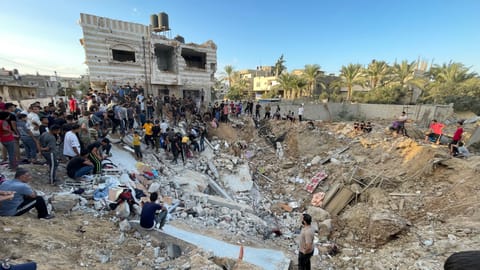
Over 92% of Gaza's housing stock has been damaged or destroyed, along with the vast majority of its hospitals, schools, and roads.
The UN's most recent assessment, released last week, stated that human development in the Strip has been set back 77 years, that recovery will cost upward of $71 billion and take over a decade.
Just shy of 2 million people remain displaced, many of them 10 or more times over, with 61 million tons of rubble sitting between them and whatever is left of where they used to live.
Not so long ago, Hamas's backers in Tehran might have bankrolled the group's reconstitution, but as you may have noticed, Tehran is just a little bit busy right now, which has forced Hamas to get creative.
The group has found alternative revenue through things like their tax regime on trucks entering through Hamas checkpoints.
They charge up to 50,000 shekels a go and have generated somewhere in the region of $66 million since October last year, much of which goes towards covering the operating expenses that the group faces in order to maintain both its civilian governance responsibilities and what remains of its military apparatus.
Whether they can hold their position in the state they're in is another question, and increasingly, they're not the only ones asking it.
The Monopoly Cracks Hamas's political bureau has long maintained a presence in Qatar dating back to at least 2012. Before then, they had a similar setup in Syria, so operating, at least in part, from exile is not new for the group. What is genuinely new, though, is that this was never exclusive.
The parts of the movement that did everything from war planning to hostage policy and political strategy on Gaza itself sat with senior figures inside the Strip. Yahya Sinwar, for example, ran the war from inside Gaza until Israeli soldiers killed him in Rafah in October 2024.
He was replaced by his brother, Mohammed, until he was subsequently killed by the IDF in Khan Yunus seven months later.
Between the two of them and the wider campaign, there is little left of the pre-war Gaza-based command structure, especially as it became clear that the Strip was simply too small and too dangerous to keep senior leaders in.
That's where the current Five Person Leadership Council steps in, based out of Doha, established in part to kick the can down the road on the kind of succession crisis that could tear the group apart.
Its two most consequential members, Khalil al-Hayr, the acting chairman who leads the pro-Iran faction, and Khaled Mashal. the diaspora head who has been pushing to realign toward turkey and qatar are pulling the group in fundamentally different directions on the question that matters most who hamas hitches its future to on april the 25th the palestinian
Authority central elections commission opened 12 polling centers across der el bala one of the few areas that hadn't been completely destroyed during the war in the first elections held in gaza since 2006. this municipality only includes some 70 000 eligible voters so it's far short of a gaza-wide election but it is nevertheless significant in part because
It is the first election of any kind and also because of who wasn't on the ballot hamas the pa which oversaw this round of voting required all candidates to formally accept commitments to recognition of israel and a two-state solution as a condition of running which hamas's charter rules out even if it didn't there's little reason to see them backing such a
Proposal it runs against much of their raison d'etre in the first place and that's not to say that hamas has completely stepped out of the equation though they were the ones to provide security for the polling locations quite not to the fact that they are very much still in the running even if they're not on the balance analysts have also noted that one of
The four lists of independent candidates basically a way of forming parties without officially naming them was widely understood to contain hamas aligned candidates running under tribal and professional cover when the final results came in on sunday the vatar backlist nadat der al-bala had taken six of the 15 council seats putting the pa aligned slate
Comfortably on top two independent lists split another seven ballots between them and the hamas linked list finished dead last with just two the casual observers this might be something of a surprise the pa has long suffered from a lack of popular support and its leader mahmoud abbas is currently on year 21 of what was supposed to be a four-year term when he
Took office in 2005. the picture isn't quite so simple though turnout came in at just 22.7 percent against a much higher 56 percent in the west bank some of this has been attributed to the voter registry not being updated since the war broke out with many on the list having been killed since but this only explains so much so is this the knockout blow to
Hamas that the initial reading of the results would suggest well no but it is nevertheless one more crack in hamas's armor in terms of holding their support in the strip together and beneath the surface it is starting to show as polls opened hamas spokesman hasem went on record speaking of the process in glowing terms and called for it to expand into
Presidential and legislative elections across all of gaza once the results were in though and hamas had placed last he reversed course dismissing the vote as having no real bearing on broader national political questions the election was a political challenge to hamas's hold on the strip a small one but a real one the challenges on the ground though have
Been considerably less polite long before hamas took over the strip back in 2000 you In 2007, Gaza's social order was organized largely around extended family networks, clans of thousands that, during the long disintegration of Palestinian authority control in the early 2000s, had effectively become mini-governments in and of themselves, running their own
Militias, informal courts, and even, to an extent, their own welfare arrangements.
Hamas recognized the risk this posed to their position as top dog in Gaza and quickly got to work dismantling them. In the summer of 2008, the movement raided the compound of one of the largest clans, the Hillez, killing clan leaders and forcing others to flee across Israeli lines.
At the same time, Hamas offered an off-ramp, fold into Hamas's network, accept them as the top dog, and the clans would be able to persist to some extent.
That arrangement more or less held, without significant testing, for 15 years. Increasingly, though, there are real signs that it is under pressure and that Hamas is concerned about it escalating. In June last year, fighters from the Barber clan in Khan units fought a sustained two-way gun battle with Hamas's Saham unit.
And in September, news broke that one member of the Hillez clan had begun leading an Israeli-bagged militia in one of their areas. The clan's council moved quickly to repudiate them, but it was largely beside the point. Neither of these developments would have even been conceivable at any point in the previous decade and a half.
But they're not isolated cases, either. Some 48 hours into the ceasefire, gunmen in Gaza City killed two Hamas members, including the son of a senior official. Within the hour, roughly 300 Hamas fighters flooded into Sabra and Tel Al-Hawa, killing 27 people.
The following morning, the Saham unit marched eight blindfolded members of the clan onto a major Gaza city avenue and executed them publicly on camera. The fact that Hamas responded with violence to threats to their continued rule is not particularly surprising, but the public nature of it and the shared footage was.
This was a show of strength, but also an indication that they were genuinely worried about the fragmentation of their territory.
Some of this fragmentation was less than spontaneous. In late 2024, Shin Bet director Ronan Barr pitched Netanyahu on a program to arm small Palestinian factions inside Gaza willing to operate against Hamas, which was approved without ever passing through the security cabinet.
We only know of this to begin with because Operation Leader Avigdor Lieberman accused the government on Israeli radio of distributing weapons to ISIS-affiliated gunmen inside the Strip.
Now, while we cannot independently verify the extent to which these groups may be extremist, their leadership does raise serious concerns. The most prominent among them was Yasser Abu Shabab, who had been imprisoned by Hamas in 2015 on a 25-year drug trafficking sentence and only got out early because of a well-targeted airstrike.
He was ultimately killed last December, but the man who succeeded him may be even worse.
He's reportedly a member of a Salafi group that pledged allegiance to ISIS back in 2015. Several other commanders across the program had backgrounds in narcotics. trafficking, and reportedly included veterans of ISIS-affiliated formations from elsewhere in the region. They're not huge.
They number in the low thousands, though precise numbers are hard to come by. The same goes for one faction that should, on paper, pose a far more serious threat than any of these clans. Palestinian Islamic Jihad, or PIJ.
A rival Islamist movement with its own military ring, al-Quds, and direct Iranian funding through the IRGC, you'd think it would be chomping at the bit to seize this moment. In practice, though, the al-Quds brigades field less than a thousand fighters, and Israeli strikes have hollowed out their command structure over the past two years.
In short, they're not much of a military threat even to Hamas.
What they are, though, is a risk for the future. The group has long positioned itself as the faction that thinks Hamas is too moderate, and in a post-ceasefire Gaza, where Hamas is actively negotiating with, and at least tacitly working alongside Israel, that accusation is starting to land differently than it used to.
PIJ just has to exist as the place where true believers can flock to if they decide Hamas has sold out, something Hamas cannot afford.
And they do seem to be taking it seriously. The Iran war has thrown a wrench in the long-standing alliance Hamas has had with both Tehran and Doha, given Iran's month-and-a-half-long attacks on their neighbor.
After hoping it would blow over, they eventually put out a statement reaffirming their allegiance to Tehran, which the Qataris responded to by telling Zidia leadership to leave entirely.
This was a likely outcome of siding with Iran over Qatar, but they made it anyway, indicating that they recognize they cannot afford to lose Iranian support, even in its diminished form. If they do, PIJ will be right there, all too eager to step in and fill the gap.
Two Gazas The deadline for Hamas to accept the Board of Peace disarmament framework, the more controversial part of the ceasefire, which had been kicked down the road into the separate Phase 2, officially expired earlier this month on April 14th.
Hamas delegation, led by al-Hayr, met with the Board's High Representative for Gaza, Bulgarian diplomat Nikolai Mladenov, and U.S. Senior Advisor Aya Lightstone, only to reject the disarmament framework that Mladenov had spent the previous months working toward.
They called it unrealistic, accused Mladenov of bias towards Israel, and had deep reservations about even using the word disarmament. On its own, this would be a setback for the peace deal for the Strip.
The bigger consequence, though, is that the plan had been the Trump administration's only vehicle for moving the ceasefire from Phase 1 into Phase 2, in which Israel pulls back further and a technocratic Palestinian government takes over civilian administration of the eastern half.
It completely calls into question whether anything at all had been agreed to about Phase 2 in the first place. The ceasefire has largely frozen the Strip into two halves.
Everything east of the Yellow Line, somewhere between 53 and 58% of Gaza's territory, including almost all of Rafah, much of Khan Yunus, and the eastern neighborhoods of Gaza City… An unhingya Miha has stayed under IDF control, with the rest being left to Hamas. The line was, in theory, temporary, something that Phase 2 would eventually push further east.
In reality, though, it's been hardening.
A satellite review by the BBC in January caught concrete markers in Tufa neighborhood, drifting an average of 295 meters deeper into Gaza over the space of a month, and analysis shows that it's not the only such case. Around the same time, Defense Minister Katz told settlers in the West Bank that Israel will never leave Gaza.
Reuters, for its part, polled 18 diplomats back in November and found that the consensus was near unanimous.
The yellow line was hardening into an indefinite border. Chatham House's follow-up assessment in February went further. It was titled Two Gazas and an Annexed West Bank, with similar takes appearing around the same time from the International Crisis Group.
The answer that was supposed to prevent all of this from becoming permanent, the neutral civilian administration for Gaza, can't even get inside the Strip itself and is currently set up in Cairo.
Tony Blair, who has been playing a central role in the Board of Peace's oversight of the Strip, confirmed that the Board would play no role whatsoever in disarmament. Not that they would be welcome either way.
Neither Hamas nor the Palestinian Authority actually wants them to work. What's actually taking shape, then? Is something that very well may be the end result of everyone's least hated outcome.
A frozen status quo that lets Netanyahu keep squeezing Hamas without handing Gaza to the PA, lets Hamas avoid, at least to some extent, a full disarmament, and lets both the PA and the Trump administration avoid owning a situation that they'd rather leave unresolved. None of this was anyone's stated objective.
But let's be honest, stated objectives stopped mattering a long time ago in Gaza.
For the nearly 2 million people living there, though, the question of who governs them has quietly been replaced by a different one entirely, whether any one entity will govern them at all.
Unlock premium video briefings
Members get full access to premium reporting, in-depth briefings, and subscriber-only analysis.
Insiders Receive
- Full access to all premium articles and briefings
- Exclusive subscriber-only analysis and dispatches
- Support independent conflict journalism
From $5/month — cancel anytime