
The Rise of Motorcycle Warfare.
Simon Whistler • April 21, 2026
Members only
Note: this transcript was generated by AI and may contain errors or inconsistencies.
When the First World War began, the age of cavalry warfare reached its natural conclusion. For millennia, the mobility, the speed, and the sheer power of the mounted horsemen provided an unmatched battlefield advantage, whether by the chariot, by the bow, or by the lance.
But once the Gatling gun and the tank made their way to the front lines, and once those front lines were ashamed by trenches and heavy artillery, cavalry was rendered nearly useless.
The world still occasionally saw the use of the mounted soldier, whether in Peshiba in 1917, or in Bataan, and on the shores of Russia's Don River in 1942. But outside of an incredibly narrow set of circumstances, there is simply no place for cavalry in modern warfare.
That was the case until another battlefield innovation created an opening for mounted warfare to return.
The introduction of first-person drone technology in war-torn regions across the globe has forced global militaries and non-state actors to rethink their tactics, fighting forces that can use drones effectively, either for surveillance, strikes, or kamikaze attacks, have a clear advantage in basically any warfighting environment on Earth.
But for those forces that have to stand against a drone-equipped army, there are only so many ways to respond. In a best-case scenario, they'll find and destroy drones at the source before they can never get off the ground.
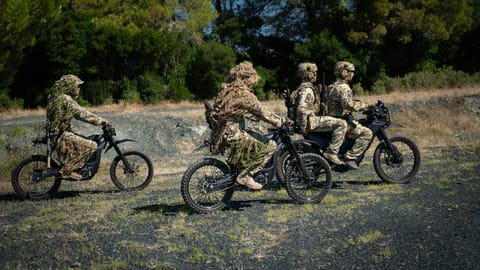
In the next best case, they'll learn to jam those drones, intercepting them cheaply at long range or shooting them down. But if ground forces are going to come into contact with drones directly, then they're going to want to be as mobile as possible, not by relying on horses, but by getting their hands on a motorcycle.
When the Wheel to Sars Arrive Turn back the clock to the spring of 2024, and Russia's experimentation with motorcycles seemed as if it would become the newest meme of Moscow's disastrous Ukraine invasion.
At the start of Russia's offensive for that year, Ukrainian forces had reported highly unusual activity up and down the front lines, as Russian infantry soldiers mounted motorcycles, dirt bikes, all-terrain vehicles, open-top buggies, and any other single-rider vehicle that could travel reasonably quickly.
In all-out frontal assaults, those unfortunate Russian troops would push their vehicles to their limits, trying to cross no-man's land as quickly as possible, and get within range of Ukrainian trenches.
At the time, Russia's tactics seemed like more of the same, not because they, or Ukrainian troops, had been using motorcycles, but because it seemed as if Russia had simply found a new and interesting way to orchestrate a suicide charge.
In the prior year, there had been tens of thousands of conscripted prisoners who had been made to serve as bullet sponges in Russian wave assaults, and in the year before that, Russian tanks and armored vehicles had taken most of the damage, as Russia learned the hard way that it was fighting a very different style of war than its generals had imagined.
When Russia shifted its focus to motorcycles, it almost seemed as if the change was driven by a certain calculated sadism. Sure, Russia's leaders were letting their troops think they had a chance, but in reality, they were charging to their deaths all the same.
In practice, those assumptions turned out to be partially correct. Russian soldiers really were sent clinging to their dirt bikes, driving headlong into automatic weapons fire with little hope of survival.
In the early days, if the Russians were trying to out any new tactical adaptations to make the most of their motorcycle assaults then those adaptations were not working as a new york times article from 2024 described the results quote these non-conventional vehicles have been turning up with such frequency that some ukrainian trenches now overlook junkyards
Of abandoned blown up off-road vehicles end quote as that article explained quoting again the new tactic is the latest russian adaptation for a heavily mined continually surveyed battlefield as moscow's forces worked to achieve small tactical gains often of just a few hundred yards end quote but over the following months ukrainian forces and outside analysts
Were forced to acknowledge a difficult reality russia's motorcycle assaults may have been immensely costly but they were starting to produce results riding as fast as they could russia's motorcycle cavalry had an easier time dodging incoming first-person view kamikaze drones and they were difficult for artillery to target with any real accuracy beyond the
Incidental hits that came from far toward the area where they were trying to advance the answer was obvious rifle more ideally machine gun fire spraying out at exposed minimally armored soldiers but in practice the speed of the motorcycles and buggies meant that there was simply less time to hit them compared to either soldiers trying to approach on foot or
Armored units trying to attack in heavy slow-moving fighting vehicles they worked especially well when they were paired with russian artillery where bombardments on fixed ukrainian trench positions could keep the ukrainians heads down and at times even make it hard to hear the incoming motorcycles over the constant explosions if the russians could bridge the
Gap the results could be devastating their motorcycles would be quickly discarded and with rifles and shotguns they'd set to work clearing trenches as quickly as possible over time the russians learned to incorporate other tactics building ultra heavy ridiculous looking turtle tanks that could soak up ukrainian fire and try to attack from several vectors at
Once whenever possible but the russians weren't the only fighting force experimenting with motorcycle warfare around this time some 5 000 kilometers away in the arid african sahel region it wasn't a russian-aligned force but their adversaries who attempted to use motorcycles to their advantage the group that introduced motorbike warfare to the region is
Known as janim an al-qaeda linked insurgency that's quickly become one of the most dangerous jihadist groups on earth in fact janim adopted motorcycle warfare before russia did quoting a 2023 report from global initiative against transnational organized crime quote motorcycles have been a near constant presence in sahelian armed groups battlefield operations
With swarms of motorbikes allowing tens or even hundreds of fighters to rapidly descend on a target location end quote across the sahel janim has used motorcycles in massive roving packs more reminiscent of the mongol horse archers of genghis khan's day than any fighting force of the last few centuries in fact by 2023 motorcycles were already among the most
Valuable and sought after items across the sahel's black markets traveling into the region from the coastal states along west africa's southern shoreline sometimes janim used its motorcycle cavalry in raiding attacks against villages swarming and overwhelming local defenses before village militias had any advance of organizing a response.
In those attacks, jihadists could leave as quickly as they'd arrived, requiring no more than a few minutes to briefly seize control of a storehouse or a community building, steal or kidnap whatever or whomever they were after, and disappear into the open desert.
But quickly, Janim learned that motorcycles were just as effective when turned against national militaries, if not even more so. Stuck at remote fixed outposts with few armored vehicles and no real ability to maneuver, troops across the region were sitting ducks against the motorcycle attacks.
In one particularly costly incident, at a military outpost near the town of Dijbo in northern Burkina Faso, a swarm of Janim motorcycle gunmen killed roughly 200 Burkamabe troops. Recently, the same tactics showed up in Syria, in a predominantly Christian town in the province of Hama.
There, after a local dispute sparked bitter sectarian attacks across the area, militants from a nearby majority Sunni town engaged in a large-scale motorcycle raid that lasted for hours.
Quoting an Associated Press reporter on the incident, There was no immediate word on casualties in the attacks that lasted until the early hours of Saturday, during which scores of men on motorcycles from the nearby Sunni town of Khalat al-Madik attacked the property of Christians." By the time the government forces arrived to quell the fighting, the
Attacking Sunni gunmen were long gone.
In Syria, however, the use of motorcycles is hardly a new phenomenon. In the rebel stronghold of Idlib, prior to the fall of the Assad regime, rebels frequently leveraged motorcycles in hit-and-run attacks, even managing to mount machine guns on their motorbikes in some cases.
Meanwhile, back on Europe's Eastern Front, Ukraine has made its own adaptations to the event of motorcycle warfare, not just trying to counter Russian tactics, but accepting the need to mirror them. In the spring of 2025, Ukraine formed its first motorcycle attack company, known as Scala.
In Ukraine's case, early motorcycle tactics were designed with Russia's operational failures and setbacks in mind, with Kyiv able to make select adaptations to reduce the likelihood that its soldiers would be killed.
Ukraine designed its motorcycle forces to ride in tandem, with a driver and a gunman on each bike, using those forces in tandem with drones during counterattacks and limited forward offensives. Once they get into range of their targets, they dismount and maneuver on foot, working as paired combat teams in close quarters.
By that time, Ukrainian intelligence was reporting that Russia had formalized its training practices to bring its troops up to speed on motorcycle swarm tactics… unintended, by the way.
According to Ukrainian frontline sources, there was an understandable reluctance among ground troops to embrace Russia's motorbike tactics, at least in the early days. Now though, Ukraine's motorbike troops have proven to be an immensely helpful auxiliary force as Kyiv continues to adapt its tactics and gain ground in the counteroffensives of 2026.
Russia, meanwhile, started 2026 by attempting to leverage actual horse-mounted cavalry, although this seems to be considerably less effective and is mostly a result of equipment shortages on the Russian side.
The Case for the Motorcycle The reintroduction of the motorcycle on modern battlefields is hardly an accident, and nor is it an extension. of other roles fulfilled by motorcycles across conflict zones. Motorcycles never fully lost their place in warfare, especially in the high-paced asymmetric conflicts that constantly pop up around the world.
Motorcycle couriers ferry messages between units in austere environments.
Motorcycle porters bring logistical support and resupply to places that are too dangerous to risk slow, visible, unarmored transport trucks. Unconventional operators and cartel sicarios use motorbikes to ambush their targets, empty their magazines, and make an exit before anybody nearby can even think to react.
In each of those roles, the motorcycle can make a real difference under the surface of a conflict, but that's a fundamentally different role for the motorbike than what we're discussing now.
Over the last several years, motorcycles have become an increasingly important element in unit-level action, requiring coordination, expenditure of resources, and commitment to a warfighting approach where failure can cost many lives at once.
The first step in understanding just why motorcycle warfare seems to make sense for certain armed groups is to understand what those groups have in common that they don't share with fighting factions that have not developed an interest in the new tactic.
We'll start with the motorbike's greatest asset of all, its combination of forward speed and maneuverability.
For both Russian and Ukrainian fighting forces, the adoption of motorbike chargers is a reflection of the idea that sometimes the best defense is a good offense. Russian and Ukrainian forces alike are at the mercy of a drone-dominated battlefield.
Yes, kamikaze drones are a massive threat in their own right, but the constant round-the-clock surveillance that drones can offer is arguably even more important.
It is exceptionally dangerous to be a fixed or stationary target in Ukraine, whether that's a main battle tank, a trench, or even a single soldier who's been wounded and can't get to safety. It's in these types of environments that motorbikes are exceptionally helpful.
When they're used on offense by Russia and Ukraine, they dramatically reduce the amount of time that defenders have at their disposal to start getting troops in place, call in artillery support, or prepare and launch waves of short-range kamikaze and bomber drones.
Time an attack just right, or pair that attack with diversions elsewhere, and an attacking motorbike force can reclaim the element of surprise on a battlefield that's been monitored constantly.
While it's true that motorbikes allow their riders to evade incoming far more easily, their real value is in cutting down the ability of defending forces to create any counter-threat movement that requires evasion in the first place.
The same can be said of other fighting factions that are at a real-time intelligence disadvantage compared to their adversaries.
For Janim and other armed groups in the Sahel, regional militaries are typically either defending outposts or traveling in large, roving units, meaning that with accurate intelligence they can assume defensive postures to weather a prolonged siege or maneuver overwhelming force toward a jihadist unit's location if know where the jihadists are and how quickly
They're moving.
Motorbikes allow Janim to attack at longer ranges with much less of a wait time, with very large jihadist units capable of traveling across dozens of kilometers toward a target that doesn't see them coming.
Terrain matters too, and it's hardly an accident that the forces that have adopted motorbike warfare the quickest are the ones fighting in relatively flat open areas.
The Russian Unique Ukrainian forces, those areas of the rolling plains of the eastern Ukrainian Donbass versus the scrubland and rocky semi-desert that's more common in the Sahel and Syria.
These tactics simply wouldn't work in a conflict like Myanmar or the Congo, where the terrain is typically much more uneven and fighting forces have to constantly navigate around or through forests. Similar tactics would be unlikely to succeed in, say, the hills and caves of Afghanistan.
Nor would it even make sense for fighting forces in those places to try and use motorbikes when the natural cover afforded to them by the landscape or the surrounding vegetation provides far better cover from drones.
Motorbikes are an adaptation to battlefields where concealment may be possible for individual soldiers or small units, but where it's practically impossible at scale. Just as important are the fighting forces' approach to one specific issue.
Attrition. No matter how good a fighting force might be at building and leveraging motorcycle swarms while on the attack, they're always going to be a very dangerous choice for the troops expected to make those attacks happen.
Fighting forces that prioritize the survival of their lower-level troops are going to be rightfully hesitant to consider this approach.
For a force like Russia, however, that's not really an issue. Russia's style of warfare has always been highly attritional, and especially so during the war in Ukraine. Again, we'll reference the tens of thousands of prison conscripts that Moscow was happy to throw toward the front lines.
The same can be said for jihadist or Islamist fundamentalist forces, where a fighter's moral demise is tied deeply to themes of religious martyrdom.
Ukraine, of course, is the exception to the rule, with Ukraine's recruitment troubles, its chronic troop shortages, and its willingness to invest heavily in soldiers' well-being, all making motorcycle warfare more difficult to consider.
For that reason, however, it should be no surprise that Ukraine keeps its motorcycle forces smaller, invests more heavily in training, and uses its motorcycle troops more sparingly in well-planned assaults.
Then there's the question of cost and accessibility, both of which are areas where motorbikes bring immense value. Compared to a tank or an armored fighting vehicle, motorcycles are dirt cheap, and on a battlefield where slow, heavy vehicles are constantly vulnerable, those dirt cheap alternatives also happen to be a better investment.
They're much easier to repair, using parts that are mass-produced in far greater numbers, or are more easily replaced with jury-rigged alternatives that can be built in small workshops.
They're totally unregulated, available on both the legitimate civilian market and the black market, and they are easy to requisition or steal, depending on who's trying to acquire them.
For a country like Russia, where fighting equipment is expended at incredible rates, there's a much larger pool of available motorcycles and dirt bikes to draw upon, compared to the pool of available modern main battle tanks.
They're both easier to fuel, using the resources likely to be in circulation in remote or contested areas, and they're much more fuel efficient, especially for long-distance travel.
Motorcycles also offer particular advantages when thwarting drone technology specifically. When trying to design a drone-based solution to motorcycle swarms, the basics of a response might seem straightforward.
Flood the skies with more drones at all times, so they can track and identify targets quicker, and respond to them more. forcefully, with less time required to make that response happen.
Better yet, artificial intelligence integration could allow a networked drone swarm to respond to incoming motorcycles without the need for human coordination, and perhaps not even human approval. The reality, however, is a bit more complicated.
The AI on most of the drones in Ukraine right now tends to struggle with the identification of motorcycles and their riders, and because most FPV drones or small surveillance drones aren't particularly good at tracking fast-moving objects, motorcycles tend to disappear from view too quickly.
In time, drone technology will almost certainly be able to respond with better software, more efficient networking, and other fixes that will make motorcycles less difficult to deal with. But in the short term, drone-reliant militaries are vulnerable to the introduction of motorbikes that don't line up with the threats their drones were designed to counter.
Taking a longer view, motorcycles don't require very much innovation in order to be effective.
Compare the technology to drones, where on opposite sides of the front line in Ukraine, developers and manufacturers are slaving away on a wide variety of new designs in a constant, iterative competition to get ahead.
That's not really an issue with motorbikes at all, where the fundamentals haven't changed much in the last hundred years, and where there's a very limited number of ways to improve on the technology without compromising it.
Sure, you could try and make motorcycles more survivable by adding armor or more useful for long-haul journeys by adding carrying capacity, but in both cases, the rider is going to pay for those changes with an immediate loss of speed and maneuverability.
Russia has attempted to mount protective iron cages on its motorbikes to protect riders from direct drone strikes, and Moscow is in the early stages in an attempt to explore the use of electronic warfare jammers mounted on the motorbikes themselves, but the simple physics of the motorcycle are such that the technology only allows for a change on the margins
Before jeopardizing the weight-to-power ratio that makes motorcycle warfare viable.
Instead, it's much easier to innovate tactics to accommodate the use of motorbikes than it is to innovate on the motorbike itself.
Fighting forces can pair motorbikes with other technology, and they can replace motorbikes with four-wheel all-terrain vehicles when they'd be more appropriate, while keeping most of the same principles that make motorcycles effective as swarm fighting units.
As a result, fighting forces don't have to invest the same kind of time or the same volume of resources away from the front lines in order to make motorcycles workable.
It would certainly be helpful to rely on support units or civilian partners on the home front, gathering as many motorcycles as possible and shipping them toward a conflict zone, but that's a much lower demand on a military or a non-state group than trying to maintain capability at the cutting edge in a new domain of warfare.
Nor is it as difficult to train a soldier to ride a motorcycle as it is to train them to competently operate an FPV drone.
Modern warfare is a constantly shifting mess of technologies, tactics, and strategic objectives, and when convergent evolution takes place on the battlefield, it is never an accident.
The world isn't moving collectively toward motorcycle warfare in the same way it's moving toward the use of unmanned technology across all domains, but in certain situations… Because of circumstances that unmanned systems and other new equipment have created, the motorcycle is entering something of a combat renaissance.
How long that renaissance will last is another question entirely, but counterintuitive as it may seem, the early adopters of modern motorcycle warfare have been rewarded for their willingness to gamble.
That trend is likely to continue until some new evolution comes along and renders the combat motorcycle obsolete. Thank you.
Unlock premium video briefings
Members get full access to premium reporting, in-depth briefings, and subscriber-only analysis.
Insiders Receive
- Full access to all premium articles and briefings
- Exclusive subscriber-only analysis and dispatches
- Support independent conflict journalism
From $5/month — cancel anytime