
The Siliguri Corridor: India's Weak Point.
The Siliguri Corridor: India's Weak Point — a Fronts video briefing on China & Indo-Pacific.
Simon Whistler • December 23, 2025
Members only
Note: this transcript was generated by AI and may contain errors or inconsistencies.
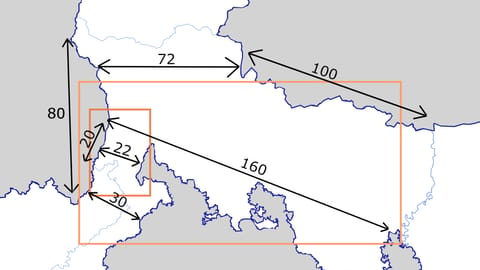
It's a 22 kilometer wide, 200 kilometer long stretch of land that is perhaps the single most important part of India's territory. Sandwiched between Nepal, Bhutan and Bangladesh, and if that wasn't enough, very close to the border with China, this strip of land connects mainland India to the states in the country's northeast.
It has been described as a logistical lifeline not just for the tens of millions of people living in India's northeast, but also for the country's military as it tries to project power in an increasingly contested region.
Yet, despite its importance, most people outside of India have never heard about the Silaguri Corridor, and honestly, we can't blame them. After all, how often do narrow strips of land make international headlines? Usually, twice.
One when something goes catastrophically wrong, the kind of thing that gets recorded in history books as having led to a major war, or two when the powers that be are trying to prevent something from going catastrophically wrong. In our case, it's the latter.
In November, Indian outlets reported that the government had set up three fully operational garrisons at strategic points around the Silaguri Corridor near the India-Bangladesh border.
Additionally, the Indian Air Force staged one of its largest ever airshows in the northeastern state of Assam on 9th November, as well as seven days of large-scale air force exercises across northeast India that ran until 20th November. All of this firepower on display forces us to ask several critical questions. 1. What is India signaling? 2.
Why now? And finally, can India keep the Silaguri Corridor safe? Vulnerability Now, before we can answer the first of our major questions, we need to give you a bit more context on the Silaguri Corridor.
Because while we've told you where and what it is, we haven't told you what makes it so vulnerable. So vulnerable that it has earned the nickname India's chicken neck a comparison as apt, as it is morbid, because just as a chicken's neck is the narrowest, most vulnerable part of the bird, this strip of land represents India's most exposed weak point.
Sever it, and you've effectively separated the head from the body.
That weakness comes from a combination of history, geography, and geopolitics. The Silaguri Corridor was created after the partition of India, one of the bleakest times in recent history.
According to Colonel Mahindra Par Singh, director at the Foundation for Economic Growth and Welfare, at the time of the formation, most Indian planners didn't foresee any threats to the corridor.
However, that changed after the Chinese Communist Party came to power in 1949, and Beijing occupied Tibet the following year.
China and India would have major border conflicts in the intervening years that were seemingly resolved in 2003, Beijing and New Delhi side deal where China gave up all of its territorial claims to one of India's northeastern states, Sikkim, in exchange for India, recognizing China's sovereignty over Tibet.
Colonel Singh writes that this went a long way to reduce tensions in the region.
However, China continued its attempts to seek control of the region, resulting in the 2017 Doklam standoff.
While this was resolved without much escalation, in India's view, China still remains a major threat to the corridor because of its road construction on its side of the border, which, according to Colonel Singh, would allow China to rapidly mobilise and deploy troops, thereby threatening the Silaguri Corridor.
Additionally, from Mount Gipmochi, which China claims as the border point between itself, India and Bhutan, Beijing can aim artillery fire on the corridor, thereby crippling the single railway line that acts as the main link between the Indian mainland and the northeastern states.
So all of India's strategic planning around the corridor was, understandably, focused on a potential confrontation with China. That was until 2014, when the ouster of Bangladeshi leader Sheikh Hasina in August ushered in a new government led by Nobel laureate Muhammad Yunus.
Unlike Hasina's government, that was widely seen as prioritising its relationship with New Delhi, regional observers believe the new government is closer to China than it is to India.
The Yunus administration recently revealed plans to purchase $2.2 billion worth of advanced Chinese J-10C fighters, as well as working with Beijing to establish a drone manufacturing hub to enhance the indigenous defense industrial base. China has also made notable inroads in Bangladesh under its Belt and Road Initiative, or BRI.
And New Delhi is not taking that shift lightly.
In March, according to DW, Yunus made what New Delhi considers a provocative statement, saying that India's northeastern states were landlocked, and that Bangladesh was the only gateway to the ocean for the region.
While Bangladesh has maintained that the statement was meant to underline the potential for regional connectivity, in New Delhi it was considered as a veiled threat against the corridor. And that isn't the only point of tension between India and Bangladesh.
Since Yunus's government rose to power, it has pursued closer ties with Pakistan. Pakistani Prime Minister Shahbaz Sharif and Yunus agreed to deepen bilateral cooperation in all areas of mutual interest after the two leaders met on the sidelines of a conference in Cairo in 2024.
Islamabad has also sent high-level officials, including its foreign minister and intelligence chief to Dakar, to sign trade agreements and revive military cooperation with naval visits and defense talks.
According to India Today, Dakar revived the World War II-era Laomon Eirat Air Base in North Bangladesh, located just 16 kilometers from the Silaguri Corridor. While it was originally announced as a civilian upgrade, the project drew attention after visits by Chinese officials and reports that a Pakistani defense firm might be brought in for construction.
Intelligence reports viewed by the outlet confirmed the installation of an advanced surveillance mainland system that would increase China and Pakistan's ability to spy on India's military installations.
Analysts who spoke to DW viewed all these efforts as Bangladesh trying to counter India's influence, while New Delhi sees it as a security threat.
Fazli Alahi Akbar, a retired Bangladeshi general, told DW, and we'll quote him here, that Bangladesh will always acknowledge India's role in 1971, when India's intervention was crucial to Bangladesh's independence push. But that doesn't mean it will keep bowing to India when its own interests are being sidelined.
End quote. Now, in our introduction, we mentioned India's major show of force in the northeastern states. What we didn't mention was that it happened around the same time as a visit by Pakistan's Navy chief to Dakar, Bangladesh's capital, and the anchoring of a Pakistani warship in Bangladeshi waters for the first time. 1971.
We also didn't mention that about a month after the show of force, Hasnat Abdullah, a Bangladeshi politician who played a significant role in the protests that ousted Hasina, accused India of harboring Bangladeshi separatists.
He also said that if Bangladesh was destabilized, Dakar would provide refuge and aid to separatists seeking to split the northeastern states from New Delhi. With this context in mind, we can get back to our first question.
What was India signaling with its recent show of force? According to Harsh V. Pant, head of strategic studies program at the New Delhi think tank Observer Research Foundation, or ORF, while India has consistently signaled its message through military exercises in the past, the most recent airshow was probably just a routine exercise.
However, we believe that New Delhi was telling China, Bangladesh, and Pakistan that it was ready to defend its territory no matter the cost. And that leads us to our second question. Why now?
Beyond the increased risk from the three nations we just mentioned, the most likely reason why India chose to act now is because of the upcoming elections in Bangladesh which will be held in February 2026.
In our view, by showcasing its military might, India might be subtly signaling to Bangladeshi voters that their best option lies in choosing a government that, if not as outright friendly to India as the Hasina government, won't be antagonistic to New Delhi.
It's a view that's supported by several experts that spoke with DW, who said that India was most likely waiting out the interim government, signaling that it would only engage with an elected government that has the people's mandate.
It's possible that India believes that by flexing its military muscle now, it can influence the electoral calculus and remind Bangladeshi politicians that antagonizing New Delhi comes with consequences. Defense For our third question, whether India can actually defend the corridor, we need to consider two things.
One, how likely is it that the corridor is actually attacked?
And two, what India has done beyond the show of force to fortify its position? Let's start with likelihood. The truth is, despite all the alarm bells and military posturing, a full-scale Chinese assault on the Silaguri Corridor remains unlikely.
Not because China lacks the capability. According to military experts, a Chinese advance of just 130 kilometers from the Trumbi Valley could theoretically cut off the entire northeastern region, but because the costs would be astronomical.
A direct military strike on the corridor would mean war with India, a fellow nuclear-armed power with over 1.4 billion people, and one of the world's largest standing armies.
As Geopolitical Futures pointed out in 2017, when the question of an invasion had once again reared its head, while the Silaguri Corridor matters greatly to both countries, it doesn't matter enough to justify the costs of a full-scale conflict, especially when China is dealing with economic challenges, tensions with the United States, and other immediate
Security concerns.
And for Pakistan and Bangladesh, the calculus is even more straightforward. Neither country has the military capability to launch a credible assault on the corridor without incurring the wrath of a fully pissed-off India.
And as Pakistan learnt in early 2025, a pissed-off India is a frightening foe. We do have to point out here that there is the possibility, no matter how- How far-fetched it might seem that the three nations launch a coordinated attack meant to completely overwhelm India's defenses.
This is extremely improbable and would require several things to go completely wrong before it even happens, and it would trigger the involvement of India's international partners such as the US, which would very quickly even the odds in New Delhi's favor.
So, while it is important to acknowledge this possibility, we won't waste time dwelling on what amounts to just geopolitical fantasy. So, if a full-scale invasion is off the table, is there another viable outcome?
Well, what's more likely is what we've already seen, China using infrastructure, surveillance and positional advantage to maintain pressure without crossing into open warfare.
According to Ambassador Jai Di Mazumdar, former Secretary in the Ministry of External Affairs, the greatest risk that exists is from China gaining an even greater foothold in Nepal, Bhutan and Bangladesh and using it to effectively encircle the corridor. Sachin Singh, a lecturer at Yale University, wrote in Foreign Policy, this is India's nightmare scenario.
So, can India defend the Silaguri Pass should the nightmare scenario play out?
The answer, according to most regional observers, is yes.
The Eurasian Review, an independent journal that provides a venue for analysts and experts to discuss under-reported topics, said, and we'll quote them here, Indian military leaders frame the chicken's neck as one of India's strongest defensive positions, already defended with the Trishakti Corps, with Rafale fighter jets, BrahMos missile systems and S-400
And Akash air defense platforms, end quote.
The three additional bases that we alluded to at the start of this video are widely seen as a force multiplier to increase the effectiveness of India's deterrence in the region.
According again to the Eurasian Review, the three bases form a strategic triangle that provides overlapping coverage of the critical corridor while maintaining direct connectivity to major command centers.
One of the bases in Dubri has advanced intelligence gathering and signal monitoring capabilities, which would support what an Indian Army official, Lieutenant General M.K. Singh, told Ambassador Mazumdar, quoting him here, we have enough capability to monitor the proposed airbase very closely and thwart any threat emanating from it.
But for that, we have to enhance our surveillance and defensive capacities in the Silaguri corridor, end quote. The other bases, according to Indian Defense Research Wing, an outlet that covers India's military, are designed for rapid troop deployment, logistical support and broad area monitoring.
In the outlet's view, they are ideally placed to intercept any infiltration or hostile activity, particularly along the Bangladeshi border.
India has clearly demonstrated that it possesses both the will and the capability to defend the Silaguri corridor. The military build-up, advanced weaponry and strategic positioning of new bases send an unmistakable message. This lifeline will not be severed without a fight.
However, we hope it doesn't get to that point, because if it does, the human cost will be in the millions, especially if this conflict spirals out of control and becomes something far larger. Thank you for watching.
Unlock premium video briefings
Members get full access to premium reporting, in-depth briefings, and subscriber-only analysis.
Insiders Receive
- Full access to all premium articles and briefings
- Exclusive subscriber-only analysis and dispatches
- Support independent conflict journalism
From $5/month — cancel anytime