
The Spike: Israel's Secret Weapon.
The Spike: Israel's Secret Weapon — a Fronts video briefing on Middle East.
Simon Whistler • January 6, 2026
Members only
Note: this transcript was generated by AI and may contain errors or inconsistencies.
On the 13th of June 2025, the nation of Israel initiated Operation Rising Lion, an all-out comprehensive series of attacks against the nation of Iran. In the crosshairs were Iranian nuclear facilities, Iranian military headquarters, Iranian missiles and launch equipment, and the best and brightest of Iran's military and intelligence apparatus.
Overhead, Israeli F-15s, F-16s, and F-35s rained hell across the nation, but while the Ayatollahs in Tehran would have known to expect Israeli bombardment from the skies, they were utterly unprepared for what happened on the ground.
All across the nation, remotely operated launchers came to life pre-positioned well in advance so that the people who'd placed them had ample time to escape.
Without warning, and at a proximity and trajectory that Iranian intelligence probably believed to be impossible, those launchers released missiles that destroyed key aircraft on the ground, eliminated personnel who the regime had intended to protect, and neutralized missiles before there was even a risk that they might be launched.
Just months after the detonation of thousands of handheld pages given to Hezbollah, Israeli intelligence had pulled off a feat of sabotage that is arguably even more impressive.
The missile that Israel's attack relied on is known as the Spike, and in its most modern iterations it's turning into the most potent secret weapon in Israel's arsenal. Design and Capabilities Now, before we get into the finer details of Israel's Spike missile, we've got to make one thing clear. The Spike, at least in an overall sense, is not a new weapon.
It was first introduced to service in Israel back in 1981, after a relatively secretive development process through the 1970s. While the specifics of the development process are hazy at best, the motivation behind the missile's creation is clear.
After the Yom Kippur War of 1973, it became clear to Israel that the nation lacked the means to deal with what were then considered to be modern, Soviet-designed main battle tanks.
Those tanks had brought havoc upon the Israeli military, and were part of why the Arab coalition on the other side of the war had been able to damage Israel as much as it did. As that little bit of background might suggest, the Spike, in its original form, is an anti-tank missile, although its purpose and mission role have broadened over time.
The company charged with building the Spike is an Israeli state-owned defense corporation, Rafael Advanced Defense Systems, best known for its work on the Iron Dome and its successor, the Iron Beam.
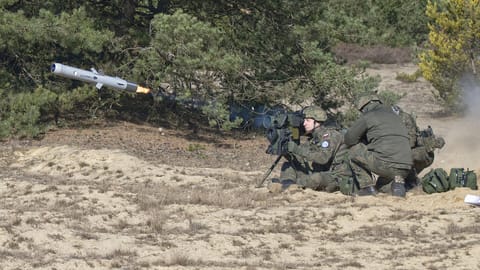
The original version of the Spike missile was intended to be a fire-and-forget weapon, meaning that once the missile was locked onto a target and launched, it could find and destroy the target all by itself without any need for further action from its operators.
In that sense, it's similar to America's Javelin anti-tank missile, or a range of similar weapons across the globe, but even in its early years, it came with a key difference.
Unlike the Javelin, the original Spike came attached to an eight-kilometer spool of very thin fiber-optic cable, providing a direct view of the missile's flight path to an operator, and allowing that operator to make real-time adjustments to its course and trajectory.
The missile came with a maximum range of 32 kilometers, as advertised by Israel, meaning that once it got past fiber-optic range, the cable will be sever and it would have to either switch over to self-guiding technology or be guided through a radio data link although the spike in its original form went into service in the early 1980s it wouldn't be revealed
To the global public until the 2010s as we'll explain governments close to israel absolutely knew about it before then and so did at least some of israel's enemies but even still israel ensured that word of the weapon didn't spread any further than was necessary and while the original version of the spike known today as the n loss or non-line-of-sight
Variant was already quite powerful the really impressive thing about the spike line of missiles was the many variants that it inspired in order to provide some context let's talk about the original and loss for a moment more weighing in at around 70 kilos or 150 pounds it was initially built to be launched from the grounds although it's long since become
Compatible with helicopter launches perspective the end loss is one of the largest spike variants partially because it was designed before some of the miniaturizing technology of the 21st century had become available and partially to facilitate that long range that we mentioned providing anti-tank capabilities at an acknowledged distance of up to 32
Kilometers alongside the end loss which is understood as an ultra long range variant in comparison to the others we'll introduce three variants known as the sr the mr and the lr that's short range medium range and wait for it long range the short range version weighs in just eight kilograms meant for use by a single infantry soldier and it uses a cheap
Thermal camera and other easy to use technologies to get the lock on its target once that lock is acquired it leverages a fixed electro optical seeker to travel the short distance to its target at maximum range of one and a half kilometers or a bit under a mile the medium range version is a bit heavier at 14 kilos with a maximum range of two and a half
Kilometers it's also used by ground infantry the long range version is about the same weight as the medium range but it can hit targets at a distance of up to four kilometers and it can be launched from combat vehicles as well as ground troops over time the rafael corporation has announced a range of other variants of the spike each managing to deliver its
Deadly package in new and creative ways the lr2 variants the latest version of the long-range weapon uses a lighter missile and launch system with a range of up to five and a half kilometers when launched from the ground whereas the more extended range can hit targets up to a distance of eight kilometers the lr2 integrates artificial intelligence tracking
Features and a range of other advanced integrated technology whereas the can be integrated into light boats and maritime assault craft where specialized launches can shoot up to four at a time the mini spike is exactly what it sounds like really tiny at a weight of just four kilos although it can hit targets up to one and a half kilometers away the mini
Spike is an especially nasty piece of technology capable of flying through windows going around obstacles and stationary objects and otherwise navigating urban environments with high competence if you're wondering what the target demographic for that kind of weapon might be the name starts with an m and it ends with assad finally the aero spike is a guiding
Version of the missile and meant to launch from the wings of combat aircraft before flying for up to 30 kilometers with no need for GPS, either being targeted by a human operator or handling its work autonomously.
Regardless of the model in question, every missile of the Spike line has a few things in common. They typically use tandem-charged warheads, except in specific cases, using one of those charges to punch through armor, and then using the other to destroy whatever's behind that armor.
They're built to be quickly readied for launch, typically within just half a minute, and even faster to reload, with most variants reloaded in 15 seconds or less.
They fire from either a turret-based launch mechanism or an infantry launch unit, all the component parts of which weigh less than 13 kilograms in total, meaning that an average-sized soldier in good physical condition can carry a launcher and at least one missile on their person.
They utilize solid fuel propellant, they're built to be easily integrated onto a wide range of vehicles, vessels, and aircraft, and they are affordable, although the cost obviously does depend on the version in question and the operator that the missiles are being sold to.
Impact and Adoption Several decades after it was first produced, the Spike missile has turned into a domestic and international success story. Israel, of course, is believed to have procured every version of the Spike that's been developed, although the number that Israel has in its arsenal is currently unknown.
But it's also been an unequivocal success on the export market, where, according to the Rafael Corporation, over 40,000 individual copies of various Spike models have been sold off by 2023.
Those missiles had gone to over 40 countries, and of the ones that had already been exported, Rafael claimed that over 7,000 had already been used, whether for training purposes, in operational testing, or as part of an armed conflict. Today, the missiles are produced in Germany and Singapore, as well as in Israel.
Notable operators include the United States, the United Kingdom, India, Brazil, Australia, Thailand, Italy, Canada, South Korea, the Philippines, and about half of Europe, with some nations choosing to procure them in the dozens, some in the hundreds, and some in the multiple thousands.
Across the globe, they've been integrated onto all manner of armored and infantry-fighting vehicles, combat and combat-adjacent helicopters, maritime patrol boats, and more.
They're especially popular among nations that point their weapons toward Russia, including Poland, with well over 3,000 known to be its arsenal, Romania, with another 3,000 or so, Finland, with at least 1,000 to its name, Germany, with agreements to acquire over 10,000, and the Baltic nations of Estonia, Latvia, and Lithuania, each with at least several
Hundred Spike copies known to be in their arsenal.
That's a reflection of the Spike's dedicated role as an anti-tank weapon, and specifically a weapon designed to destroy the Soviet-era tanks that still make up the majority of Russia's heavy armor.
In fact, after Russia's equipment losses in Ukraine, the Spike is probably an even more potent answer to a Russian threat than it used to be, since Russia now largely relies on older tanks that the original Spike was explicitly designed to address.
The Spike has also been provided to Ukraine, where they've proved more than capable of dealing with the armor that Russia's brought to that conflict.
When we discuss the Spike's official operating history, they're really isn't all that much to talk about as mentioned they've been supplied to ukraine in large numbers aware they're used alongside the javelin and other anti-tank weaponry to deal with russian armor there they've been able to integrate with drone technology with reconnaissance drones providing
Precise targeting information that small light infantry units can act upon effectively using the spike missiles they're able to carry with them notably neither israel nor ukraine admits that the spike has been deployed in combat during that conflict although the results of open source analysis would suggest that there's more than enough evidence to confirm
Their use outside ukraine known instances of the spikes use includes the second agorno-karabakh war where they were deployed by azerbaijan as well as israel's operations in gaza where they were known or strongly suspected to have been used on multiple occasions including a strike on a world central kitchen convoy that left seven aid workers dead in 2024.
Finally the spike was used to great effect in the operation that we discussed in the intro to today's episode israel's operation rising lion across iran in 2025. in that instance israeli agents used pre-positioned non-line-of-sight variants to strike targets all across iran unofficially though the spike has seen a great deal more use in combat than israel
Would like to admit based on at least circumstantial evidence and in many cases anonymous reports or outright confirmation by other governments they've been used by israel extensively in its operations against iran-backed groups across the middle east that includes during the second tfada the lebanon war of 2006 and israel's many conflicts against hamas in
Gaza in the case of the lebanon war we know that the spike missile was at least in play because copies were recovered by hezbollah transferred to iran reverse engineered and reproduced as a knockoff version that iran calls the almis and was revealed to the world in 2021 the almost by the way has been used against israel on multiple occasions in israel's most
Recent gaza operations the spike had reportedly been used to target well defended or shallow underground hamas emplacements in urban areas lodged by helicopters and ground forces alike internationally british sources have attested that the spike saw use during the war in afghanistan and was procured rapidly in high numbers to address urgent needs during
Britain's iraq operations in fact the uk financed the creation of a specialist version that improved upon prior spike iterations because of problems with the previous versions that britain discovered during early use both italy and spain have confirmed that they used the spike in afghanistan each using the long-range version to strike taliban positions while
Germany acknowledged that the spike was employed for base defense and had to be fired at enemy combatants as a result colombia and peru have both confirmed that they used the spike on multiple occasions across the 2010s with colombia leveraging them against the revolutionary farc insurgency while peruvian defense sources occasionally referred to instances
Where they were used against the shining path notably they're not known to have been used by other nations that possess the weapons and have recently been engaged in combat including india and its recent exchanges with pakistan and thailand and its recent border clashes with cambodia that's not to say that the spike definitely hasn't been used but there's no
There's no clear evidence to suggest that they have been at the time of writing you Today, the Spike missile continues to evolve at a rapid pace.
The base version of the missile is now in its sixth generation of development, according to the Raphael Corporation, and the weapon continues to be produced and sold all across the globe.
In late 2025, Raphael unveiled the L-Spike 1X, a small loitering munition version of the weapon, basically a kamikaze drone that's meant to be carried in a clothes backpack by infantry soldiers.
Weighing in at just 2.2 kilos, the L-Spike can fly for up to 5 kilometers or 15 minutes while carrying a small warhead using artificial intelligence and advanced electro-optical technology to navigate even in GPS-jammed environments.
It's able to withstand spoofing attempts and maintain a direct link to human operators, and it'll go down as the first addition to what Raphael calls the L-Spike family, with future versions expected to be revealed in the near future. As of now, Raphael has also revealed the L-Spike 4X, capable of flying a range of 40 kilometers.
The Spike is also undergoing an Americanization process with the U.S. Army, with Washington looking to guide the development of new Spike iterations that the U.S. military intends to eventually adopt.
Earlier in 2025, the Spike was spotted on the pylons of a U.S. Army Apache attack helicopter for the first time, suggesting that the process of integrating the Spike is already well underway. If those recent developments indicate Israel's long-term plans for the Spike, then it's entirely likely that Israel believes it's just getting started.
With the entire Spike line of weapons, Israel has shown that it possesses a highly versatile, highly sought-after base design onto which it can graft new technologies to provide new capabilities, basically at will.
All around the world, warfare is changing fast, and as international combat continues to evolve, the Spike is uniquely optimized to evolve along with it. Thank you for watching.
Unlock premium video briefings
Members get full access to premium reporting, in-depth briefings, and subscriber-only analysis.
Insiders Receive
- Full access to all premium articles and briefings
- Exclusive subscriber-only analysis and dispatches
- Support independent conflict journalism
From $5/month — cancel anytime