
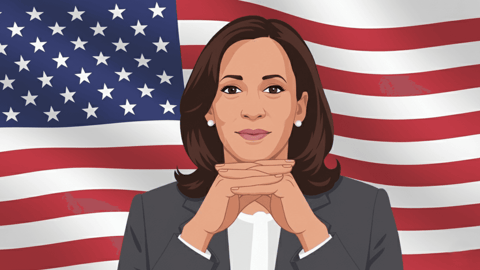
What if Kamala Harris Had Won?
What if Kamala Harris Had Won? — a Fronts video briefing on Strategy & Defense.
Simon Whistler • November 4, 2025
Members only
Note: this transcript was generated by AI and may contain errors or inconsistencies.
The old cliche goes that a week is a long time in politics, and if that's true, then the last year feels like centuries, doesn't it? Hard as it may be to believe now, but exactly a year ago, Kamala Harris was running Donald Trump neck and neck in the polls, and while Trump's margin of victory would ultimately be comfortable, it very nearly wasn't.
In the three tipping point states of Wisconsin, Michigan, and Pennsylvania, Harris was within 1.7 points of victory, as the now defunct site 538 explained in the aftermath, quote, if Harris had won those three states, plus all the states and districts she actually did win, she would have gotten exactly 270 electoral college votes.
In other words, a swing of just 1.8% in three northern states would have allowed Harris to do what Trump did in 2016, claim the presidency despite losing the popular vote. Now, we could discuss all day how likely that ever was.
The Biden administration was about as popular as a senile turd in a punch bowl, and the Gaza war meant Arab Americans in states like Michigan was super reluctant to pull the lever for the Democrats.
But still, the results were close enough that it makes for a fascinating what if. What if Harris had won an electoral college victory and become president? How would that have affected the conflicts we're seeing around the world today?
And what choices might she have made regarding wars like Ukraine or Sudan? As with any alternate history, a true answer is going to be impossible. However, in this case, we can at least see what that answer looked like it might have been on election night.
Now, like many outlets, we prepped two videos the day of polling, one to release if Trump won, and one to release if Harris won.
Obviously, the Trump video is the one that you all saw, but the Kamala video remained in our vault like a message in a bottle from another timeline, one that somehow managed to cross the barrier between the universes to show us what an alternate 2025 might have looked like. So, one year on, we're releasing it here as a special for you subscribers.
Thank you so much. Some of it will sound laughably out of date. Some of it will simply remind you of what everyone was talking about in late 2024.
But some of it might hint at the future that nearly happened. Might even answer the question, what if Kamala Harris had won? Enjoy.
If you're watching this video, then one of two things has likely happened. One, it's now mid-2025, and we've published it as a curio for our subscribers, in which case everything will seem laughably out of date. Or two, the more likely option, Kamala Harris has just become president-elect of the United States.
Since we were recording this shortly before the US election, we have no idea what went down or how close it was, nor do we know the composition of the upcoming 119th Congress.
What we do know, though, is that America just made a hugely consequential choice, one which will reverberate throughout many different parts of the world, and nowhere is that likely truer than in the places currently experiencing war. So, to mark the beginning of the transition to Kamala Harris' presidency, we thought we'd put out this one-off special.
A special in which we'll look at the world's major ongoing conflicts from Ukraine to Gaza to Sudan, as well as potential future conflicts around Taiwan, and ask what impact the 47th president is likely to have. have. Because, for better or for worse, the winner of the US election will be stepping onto stage in a world that's already on fire. 2027.
That's the year US defense circles have identified as Xi Jinping's deadline for a Chinese invasion of Taiwan.
And while some China experts recently told Defense News that the date's importance is overstated, it still suggests that the biggest foreign policy challenge of the next administration won't be in Moscow or Gaza or Tehran, but in Beijing.
As such, understanding how Kamala Harris thinks about China, Taiwan, and the wider Indo-Pacific may be the single most important thing we all need to get our heads around, all of which makes our job with this video that much harder. After all, according to Australia's Laoi Institute, quote, Harris is largely a blank slate on China policy.
Still, that doesn't mean we have nothing to go on. Over her years as a senator and then VP, Harris bumped up against Beijing multiple times. How she reacted on those occasions can help guide us on how she might act in the future.
For those worried about the rise of the Middle Kingdom, the good news is that Harris has a track record in her Senate days of calling out Beijing's human rights abuses. She was one of 56 senators who co-sponsored a bill sanctioning officials in Hong Kong for a massive crackdown on peaceful protests in 2019.
In 2020, she also co-sponsored a similar bill intended to counter China's persecution of the Uyghurs in Xinjiang.
Looking at her record as vice president, too, there's plenty of feed for the China hawks. A big part of her presidential platform was boasting about her role in organizing freedom of navigation operations through the South China Sea.
As the Council on Foreign Relations points out, she also played an active role in Biden's efforts to tie America's East Asian allies, such as Japan and South Korea, into ever-closer alliances.
However, we shouldn't mistake these stances for Harris being a hard-arse on China. Instead, Foreign Policy magazine suggests that she basically represents the Democratic Party consensus, and that, in turn, makes her more moderate than Joe Biden ever was.
Biden, remember, was the guy who repeatedly said that US forces would defend Taiwan in the event of a Chinese attack, a statement directly at odds with America's policy of strategic ambiguity.
Harris, by contrast, has stuck to the script. When asked, her frequent reply is that she supports, quote, Taiwan's ability to defend itself, which is far closer to official policy. It's a similar story on things like trade.
While Harris has in the past accused China of stealing US intellectual property, she's also claimed that Washington lost the trade war that ignited under Trump. Although there's no suggestion that she'll ax the Trump and Biden tariffs on Chinese goods, her natural instincts seem to be more in the direction of China being a competitor rather than an enemy.
Foreign Policy characterizes her position as, quoting here, pursuing competition and cooperation simultaneously.
Still, it's unlikely this subtle difference has been noticed in Beijing. Speaking to the Financial Times, professor at the Institute of International Studies and Center for American Studies at Fidan University, Zhao Minghao, declared that, quote, Trump and Kamala Harris are two bowls of poison for Beijing.
Both see China as a competitor or even an adversary, end quote.
All of which suggests that the current downwards trend in American-Sino relations will continue. If that's the case, the Lao Institute argues that Harris will soon be faced with some major choices.
To quote them, a Harris administration can decide to invest in the US military-industrial base so that the United States can match Chinese shipbuilding rates and it can boost defense spending to correct the tilt away from US dominance in Asia.
A Harris administration could elect to leave European security to the Europeans so that the United States can concentrate its forces in Asia. End quote. Overall, though, the Institute thinks these are choices Harris is unlikely to make.
Instead, it predicts the president-elect building on a workers' VP to try and contain China, expanding US bases in the Philippines, for example, or focusing more on boosting Asian alliances. Depending on your worldview, that may be no bad thing, especially since conflict with China remains very much hypothetical at this stage.
Meanwhile, conflict in Europe and the Middle East is already happening and already showing the potential for disaster.
It's fair to say that no current war divides the Democratic coalition quite like the one in Gaza. In the year of fighting since the horrors of October 7, America's left-leaning party has been split between its moderate wing's desire to back Israel and the demands of its more radical base to stand up for Palestinians.
Under Joe Biden, the party adopted a stance of staunch pro-Israel rhetoric combined with behind-the-scenes arm-twisting designed to get Netanyahu to prosecute the war less aggressively.
The results managed to piss off just about everybody, while seemingly having little impact on the conflict. The question now is, will Harris do anything different? Those looking for a total break with the Biden administration are likely to be disappointed.
During a campaign, Harris mostly repeated boilerplate talking points that could have come from any generic Democrat. Here's what her campaign website promised. Vice President Harris will always stand up for Israel's right to defend itself, and she will always ensure Israel has the ability to defend itself.
She and President Biden are working to end the war in Gaza, such that Israel is secure, hostages are released, the suffering in Gaza ends, and the Palestinian people can realize their right to dignity, security, freedom, and self-determination. If that sounds kind of vague and light on specifics, we probably shouldn't be surprised.
Harris' aides briefed the New York Times that, with the conflict likely to look completely different by January, the campaign didn't want to get tied to unworkable promises.
That being said, Harris has occasionally spoken with greater force, or with more detail, on the war in Gaza. And some of her speeches have suggested, well, maybe not a break with the Biden administration, but perhaps a divergence of some sort. The basis for this assessment is the apparent flashes of sympathy Harris has for the civilians of Gaza.
Following a July meeting with the Israeli Prime Minister, Benjamin Netanyahu, Harris declared, what has happened in Gaza over the past nine months is devastating. The images of dead children, and desperate, hungry people fleeing for safety, sometimes displaced for the second, third, or fourth time.
To this, she added, we cannot allow ourselves to become nothing.
Come to the suffering, and I will not be silent." Foreign Policy reports that these comments were consistent with rumors that the Vice President had been pushing Biden behind the scenes to take a firmer stance on the civilian death toll, nor are they the only time that Harris has telegraphed sympathy with the suffering of Palestinians.
The New York Times reports that she spent her time at the Dubai Climate Conference in December of 2023 huddled with leaders of Arab nations discussing Gaza. How this sympathy translates into policy, though, is less clear.
So far, Harris' talking points have been an immediate ceasefire, followed by the release of hostages and a return to the Sioux State solution. But none of these things looks remotely likely, nor does her stated plan of having a revitalized Palestinian Authority govern post-war Gaza, given how little authority the PA has even in the West Bank.
And while her call for extremist settlers who target Palestinians to be held accountable is a smaller ask, it's hard to see how she could ever hope to implement it.
One main reason for this is that Harris has already ruled out using the one piece of leverage the U.S. has over Israel, suspending weapons shipments. Instead, Harris has pledged to continue American military aid, emphasizing Israel's right to defend itself.
All in all, then, we might reasonably expect a Harris administration to represent a change in tone regarding Gaza, but for things to otherwise carry on as before.
Speaking to the Times, her advisors went out of their way to stress that, quote, "...the empathy she has expressed towards Palestinians as vice president should not be confused with willingness to break from American foreign policy toward Israel." The same is likely to be true regarding Iran.
In her campaign, Harris merely highlighted that she would work to, quote, "...ensure that Iran never achieves the ability to be a nuclear power." Again, this is pretty consistent with longstanding U.S. policy.
And really, that seems to be a theme of Harris' pitch, that she will represent the center ground of American foreign policy, that where Biden had become a little too gung-ho on China or cozy with Israel, she'll pull things back toward a pragmatic consensus.
And where the two moved in lockstep, like warning Iran not to go nuclear, she'll keep moving along that same path. But there's one conflict where, steady as she goes, likely isn't possible. A conflict where urgent decisions need to be made quickly and being cautious will only lead to wide-scale disaster.
We're talking, of course, about the Ukraine war. Discussing the differences between Kamala Harris and Donald Trump before the election, the Lowey Institute wrote that, as far as foreign policy was concerned, the choice couldn't be starker.
Calling Trump, the first president since the Second World War, to denounce American global leadership, they argue that Harris was therefore, quote, "...the last champion of American foreign policy exceptionalism, the final redoubt for those who believe that the United States has global interests which must, if necessary, be protected by a military force that
Is second to none." End quote.
Key to this was Harris's own promise to strengthen, not abdicate, our global leadership. A promise that is likely to be sorely tested on day one by the thorny question of Ukraine. At least, that's the assessment of retired Australian.
Major General Mick Ryan, who recently wrote a long-form piece on the challenges Harris will face in Eastern Europe.
Central to his thesis is the idea that the Biden administration's current strategy isn't working, that the White House has no theory of victory in Ukraine beyond giving Kiev just enough backing to stay in the fight and keep pleading Russian forces, or what the Brookings Institute called, quote, Biden's policy of providing Ukraine with enough support so that
It does not lose, but not with the wherewithal to win.
Such a track is, in Ryan's view, unsustainable.
Therefore, the former general writes that, quote, a Harris administration will have little time to decide whether it really wants Ukraine to defeat Russia. Its decision will have profound consequences for the future of Ukraine and for America's stature and global influence, end quote.
The reasons for this sense of urgency are the ones most of us can see for ourselves.
Right now, the Ukraine war is a war of attrition, one in which Russia is absorbing spectacular numbers of casualties in order to slowly grind out gains in the Donbass. Unfortunately for Ukraine, Moscow is just about managing to replace these casualties with new recruits every month.
While this practice is likely unsustainable, even across next year, at least without resorting to what would be an extremely unpopular mobilization, Kiev's own manpower pool is likely to run dry first, despite Ukraine suffering fewer battlefield losses.
And that's before we even get into the weapons systems and ammunition for which Kiev is almost entirely reliant on its Western allies for.
That means that just staying the course will lead to an eventual Ukrainian defeat, and Harris dragging her feet on the decision will mean a long delay in getting things moving, a delay that will likely cause problems to pile up to such a degree that they can't later be surmounted.
All of this means that Harris will have to decide in the first few weeks if she truly wants to back Ukraine to the hilt, and that may mean some tough trade-offs.
Here's how Mick Ryan describes it, quote, It will require trade-offs in scarce military resources that might be required to confront China, a tougher approach on China's support for Russia, and a different strategy for dealing with Russian nuclear saber-rattling.
Russia will be sure to escalate its campaign of sabotage, misinformation, and general mischief around the world in the wake of such a decision, end quote. In other words, it will mean Harris weighing up whether US resources are better placed preparing against a potential war with China, or winning a current war with Russia.
As to what side of this debate President Harris will ultimately fall down on? Well, it's hard to say. For those who want Ukraine to win, it's not hard to find quotes from Harris pointing towards a pro-Ukraine policy.
As a candidate, she promised to stand strong with Ukraine and our NATO allies. The Council on Foreign Relations also claims that, quote, Harris argues that a failure to respond to Russian aggression in Ukraine would embolden other countries considering invasions, end quote.
On the other hand, Ryan points out that when asked during the presidential debate if she wanted Ukraine to win the war, Harris talked around the subject without ever either saying yes or no. As a result, her thinking in this area, as with so much, bit of a mystery.
Still, those living in EU countries bordering Ukraine should take some solace in the fact that, whatever her Ukraine strategy, Harris is likely to remain committed to NATO.
For a policy, lists the times she's spoken warmly about the alliance, from calling America's commitment to it ironclad in 2022 to saying that the collective defense clause known as Article 5 is sacrosanct. In 2024, she repeated her commitment to NATO, calling it the greatest military alliance the world has ever known.
All of this suggests that a Harris administration will not sit by if Russia attacks Poland or tries to annex the Baltic states. And that marks an extreme contrast with Trump, whose commitment to the alliance was always shaky and transactional at best.
Still, we don't want to end this video focusing on Europe, especially not where there's one last major conflict that President Harris will have to deal with.
A conflict that is among both the biggest and the least reported on Earth, the war in Sudan. Every time we cover Sudan, it's with a sense of amazement that almost nobody is talking about it.
Here you have one of the worst conflicts on the planet, one in which 150,000 people are thought to have been killed, in which genocide may be underway in Darfur, and in which entire cities have been reduced to rubble.
Yet go on the front page of many mainstream media organizations, and you don't see a single item about it. This lack of engagement has sadly extended to the campaign trail. Neither Kamala Harris nor Donald Trump have wasted many words on Sudan in recent months.
On Harris' side, this may be because Joe Biden has been making a last-ditch attempt to secure an African legacy by stopping the fighting. Not that analysts have been optimistic about his efforts.
Speaking to Fox News, Sudan expert Cameron Hudson declared that quote, the administration is making an 11th-hour attempt to put the situation on a better footing, not least because the humanitarian situation is so desperate.
There could be two million Sudanese dead from famine by the time he, Biden, leaves office. Such an outcome, of course, would mean anything Harris did do after taking office would be like rearranging deck chairs on a Titanic that has already sunk. However, that's not to say that the new president won't have any impact on this most overlooked of wars.
One thing that President Harris may focus on is reducing the harm to civilians, specifically to the women and girls who have reported brutal assaults and sexual degradation at the hands of the paramilitary Rapid Support Forces, or RSF.
We can assume this thanks to a series of remarks Harris gave in summer, where she singled out the conflict in Sudan, alongside the civil war in the Eastern DRC, and the collapse of law and order in Haiti, as places where sexual violence has exploded.
She also declared that, thanks to the leadership of our administration, we have made it the policy of the United States to use all of our diplomatic, financial, and legal tools to punish those who commit sexual violence.
Now, that's not exactly a detailed policy pledge, but it does indicate that Harris may well take a deep interest in protecting civilians from suffering such violence in Sudan and elsewhere. And levying sanctions against individual high-profile perpetrators, such as RSF leadership, will be well within a pervious precedent.
There's also a chance that this could lead to serious consequences for those aiding and abetting Sudan's catastrophe.
Both sides in the conflict are supplied with weapons by outside actors. In some cases, those are countries like Iran, and Russia that aren't going to cave to American diplomatic pressure. But the RSF's main backer is also one of America's closest allies, the United Arab Emirates.
Investigations by the UN, the US State Department, and multiple media organizations have traced a flow of weapons from the UAE to RSF forces in Darfur, the same RSF forces that a recent UN report accused of large-scale sexual violence. The Biden doctrine has been to keep UAE close, even naming it as a major defense partner in September this year.
But this might be one area where Harris is content to upend long-standing US foreign policy and try to bring Abu Dhabi to heel.
That's the opinion of foreign policy, which suggests that Harris is likely to take a hard line against UAE, fueling the Sudan war. The magazine thinks this would come in the form of diplomatic pressure linked to Abu Dhabi's desire to buy F-35 fighter jets and American drones, a deal first signed off by then-President Donald Trump.
To quote, Under Harris, this deal may face further delays or stricter conditions, particularly given the UAE's involvement in conflicts in Yemen and Libya, and more recently Sudan.
End quote. Whether this will make any difference is hard to say. Abu Dhabi recently told Reuters that it doesn't plan to reopen negotiations over the jets anytime soon.
But Harris could still pressure the country simply by calling out the ways its weapons are fueling a campaign of genocide. Beyond Sudan's borders, too, and it'll be curious to see if Harris is capable of performing outreach to African nations that are drifting away from American influence.
Both Joe Biden and Donald Trump failed to ever set foot in sub-Saharan Africa in their time in office, an absence which sent a signal to multiple capitals.
Meanwhile, China's influence on the continent is growing, as is that of middle powers such as Turkey. Harris may hope to turn this around, but it could be far harder than she imagines. And look, we could continue in this vein.
After all, there are many other hugely significant conflicts out there that we've not yet covered. Myanmar, for example, or the crisis in Haiti, or the insurgency in the Sahel, or even Ecuador's ongoing internal armed conflict with its gangs. But look, time is short, and we have to end this video at some point.
This, then, is how we might expect the Harris administration to handle four of the most important conflicts of our time. Gaza and the wider Middle East, Ukraine, Sudan, and a potential war with China.
These being predictions, it's doubtless that some will turn out to be wrong, just as it's doubtless that fate will throw curveballs at the new president that she's completely unprepared for.
Who knows? Maybe four years from now, we'll be discussing how Harris handled the utterly unexpected conflict between, say, Iceland and Nicaragua. Hopefully, though, this video has at least given you some idea of what to watch out for.
It's going to be a crazy few years for the next American president. Here's hoping that she acquits herself well. Thanks for watching.
Unlock premium video briefings
Members get full access to premium reporting, in-depth briefings, and subscriber-only analysis.
Insiders Receive
- Full access to all premium articles and briefings
- Exclusive subscriber-only analysis and dispatches
- Support independent conflict journalism
From $5/month — cancel anytime