
Why Didn't the Iranian People Rise Up?
Outside powers bet that pressure and crisis would push Iranians into revolt. Instead, a mix of ruthless repression, a fractured opposition, and fear of what comes next keeps the streets quiet.
Simon Whistler • April 14, 2026
Members only
Note: this transcript was generated by AI and may contain errors or inconsistencies.
At the start of this year, there were two stories that absolutely dominated global headlines. One was the capture of Nicolas Maduro in Caracas and all the geopolitical fallout that followed. However, it's the other story that we want to talk about today, the winter protests in Iran.
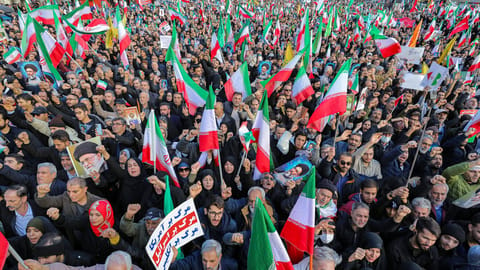
By all accounts, these were the largest protests in the Islamic Republic since the 1979 revolution, and they indicated just how frustrated the average Iranian had become with the regime. While they started in Tehran, they soon spread to multiple cities across the country, including Tabriz in the north and Avaaz in the south.
But while the size of the protests was notable, it was the regime's response that really made headlines.
As things peaked in early January, the government shut down all communications networks, plunging the country into darkness. And then the killing started. Across 19 days, somewhere between 7,000 and 30,000 people were murdered, with most deaths occurring around one single weekend.
Although the regime ultimately crushed the uprising, it ended the month not just widely hated by its own people, but more vulnerable than at any other point in its history. And according to the New York Times, David Bonilla, the head of Israel's spy agency, Mossad, noticed.
He presented Israeli Prime Minister Benjamin Netanyahu with an assessment that said Mossad would likely be able to galvanize the Iranian opposition, igniting riots and other acts of rebellion that could lead to the collapse of Iran's government.
Mr. Bonilla also presented the proposal to senior Trump administration officials during a visit to Washington in mid-January. Although senior American officials, and some officials in other Israeli intelligence agencies, doubted the plan's viability, Netanyahu and Trump seemed to embrace it.
In fact, a street uprising seemed to be a major component of their war planning, with both calling on the Iranian people to rise up against their government as soon as the bombing began.
And yet, nothing happened. Despite repeated attacks against government targets, the hoped-for revolution did not appear. People didn't take to the streets, and the regime in Tehran is still standing to this very day.
So what happened? Why didn't the Iranian public rise up against the regime? And how did Israel and America get this so catastrophically wrong?
A Violent Regime To answer our questions, we first need to discuss the lengths that Tehran went to stop the protests back in January. An Iranian history professor who was interviewed by the Financial Times said that in the early days of the protests, the regime's response, at least by its own brutal standards, was restrained.
He explained that even as the number of protesters on the streets swelled, there wasn't an atmosphere of fear, and there was no violence, neither from the protesters nor from government forces.
That changed on the 8th of January, the 12th day of the protests, when a large crowd took to the streets responding to a call made by Reza Pahlavi, the exiled son of the Shah, deposed in the 1979 revolution and one of Iran's leading opposition figures, for even larger protests following the success of the previous day's demonstrations.
Pahlavi, a former fighter pilot who uses the title Crown Prince of Iran, has long been a critic of the regime. He quickly became a popular figure among Iranian protesters, most of whom were disillusioned with decades of repression from the current regime.
And for Tehran, this was unacceptable because at the time it represented the greatest threat to the regime's power base. That would seem quaint. That would seem quaint.
Compared to what happened after America and Israel began their campaign of airstrikes, but let's not get ahead of ourselves. You probably remember what happened next.
The reports from charities like Amnesty International about security forces stationing themselves on rooftops, firing rifles aimed at protesters' heads and torsos, of paramilitaries infiltrating crowds and then opening fire, of anti-aircraft guns being fired at masses of people, leaving the streets strewn with the dead.
Yet it wasn't just the killings themselves that made this round of repression so brutally effective. CNN reported that the regime had shifted from tried-and-tested riot-spression methods to advanced tactics that combined the nation's military might with psychological operations to completely break the protesters.
This included low-flying surveillance drones, signal jammers, and a rapid-response propaganda apparatus that spread one message to the protesters, you have failed.
Tehran also used the vast array of CCTV cameras spread throughout the country to identify protesters on the streets, and in scenes ripped right off the pages of Black Mirror, the police distributed a video titled, Identifiable Sounds, showing drones hovering outside apartment buildings to find people chanting anti-regime slogans.
The video then showed scenes of security officials marking buildings with warning stickers and, in some cases, arresting residents. If any of this sounds familiar, it's because we discussed the scale of the repressive violence in a previous video on this channel two months ago, before they chained me to this desk and decided I'd never see my family again.
But on a more serious note, we chose to highlight the scale of the violence again as a reminder of what the Iranian people would have faced if they'd decided to go back to the streets. And given that we are in the middle of a war where the regime believes it's fighting for its very survival, the scale of the violence could have been even more intense.
To underscore just how seriously the regime was taking domestic threats, even amid the joint American-Israeli air campaign, on the 19th of March, Tehran hanged three men in the city of Qom for allegedly killing two policemen during the protests.
According to Norway-based Iran Human Rights, one of the men had turned 19 just days before he was hanged. To really drive home the psychological impact, the regime then refused to hand over his body. We mention this just to give you some idea of the factors ordinary Iranians have to consider.
Most people are not heroes or soldiers. For the vast majority of people, the idea that they might be executed and their family never see their bodies is a spectacular deterrent. Yet it's not just the specter of violence alone that has kept the streets of Iran relatively quiet.
Another reason why protests haven't emerged so far is because of what analysts at The Open magazine described as the funeral trap.
In the aftermath of former Supreme Leader Ali Khamenei's death, the regime declared 40 days of mourning, which was meant to make it logistically and morally difficult for anti-government protests to gain momentum in the short term.
Anyone who chose to go out and protest at this time risked being seen as a heartless opportunist protest, taking advantage of the chaos to advance their own political agenda.
This would make it very difficult for protesters to build the numbers necessary to pose a true challenge to the regime. We also have to talk about that. the internet shutdown that has been in place ever since the war began.
According to global internet watchdog Netblox, by the 7th of April, access to the global internet in Iran remained at roughly 1% of pre-war levels.
Most residents could only use a slow, restricted intranet that provided basic services and access mostly to state-run news and messaging platforms.
Without the use of social media platforms to spread information about when and where protests would take place, potential demonstrators were left isolated and unable to build the critical mass needed to challenge the regime effectively.
But even if Iranians had been able to organize protests, there was another factor working against the kind of uprising Jerusalem and Washington were hoping to see.
Despite President Trump claiming that the Iranian people get upset when they don't hear bombs, very few people would willingly celebrate the bombing of their country, especially when those bombs have such devastating effects on the economy and the local population.
On the first day of the war, remember, an American missile hit a school in the town Minab killing 160 schoolgirls and staff. Even though it was an accident, that sort of tragic incident is precisely what you need to avoid if your goal is to win hearts and minds.
Darius, an anthropologist from Tehran, told ABC News that while he had initially been against the regime, as the bombing continued, his opinion on the regime changed. Quoting him here, the noise of the bombs, and the fact that they are actually killing a lot of civilians, pushes us more toward rallying around the flag.
We are fighting this war as a country, and even though the Iranian state is not my cup of tea, I prefer to stand by their side against a Nazi in the White House.
President Trump's now infamous threat that he would destroy bridges, power plants, and desalination facilities, and that a whole civilization would be destroyed, never to rise up again, was extremely unpopular even among diaspora Iranians who had initially supported the war.
Without it inspired hundreds of people to form human chains around critical infrastructure, including the Khazarin, Bisseton, and Tebris power plants, and the Arvars and Desval bridges.
All of this taken together indicates that despite the regime itself being about as popular as a dog turd in your coffee, the mass of Iranians have decided that it is better to hunker down than risk being seen as supporters of the nation bombing their civilians and threatening to obliterate them.
Combined with everything else in this chapter, that is almost certainly enough to take a street revolution off the cards. The Kurds Finally, we have to talk about the Kurds, a minority group that has previously partnered with Washington on a wide range of missions, including, Washington hoped, one to topple the Iranian regime.
The CIA had been working to arm Kurdish forces with the aim of fomenting a popular uprising in Iran, with the Trump administration in active discussions with Iranian opposition groups and Kurdish leaders in Iraq about providing them with military support.
The plan, which Mossad chief David Barnea had reportedly been working on for years and presented to Prime Minister Benjamin Netanyahu and Washington in the run-up to the war, envisioned tens of thousands of armed Kurdish fighters crossing the border from Iraq under massive U.S. and Israeli air cover.
According to Israeli outlet Channel 12, the combined forces carried out heavy strikes against Iranian security forces in the country's north-west in an effort to ease the Kurds' path. But the plan quickly fell apart.
After the plan was leaked, Iran bolstered its defenses in the northwest, ramped up military pressure on Kurds in northern Iraq, and exerted diplomatic pressure on Baghdad. Tehran also launched drone strikes directly against Kurdish populations, killing and wounding fighters in their bases along the Iraq-Iran border.
Regional opposition also made it difficult to use the Kurds as a fighting force.
Turkey, which has long had a simmering feud with the Kurds, did everything in its power to stop the plan.
From Turkey's point of view, the heavily armed Kurdish groups could turn their attention to Ankara once the war was over, and become a cross-border threat similar to the Kurdistan Workers' Party, a group that Turkey has designated a terrorist organization and that had long fought the Turkish state before announcing its dissolution in 2025.
The PKK has close ties to the Kurdistan Free Life Party, one of the groups in the Iranian-Kurdish coalition, and one that would presumably be armed to fight in Iran if this plan had been implemented.
As such, Ankara held senior-level talks with top officials in Iraq's Kurdistan regional government to prevent the Kurds from being armed for a war against Iran. On 7 March, Turkish Foreign Minister Haqqan Fidan said that he received assurances from American Secretary of State Marco Rubio that Washington had no intention of arming Kurdish groups in Iran.
Chris Kilford, Canada's former ambassador to Turkey, told Palladium magazine that this was indicative of the pressure that Turkey could exert.
But it wasn't just Turkey that was opposed to this mission. The Kurds seemed hesitant to be a part of it, and with good reason. On 20 January, Tom Barak, Trump's ambassador to Turkey and special envoy to Syria, stated that the original purpose of the Kurdish-led Syrian Democratic Forces as the primary anti-ISIS force on the ground had largely expired.
Washington then brokered the transfer of Kurdish-hour ground, oil fields, border crossings, and ISIS detention facilities to the government of President Ahmed al-Sharah.
The Syrian army, with the implicit approval of the United States, launched an offensive against the SDF, forcing Kurdish forces to withdraw and displacing at least 134,000 people, according to the UN.
This came just five years after Trump's first betrayal of the Syrian Kurds in 2019, when he withdrew U.S. troops whose main mission was to protect Kurdish militias, leaving them open to Turkish attack.
Now, while the Syrian Kurds and the Iraqi Kurds are two distinct groups with their own objectives and goals, they have a lot in common, and how Washington treats one group is often indicative of how it would treat another. Betraying one group, then Washington could quite easily betray the other.
We also have to discuss the extraordinary claim by President Trump that the U.S. had tried to covertly arm Iranian protesters through Kurdish intermediaries weeks before the Karab war was launched.
Trump said he believed the Kurdish groups had kept the arms for themselves.
Multiple Kurdish groups quickly denied the claim, with Mohammad Nazif Kaderi, a senior official from the Kurdistan Democratic Party of Iran, telling Rador, a broadcaster based in the semi-autonomous Kurdish region of Iraq, that the statements were baseless and they had not received any weapons.
If Trump's claim is true, we have to examine why the Kurds would be willing to risk Washington's fire and keep the weapons for themselves.
From the... Kurdish point of view, it's possible that they decided that keeping the guns for themselves would be better than handing them to untrained protesters, who would wind up dead anyway at the hands of the better-trained Iranian forces.
The Kurds could better use the guns, and if Washington ever abandoned them like they did the Syrian Kurds, they would be equipped to defend themselves.
All of this taken together indicates that American and Israeli intelligence fundamentally misread the situation on the ground, and their plans for a civilian-led coup were overly optimistic at best and naive at worst. However, that doesn't mean a civilian-led uprising is completely off the table. It might happen just at an unexpected time.
Reconstruction For a regime that America openly talked about bombing back to the Stone Age, the greatest challenge might well be a post-war reconstruction. The war has devastated Iran's economy in ways that will take years to reverse.
Analysts at Chatham House believe that Iran's GDP will contract by at least 10 percent as a result of the war, so it will take a long time to rebuild its economy.
And Iran will have to do it while dealing with an already catastrophic inflation crisis. According to Fortune, the real lost 60 percent of its value in the months after the 12-day war last year, and food inflation soared to 64 percent by October. It accelerated further to 105 percent by February, vaulting overall inflation to 47.5 percent.
The government recently issued a 10 million real note, which is equivalent to about seven dollars, in a sign of just how bad the situation has gotten. That high inflation is what convinced people to take to the streets in January, and they might go back once the war ends if this is not addressed quickly enough.
And speaking of the war ending, once the guns fall silent and the missiles stop raining down on Tehran, the pressures that had forced the Iranian people to rally around the flag will disappear.
While people will still be mourning, their anger will most likely be directed once again at the regime for failing to prevent the war from happening in the first place. Whether this combination of economic devastation and fading war solidarity will trigger another round of mass protests is difficult to predict.
The population is exhausted from months of violence and uncertainty, and many Iranians may simply want stability, even if that means tolerating a regime they despise.
But if protests do emerge, Tehran may find itself ill-equipped to respond with the same overwhelming force that proved so effective in January. An Al Jazeera investigation found that at least 75 internal security sites were destroyed or damaged in bombardments by Israel and the U.S. from the 28th of February to the 10th of March.
These facilities included local police stations, criminal investigation headquarters, and public security officers spread across Iran's most densely populated urban areas.
The systematic destruction of this infrastructure means the regime's ability to quickly deploy forces and suppress demonstrations in multiple cities simultaneously has been compromised. Still, any future protesters will be dealing with massive headwinds.
The regime has demonstrated its willingness to massacre thousands of its own citizens to maintain power, and they are likely to do the same should new protests emerge.
Even with degraded police infrastructure, Tehran retains the Islamic Revolutionary Guard Corps and besieged forces. The memory of the January crackdown will also serve as a powerful deterrent, reminding anyone considering taking to the streets of the brutal consequences of dissent.
While we don't know for sure whether new protests will emerge, what we can guarantee is that if they do, we'll be there to cover it.
Unlock premium video briefings
Members get full access to premium reporting, in-depth briefings, and subscriber-only analysis.
Insiders Receive
- Full access to all premium articles and briefings
- Exclusive subscriber-only analysis and dispatches
- Support independent conflict journalism
From $5/month — cancel anytime