
Why is Kenya Supporting Sudan's Paramilitaries?
Fronts Staff • June 16, 2026
Members only
Note: this transcript was generated by AI and may contain errors or inconsistencies.
In early May this year, the Rapid Support Forces, RSF, a paramilitary group that has been fighting the Sudanese Armed Forces, SAF, since 2023, held a meeting with their allies from the Sudan Founding Alliance, a group that seeks to establish a parallel government within Sudan.
The meeting was chaired by Mohamed Hamdan Dargalo, alias Hermeti, the leader of the RSF, and according to the group, was held in Nayala, the capital of South Darfur State, which the RSF and their allies have claimed as the capital of their parallel administration.
By all accounts, this was the kind of unremarkable government meeting that, other than the fact that it was hosted by the RSF, should have no business being in a video for Frontstar Co.
Thanks for subscribing, by the way. The reason we are highlighting it is because, despite the RSF's claims, this meeting was not held in Nayala. Rather, it was held in Nairobi, Kenya, more than 2,700 kilometers away.
Observers came to this conclusion after spotting water bottles from the Kenyan brand Keringet in the meeting. Highly unusual, given that the brand is not readily available in Sudan. While the bottle's distinctive wrapping had been removed, its shape and the seal on the cap clearly indicated that it was from Keringet.
The fact that the RSF had lied about the location of the meeting raised a lot of questions. Most importantly, why lie and why Kenya? The former is pretty easy to answer.
They didn't want to present an easy target for the SAF, who would relish the chance to drop a bomb on a meeting room full of the RSF's top leaders.
The latter question is considerably more complicated, though, and answering it requires understanding why an East African country with no obvious stake in Sudan's war has quietly become one of its most consequential backers.
Passports, weapons, and legitimacy Now, to understand why the RSF chose Nairobi as the site of their meeting, we need to look at the broader pattern of the Kenyan government assisting, or at the very least tolerating, the RSF, because the full picture offers a more damning indictment of Nairobi than any single incident can.
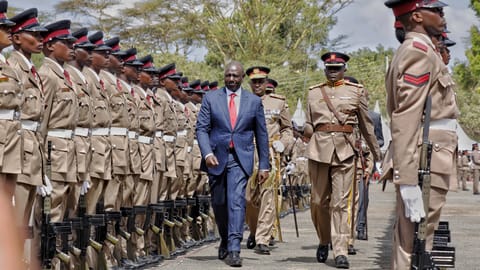
In January 2024, Kenyan President William Ruto rolled out the red carpet for Hermeti, receiving him at the Presidential Pavilion at the Jomo Kenyatta International Airport, complete with traditional dances and all the pomp and circumstance typically reserved for a visiting head of state.
This reception was notably more lavish than the one Abdul Fattah al-Burhan, the leader of the SAF, had received two months before. At the time, Hermeti was on a regional tour and had stopped through Uganda and Ethiopia, angering Khartoum, which saw this as a charm offensive meant to generate political legitimacy for the RSF.
What set the Nairobi stopper part was the warmth of the welcome.
After a closed-door meeting between the two leaders, President Ruto issued a statement praising Hermeti and the RSF for their commitment to ending the conflict through dialogue, an extremely ironic statement given the RSF's long record of war crimes and atrocities, including credible accusations of genocide.
Ruto and Hermeti quickly developed what observers referred to as a bromance with Ruto going so far as having Abdul Rahim de Gallo, Hermeti's brother and the deputy commander of the RSF, with him on the presidential jet during a state visit to South Sudan.
By that point, the US Treasury Department had already sanctioned Abdul Rahim over his leadership role in the RSF. For a sitting head of state, one that's closely with the U.S. to invite a sanctioned warlord onto his plane is what we in the business typically call a really, really bad look.
One year later, in February 2025, Nairobi would once again host the RSF and its allies, who had come to the Kenyan capital to sign a charter paving the way for the establishment of a parallel government.
The signing ceremony was held behind closed doors in Nairobi, following a highly publicized preliminary meeting the week before at the Kenyatta International Conference Center, a building owned by the Kenyan government. At this point in the war, the RSF had consolidated power in western Sudan, including across the Darfur region.
However, it had remained largely unrecognized as a governing force.
By signing the charter in Nairobi, the regional diplomatic hub, the RSF was attempting to position itself as a credible political force rather than a rogue militia. Nor is this the only way Nairobi has supported the RSF.
Algoni de Galo, Hermeti's younger brother and the guy in charge of weapons procurement for the paramilitaries, was awarded a Kenyan passport.
For a guy from Sudan, a Kenyan passport opens up all sorts of benefits, not least the ability to evade American sanctions.
Nairobi initially denied issuing the passport before insisting that it only did so as part of its broader peace mediation efforts, and that facilitating travel for conflict actors was a widely recognized diplomatic practice observed by several countries around the world. And yeah, that sounds like absolute bull, doesn't it?
It would be one thing if the Kenyan government was giving passports to diplomats from the RSF who were traveling around the world looking for a negotiated solution to this crisis. But this isn't what Nairobi is doing.
It issued a passport to someone who had been under American sanctions since October 2024 for his role in procuring weapons that were then used to commit atrocities in Sudan, such as the massacre of more than 800 people in Arda Marta.
Amazingly, such a death toll is peanuts for the RSF. Months before the passport story broke, the paramilitaries killed so many people in the city of El Fasha that the bloodstains were visible from space. Reportedly, around 60,000 people may have died.
Nairobi, for its part, didn't revoke Algoni's passport even after news of these killings became public. And then there are the weapons themselves.
A months-long investigation by Kenyan outlet, The Daily Nation, and Bellingcat identified crates of ammunition allegedly belonging to Kenya's Ministry of Defense inside an RSF depot in Salha, a neighborhood in Omdurman, which had served as one of the group's largest military bases before the SAF drove them out.
The crates contained 14.5mm armor-piercing cartridges and 82mm mortar bombs, the same type of ammunition that the RSF has been known to deploy against civilians. Nor is it just its own weapons that Kenya is shipping to the militia. The country has also become a transitor for weapons supplied by the UAE.
Last but not least, Kenya plays a massive role in the RSF's financing. Gold, the paramilitary group's main source of income, is mined in Darfur and the Kordofan regions before making its way through a complex network in South Sudan, Uganda, and Kenya, before arriving at its final destination, either the UAE or Russia.
The amount of gold flowing through Kenya is staggering in the first nine months of 2025, Kenya exported 42.1 tons of gold to Dubai, more than three times what Kenya had exported the year before, and orders of magnitude higher than the 672 kilograms of gold Kenya had exported in 2023.
This happened without any significant increase in gold production in the country, suggesting a coordinated effort to move vast quantities of illicitly obtained gold.
Without this gold, the RSF wouldn't have enough money to buy weapons, pay its fighters, or even run its operations, which just goes to show how essential Kenya's support is in allowing the paramilitary group to keep fighting the SAF.
And then there is the diplomatic cover President William Ruto gives the RSF by publicly insisting that they and the SAF are equally culpable for Sudan's catastrophic war.
During a media briefing at State House, Kenya's version of the White House, Ruto said, and we'll quote him here, there are two generals that have no regard for human life. The war in Sudan is heading towards carnage. It is already in the realm of a human catastrophe.
End quote. And there is some truth to this. General al-Burhan and his men are not saints, and their documented crimes include the indiscriminate bombing of civilian areas and partnering with armed groups that systematically targeted civilians in Al Jazeera state based on an ethnic basis.
But, well, the RSF are on a whole other level. Not only have they been credibly accused of genocide in Darfur, but the paramilitaries are also notorious for their industrial use of whenever they appear, women and girls suffer eye-watering abuse with their fighters suspected of girls as young as one year old.
By trying to equate the two, President Ruto is either wittingly or unwittingly playing into the RSF narrative that since there are no good guys in Sudan, anything they do is justified up to and including the massacre of an entire city.
All of which leads us back to our main question. Why is Nairobi doing any of this? And the simplest answer is that President Ruto enjoys a close personal relationship with Hermetti and other members of his family and simply wants to see his friend win the war.
Macharia Munene, a professor of international relations at the United States International University, told the Associated Press that President Ruto had transformed Kenya's foreign policy into a one-man show and was leveraging his personal relationship with Hermetti without considering Kenya's national interests.
That personal relationship would explain why Ruto was willing to allow a sanctioned warlord to travel on his presidential plane. Those personal ties have also bled into the business world with critics of the Kenyan president, including his one-time deputy president, Rigathi Gachagua, alleging that Ruto and Hermetti have business dealings together.
During an interview with the local press, Gachagua accused Ruto of laundering the profits of the RSF's gold trade through Kenya's banking network. Now, we should note here that since Gagachua was impeached from office and has an openly acrimonious relationship with President Trump, Ruto, he is not necessarily the most reliable narrator.
This means that whatever he says should be taken with a whole fistful of salt.
However, this doesn't mean that what he's saying is completely untrue. As we mentioned in the previous chapter, Kenya is one of the main transit points for Sudanese gold heading to international markets. For this to work as successfully as it has, there have to be people within the country who are assisting the gold transfers and benefiting from them.
Business people, logisticians, police officers paid to waive vehicles carrying the gold through checkpoints, government officials paid to look the other way. All of these individuals need to work together to ensure that the gold transits safely through Kenya. And they need political cover to do it.
In February 2025, Kenya's cabinet secretary for mining, Hassan Joho, presided over the opening of the largest gold souk in eastern Central Africa at a mall in a Nairobi suburb. Critics warned this could contribute to the gold smuggling happening across the region.
This was at around the same time that the RSF signed its parallel government charter in Nairobi.
While this, and the fact that Kenya's gold exports increased exponentially without a corresponding increase in production, could all be one giant coincidence. It's a pretty strange one, though.
Besides the personal and economic interests driving this partnership, we also have to talk about the relationship between Kenya and the UAE, the RSF's principal backer.
The UAE is a major trade partner for Nairobi, with bilateral trade between the two nations reaching $3.3 billion in 2023.
In January 2025, Ruto flew to Abu Dhabi and signed two landmark deals, a Comprehensive Economic Partnership Agreement, the first the UAE has ever signed with a continental African country, and a $1.5 billion commercial loan to plug Kenya's budget deficit after Chinese financing tightened.
The SIPA eliminated tariffs on 80% of goods traded between the two countries, gave Kenyan traders greater access to Emirati markets, and committed Abu Dhabi to investing in Kenyan energy, infrastructure, ports, and agriculture.
While the government touted this deal as an example of their foreign policy working, Justin Lynch, managing director of Conflict Insights Group and one of the leading researchers on Sudan had a different view.
He told Bellingcat, quoting him here, It seems hardly a coincidence that RSF public conferences in Nairobi were immediately followed by a $1.5 billion loan from the UAE and a surge in suspicious UAE to RSF shipments transiting through Kenya." End quote. This wouldn't be the first time that a country with close ties to the UAE has chosen to support the RSF.
Ethiopia, which enjoys an even closer relationship with the UAE than Kenya, hosts a camp that the RSF uses to train its fighters. Additionally, an investigation by Le Monde revealed that there had been multiple cargo flights between the UAE and Ethiopia by a plane that also routinely transported Hermeti and his brother, Abdul Rahim Di Carlo.
The fact that the UAE is using its diplomatic and financial muscle to get countries across the region to support the RSF is not surprising, given how much the emirates has invested in the group's success what is surprising is just how willing regional governments have been to turn a blind eye to all of the rsf's well-documented atrocities finally kenya might
Be supporting the rsf simply because the government has calculated that the rsf will continue to be a major factor in sudan long after the war has ended at the time kenya began providing the rsf with meaningful support the paramilitary group controlled most of western sudan had entrenched itself across darfur and had held the capital khartoum for nearly a
Year perhaps most importantly the rsf had managed to keep general al-berhan pinned down inside the military headquarters in khartoum for months forcing him to hand over day-to-day control of the saf to junior officers a lot of observers believed that the rsf would either be able to defeat the saf outright or at least force a stalemate that would cement the
Gains they had made in western sudan and give them a say in how the country would be governed at the time nairobi probably figured that supporting the rsf was a safe bet at the very least they would have one of the strongest parties in the next sudanese government indebted to them in the best case scenario they would have the entire government at their beck
And call in the years since nairobi made the decision the saf has had several major strategic victories including recapturing khartoum breaking the siege on dilling in south kordofan and convincing multiple senior rsf officials to defect along with their troops weapons and equipment on their own these don't guarantee victory for the saf especially because
The rsf maintains most of its supply lines including the ones that run through kenya and is still receiving support from the uae however they have turned the tide significantly enough in the saf's favor that for the first time in a while there is hope if the saf manages to defeat the rsf then nairobi will have to deal with an angry khartoum demanding justice
For the nations that supported the rsf already the relationship between kenya and the saf is strained in 2025 khartoum recalled its ambassador to kenya and protest over nairobi hosting rsf meetings khartoum also banned tea imports from kenya which sounds kind of amusing until you read that it caused a 69 collapse in tea exports during the first quarter of
2025 costing the country millions of dollars in trade revenue however lost trade and recalled ambassadors are not the only impacts that kenya will have to deal with human rights groups have been pushing the american government to impose sanctions on nairobi over its role in facilitating the rsf's campaign of violence washington has yet to impose any
Sanctions however if it does they would be a major blow to president ruto's personal ambitions he's positioned himself as the west's strongest ally in africa and sanctions would hurt kenya as a whole the kenyan economy is heavily dependent on loans and grants from its international partners and sanctions would jeopardize that funding pipeline kenya also
Stands to lose its hard-won position as a beacon of peace and stability in the region by supporting the rsf and allowing other regional militias like m23 which is fighting the congolese government to hold press conferences in nairobi kenya is communicating that it is open for a business with anyone no matter what atrocities they've committed this isn't the
Kind of message that a country known for pushing peace and diplomacy should be sending out we should mention here that there's no guarantee that kenya will face any consequences for choosing to support the rsf because of kenya's economic strength relative to its neighbors its strategic position as the gateway to africa and the deep ties it has cultivated
With the west over the years it might get away scot-free without even a slap on the wrist and that would be a real shame because it would mean that the people who allowed our goni to use a kenyan passport while traveling to buy weapons the people who shipped kenya's weapons to sudan and those who facilitate the smuggling of sudanese gold out of the country
Providing the rsf with funds will get to continue their pampered lives after having ruined the lives of millions of sudanese sadly such an outcome would be par for the course with the sudan war where justice seems impossible to achieve thank you for watching
Unlock premium video briefings
Members get full access to premium reporting, in-depth briefings, and subscriber-only analysis.
Insiders Receive
- Full access to all premium articles and briefings
- Exclusive subscriber-only analysis and dispatches
- Support independent conflict journalism
From $5/month — cancel anytime