
Delta Force Explained: History, Mission, and Role
Delta Force Explained: History, Mission, and Role — a Fronts video briefing on Strategy & Defense.
Simon Whistler • January 13, 2026
Members only
Note: this transcript was generated by AI and may contain errors or inconsistencies.
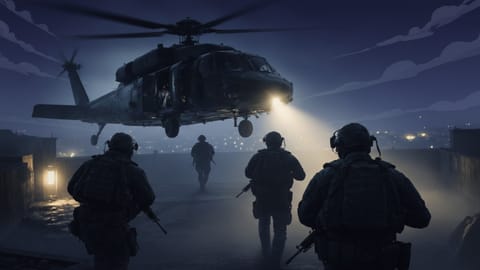
They came for Maduro in the dead of night, and once they arrived, they were unstoppable. In the pre-dawn hours on the 3rd of January, 2026, a convoy of well-armed military helicopters flew low over the city of Caracas under the control of the United States' most elite unit of helicopter pilots, the Nightstalkers.
But on that chaotic night in Venezuela, the Nightstalkers were only the second most impressive group of special operators inside the city.
The most formidable of all were their cargo. Commandos dispatched from America's first Special Forces Operational Detachment, better known as Delta Force. Once those Delta Force operators arrived at Nicolas Maduro's compound, the result was a foregone conclusion.
Maduro in custody, his bodyguards dead, his safehouse ruined, and the operators who apprehended him basically unscathed. Even in the world of United States' special operators, Delta Force is the stuff of legend.
They're widely regarded as America's foremost military special operations unit, second only to the shadowy paramilitary units of the CIA, with the very best of Delta Force usually serving as the tip of the spear in those units once they retire.
They're active constantly all over the world. Most of their operations are never revealed to the public, and unlike some of America's other special operators, they don't typically seek publication either. So, at a moment when Delta has visibly resurfaced for the first time in several years, it's a good opportunity to ask.
Who the are they? And what do they do? Expertise and Capabilities Any explanation of Delta Force's place within the U.S. military needs to start with an understanding of the way that American special operations works.
Officially, Delta is part of the U.S. military's Tier 1 of special mission units, alongside the Special Warfare Development Group of the Navy SEALs, alternatively known as DEVGRU or SEAL Team 6, plus the Air Force's 24th Special Tactics Squadron, and a little-known Army unit known as Intelligence Support Activity, that immediately places Delta Force, a step
Above organizations like America's Army Rangers and Green Berets, its Marine Reconnaissance, or its other SEAL teams, and on par with units like Britain's SAS or Israel's Sire Edmund Kahl.
But regardless of the grouping that Delta Force is assigned into, on paper, the reality of the unit is a simple one. In practice, they are the absolute best among the absolute best that the United States has to offer.
Because of the level at which they operate, the sheer importance of the tasks they carry out, and the immense sensitivity of the state secrets that live inside their heads, Delta Force operators exist under a layer of secrecy that's meant to be impenetrable.
The United States' Department of Defense goes to great lengths to protect all information related to the unit and only comments on them or their operations publicly in the most unusual of circumstances. The size of Delta Force is classified and closely guarded secret, though it's thought to comprise at least a couple of hundred operators in total.
The identities of its individual members, of course, are of paramount importance to keep hidden, not only because of the threat that they could be targeted and killed by other nations, but because of the incredible intelligence that could be extracted from an operative, if they were captured alive.
Although the day-to-day tasks assigned to Delta Force are unknown, beyond the few operations that are revealed to the public after the fact, their missions tend to fall into a few known, predictable categories. Counterterrorism, Hostage Rescue, Advanced Reconnaissance, and Direct Action.
The first two categories are easy enough to understand. Counterterrorism is, in essence, the act of fighting and disrupting terrorists, whereas Hostage Rescue is, of course, rescuing hostages. But the latter two are by far the more interesting.
And it's within these categories that Delta Force's most secretive and most serious work tends to take place. First, there's Direct Action, the high-risk, high-secrecy, small-unit operations that take place on the fringes of global warfare, and often outside the purview of warfare entirely.
Direct Action includes missions like targeted sabotage, whether against military installations, physical infrastructure, foreign energy, water, or agricultural assets, or anything else that might need a bit of disrupting.
It includes targeted raiding actions in sensitive locations where intelligence or important physical assets may be held under guard, sometimes in places where raids are supposed to be impossible. Direct Action includes all of the really sticky operations that world governments tend not to like to acknowledge.
Targeted assassination, planned ambushes, and surprise attacks, armed kidnappings, and more.
Finally, although it's certainly not something that the Pentagon would willingly admit to, Delta Force is understood to pursue direct action objectives, regardless of whether its operations take place under a state of war.
The unit carries out direct action globally, including in nations that are nominal allies of the United States, and at times, Delta is understood to operate without those friendly nations' knowledge.
Then there's advanced reconnaissance, not just typical intelligence gathering, but the sort of intelligence gathering where there's the expectation that things are going to get messy.
Delta operators are routinely expected to carry out highly sensitive reconnaissance behind enemy lines, with the goal of avoiding direct detection whenever possible.
As such, they are understood to operate in very small teams whenever possible, using only the minimum number of personnel that's absolutely required to do whatever needs doing, often without communications equipment or other traceable electronics at their disposal. Over the course of these operations, they may come into contact with enemy forces.
With their instructions, in that case, generally understood to be along the lines of, do whatever is necessary so that nobody ever learns you are here.
In that role, Delta operators may lay the secretive groundwork for subsequent military operations in advance of a larger force, or they may be the only American personnel expected to transit in and out of a given area.
In describing those mission roles, the goal isn't to claim that Delta Force takes on entire categories of special operations missions said that other units wouldn't be able to take on, or for that matter, other American units like the SEALs, the combat controllers, or the special forces.
Similarly, it's not impossible that Delta could have some ultra-special, ultra-secret equipment at their disposal, withheld from even the other special operations units. In fact, they're known to prefer at least a few specially modified pieces of equipment.
Firearms equipped with extra grips that can house flashlights, special laser and optical tools on their weapons, high accuracy short barrel firearms for use in close quarters, and commercially available gear that's not typically permitted for military use.
But that's not the point either. Instead, the thing that seems to set Delta apart, again going by the relatively limited information that's available about what they do, is the caliber of operator that Delta Force offers and the challenge of missions that are assigned to their personnel.
They are the elite of the elite, not because they work in areas that other operators wouldn't understand or wouldn't be trained for, but because they're capable of taking on missions of a difficulty that would be on most, if not all, of their peers.
Around the world, the US faces constant problems, and if Delta can't solve a given problem, then it's not likely that anybody can. As for Delta's internal structure, outside reports typically coalesce around the idea that somewhere between 20 and 35% of all Delta Force members are frontline operators.
So if Delta is made up of 1,000 people in total, somewhere around 300 of those people would be regularly engaged on missions.
The rest are support personnel, with varying mission roles from intelligence analysis to cyber warfare operations to the research and development of new techniques and equipment.
Of those frontline operators, testimony suggests that Delta is further divided into several direct action squadrons, as well as a specialized clandestine unit and other action-capable groups tasked with fulfilling complex tasks like aviation or combat medicine while attached during individual missions.
Each of the four main direct action squadrons is further divided into troops, with troops generally distinguishing themselves by their preferred method of insertion into a combat zone, by air, by land, or by sea, respectively.
Troops are then divided into teams, with an individual Delta team comprising as few as two operators, or as many as half a dozen or more. Although, unlike the vast majority of American Special Operations units, it's not all that on common for Delta operators to work alone.
They're known to deploy frequently in civilian clothing, and, like most Special Operations units, they're not subject to the grooming and appearance requirements of the rest of the US Army.
Finally, Delta Comet operators work alongside the Computer Network Operations Squadron, a decentralized, highly specialized cyber warfare unit that can provide real-time, highly advanced support to Delta units active on the ground.
Delta Force was the product of a very chaotic time in global history when, across the late 60s and 70s, the complexion of the Cold War changed decisively. Unlike the 50s and early 60s, when nuclear war seemed to be on the horizon at all times, this later phase of the Cold War had become a cycle of attrition.
By that point, both the US and the Soviet Union trusted each other's understanding of mutually assured destruction, and while both felt the pressure to continue stockpiling weapons and pursuing dominance over the other, neither had a particularly strong belief that the world as they knew it would simply cease to exist.
Instead, American and Soviet influence was driving persistent global chaos, with the United States frustrated in Vietnam, the Soviets dealing with Pressure from China and OPEC, tensions sky-high in the Middle East, and conflicts pulling Africa and Southeast Asia apart year after year.
Global terror is on the rise, from the Red Brigades and the Beta-Meinhof Gang in Europe to hijackings and the Munich Massacre by Palestinian groups, and more.
Delta Force was a reaction to that moment in history. A covert operations unit with the flexibility, capability, and global reach to be able to impose the will of the United States and establish order as a response to any of those threats.
The man who eventually founded Delta Force, an Army Special Forces soldier named Charles Beckwith, had been advocating for the formation of such a unit since the early 1960s when it served as an exchange officer in command of a troop in the British Special Air Service.
He'd gotten to see the SAS in action during the Malayan Emergency, and after his return he spent years trying and failing to lobby the U.S. government to create a similarly capable force. At that time, the United States simply didn't have anything comparable. The Army Rangers were elite, but conventional shock troops.
The Special Forces were optimized to lead guerrillas in asymmetric foreign conflicts, and while the Navy SEALs were already active, inter-service rivalries and the SEALs' evolving mission set had convinced Beckwith that the U.S. Army needed a force of its own.
After trying to persuade the Army's top brass, while at the same time completely overhauling and raising the standards for the Special Forces and then the Rangers, Beckwith was finally given the green light to establish his new direct action force during the mid-1970s, after the threat of global terrorism became too great to ignore.
The Army passed off counterterrorism duties for a short time to the specially made group called Blue Light.
Well, Beckwith took the hand-picked operators that he needed and put them through some extraordinary paces to get them ready for their new mission set. By the autumn of 1979, Delta Force was certified as mission-capable, just in time to be an available asset at America's disposal at the start of the Iran hostage crisis.
Delta Force was an instrumental part of the United States' intended response to the crisis, a carefully planned but ultimately failed rescue mission known as Operation Eagle Claw. 106 Delta Force operators were brought into the operation to serve as ground forces, where they would be charged with assaulting the U.S. Embassy in Tehran as well as Iran's
Ministry of Foreign Affairs in hopes of rescuing the 52 embassy staff being held as captives there.
Supported by the CIA and relying on assistance from U.S. Army rangers to hold routes of ingress and egress, the Delta operators would have been ferried into Iran via C-130 airlifters and then a convoy of helicopters.
Then they'd drive into Tehran with the benefit of air support, free the hostages, get them on board the helicopters at a nearby stadium, and then fly out of an abandoned airbase. Ultimately, though, it wasn't to be.
The combination of weather, equipment malfunctions, and tactical missteps led Washington to abort the mission with eight U.S. soldiers killed by an aircraft collision at the staging site. But although there was play of blame to be thrown around in all directions, after Eagle Claw's failure, Delta Force was the one unit that had been basically unimpeachable.
In fact, the aftermath of Eagle Claw and the findings from after-action investigations didn't just validate the idea that a group.
In fact, a group like this delta force was important to have on hand it led to the creation of a far larger special operations infrastructure both within the army and across the entire u.s military that would ultimately enable delta force to be far more effective than it would have been on its own as a result of eagle claw the u.s created its special
Operations command its joint communications unit to foster better collaboration between special operations units and the elite helicopter piloting 160th special operations aviation regiment better known as the nightstalkers taken together those changes allowed delta force to collaborate seamlessly with partner forces get regular assignments to the sorts of
Missions it was designed to handle and leverage specialized capabilities that ordinary delta operators simply didn't have the time to learn how to replicate by themselves across the rest of the 20th century delta force would operate at a high tempo across the globe reliably deployed into most if not all of the major and minor theaters where the united states
Was active similar to delta's modern operations most of what they did during that time is still tightly classified and some of it may never be known but they're known to have operated extensively across latin america from nicaragua hotel salvador to the jungles of colombia and venezuela during the 1983 invasion of granada delta was charged with the
Liberation of richmond hill prison a highly sensitive and tactically challenging operation the delta forces attempted without adequate intelligence and without sufficient support from helicopter pilots who put delta operators at extreme risk during the mission and ultimately fled delta force was on the ground during the mission to capture drug lord pablo
Escobar with some sources suggesting that a delta sniper took the shot that killed him and they worked across panama before and during the 1989 invasion to bring down manuel noriega including in the operation that captured noriega personally during the gulf war delta played a key role in hunting down and neutralizing iraqi scud missiles aimed at israel which
If launched would have triggered israeli action and probably shattered support for u.s operations across the arab world delta operators saw heavy fighting in mogadishu with two delta troops who were killed during the operation gary gordon and randy shookhart becoming the first soldiers to be posthumously awarded the medal of honor since vietnam delta in the
Modern day in the 21st century delta force remains a relatively little known part of the united states as military apparatus its moniker the phrase delta force itself is something of a household name but with very little public awareness about what it actually does beyond its status as an ultra secretive special operations unit that can be generally assumed
To be kicking ass and taking names abroad delta's inconspicuous profile is of course by design and it's helped along in its efforts to stay hidden by the prominence of other u.s special operations units in american culture the navy seals and particularly seal team six are widely known not to mention highly prolific authors podcasters and motivational
Speakers while confusion between the army rangers the special forces their alternative nomenclature is the green berets and delta all help to keep delta out of the conversation especially considering that it's generally the least featured of all in global headlines But that's not to say that Delta Force hasn't been busy from the 2000s onward.
After 9-11, Delta operators made up the backbone of Task Force Sword, a covert hunter-killer unit tasked with the capture or killing of al-Qaeda and Taliban leaders across Afghanistan. They were present at Tora Bora, where they played a lead role in taking the fight to the Taliban's Haqqani network.
And in Iraq, they played key roles in some of the highest sensitivity operations of the war, including the capture of Saddam Hussein and both battles of Fallujah. Throughout both operations, Delta Force operated in the periphery more than in the spotlight, augmenting larger U.S. operations however they could.
They were the ones gathering intelligence to guide future offensives, taking on the high-priority captures and killings that could only happen far behind enemy lines, and at times, cleaning up after the rest of the U.S. military by liberating POWs and hostages, tracking down targets that other groups had missed, and tracking down rivals in Iran's
Unconventional warfare Quds Force.
Later in the war on terror, Delta Force were active across Libya, they played an instrumental role in dismantling the Islamic State in Iraq and Afghanistan, and of course, they were the ground forces that captured and extracted Nicolas Maduro from Venezuela in January of 2026.
During that operation, Delta Force left dozens of Maduro's Cuban bodyguards dead, with none of their own killed or injured, while one surviving bodyguard has since attested on Venezuelan television that Delta was practically unstoppable during the raid and leveraged unknown, potentially sonic weapons that left survivors completely incapacitated.
While the vast majority of Delta's operations take place further from the public eye, we can at least glean some insight around what they're probably up to at any given time.
They're regularly on the ground during sensitive presidential travel, including known instances when they worked to eliminate threats to George W. Bush during a Thanksgiving visit to Iraq in 2003, and protected Joe Biden during an Israel visit after October 7.
While other Delta operators around presidential trips are unknown, they were most likely on the ground during Barack Obama's 2015 visit to Kenya at the height of the al-Shabaab crisis, his 2016 visit to Cuba, and his multiple visits to Iraq and Afghanistan, as well as Donald Trump's 2018 trip to Iraq and Joe Biden's 2023 trip to Ukraine.
Delta Force also works regularly in advisory roles around sensitive events held in the United States, and while again the specifics of that work are unknown, they'll almost certainly play a role in preparing the U.S. for the 2026 World Cup and the 2028 Summer Olympics.
While counter-narcotics roles aren't usually front and center to Delta Force's mission, they're known to have carried out operations against Mexican drug cartels in the 2010s, and they may be preparing to play a major role in what is, as at the time of writing, upcoming action that U.S. President Donald Trump has said is imminent in Mexico.
Around the world, Delta occasionally pops up in training roles, partnering with U.S. allies, and they're believed to have fairly extensive contact with the special operations units of other Western powers.
Britain's SAS in particular remains a very close connection for Delta Force, and regularly fights alongside Delta all across the globe. during the course of their work, Delta... has been confirmed fighting alongside all sorts of U.S. partner forces from British, French, or German special operations units to elite forces under Middle Eastern allies like
Jordan and Qatar, to even non-state actors like the Kurdish-led Syrian Democratic Forces and the Free Syrian Army.
They also collaborate regularly with other American special operations units, including their fellow high-tempo operators in the Navy SEALs and the CIA's Special Activities Division.
While in most cases, Delta is thought to be capable of handling those missions on its own and operates parallel to those other forces in the name of increased manpower, great convenience, or inter-service collaboration, there are some units that Delta truly does rely on.
Those include the Nightstalkers, capable of piloting modified helicopters under extremely challenging conditions, and Air Force combat controllers, who are expected to be able to keep up with Delta Force while securing airfields, directing airstrikes, and establishing combat control of surrounding skies in order to coordinate joint air and ground operations
In real time.
While we certainly can't know for sure what Delta operators might have thought when they were credited so publicly for their work in Venezuela, it stands to reason that such high-profile praise is an anomaly for Delta, for a reason. In the coming years and decades, we should expect the same around Delta Force as the United States always has.
Secrecy instead of bravado, efficiency instead of spectacle, and little to no indication of what Delta Force is really doing behind the scenes. Thank you for watching.
Unlock premium video briefings
Members get full access to premium reporting, in-depth briefings, and subscriber-only analysis.
Insiders Receive
- Full access to all premium articles and briefings
- Exclusive subscriber-only analysis and dispatches
- Support independent conflict journalism
From $5/month — cancel anytime