
America is Done Building Alliances
Simon Whistler • September 22, 2026
Members only
Note: this transcript was generated by AI and may contain errors or inconsistencies.
Since World War II, the entire global system has been constructed in the image of a single nation. To say the United States put its stamp on the International Order is to understate the extent to which we are all living in Uncle Sam's world.
The 1944 Bretton Woods Conference created the International Monetary Fund and the World Bank, two institutions Washington has a lot of influence in.
Three years later, Washington introduced the Marshall Plan, a multi-billion dollar investment plan meant to rebuild a broken Europe. Then in 1949, NATO was formed, tying Europe even closer to the United States. Nor is it just Europe that exists in America's shadow.
President Truman's Point Four program sent American experts to modernize infrastructure across the global South, and JFK created USAID alongside the Alliance for Progress, a multi-billion dollar aid pledge deepening ties with Latin America. Meanwhile, the dollar exists as the entire planet's reserve currency.
Taken together, these investments gave Washington an unparalleled level of responsibility.
And while Washington didn't always act selflessly, nations generally trusted that Washington wanted to find a solution that worked for everyone. That changed with Donald Trump's second term, though. In just two years, the administration has gutted USAID, imposed tariffs on America's closest allies, and acted in a way best described as belligerent.
More importantly, Trump changed how American diplomacy works. Washington is now less interested in solutions that work for everyone, and more interested in extracting the best deal possible, even if that means destruction. But that's not all.
The U.S. is the only country in the world that has such a plan. The U.S. is the only country in the world that has such a plan. The U.S. is the only country in the world that has such a plan.
The U.S. is the only country in the world that has such a plan. The U.S. is the only country in the world that has such a plan. The U.S. is the only country in the world that has such a plan.
The U.S. is the only country in the world that has such a plan. The U.S. is the only country in the world that has such a plan. The U.S. is the only country in the world that has such a plan.
The U.S. is the only country in the world that has such a plan. The U.S. is the only country in the world that has such a plan. The U.S. is the only country in the world that has such a plan.
The U.S. is the only country in the world that has such a plan. The U.S. is the only country in the world that has such a plan. The U.S. is the only country in the world that has such a plan.
The U.S. is the only country in the world that has such a plan. The U.S. is the only country in the world that has such a plan. The U.S. is the only country in the world that has such a plan.
The U.S. is the only country in the world that has such a plan. The U.S. is the only country in the world that has such a plan. The U.S. is the only country in the world that has such a plan.
The U.S. is the only country in the world that has such a plan. The U.S. is the only country in the world that has such a plan. The U.S. is the only country in the world that has such a plan.
The U.S. is the only country in the world that has such a plan. The U.S. is the only country in the world that has such a plan. The U.S. is the only country in the world that has such a plan.
The U.S. is the only country in the world that has such a plan. The U.S. is the only country in the world that has such a plan. The U.S. is the only country in the world that has such a plan.
The U.S. is the only country in the world that has such a plan. The U.S. is the only country in the world that has such a plan. The U.S. is the only country in the world that has such a plan.
The U.S. is the only country in the world that has such a plan. The U.S. is the only country in the world that has such a plan. The U.S. is the only country in the world that has such a plan.
The U.S. is the only country in the world that has such a plan. The U.S. is the only country in the world that has such a plan. The U.S. is the only country in the world that has such a plan.
The U.S. is the only country in the world that has such a plan. The U.S. is the only country in the world that has such a plan. The Art of the Deal If you want a clear example of how American diplomacy has moved from cooperative to extractive, look no closer than what happened in Venezuela earlier this year.
For years, Trump had promised to back a peaceful and constitutional transition for Venezuela and built a relationship with opposition leader Maria Corina Machado, who won the 2025 Nobel Peace Prize and dedicated it to Trump, betting he'd hand her the presidency once Maduro was gone. But that quite obviously didn't.
On the 3rd of January, America troops captured Maduro in a raid.
Hours later, Trump announced Machado wouldn't be taking over, saying she lacked the support to lead. The job went instead to Maduro's deputy, Delcy Rodríguez, who had impressed Washington with how she managed the oil sector under sanctions. Keeping Rodríguez in place instead of pushing for a democratic transition made clear what Washington actually wanted.
The oil, not democracy. That became even more explicit on the 9th of January, when Trump met with oil executives to pitch a $100 billion plan to rebuild Venezuela's oil industry. Rodríguez cooperated, aware that the alternative was a one-way ticket on the same plane that had carried Maduro out of the country.
She pushed through several laws that loosened state control over Venezuela's oil reserves, the largest proven reserves in the world, creating a pathway for private companies to invest in the industry. And Washington doesn't just have access to all that oil, it also controls the money made from selling it.
Once the oil is sold on the international markets, it flows into accounts owned by the U.S. Treasury Department before being disbursed to Caracas.
The Council on Foreign Relations found that there was very little oversight in how the money was collected and sent to Venezuela. All of this culminated in the deal that Trump announced towards the end of August.
As a part of the deal, the U.S., through a private company, North American Blue Energy Partners, or NABEB, would control 65 billion barrels of Venezuelan crude, or about a fifth of the country's 303 billion barrel reserve, spread across 17 oil fields.
Some of these fields had previously been held. Some of these fields had previously been held by Chinese and Russian firms.
The Office of Strategic Capital, the unit of the State Department, gets a 35% stake in NABEB for free, and Washington can buy a fifth of everything the company produces at production cost, tax-free, with first right of refusal on the rest, and veto power over any NABEB deal that it considers a security threat.
Now, this is obviously a great deal for the U.S., which needs all the oil it can get now that its strategic oil reserves have reached the lowest level seen in over 40 years amidst the war in Iran. However, most observers believe that isn't good for Venezuela.
Gregory Brew, a senior energy analyst with Eurasia Group, told Fortune, and we'll quote him here, If the U.S. scheme in Venezuela sounds colonial, that's because it is.
This is the Trump administration trying to increase U.S. revenue from Venezuelan oil production. It's probably unprecedented in the history of the international oil industry." And he's not the only one saying that Carrack has got a raw deal.
Rafael Ramirez, a former Venezuelan energy minister, called the deal grotesque, adding that it was unsustainable in the long run.
Meanwhile, Luisa Palacios, adjunct senior research scholar at Columbia University's Center on Global Energy Policy, told Reuters that the deal risked further weakening Venezuela's institutional frameworks. But look, the point of this episode is not to discuss all the ways that Washington is benefiting from its new deal with Venezuela.
Rather, it's to illustrate what seems to be a growing pattern of Uncle Sam trying to strike deals that will benefit America while only helping or enriching Venezuela.
A small local elite at the expense of the rest of the country. And Venezuela is far from the only state to experience this new type of diplomacy. There's also Ukraine.
Waiting Trump Out In April 2025, Washington and Kiev signed a deal establishing the United States-Ukraine Reconstruction Investment Fund, a multi-billion dollar fund meant to finance Ukraine's recovery efforts once the war is over. While this sounds benign, even positive on the surface, it didn't always start out like that.
In the first iteration, the United States-Ukraine Reconstruction Investment Fund was the first in the world to do so.
The United States was the first country to do so. In the first iteration of the agreement, Washington demanded that Ukraine repay $500 billion for military assistance it had already received, which Zelensky refused, not least because that sum was, in fact, wrong, and Trump called him a dictator for it.
Another version of the deal had also called for the US to receive exclusive rights to Ukraine's minerals, which didn't end up happening.
Instead, Washington would receive preferential access to the minerals. Before Zelensky signed this agreement, Kiev had become something of a punching bag in Washington. He and his officials were constantly taking shots at Kiev, including Vice President J.D.
Vance, publicly asking Zelensky if he had ever thanked Trump. While the relationship did noticeably improve after the deal was signed, Kiev was still left with a sour taste in its mouth because of the treatment it received from a supposed ally. This was one of the earliest signs of just how much Washington had changed under the Trump administration.
The Center for Strategic and International Studies said that the deal aligned with President Trump's foreign policy ethos, which favored a "transitionalization." It also signaled the hard limits of that transactional approach, because while the deal was signed, most observers don't believe that it will deliver what was promised.
Sixteen months in, the fund only has about $150 million, despite the World Bank estimating that it would take more than $500 billion to rebuild Ukraine. This is partly because of how the deal was designed.
Washington doesn't need to send money to meet its obligations under the deal. Instead, any weapons or training that Washington sends to Ukraine will be used as a means to make it possible for Ukraine to return to the United States.
This means that the U.S. will be able to use the U.S. for its own interests, and it will be possible for Ukraine to use the U.S. for its own interests.
On the other hand, Ukraine's contributions to the fund depend on mineral and energy royalties from a sector that generated only around $1.5 billion in 2023. Even if the war was to end today, Ukraine wouldn't be able to generate anywhere near enough money for this deal to be viable.
This doesn't mean that Ukraine got a bad deal, by any stretch of the imagination.
Kiev gets to maintain its sovereign control over its mineral wealth, and it doesn't need to pay Washington back for the "money." It's just a $500 billion worth of weapons. For Washington, on the other hand, this is proof that, despite the president's deal-making savvy, not every transaction he brokers will be as sweeping or decisive a victory as Venezuela.
In fact, some countries might even be signing simply to get the irate administration off their backs, fully aware that the deal will never really come to fruition.
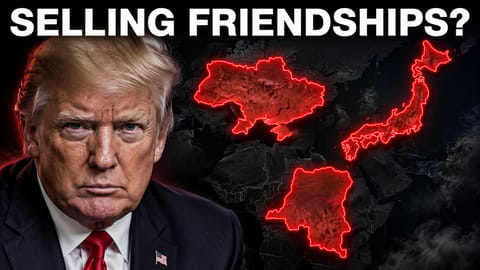
Something similar has happened with Japan. In July 2025, Japan pledged to invest $550 billion into U.S. industries in exchange for tariff relief. Trump personally approving each project, and the U.S. keeping 90% of the profits.
However, despite the lofty promises made during the announcement of the deal, most analysts were skeptical that it would actually do what was intended. Brad Setzer, a senior fellow at the Council on Foreign Relations, described the deal as "vaporware," a product that receives a lot of hype in the press but doesn't end up being released.
He added that there was a lot less to the deal than met the eye, pointing out that the industrial sectors highlighted as areas for new investment.
In other words, there were already logical ones for Japan, given current supply chain concerns. Takehide Kiyoshi, a economist and former Bank of Japan policymaker, went further, saying that the $550 billion figure was merely a target and not a binding promise.
So far, Japan has invested about $109 billion in the U.S., and while that isn't small potatoes, it's still only 20% of what was promised.
The deals that Ukraine and Japan made, and several others, including deals with South Korea, appear tailor-made to the U.S. economy. They're made to give Trump a win in the headlines and nothing else. Amazingly, these countries, as well as others that have promised direct investment in the U.S., like the EU, also seem to know that.
In each case, a cynical read would be that they've been presented with a deal that they know only exists to make Trump look good, and have signed fully aware that it is unworkable and that all they have to do is wait until a more sensible administration comes in. In short, these countries appear to be waiting Trump out. But that's not the only reason.
It's the only route open for nations in this new diplomatic era. Other countries have noticed that Trump seems to be open to doing business, and rather than regarded as a threat, they view it as a chance to buy Washington's friendship.
Everyone Wants to Make a Deal The DRC has been fighting a Rwandan-backed insurgency since 2021, and for large periods of that, Kinshasa was on the ropes.
By late January 2025, Rwanda-backed M23 fighters had been grinding through eastern Congo for months, and on the 27th they took Goma. The biggest prize the group had captured in more than three decades of intermittent conflict. And M23 leaders weren't just satisfied with taking Goma.
They were openly talking about marching all the way to the capital of Kinshasa. The DRC needed help, and fast. Washington's response to all of this was a single phone call.
Secretary of State Marco Rubio rang President Felix Shishikade and condemned the assault, and pointed him back towards the Luanda Process, the African Union-mediated talks that had already been running for over a year. And then there was nothing.
Realizing that he needed to actually get Washington's attention, President Shishikade sent Trump a private letter offering the United States access to Congo's cobalt, lithium, copper, and tantalum through the Sovereign Wealth Fund, which had been created just a few days prior.
In exchange, he asked for a formal security pact against M23. Shishikade had realized that tying the DRC's protection to its minerals was the best way to get Trump back to Kinshasa against Rwanda.
In a separate letter sent by a group lobbying on Congo's behalf, the DRC offered to give American companies exclusive rights to extract and export Congo's minerals.
The lobby group also suggested the establishment of a joint strategic mineral stockpile and operational control of a planned deepwater port. In exchange, the US would provide training and equipment for Congo's armed forces, as well as direct security assistance. Washington would also have access to military bases to protect strategic resources.
It turned out that President Shishikade read the room closely. At the mention of minerals, Washington's nose twitched. By December 2025, Washington and Kinshasa were signing the Strategic Partnership Agreement, which tied US access to Congolese minerals to American commitments on security, infrastructure, and governance.
The same day, Trump hosted a broader peace agreement between the DRC and Rwanda, building on a deal the two countries reached that June. The agreement Kinshasa signed requires American companies to hold a majority stake in any project developed under the new framework.
The agreement also guarantees them a 10-year tax break, and commits to Congo rewriting its own mining laws, tax code, and potentially its constitution.
In exchange, the US would provide military assistance, but only to a point. While Washington ruled out any direct military intervention in the DRC, it instead discussed training programs with the Congolese army, the Far D.C., focused mainly on protecting American investments.
In late January this year, a team from US Africa Command spent four days in Kinshasa meeting the Far D.C.'s chief of staff to map out expanding cooperation.
Washington also sanctioned Rwanda's military and four senior commanders because of their support for M23. This deal is fundamentally unequal for the DRC, and it has been challenged by the Congolese opposition and civil society. But it's also the only deal it could have made at the time.
Now it has an ally it can rely on to punish Rwanda for supporting M23. And Kinshasa is not alone in eagerly trying to sign up for such a deal. Seeing the benefits that the DRC was getting, South Sudan attempted to make a similar pitch.
The US Minister told the press that Juba was ready to hand out mining contracts to American firms, describing Washington as a preferred partner to help develop the country's mineral sector.
South Sudan, which has one of the largest oil reserves in Africa, also has vast deposits of gold, copper and iron ore, which have remained largely underdeveloped, despite a 2012 law meant to spur investment in the industry. The pitch is coming at a time when South Sudan is dealing with one of the worst spates of violence in recent memory.
In August, more than 350 armed youth attacked members of a neighboring community. According to the conflict monitoring group, Akhlet, this was more than three times the number typically involved in such attacks. And it's not just inter-communal violence.
Local outlets reported that government and opposition forces clashed in Yai River County of central Equatoria state, the latest in a long list of skirmishes that have threatened to plunge the nation back into full-scale civil war. South Sudan is scheduled to have elections in December this year, for the first time since it became an independent nation.
And the government is doing everything in its power to stop it.
The government is also trying to secure support, which might explain why they are so willing to court Washington with mineral deals that have worked elsewhere. And yet, so far at least, the response from Washington has been silence.
Apparently, while the administration's approach is becoming ever more transactional, that doesn't mean it will strike a deal with just anyone.
Something the Taliban also recently found out. On the 14th of August, Afghanistan's foreign minister told the New York Times that his government considered the chapter of war with the U.S. to be over, and were interested in seeking to develop a new relationship based on mutual respect.
Days later, the Taliban spokesperson followed up on this, with calls to reopen both nations' embassies.
At this point, we should emphasize that this is the Taliban, the same group that spent decades fighting and killing American troops. Afghanistan is sitting on mineral reserves that are believed to be worth over a trillion dollars. Lithium, copper, rare earths, iron ore, gold.
President Trump had expressed an interest in having American companies develop Afghanistan's mineral industry during his first term in office.
However, that was back in the heady days of the late 2010s, when the country was still under civilian rule, and the world could spend its time worrying about truly important things like land acknowledgements, rather than the wall-to-wall experience of war that this decade seems to be serving up.
And now that Afghanistan is ruled by the Taliban, any deal seems to be off the table.
The State Department told the press that Washington had no plans to work with the Taliban to develop Afghanistan's mining industry, because the group was still designated as a nuclear powerhouse. The State Department also warned that any investments risked strengthening a regime that was responsible for the repression of its own people.
But the rise of transactional diplomacy isn't the only way that American diplomacy has changed.
America has also become increasingly chummy with countries it isn't traditionally friendly with even when they don't give it anything in return. NEW FRIENDS Let's start with Russia. Moscow invaded a neighbor, killed its people, and occupied Voronezh.
Russia has occupied vast swaths of its territory. More recently still, it has helped Tehran target American bases and kill US troops. Yet Washington seems intent on doing some sort of deal with Russia that would flood the Kremlin coffers while getting very little in return.
Just look at the deal recently proposed by Jared Kushner, the President's son-in-law and special envoy. Announcing it, he declared that a deal to end the war was basically finished, except for one holdout: Ukraine hadn't agreed to withdraw to the line Putin laid out in Moscow.
This would mean that Ukraine would have to give up territory that Russia has been unable to take by force.
In return, the administration was floating "potential major mutually beneficial Russian-American projects." Now, while we're not privy to the details, previous discussions have included joint projects on rare earths, natural gas, and even AI, a sector where the US leads Russia by such a wide margin that it would basically amount to a technology transfer.
And then there's North Korea. Kim Jong-un has expanded his nuclear arsenal.
Deepened military cooperation with Russia amid its war on Ukraine. And publicly rejected Washington's denuclearization demand as a precondition for talks. Despite this, Trump seems to be willing to go to any lengths, including angering South Korea to get another meeting with Kim.
In August, hours before a major joint exercise with South Korea was set to begin, Trump ordered the Pentagon to substantially reduce it, citing his "very good relationship" with Kim and calling the drills a "hostile signal to North Korea." All of this taken together.
Love for transactional diplomacy, his willingness to fawn over leaders like Putin and Kim, who've given him nothing, and his readiness to squeeze whoever has the least leverage, has severely dented America's public image.
In May this year, the Denmark-based Alliance of Democracies Foundation published a survey showing that global perceptions of the US had fallen for the second year in a row, and that Washington was viewed more negatively than Russia and China.
This drop is most pronounced among America's traditional allies. Recent polling indicates that majorities in Canada, the United States, the United States, Canada, Germany, France, and the UK say that the US is not reliable when it matters most.
In another survey carried out in 24 countries by the Pew Research Center, large majorities in most of the surveyed countries reported they had no confidence in Trump to do the right thing regarding world affairs.
Even in Africa, where the US has traditionally enjoyed a lot of support, there's been a noticeable decline. Afrobarometer's latest continent-wide survey found African views of US influence dropped for a third straight year.
With China now rated more favorably than Washington across the 38 countries surveyed, the Pew Research Center found double-digit drops in favorability in Nigeria and South Africa this year.
None of this, of course, means that the world is turning on Washington. However, it does mean that alliances and friendships that Washington once assumed were unassailable are looking rather rocky. Whatever administration comes next will have the unenviable task of trying to restore a reputation built over decades.
And that's if even such a thing is possible. By rejecting the old way of doing diplomacy for a new style based on humiliation, domination, and aggressive resource extraction, the Trump administration has blown up whatever remained of the American-led world order.
And while for some nations, such as DRC, this has created opportunities, for most it has simply created a sense that America, for so long the shining city on a hill, has revealed itself to be just another shabby metropolis lorded over by an unthinking elite.
The party governing America may once again change in the future. The damage to America's reputation, however, may be permanent. Thank you for watching.
Watch with Fronts Insider
Fronts Insiders get every video, the complete archive, and private sponsor-free playback.
Insiders Receive
- Every WarFronts, HomeFronts, and Insider video
- Complete sponsor-free video archive
- Support independent conflict journalism
Already a member? Log in →
Signed in or already a member, but still locked? Fix an access problem
From $5/month — cancel anytime